“The idea is to give the bass a mouthful.”
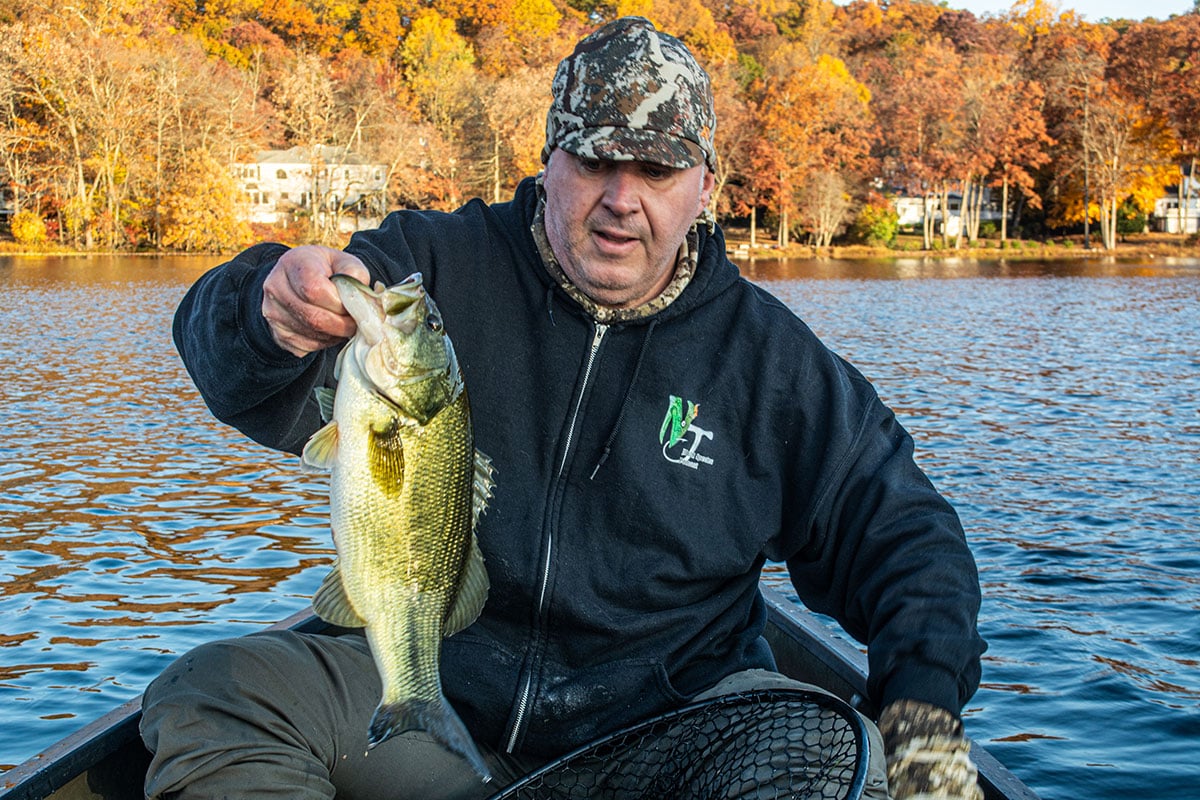
A largemouth will kill a chatterbait. That’s the impression Brian Cronk and I get. The bass hit hard. And they might strike chatterbaits more often than they will hit other lures. Over shallow flats in October, chatterbaits may be your best bet.
Bass are chasing down forage now. A chatterbait functions as a search bait and creates the large profile of a moving target if you add a Swim’n Dinger, Swim Senko, Keitech Fat Swing Impact 4.3, or KVD Swim’n Shiner to the hook. Each of those options include a paddletail. Altogether, they’re just a handful of suggestions among other possibilities. The idea is to give the bass a mouthful. The little piece of soft plastic that comes with a Z-Man ChatterBait isn’t enough, and the like may come with other brands, too. But if you want nice bass from 1-1/2 to 6 pounds, present a target with a large profile.
In addition to feeling the hard vibration produced by the swimming plate in front of a chatterbait’s jighead, you can feel the paddletail throb. That additional sensation thrumming on the lateral line of a bass doesn’t make the fish turn tail. And the visual profile is alluring. I like to think dark coloration goes along with the “bad” quality, but I’ve caught a lot of fish on a white chatterbait. Besides seeing the color, the bass see swimming action, side-to-side, in a lazy way like an underwater rat on the prowl.
The combination of plate and paddletail has always piqued my curiosity. I’m sure a bass can’t experience cognitive dissonance but maybe something similar affects them. Altogether, that leisurely swimming motion with the paddletail throbbing, combined with the hard vibration and knocking of the plate – the jighead knocks against it – is a lot going on. A finesse fisherman might think the whole contraption is like spam and can’t work. But it drives bass nuts.
Cronk’s favorite lures are chatterbaits. He’s caught more bass on them than me, and he’s noticed that especially the big bass don’t like a fast retrieve. I think of it as the situation of maximizing the effect of that leisurely swimming action. A fast retrieve blurs it; a slow one isn’t full-bodied. You don’t need to make a chatterbait behave like a crawfish, wasting your time at covering range too slowly. Just make it look like something with a healthy vulnerability.
If you don’t, you can end up dragging bottom. Cronk and I find these lures very effective in shallows anywhere from 4 to 7 feet deep. Slow down the retrieve too much and shallows like that become unfishable. Crawfish there or likely not. I wouldn’t discourage anyone from trying deeper, however, even though Brian and I haven’t tried the depths. By letting a chatterbait drop and snapping it upward, a lot of commotion is released. Depths of about 12 to 15 feet seem about right for that technique, probably better for aggressive smallmouths, but for covering ground, lakes in the Northeast exist with extensive flats of 5 or 6 and 7 feet. Fan casting methodically covers such range. With a modicum of weeds at the bottom, the water is all the better.
Weeds recede this time of year, but you can still find beds of them, lily pad fields, or algae mats. Chatterbaits are effective around other forms of cover, too. Be sure to fish the edges thoroughly, because bass will hang back under the weeds or cover while facing outward towards open water. Usually, you’ll get hit on the first retrieve, but not necessarily.
Consider the fact of weeds receding as being in your favor. During August, big bass will be all but inaccessible in the thickest stuff, but when the mass of it is breaking up, it’s easier to call bass to the edge from within. And as I’ve pointed out, a chatterbait makes a lot of noise, which can call them from quite a distance. A good reason to cast edges repeatedly, because it might take more than once for a bass near the center to come out to the edge and crush a chatterbait.
Late October last year, Cronk and I fished a local lake where, as I’ve said, most of the depths range from 4 to 7 feet. We hooked some fish just anywhere, but when we came upon floating algae mats, we hooked up where it plainly made sense that we would. You remember fish better when they come from spots like that.