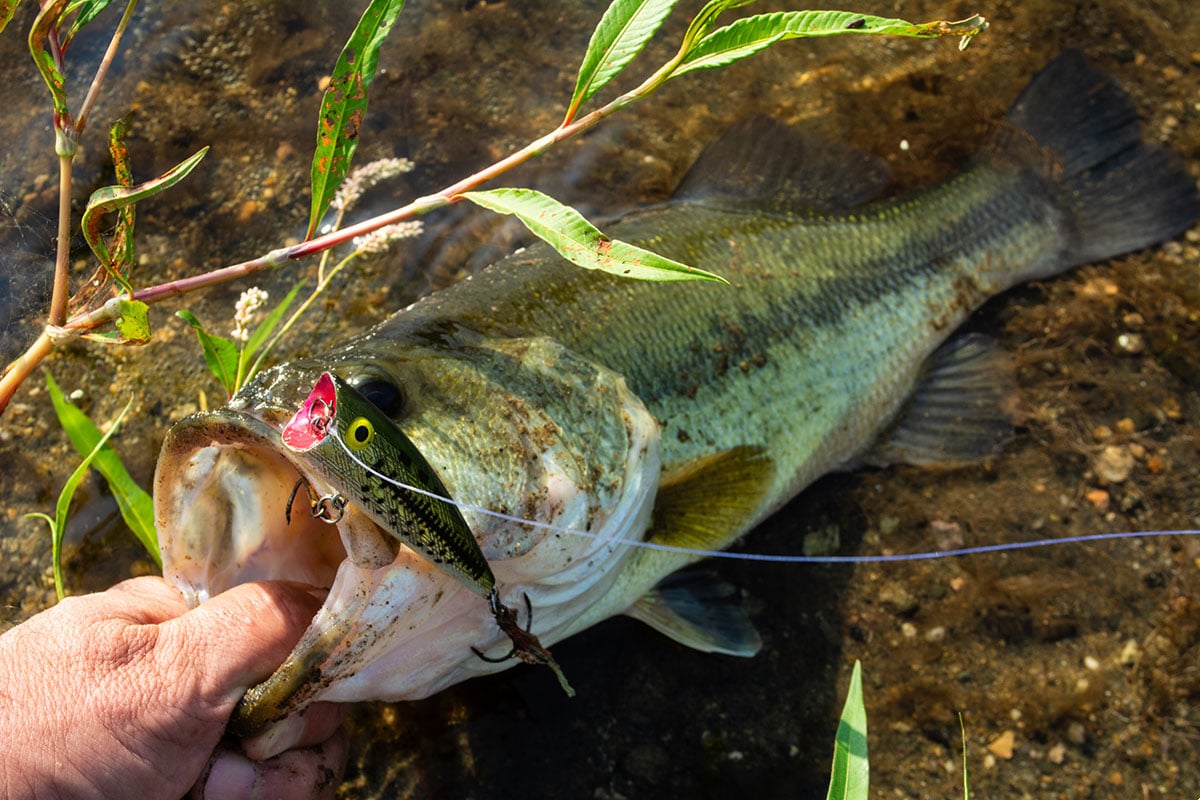
It doesn’t have to be glass calm to get those bass zeroed in on topwaters.
Especially during the summer, topwater plugs get fished early and late in the day. One exception might be casting weedless frogs on top of pads and thick mats of weeds, late in the morning and through the afternoon especially on cloudy days. Both methods will catch a lot of largemouth bass, but there’s another exception to early and late in the day: You can catch them on popping plugs in the chop during the late mornings and afternoons of summer.
It surprised me the first time. The second time, too, but I came to understand it’s just a pattern I hadn’t seen. We usually find topwater popping plugs are effective when the water’s surface is calm. Often nothing stirs early and late, whereas later in the morning until evening, the surface is probably rippled. But the mid-day topwater action I’ve enjoyed involves more than that. It happens when wind kicks up that chop.
More than a decade ago, I caught smallmouth bass in a similar situation from a reservoir. Swells of 2 or 3 feet had risen in the early afternoon, and rather than go after the bass with diving plugs, which would have made sense, I snapped on a buzzbait. It worked. I fished it over 7- to 11-foot depths, and I never could tell if the bass suspended over the rocks or shot up from them.
Given my recent experience, I believe that mid-day bass like a choppy surface. They identify with that commotion overhead. By that I mean they’re distinctly aware of it, whatever that means for a bass. Possibly lateral lines monitor the chaos. So, when something like a buzzbait or a popping plug creates an anomaly right in and among the patterns of that chop, a bass zeroes in and attacks. And I’ve taken fierce hits doing this.
It was late in 2024 when I bought a couple of Adam Mihara’s custom-made popping plugs, and honestly, I don’t remember if being overeager to try one of them pushed me over the edge into the “absurdity” of topwater fishing under noonday sun. The casts that made me wonder about what I was doing, weren’t any that let the plug sit until ripples disappeared. But I achieved a “pop, pop, pop” despite the wind’s commotion, and a bass smashed that plug.
The water was very shallow. No more than 3 feet, maybe 2, and off-color. I caught a bass on a popper in the chop on another outing there, too. I believed the shallow water made the response from the fish possible. But even though, for clear-water ponds and lakes, I believe most situations – given the greater depths – aren’t going to result in bass hitting a popper in the middle of the day, I’ve never tested “most situations.” So, for all I know, such depths will produce. They did at the reservoir.
I have another shallow water example from last summer. I fished a reservoir that had been drawn down, creating a 5-acre pond. It had no “deep” (think 10 feet or more) water. There was a chop on the surface between the middle and end of the afternoon. The temperature when I got out of my car was 86 degrees. I snapped on a 3/8-ounce Rebel Pop-R. This time I knew what I was doing. With a 7-foot medium-heavy-power spinning rod, the casting had reach, and I had control over that plug.
The first bass fascinated me. I had been popping that plug hard but without skipping over crests of the chop and losing control. I saw, and felt, the bass when it struck, but visually; it wasn’t all “there” in the sense that the chop absorbed and dispersed some of the commotion, even though the strike felt hard. I caught another bass a little later.
I only got started on testing deeper water when I caught the smallmouths over rocks many years ago. It’s possible that working a popping plug over 10 feet or more of weedy water with a choppy surface wouldn’t be an exercise in futility, but I can’t help but feel it would be. And it works in the shallows whether the water’s stained or not. (The drawn down reservoir was clear.)