“Something to be said for later summer slime dart game.”
Heat and humidity. Aggression and appetite. Pretty much sums up the weather and the disposition for those who don’t mind the late summer swelter and the sweat soaked invitation proffered by the August’s weedy water slick bake ‘n shake master: the chain pickerel.
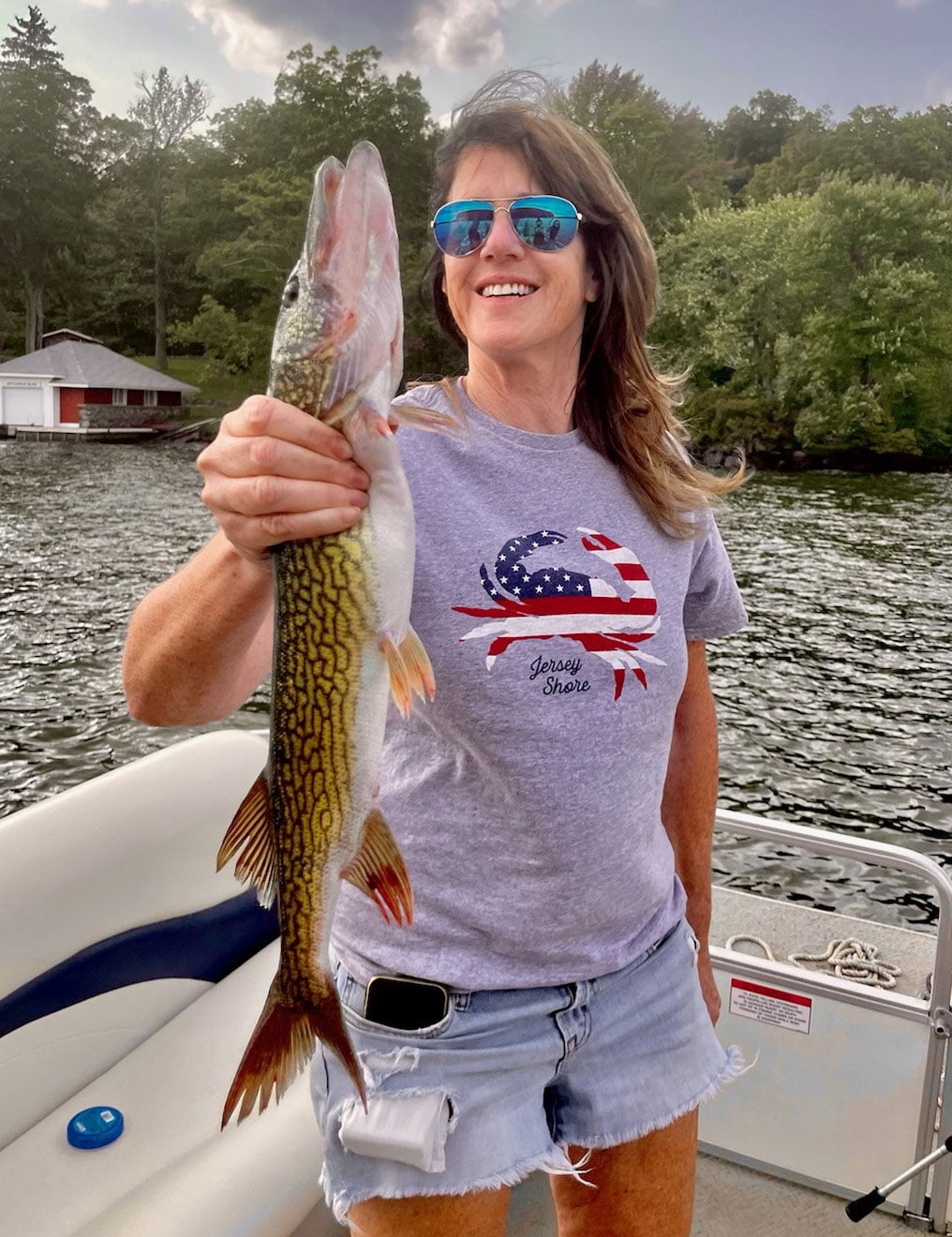
The reputation of the species’ savagery precedes it. As with its larger pure strain and tiger muskie – and northern pike kin – it’s a perfectly configured killing machine and violent to the core. And unlike its relatives, it’s found most anywhere. From urban and suburban park ponds, to rivers and creeks, to lakes and reservoirs, chances are great that if there is an abundance of weeds and sufficient forage, pickerel will most likely be in residence.
There isn’t a season, or a day in a season for that matter, when the perpetual ambush predator isn’t ready to attack prey, real or imagined. However, it’s during the hot and sticky torpor that is August, with seemingly dead air and lifeless water, that chainsides proves its summertime worth. While other gamefish will limit feeding activity to brief first light and dusk into darkness periods, pickerel will be ever ready to propel from cover to put the grab and stab on any forage that gets within range of its speed of light reflexes. This reaction, even with upper end water temperatures and sunstroke-inducing rays being the dictates.
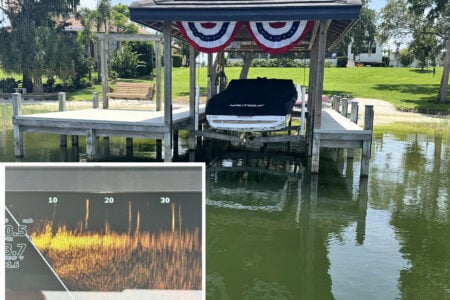
Weeds are synonymous with pickerel; the thicker the better. Ditto mats of lily pads. Ever the sneak attacker, it will also take station under docks and swim platforms, and alongside lay downs. However, weeds are favored lair, and the species’ torpedo physique is made to easily and rapidly slide and weave through said aquatic greenery. Its staggered, connected markings lend to as perfect a camouflage as nature could fashion, the fish virtually disappearing when in the weedy cover.
A pickerel will position itself facing any openings in the form of holes, gaps and alleys in the mats where baitfish will pass, albeit back in enough to be concealed. In a situation where the weeds are sporadically scattered in the shallows along the shoreline extending outward, the fish will oftentimes position itself facing inward where it can easily intercept prospective prey that moves into the opening.
Baits and tactics vary but there’s no reason to be overloaded. Pickerel are as basic as it gets: aggressive and hungry. If something that looks edible and is in motion, it’s a 9 out of 10 bet that the fish will take a shot. This isn’t to say that chainsides doesn’t possess a modicum of inherent wariness. It does, and despite its savage disposition it sometimes will pass on an opportunity. This, however, is more the exception than the rule. The esocid DNA demands death and consumption with little room for anything else besides reproduction.
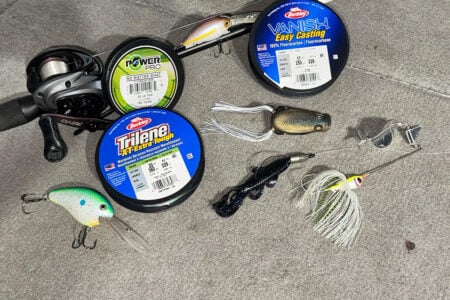
Playing to the quarry’s extreme predatory proclivities, we like to stick to the basics when seeking summertime chains. No need for the bulging tackle stuffed backpacks with a volume of baits that will result in more changing than casting. In our sling pack is a trio of the weedy go to Johnson Silver Minnows (quarter-ounce) one each in gold, silver, and chartreuse flake, and couple of packs of the Z-Man GrubZ (one each 2-1/2-inch and 3-1/2-inch; chartreuse sparkle). Slithered through the salad, these elicit crucifying clamp downs. The bonus of the GrubZ is that they don’t easily tear as per the chainsides’ tyrannosaur dentition. Other occupants are a 3/8-ounce buzzbait, two or three weedless frogs (leopard, yellow/black, green, white belly), a weedless rat (black), and a couple of floating 4-3/8-inch or 5-1/4-inch Rapala Minnows (predicated on venue), one silver/black, the other firetiger.
When the strategy calls for the frogs or rats on the mats, or the spoons/grubs through the jungle, best to go with at the minimum 30-pound, better 40-pound or even 50-pound test green braid tied directly. Not only with this connection result in near instant hooksets, but will slice through the weeds and stalks to get the fish to the boat or bank.
Working a floating/shallow running minnow style crank through the alleys and along edges should be a matter of either a steady retrieve, or a go/stop/twitch/stop/go cadence, as this resembles prey in distress. Many strikes occur as the bait floats to the surface. It’s a slow-to-rapid retrieve for the buzzer/trailer in the same territory.
Something to be said for later summer slime dart game; let the sweat flow.