To herd a few sheep, why not hear it from a couple of shepherds.
I was out late on a steamy Friday night in July of 2025 when I received a call asking if I wanted to join a sheepshead trip the following morning. Doug Keeping and Sean Holten, two South Jersey anglers were mobile and ready to seek out some sheep. I readily accepted the invite and was there at the boat ramp to meet the pair for our daybreak departure.
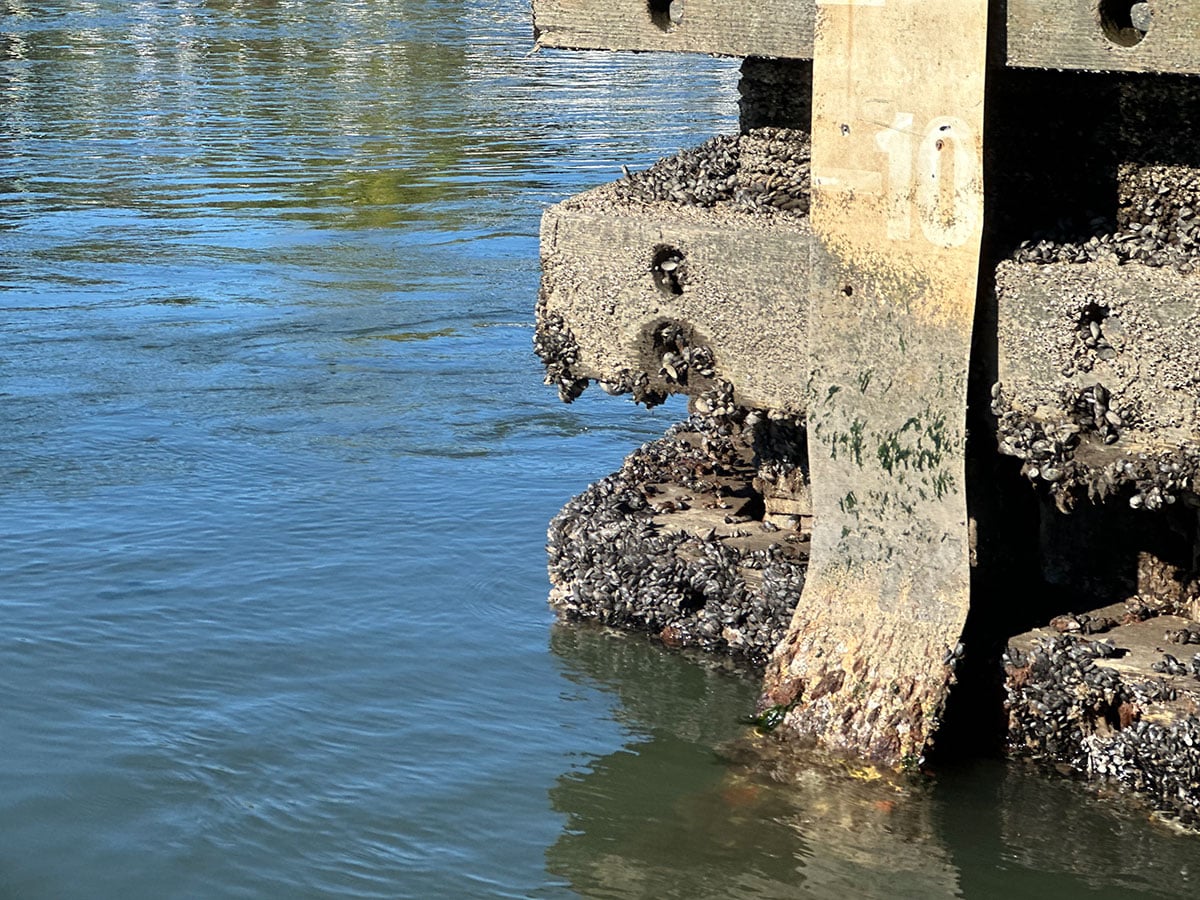
Our plan was to fish some bridges and possibly some jetty rocks. Sheepshead function much like tautog and that they stick tight to structure and are only occasionally taken off barren bottom (even as a number of sheepshead have already been scored from open beaches during the spring of 2026). But sheepshead love concrete, rock, metal and wood habitats that supply forage and current breaks where they can truly utilize their prowess of plucking unsuspecting crabs from the structure.
The weather last June and July had been much more stable than that of the prior year so the sheepshead fishing had gotten off to an outstanding start. Some seasons, anglers have to work hard to get a single sheep bite in an outing, but in 2025 the level weather patterns and cleaner water enhanced the catching from Cape May up to Barnegat according to everyone I encountered.
When we arrived at our first bridge stanchion and got the boat lined up in the leeside current, we all dropped our sand fleas along the concrete piling. The idea in sheepshead fishing is to keep the bait as close to the structure as possible. If the current accidentally sweeps the jig away, then the angler must reel up and redeploy in order to put the tiny bait right up against the structure. Fishermen must stay aggressive and not complacent. Fishing away from the piece exponentially reduces the chance of catching.
Trolling motors prove highly successful in this fishery, as they allow anglers to get super close where they can reach out and drop against the structure. The modern anchor features or “spot lock” uses GPS to hold the vessel in one place without having to tie off or set an anchor. Nonetheless, Keeping fishes for sheep the old school way. He’ll position the boat so close to the structure that random wakes will take his bow into the piece where it grazes, bumps, and collides with the concrete. His fiberglass bow is completely chewed up and he thinks nothing of it.
Keeping wants to fish his chosen way with the least amount of arm extension possible to the structure from an ordinary vessel. His singular goal is to keep the bait in the strike zone.
Drop & Steady
“Drop it down 5 feet,” Keeping told me. “Hold it still and if you don’t get a bite in a few minutes, drop it another 5 feet and do the same,” he advised, adding “Eventually you’ll get a strike as long as you stay right on the pile.” As Keeping noted, the biggest error is to get swept and not reel up and fix.” A pipefitter by trade, Keeping is well-versed in the minute details. Whenever bites didn’t come, he’d try to dissect, rationalize and explain why. He says he has caught sheep literally a few feet under the surface when the depth is 40 feet. He placed heavy emphasis on fishing every segment of the water column.
“If we can keep the tog away, the ‘mother hens’ will definitely be here,” he continued. Mother hens are one of Keeping’s own phrases for trophy fish. “Move the bait in the lee or side of the piling and make sure to hit every depth,” he told me, explaining how more tog and less sheep are on the bottom, but you can get those sheepshead somewhere higher up. “Keep the bait still once you stop and you’ll get them,” he offered.
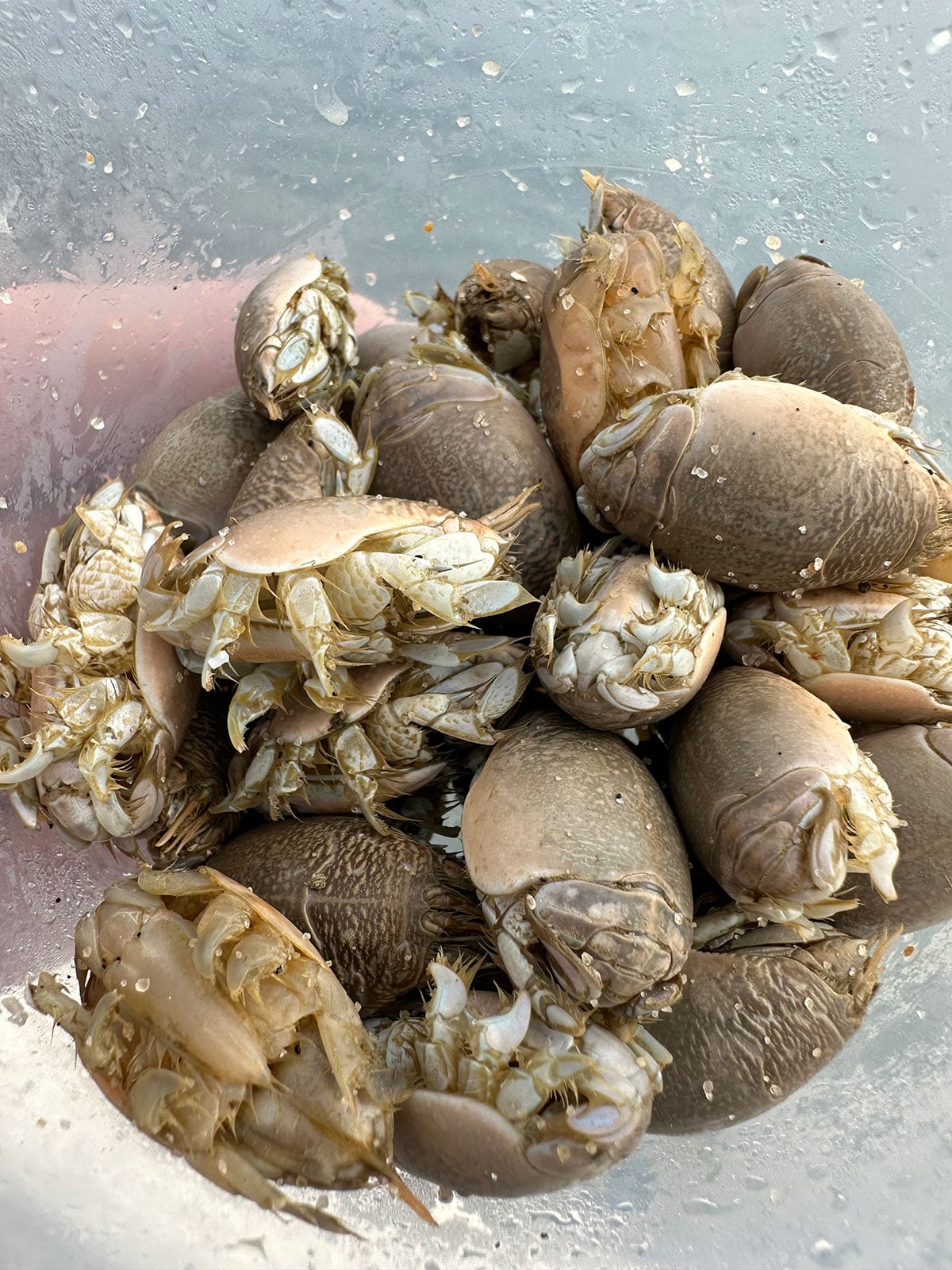
We used 6- to 7-foot, medium class rods with 20-pound braid and 4 feet of 30-pound fluorocarbon leader. The business end consisted of a white quarter-ounce tog jig with a sand flea from the supply the guys picked up the night before. If the current grabs the jig and pulls it away too easily, anglers should change to half-ounce up to an ounce. We used MagicTail and Bottom Sweeper jigs. Sand fleas are supplied by more and more New Jersey tackle shops because they are great for both sheepshead and blackfish, whereas green crabs are primarily a tog bait and rank second to the fleas in terms of summer availability. Any kind of crab is worth a shot, including shedders and calicos, while fiddler crabs are available in most marshes and have proven extremely effective for sheepshead. For those willing to hunt in the mud, they’ll often reap the spoils later on if they can place their fiddler finds in front of a sheep.
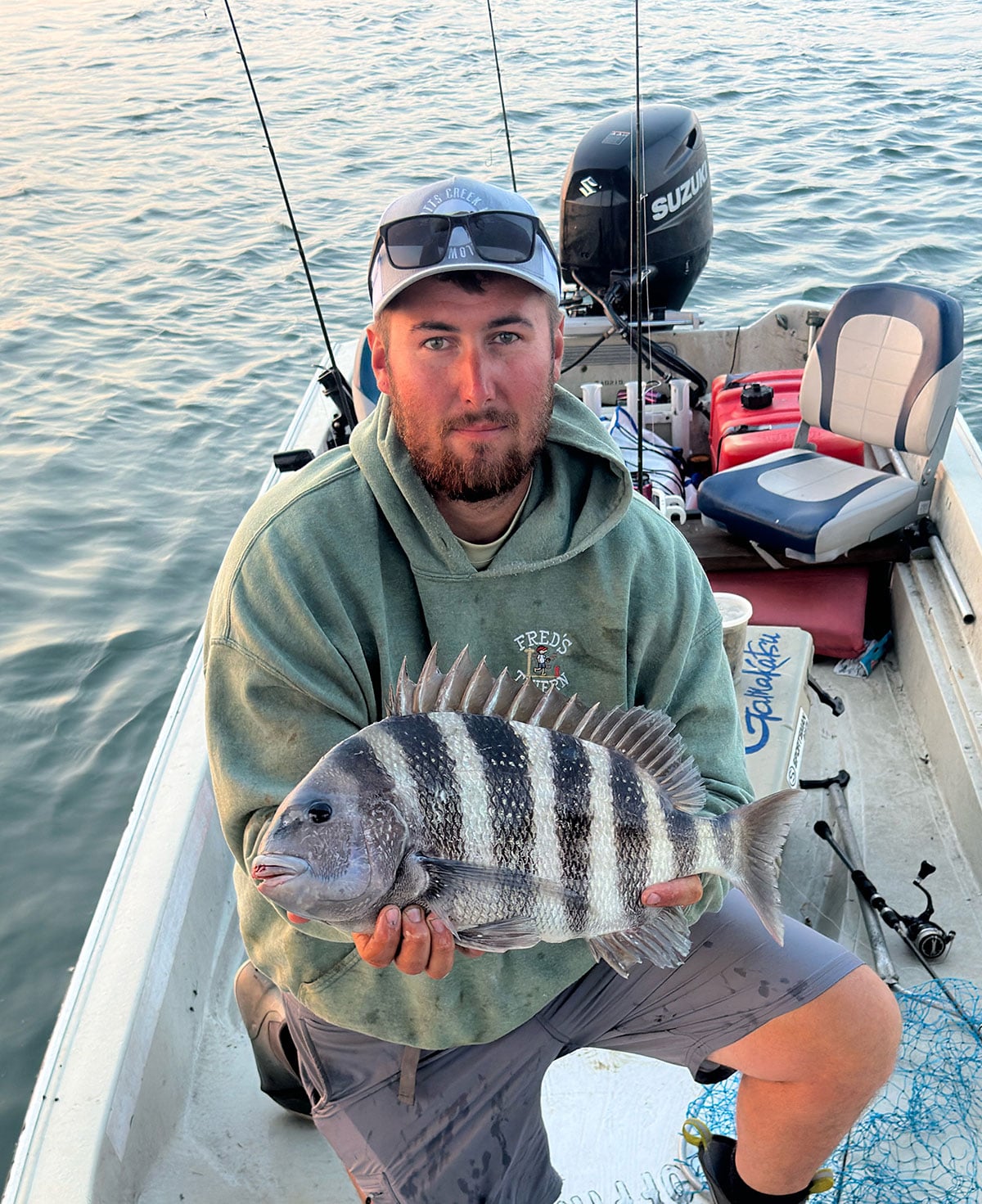
I quickly turned my gaze to Sean Holten as he set up on a nice fish and began a battle. After a feisty fight, Keeping netted the 8-pound class sheepshead and we were on the board. Holten fishes all over the South Jersey inlets and Delaware Bay waters furiously seeking sheep in spots known and unknown. Mobility is key because each season is different and some locations fire and some spots fizzle. Being a road warrior leads to more fish.
“Good to get the first one,” Holten said with a wry grin. “I like to break the ice early; it should begin to pick up shortly I think because the conditions are excellent; the water is clean. There’s no reason we won’t catch today.” Holten’s quiet determination contrasts Keeping’s unabashed and emotions-on-your sleeve approach.
Moments after Holten scored, Keeping thrust his rod upward and began a battle with a 7-pounder. Both relieved and excited to get in on the game, he dropped a flea and was on another one in a blink as the bite picked up steam. I too started catching as we took turns bringing fish to the net.”
Keys To Success
White was our jig color of initial success, but one of the guys switched to purple during a brief stall and recommenced catching. When the tide turned we switched to the lee and sides of our chosen structure. As the current poured out on the ebb, the bite didn’t disappoint as we each caught our fair share. The guys emphasized that slack tide isn’t necessary to catch sheepshead when, in fact, the moving water is often just as good or better. It is a common misconception that slack water is needed. Slack water might be easier for some vessels to work the structure and that’s possibly where the misnomer began. Sheepshead do, however, make changes to their location on slack water and move to different areas of the structure in order to use the upcoming current switch to stage and feed. Keeping and Holten continued to emphasize clean water as a pivotal element to lights-out fishing.
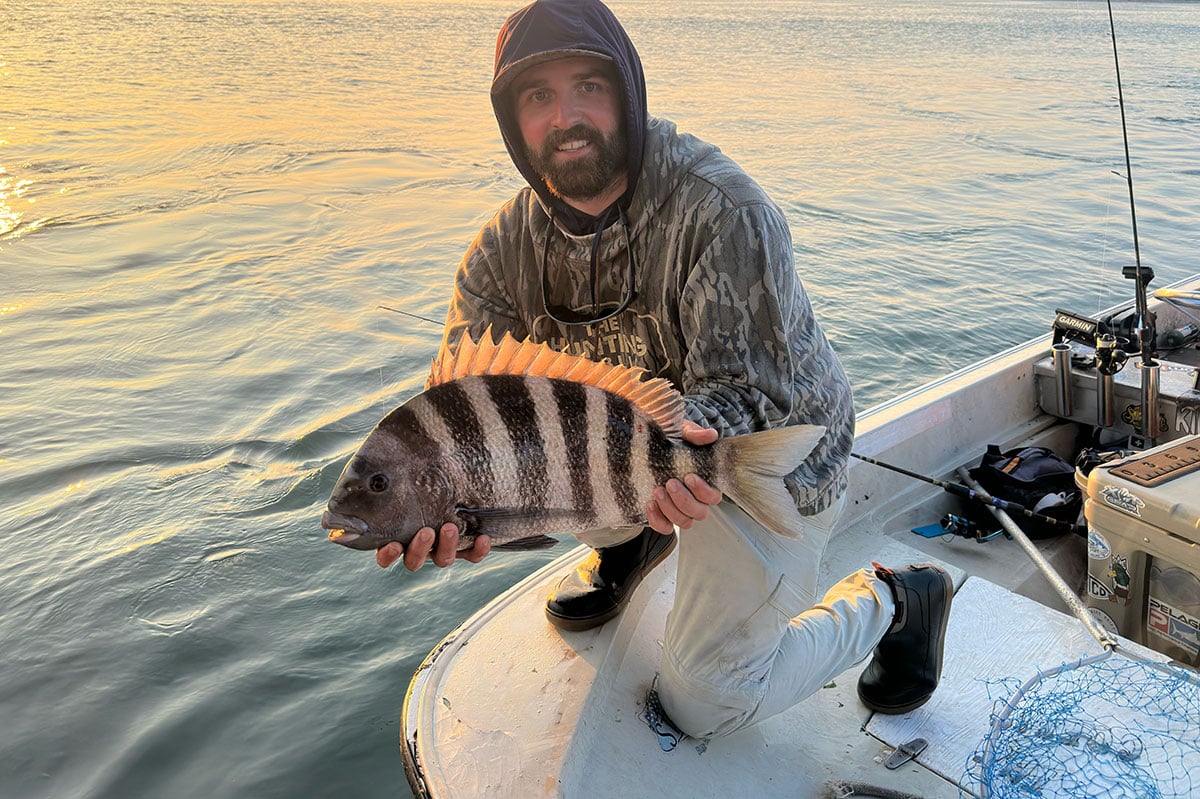
“The best days come when the water isn’t dirty. When you dip your rod in the water, the more rod guides down you can see, the better,” Keeping said, adding “Dirty, stirred up water is the biggest killer of a good bite. Heavy rain and wind can really mess up great fishing overnight.” Just then Holten loaded up on stout fish. “This one feels really good,” he said while steering the fish away from structure and barnacles that have the ability to slice the braid or leader. “Get ready with the net and I’ll guide her right in,” he shouted. The scale read 10 pounds even before we let gently laid her back in the water for release.
There’s a nice mix of sized sheep cruising South Jersey and most land within 5 to 9 pounds. Ten-pounders are normal, but definitely worthy a fist bump, while fish in the teens are considered trophy territory. The New Jersey state record sheepshead pulled the scale down to 19 pounds, 3 ounces in October of 2014 when it was taken from Longport waters. Keeping and Holten are certain more record fish are around and about.
“There’s a nice population of sheepshead in New Jersey, more than people think,” Keeping said, adding “I think the record will be broken in the next five to ten years especially with more people fishing for them. If it doesn’t get broken, I think there will be more near-misses.”
Fish Wisely
We put together a nice, double-digit tally that ranked amongst Keeping and Holten’s best outings. Despite Doug Keeping’s namesake, we released all but one. We all agreed that despite no regulations on the book in New Jersey for sheepshead, that we’d let them go in order to help sustain the fishery for years to come. It’s essential that we don’t wipe out a local population of fish with the genetic information and programming that instinctively sends them swimming back to the Jersey Shore each year, and perhaps each specific inlet and estuary.
Lessons from the demise of another southern visitor may offer a cautionary tale of how a species can disappear, especially when they populate on the edge of their range. New Jersey once had a red drum fishery that thrived. One hundred years ago, redfish were numerous up through Long Beach Island and Barnegat Inlet, but they were overharvested and never returned in the same size and numbers after. Sheepshead fishing continues to be excellent, but localized depletion could lead to similar results and shrink their range to the more traditional waters to the south. It’s safe to say, no one wants that.
Our outing had moments of frustration too. Occasionally, fish would inexplicably throw the hook mid-tussle much to our chagrin. In full form, the guys tried to figure out how fish could toss the hook so close to the boat. We couldn’t substantiate any solid theories other than their ability to use their bodies and water pressure to elongate the fight and ditch flesh-hooked jigs.
I asked the Keeping and Holten how they determine where to fish considering the amount of bridges, rocks, wrecks and sods proliferate Southern Jersey. The manmade structure in South Jersey inlets is crazy abundant. “There’s enough guys talking or reporting or sharing intel that we’ll find out if some are being caught in a region,” said Keeping, adding “That intel tells us where we need to trailer to. Then we can decide on what bridge and then what pillars or ice breakers to fish.”
The duo will choose the rocks, icebreakers or pillars based on water conditions such as tide, current and clarity. “A pillar in stagnant water without flow won’t catch nearly the same as one that has current,” said Keeping, adding “It can take some experimentation, but eventually we can find them if the conditions are good.”
“Some of the best spots are those underwater obstructions that you can’t see, but still exist,” he said. “Just because you can’t see the structure, doesn’t mean there isn’t any around. There’s underwater rock piles, broken dock piles, old bridges and other chunks submerged that all hold sheepshead.”
Holten added, “If a certain spot isn’t hitting, you have to decide whether to wait it out or move to another one. If it’s structure I have a lot of faith in, I might wait it out a little longer before switching, but if not, I’ll bounce around and try to pick off fish in different places.”
Sheepshead fishing in South Jersey generally begins in late May and can last until early November with some variance on each end. As we cruised across the back bay towards the ramp, we mused about the fun catching, missed strikes and strange break-offs. I hadn’t had this much fun sheepshead fishing since my days living in the Carolinas. It was certainly worth the early wake-up after the long night before.