Knowing your forage fish helps you target predators.
Forage fish or “baitfish” are loosely defined as small, schooling fishes that form critical links between the marine zooplankton community and larger predatory fish. Big fish need lots of protein, and they get it from eating baitfish.
WHITE BAIT
Collectively known as “white bait” in southeast waters, this term describes scaled sardines (Harengula jaguana), (or “pilchard”), and thread herring (Opisthonema oglinum), (“threadfin,” “greenback,” or “greenie”), which rank at the top of southeast forage species.
Threadfin have a bright green/blue back and spots along the dorsal side. Most notable is a long, thread-like trailer from the first dorsal fin. Threadfin have a rotund body, deeply curved belly, and small, pointed head. They range from Massachusetts to Florida along the Atlantic Coast.
The scaled sardine lacks the dorsal fin trailer, has a larger eye, an olive-green back, and scattered spots. Scaled sardines are distributed in the western Atlantic from New Jersey southward.
BUNKER AND ALEWIVES
Ranging from Nova Scotia to Florida, Atlantic menhaden (Brevoortia tyrannus), nicknamed “bunker,” are the premier forage species for many Northeast gamefish. “Peanuts” are the juveniles, and they’re the northern version of white bait. Bluefish, striped bass, weakfish, and false albacore assault bunker along New England and the Mid Atlantic shores.
Bunker are in the herring family Clupeidae, and they swim in massive schools that stratify by age and size along our coast. While adults grow to 15 inches long and one pound, peanuts range from 1 to 4 inches. Bunker are silvery overall, but dark on top, and are more flattened than herring. Black spots behind the gill plates help distinguish them. Adult schools are often seen finning in bays and estuaries.
Also in the family Clupeidae, alewives (Alosa pseudoharengus) are a few inches long as juvenile baitfish and about 10 inches as adults. They feature a blue to green back, with light sides showing horizontal stripes. The head is broad and triangular, and the body is relatively deep. They are anadromous and range from Nova Scotia to North Carolina. Alewives spend most of their adult lives in the ocean but return to the freshwater streams to spawn in spring. They’re important forage for striped bass and bluefish, and stripers pursue them up spawning rivers.
HERRING & MACKEREL
In the Gulf of Maine, Atlantic herring and Atlantic mackerel are common targets of big bluefish, large striped bass, cod, pollock, and bluefin tuna. “Tinkers” are young Atlantic mackerel (Scomber scombrus) ranging from 6 to 10 inches long. They have an elongated and rounded body and a long, pointed nose; they are steel-blue, and marked with distinctive wavy black lines on their back with a silvery-white underside.
Herring appear similar to bunker, but their body is less flattened and more elongated than menhaden. Generally, menhaden are an inshore and warmer water species whereas herring stage more offshore and favor cooler water.
BAY ANCHOVIES
Bay anchovies (Anchoa mitchilli), also known as “rainbait,” are a small, translucent fish, 1 to 4 inches long, which school from Maine to Florida. Bay anchovies are slender with a silvery-green back, clear body, and silver stripe along the sides. They have a large, underhanging mouth, single dorsal fin, and forked tail. They’re an important food source for small bluefish, schoolie stripers, bonito, and false albacore.
SILVERSIDES AND SAND EELS
Silversides or “spearing” and sand eels or “sand lance,” belong to the Ammodytidae family. They feature a slender body, pointed snout, and a silvery body with an olive back. Silversides are typically 3 to 4 inches long with a maximum of about 6 inches, and they range from Canada to Florida.
Silversides prefer a sandy bottom and grass beds in shallow water of estuaries and are popular snapper bluefish targets. Schools flash brightly in unison when disturbed. Anglers can buy them frozen or catch them with a small-mesh dip net or beach seine net. Silversides are also popular feed for weakfish, fluke, albies, and bonito.
Sand eels (or “sandeels”) are not true eels—they only look like eels due to their long, slender shape and green back. They swim in large schools close to the seabed and will burrow into the sand to evade predators. They’re a vital food for many predators, including pollock, cod, haddock, black sea bass, bluefish, striped bass, tuna, fluke, albies, and bonito.
BUTTERFISH
Butterfish are thin, deep-bodied, and somewhat circular. They have a small mouth with a rounded, blunt nose. They’re steely blue on the top, with pale sides and a silvery belly. Their size varies from 6 to 9 inches in length, but they’re often targeted as forage species when juveniles (“baby butterfish”) of only 1 to 2 inches long.
Butterfish range from Florida to Newfoundland, but they primarily occur from North Carolina to Maine. They grow quickly and are semi-pelagic, swimming in loose schools. They often stage in nearshore rips of the Northeast. Butterfish are a top food for many predators, including black sea bass, bluefish, weakfish, and tuna.
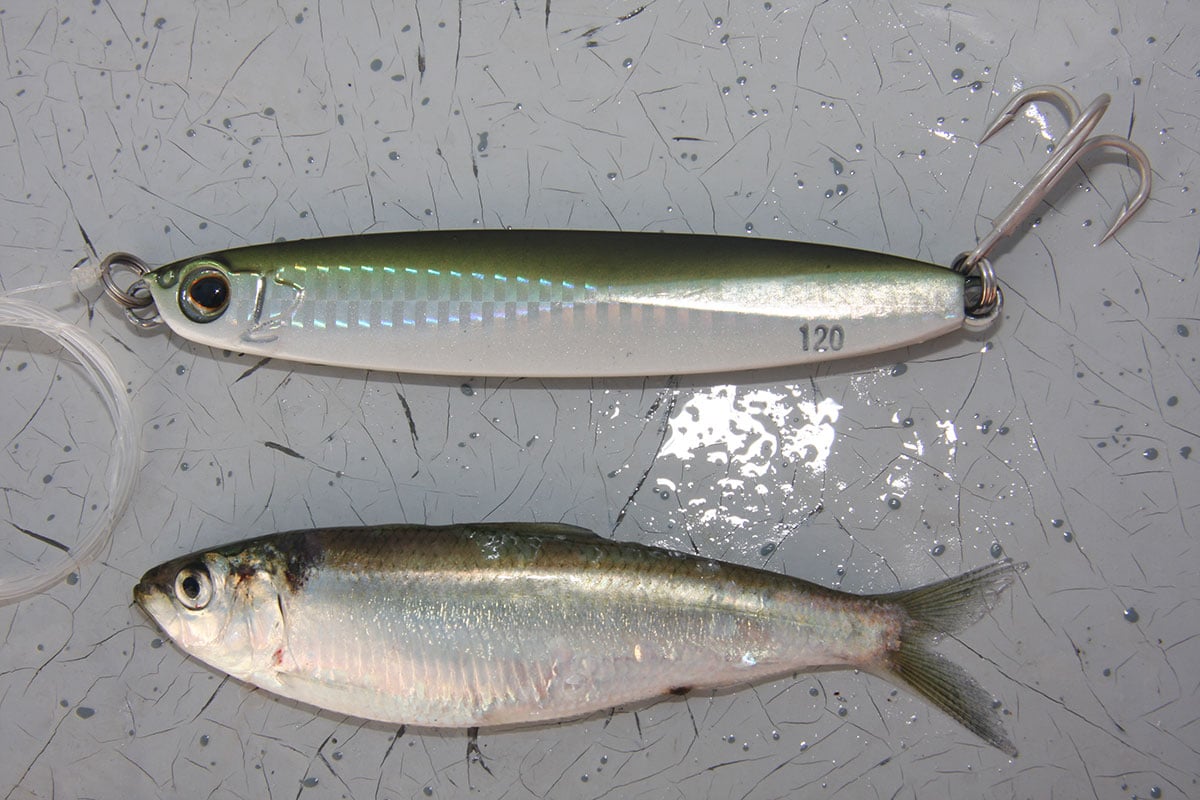
Once you determine the predators you’re targeting, it’s important to duplicate the size and shape of those baitfish with your lure. For example, a diamond jig or Deadly Dick Long closely imitates long, slender baitfish like silversides, sand eels, and herring, whereas a Kastmaster and Hopkins Shorty will imitate deeper bodied forage like white bait, peanut bunker, and butterfish.