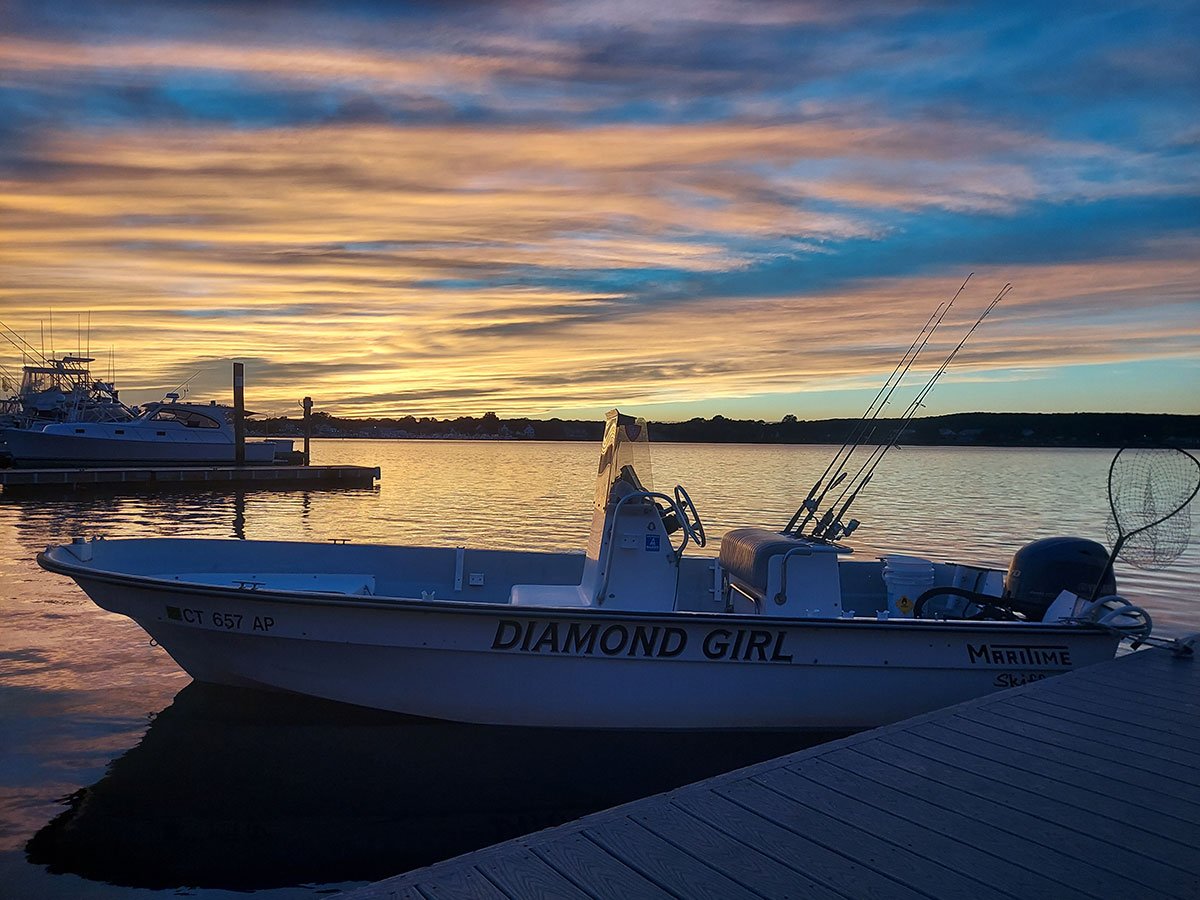
Taking the necessary steps to docking an outboard-powered boat properly.
Whether you’re a first-time boat owner, rusty on the fundamentals, buying a bigger craft, or just a passenger who wants to be prepared for an emergency, there’s a need to learn and practice docking and mooring skills for a marina or boat ramp.
One way that outboards differ from inboards is how they steer. Outboards have no rudders – they depend on direct propeller thrust to turn the craft. Therefore, unlike inboards, your outboard has little steerage capability without the prop turning. Coasting to a stop must be planned with care.
Start learning by motoring into open water on a calm day during slack tide, and toss over a capped bleach bottle tied to an adequate length of line and a brick to hold it in place. Practice maneuvering up to and around the bottle, being careful to immediately shift into neutral if you get too close or run it over (which is also good practice for fishing around lobster buoys) to prevent entanglement. Next, try docking. Don’t forget to recover your plastic bottle and then hang fenders along the dock side of your craft before your approach.
For proper docking you’ll need enough line of adequate length and strength coiled and ready. Each line should have a loop at one end that’s made from a splice or bowline knot and be large enough to fit over a piling or dock cleat.
Docking lines have their own names and functions: A “bow line” runs off your bow cleat forward to the dock. A “stern line” runs off your stern cleat aft to the dock. These lines perform best when secured at a 45-degree angle.
A “forward-leading spring line” runs from an aft boat cleat to a forward dock cleat or piling, and an “after-leading spring line” runs from an amidships boat cleat to an aft dock cleat or piling. Spring lines are used to prevent movement ahead or astern when berthed. They are also required for safely mooring to a dock where a great tide amplitude occurs.
A “breast line” is a short rope tied perpendicularly from a boat cleat to a dock. It’s used effectively for temporary moorings, such as when boarding your friends, fueling, or waiting your turn at the boat launch. A vessel left moored this way to a stationary pier, however, may cause parted lines or a sinking when the tide rises or drops. Even in freshwater, breast lines used alone don’t protect your craft from harsh forward or backward surges caused by waves or wakes.
If it’s windy or a current is running and you have a boat cleat near amidships, it’s best to run an after-leading spring line to the dock. With that line fixed, engage the motor in slow forward, which will hold you firmly against the dock. If needed, cut the wheel toward the dock to push in the bow, and turn the wheel away from the dock to push in the stern. Now you can tie off the forward-leading spring, bow, and stern lines.
If you don’t have an amidships cleat, tie-off your bow and stern lines first. Then tie spring lines forward from the stern and aft from the bow, perhaps to the same spot. If you sit at a motor with tiller steering, you may wish to secure the stern first, which is mostly for convenience. If only one dock tie-on cleat is available, place your boat so that that point is amidships, and run spring lines from the bow and stern to it.
When nearing a float, dock, or pier, such as at a boat launch, do so under power but as slowly as possible. A 20- to 25-degree angle of approach is optimal. Beginners err by trying to come in parallel, only to find that any course correction either bumps them into the dock or carries them away from it.
If possible, maintain the same angle throughout as you idle in. When your bow is about a half a boat length off the dock, turn the prop away from the structure to swing the bow off. If you have wheel steering, this means turning the wheel away from the dock; if you have tiller steering, this means moving the handle toward the dock.
As the bow starts to veer away, momentarily shift the motor to neutral. Then reverse to arrest forward progress, as needed, while turning the propeller toward the dock to pull the stern into it. Return the engine to neutral as the boat coasts in sideways to rest parallel against the dock. Be sure your motor is in smooth working condition so it doesn’t stall when approaching a dock at low speed and shifting gears.