Borrow this technique from fly fishing to increase your catch rate when working small topwaters in heavy current.
A few years back, I was drifting aboard a center console, running out of Falmouth, MA. We covered a lot of water and species that day, but when we pulled up to fish Vineyard Sound’s famous Middle Ground, a shoal that produces a wicked rip, I learned something new. Best of all, it’s something that has been applicable, again and again, in fast water and it’s something that anyone that fishes for stripers, bluefish, albies… or any other species that might feed on top, in a rip, will be able to use.
As we nosed up to the boiling rip line, there was a ton of life around us; 3- to 4-inch squid were intermittently leaping clear of the water, schools of small to medium baitfish, moving too fast to identify, raced past. The occasional ‘pop’ could be heard, punctuated by a burst of white, as the bass patrolling the rip took aim at baitfish being ushered over the wide, sandy hump.
Our captain put the bow mere feet from the rip and engaged the spot-lock on his Minn Kota Terrova trolling motor; I remember the juxtaposition of racing water and a dead-still boat feeling especially odd in that moment. The water was running hard, toward the boat, we were casting up-current and working 5-inch spooks, trying to keep up with the tide.
Our results were not great, which was really frustrating me, with all that life in the water. Basically, if we didn’t get hit within the first 10- to 20-feet of the retrieve, we weren’t getting hit. What was worse, is that first 10- to 20-feet was not near what I would consider the sweet spot of the rip. I didn’t like the way the plugs were running in the tide and the surfcaster in me wanted to ask to reposition the boat to allow us to work through a more targeted sweep, but my stubborn side wanted to figure this out. So I did what I do whenever I’m faced with a situation that isn’t working out how I think it should: I stopped fishing.
I watched as the other anglers on the boat fished their plugs through the rip and how those little topwaters were being dragged under by the tide as they approached the kill zone. Fishing with the rods provided by the captain, something I rarely do, the terminal end wasn’t set up the way I would usually do it, the snap was too big, the leader too heavy and the barrel swivel was too big, the latter was probably by design to save his tips when novice anglers were aboard, since the big swivels could not be reeled through the rod tip.
Luckily, I had my belt on and a pouch on my hip with pre-tied leaders. I pulled out a 30-pound test leader, clipped the swivel off and tied it direct to the braid using an Albright knot. The snap was downsized to a 50-pound TA Clip. I clipped the spook back on and let it fly into the rip, three casts later, the reduction in weight and drag of the rig made the action better, but still not good enough.
Over my next few tosses, I identified the problem. The difference in speeds of the water, behind and in front of the rip, were wreaking havoc on my presentation because the faster water would – sort of – engulf the line and pull it away from my position, while dramatically affecting the action of the plug and my ability to work it. I thought back through that rolodex of techniques we all have in our heads and I remembered an article I edited a long time ago that dealt with fly fishing in current and one of the segments was about a practice known as ‘mending the line’.
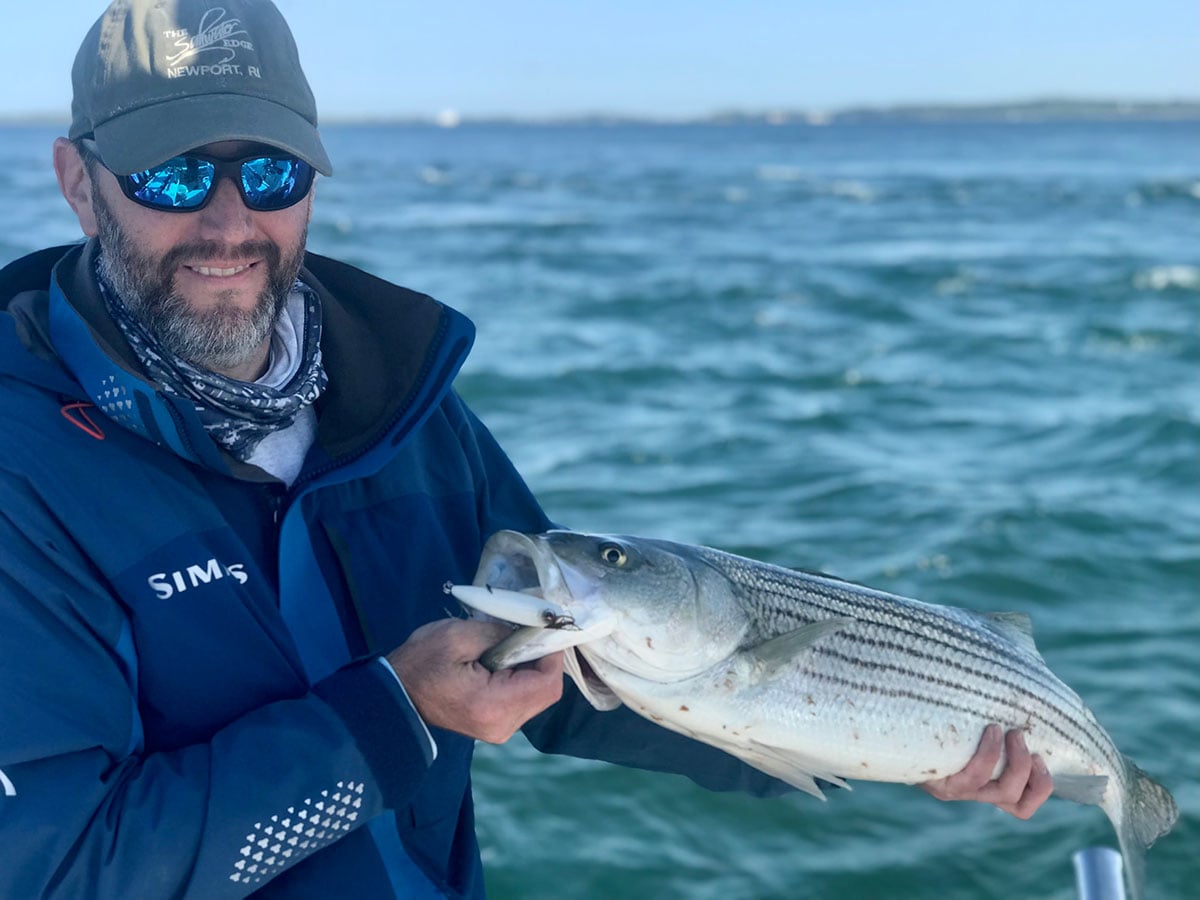
Basically, this technique involves ‘picking up’ the fly line with the rod and laying it back down in a straight line ‘in front of’ the drift. So I’d make my cast, work the plug until the water started to get a grip on the line and I’d just reel up as much slack as I could, lift the rod high, as the line hissed out of the rip and then I’d reset a straight line between myself and the plug. The results were nearly instantaneous. Within the next 30 minutes, I had two frustrated anglers looking at me like I’d remembered that I had a four leaf clover in my pocket, but all I had really done is taken the time to observe and adapt. These were not giant fish, topping out at 35 inches, but meeting a challenge and perfecting a technique to solve it, is worth at least 50 pounds to me. What about you?