So much for the ’25 bluefin fishery, but future tuna hopes are high in Spain this month.
The 29th Regular Meeting of the International Commission for the Conservation of Atlantic Tunas (ICCAT) will be held from November 17 to 24 in Seville, Spain. As described by NOAA Fisheries, “ICCAT is one of many regional fisheries management organizations where countries and fishing entities come together to discuss and develop international fisheries management measures.” When these nations assemble this month in Spain, you can expect that bluefin tuna and reasonable access to the fishery in 2026 will be a huge topic for our U.S. advocates.
In fact, the topic of increasing bluefin quotas seems popular on both sides of the Atlantic, as one commercial fishing publication noted recently in reference to the Secretary General for Fisheries in Spain, Isabel Artime, meeting with more than 60 representatives from the Spanish fishing sector to discuss the review of the bluefin tuna quota for the 2026–2028 period. “In the event of an increase in the current quota, we would be at the ideal moment to open the fishery to new fleet segments that have not been able to access it due to the previous state of the resource,” Artime noted.
Here in the U.S. there’s an ICCAT Advisory Committee (IAC) made up of individuals who represent commercial industries, recreational fishing organizations, environmental groups and academia. Committee members are nominated every 2 years and give advice to U.S. ICCAT commissioners on international issues related to the conservation and management of Atlantic highly migratory species. Armed with this information, and the backing of our own federal government – Department of Commerce officials and the White House – the United States and other Western Atlantic nations will be hoping for the same outcome in terms of increased quota.
“The most frequently voiced complaint I hear on the sport docks and co-ops is the lack of a reasonable American allocation and the continued growth of Eastern (Atlantic) recreational fishing efforts, especially now, while Americans sit idly at the dock,” noted IAC member Nick Cicero of the Folsom Corporation, adding “Simply put, bluefin access is the number one issue that needs to be addressed.”
As Cicero points out – and as referenced in our September 2, 2025 Offshore column titled What Happened With Bluefin – there’s an imbalance in bluefin tuna quota allotment when comparing the Western Atlantic here in the Americas and the Eastern Atlantic shares for the United Kingdom, Spain and Mediterranean nations. “We have waited year after year for the opportunity to correct an inequity that has disadvantaged American fishermen, manufacturers, and coastal economies alike,” noted Cicero, adding “That opportunity is in front of us now, and it cannot be allowed to slip away again.”
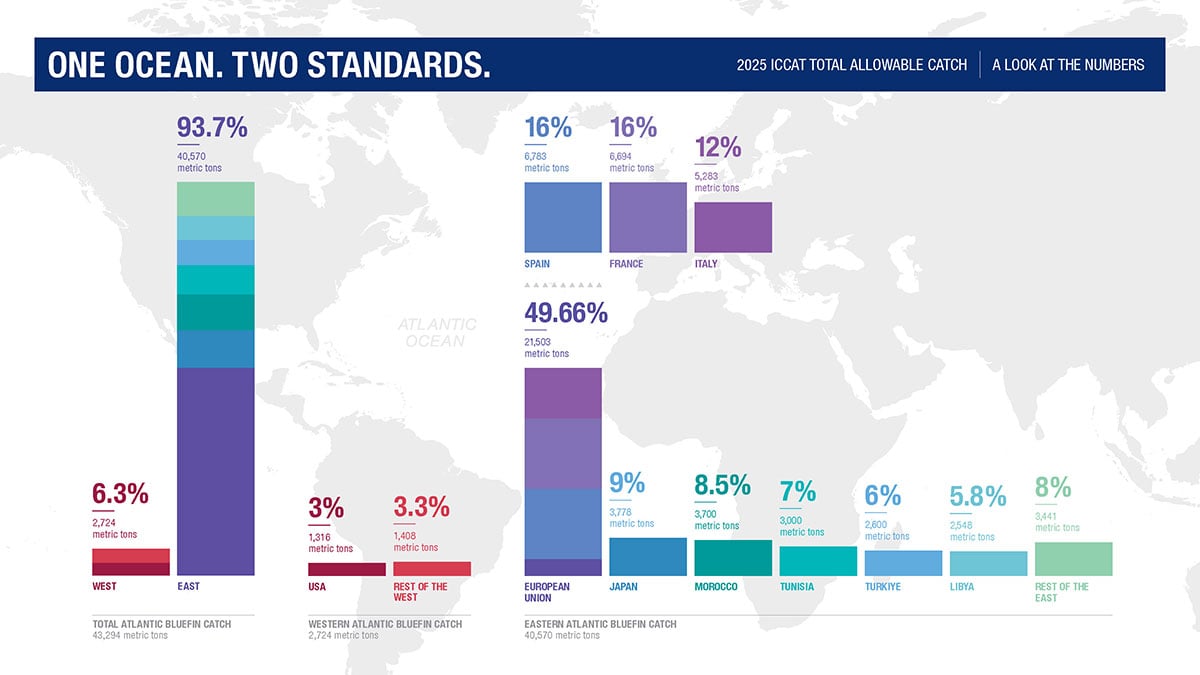
In terms of equity, the fact that Japan is allocated quota from both sides – the Eastern Atlantic (3,114 metric tons) and the Western Atlantic (664.52 metric tons) – is pretty ridiculous considering that Pacific Rim nation literally has no geographic connection to the Atlantic Ocean. But another inequity that U.S. delegates at ICAAT will be discussing later this month in overseas fisheries management is the 2,724 metric tons of allowable bluefin catch on this side of the Atlantic, versus the 40,570 metric tons on the Eastern Atlantic.
Can representatives from North America, Central America and South America capably argue for an increased share of the Western Atlantic bluefin quotas starting in 2026? It’s possible, especially as U.S. fishermen and scientists are driving new, cutting-edge research with leading American universities to strengthen tuna assessments. Scientists gathering data from U.S. commercial and recreational bluefin fishermen have been actively researching the Slope Sea area off the Northeast coast of the U.S. as an important breeding area for bluefin tuna that may greatly contribute to stock mixing between eastern and western Atlantic bluefin populations.
“Genetic research has shown the two stocks are interconnected,” according to a summary from the Northeast Fisheries Science Center, adding “This year’s survey aims to clarify remaining uncertainties about bluefin tuna stock structure and spawning dynamics.” The reproductive study was conducted by the Large Pelagics Research Center in Gloucester, MA with findings from their ongoing work expected to be presented at the ICAAT meeting.
Other valuable research on the bluefin tuna fishery has been underway this season in the Northeast with the Pelagic Fisheries Lab at the University of Maine that uses Close-Kin Mark Recapture (CKMR), a modern genetic technique which will hopefully produce more accurate population estimates and appropriate harvest levels. With the help of bluefin anglers, the folks at Viking Yachts in New Gretna, NJ are hoping that providing new citizen-supported science can help at the international level. “This is how we break the cycle,” said John DePersenaire, Viking’s Director of Government Affairs and Sustainability.
Following the sudden closure of the recreational bluefin fishery this summer, Viking stepped up to help lead the citizen science campaign in partnership with the University of Maine’s Pelagic Fisheries Lab. “If the data used to manage the fishery doesn’t reflect what’s actually happening offshore, we need to fix that, and it starts with citizen science,” said DePersenaire, who added “Anglers have the power to make a difference.”
And hopefully our ICAAT advisors, delegates and scientists will make a big difference in Spain later this month.