You’ve found them, you’ve hooked them, and now it’s time to land them.
After a long battle with a tuna, it’s imperative that anglers stay locked-in on efficiently concluding the tuna tug-of-war without losing the fish. It’s remiss to allow worn-out muscles to relax, only to provide the fish an opportunity for one more surge to freedom. So many tuna are lost right at the boat due to fatigue and angler error, therefore it bears emphasis that the gaff game is no time to diminish concentration.
Tired tuna typically swim in a circular pattern when approaching the boat, whether way down deep or near the surface. These circles can be relatively small and tight, or they can fan out well wide of a boat. The angler on the rod must gain line when the fish is swimming toward the vessel. When the fish enters the strike zone, crews must be ready to sink the gaff. But what about the gaff? And how many are necessary?
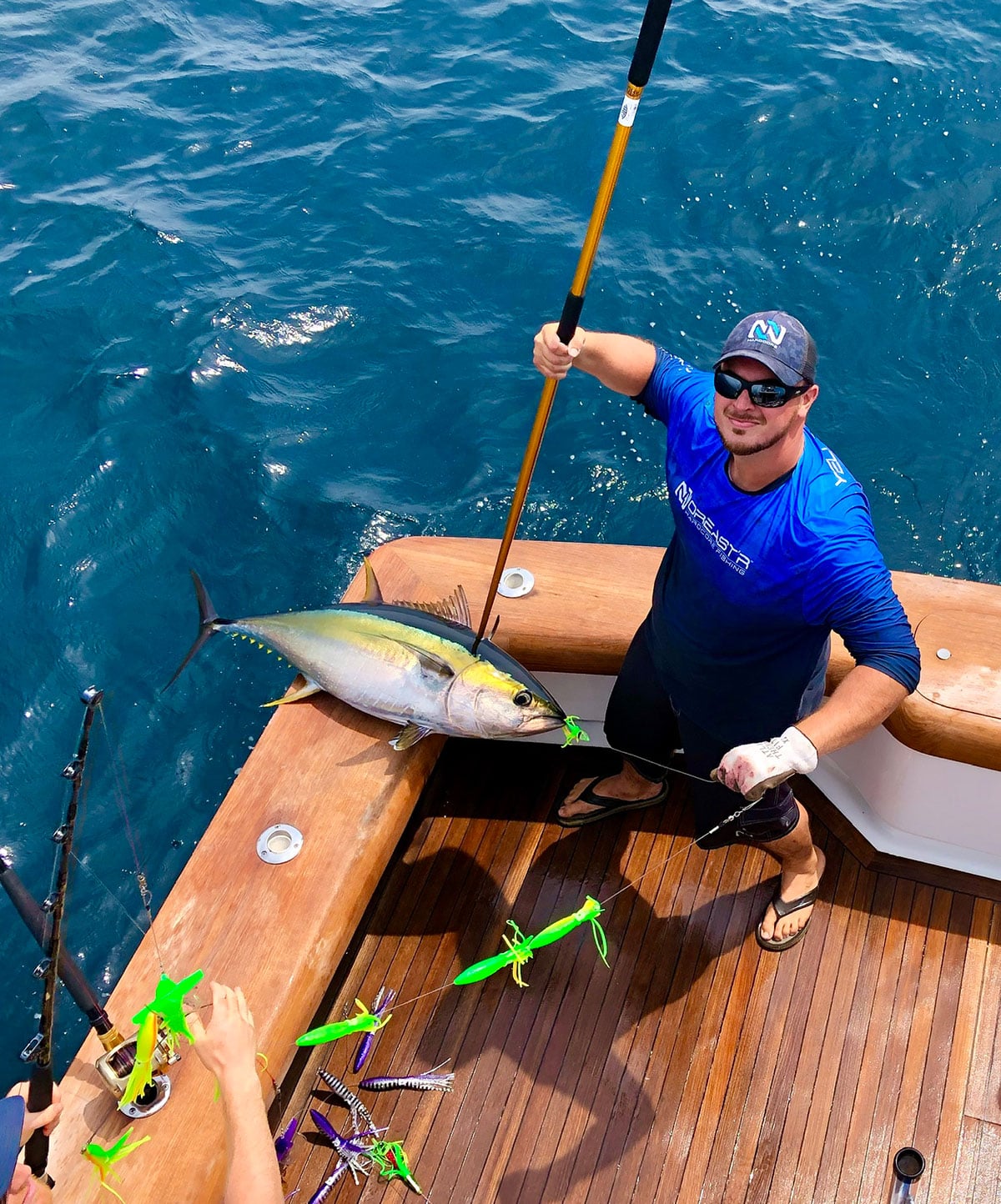
Tuna that weigh 80 pounds or less can be landed effectively with one gaff with a 4-inch hook and a sturdy shaft. Six feet is a standard shaft length, but vessels with higher freeboard require longer options. AFTCO is an industry leader and a good starting place for looking to place a purchase of new one.
Gaff shots themselves should be aimed for the head of the tuna or just outside of the gill plate where the flesh will not tear during any struggle. In the event a single gaff is sunk in the abdomen or tail region, a second gaff might help ensure a fish doesn’t break away as it’s being lifted into the boat. Likewise, a shallow gaff job that is weakly holding onto the outer flesh should be held in the water best possible while a second gaff is aimed for the head.
Individuals that lack balance and strength might need help even with 50-pound class tuna because the posture, bending and upper body strength necessary aren’t always present with each individual. Those fishing well into their senior years or those with injuries such as disc problems or shoulder repairs should always welcome a partner gaff. Gaffing a thrashing tuna is an uncertain process because sometimes they enter the boat docile and ready for the ice, while others thrash frenetically on the cockpit floor.
Fish that go above 100 pounds are handled better with a second gaff hook to the head. They can be lifted in the boat or drug in the tuna door far better when the weight of the fish is distributed amongst two crew members. If the first shot is poorly placed, emphasis must be placed on the second being properly stuck before trying to bring the fish in the boat. Buoyancy properties don’t allow the tuna to place their true weight on the gaff when still in the sea.
Fish in the 200- to 300-pound class are often harpooned initially before gaffing. The lower end of the range can be handled with two experienced gaffers and no harpoon. Gaffing and harpooning require precision and skill therefore captains should consider what works best for their crew when the tuna nears the vessel. If the mates perform one process more efficiently than the other, then that process might be best. Each time a tuna circles the boat and kicks for the bottom, there’s a chance it could come unbuttoned. Timing the endgame attempt for the just right moment is essential. Those who try to gaff too early or when the fish is out of range and miss usually stimulate the tuna to swim for the deep one more time.
Being honest to yourself, your capabilities and your back up plans is prudent. Several years ago, when a tog trip bailed on me at the last moment, I switched out my gear as fast I could and got a late start on a bluefin trip about 25 miles offshore. I was solo and hungry to get in on a solid tuna bite within reasonable range of shore. I hooked up within an hour of setting lines and fought a 65-inch tuna on light gear for about an hour before a stalemate near the boat.
Since it was getting letting and I was whooped, I went on the radio and asked if anyone could offer a helping hand. Capt. Adrian Avena was working pots about a mile away and said he’d be over to provide assistance. I raised the fish to the fish to the surface where they harpooned and subsequently gaffed my fish. The rest is history and we have remained friends since.
Had I not received help, I was prepared to horse the fish to the surface, and give it my best shot. I have gaffed and brought tuna up to 70 inches myself, but it’s not a preference.