An overview of jig styles for your tuna trips this season.
My introduction to tuna jigs and tuna jigging came by accident in mid-June of 1987. I was coming back the 25-fathom curve with my good bud Jeff Miller after tagging and releasing a dozen or so blue sharks, stopping along a 20-fathom wreck to score a few sea bass for the table. On the final leg of our journey when we came upon this overwhelming smell of watermelons and chopped the throttles. There we observed a gaggle of tuna chicks hovering over a slick about 50 yards upwind of us and idled over to take a closer look.
This was almost four decades ago when bluefish were a “nuisance” when sharking or tuna trolling, so when I observed a big bait ball 60 feet under the boat that’s what I figured we had stumbled upon. I had a pair of Penn GLS-45 graphite lever drag reels ready to go in the hardtop’s overhead rocket launcher loaded with A-47 diamond jigs. Jeff grabbed one and flipped his jig out to port, while I heaved mine to starboard, letting my white tailed A-47 sink about 70 feet down to where the bait ball was showing on the sounder. I took just three turns on the crank handle when my rod suddenly bent over, and knew this was no bluefish!
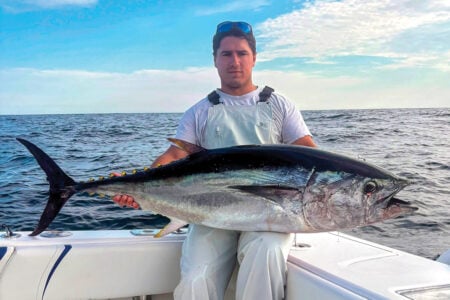
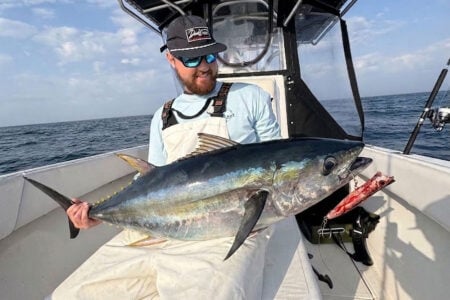
Jeff started up the Grady and we gave chase, leap-frogging with this unknown assassin for 45 minutes. When the attacker finally showed color, we were somewhat shocked to see a large school bluefin tuna form into view. Back at the marina, it measured 53 inches in length and tipped the scales at 87.5 pounds. It was a new revelation that would change my fishing life forever.
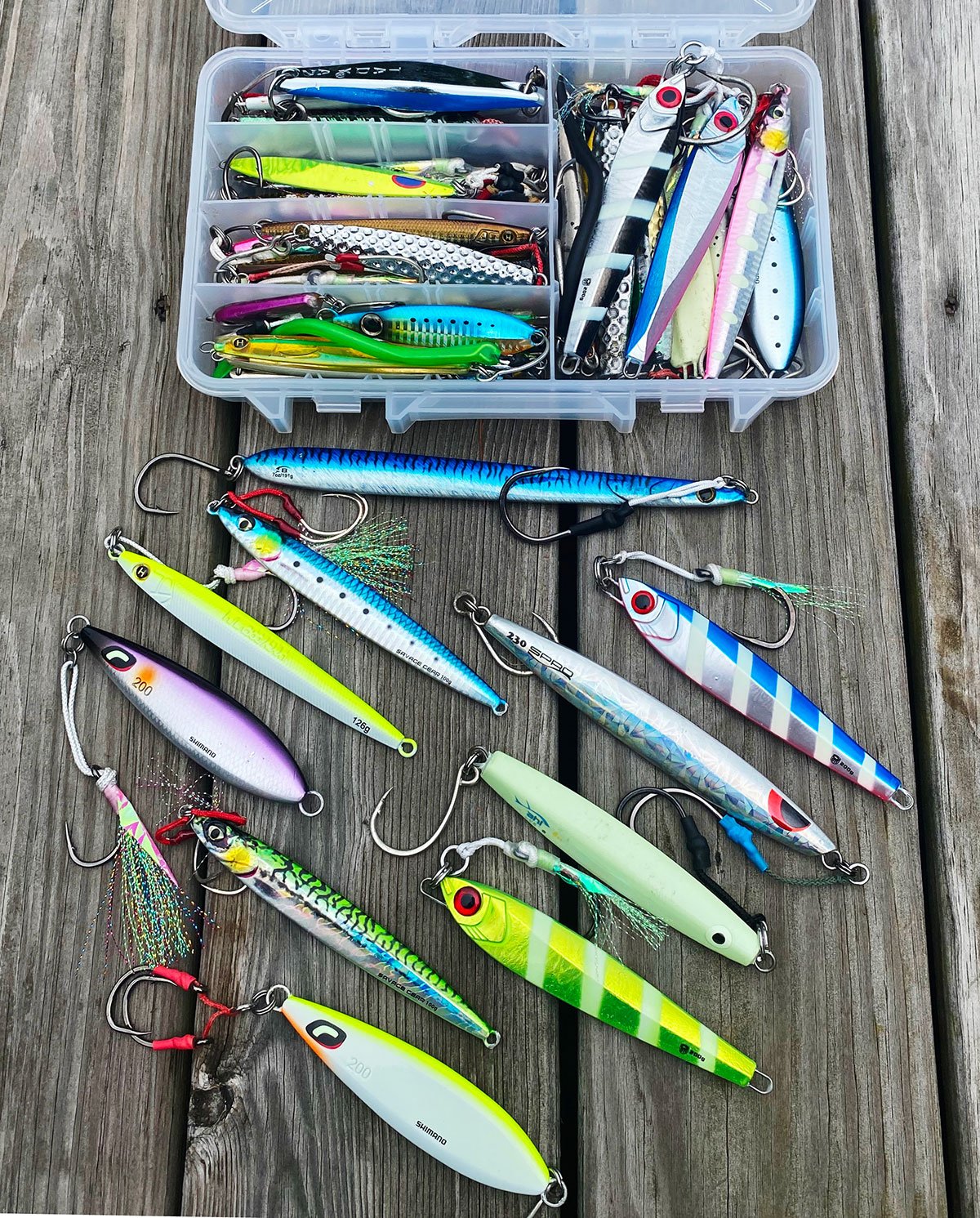
Tuna jigs come in all shapes, sizes and colors, both hard and soft. The bottom line is to match the hatch of whatever they are munching on at the moment with the color that best approximates the prey of the day.
General Purpose Vertical Jigs. These are heavy jigs designed for deep water or strong currents. They usually feature a somewhat symmetrical shape (like a plain or hammered diamond jig) and will get down to the strike zone pronto. These jigs can be retrieved with a variety of actions, from fast, stop and go, to slow and subtle. These general purpose tuna catchers are very effective when yo-yo jigging, deep drop fishing, or when targeting fish in deeper water.
Butterfly Jigs. True to their name, butterfly jigs feature a butterfly-like fluttering action on the drop. They take a while to get down to the bottom and if a current is running, they might not end up where you initially intended. Their unique action is created by employing a specific jigging motion…raising the rod with a tight circular motion and then quickly lowering it. These jigs can be effective in a variety of situations.
Knife/Blade Jigs. These long and slender jigs cut through the water with minimal resistance and are typically fast-sinking and designed for high-speed retrieves. They mimic fleeing baitfish, triggering reaction strikes. “Streaker” jigs of this type are made by the usual suspects like Nomad, Chatter, Hogy, Shimano, Williamson, Tsunami, and others, and are effective both when tuna are scattered under flocks of birds in mid-depths or when tight to the bottom hovering over clouds of sand eels. They work well using a variety of techniques from speed jigging, stop-and-go retrieves, and/or yo-yoing tight to the bottom. I’ve also had some luck casting these out from the boat, getting them into the strike zone and putting the rod in a rod holder to let the natural rocking motion of the drift do the job.
Slow Pitch Jigs. This style of jig is crafted with a unique “asymmetrical” shape that causes it to flutter and swim horizontally on the drop. It mimics a stunned or injured baitfish, enticing wary, lethargic or suspended tuna to take a bite. These are probably the slowest sinking jigs of the bunch and are best deployed when tuna are suspended or holding higher up in the water column.
Soft Sand Eel Jigs. Soft jigs include a variety of products made by RonZ, Hogy, Savage, NLBN and others. These typically feature a leadhead weighing anywhere from 3 to 8 ounces matched to a replaceable proprietary soft tail. They are effective at catching tuna using a variety of techniques from cast and retrieve in the upper water column, twitching at mid-depths, using a slow lift and fall motion near the bottom, or just casting out away from the boat and letting it wiggle unattended in a rod holder.
Suffice to say we’d need a book to fully dive into the entirety of tuna jigging, but 99% of the tuna jigs on the market fall into one of these primary categories: