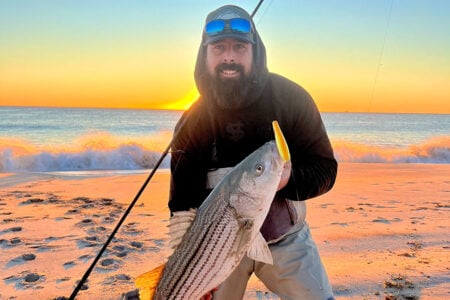
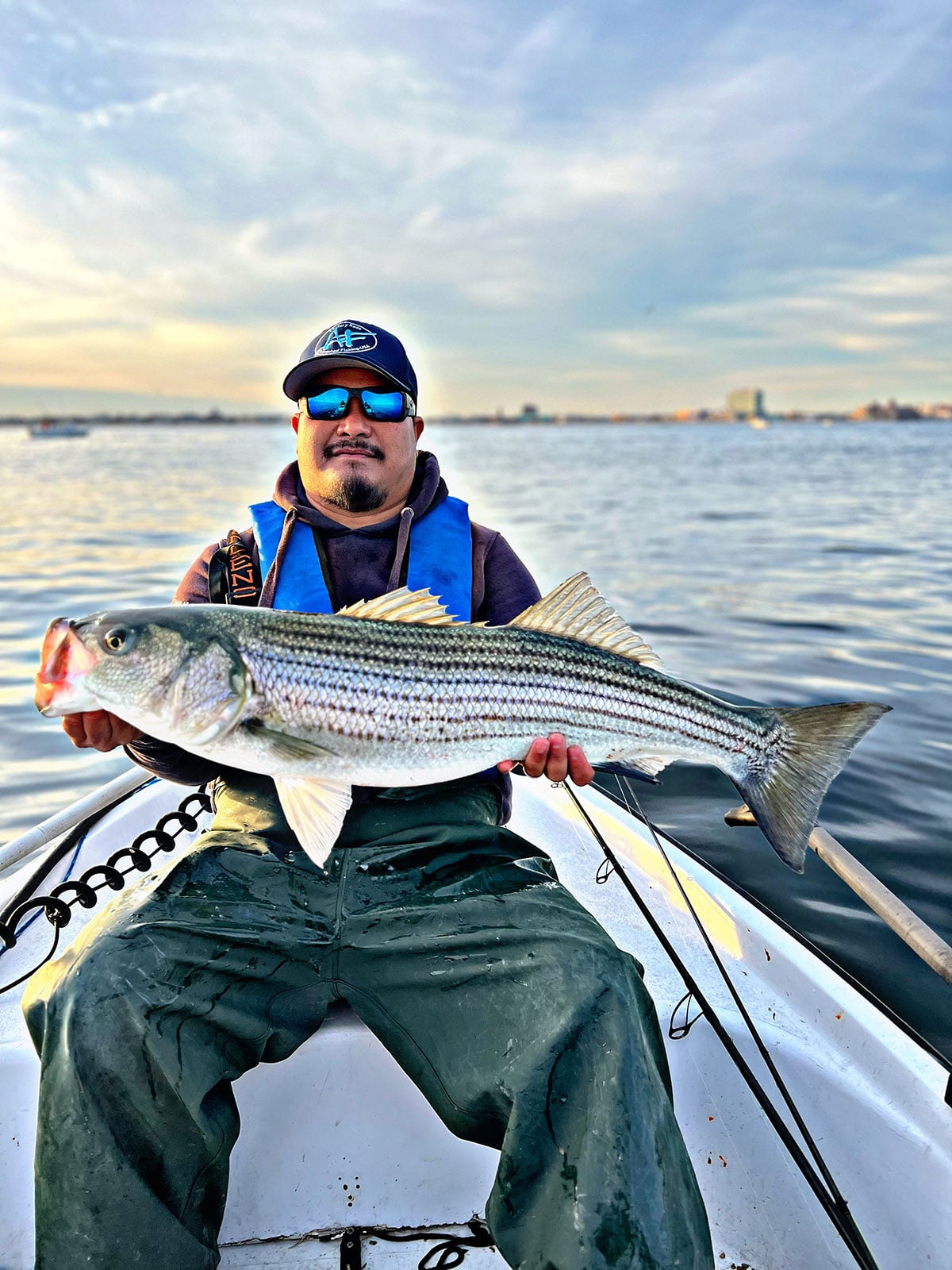
Taking the show on the road and chasing stripers from a 15-foot skiff.
Every time we’re out on the water, tucked between a fleet of 32-foot Regulators, Sailfish, Sea Hunts, and Grady-Whites, alongside big New Jersey party boats the Gambler, Big Mohawk, and Golden Eagle, we get the same look: Who’s the crazy guy running around in that little boat?
Our rig is a 15-foot Hobie Power Skiff, built back in 1986 by a small California company that’s now better known for kayaks. Funny enough, if you call Hobie today and ask about it, they’ll tell you it never existed though plenty of diehard skiff owners would argue otherwise.
So why fish from something so small? For me, it comes down to three things a full day on the water burns less than 10 gallons of gas, I can launch wherever the bite is happening, and finally I can squeeze into places the big boats can’t even dream of.
Sure, we take a few wakes on the chin and deck space is limited, but when you’re battling fish pushing 50 pounds, the little boat holds its own against the giants. While most of my spring and summer charters run out of Cape May County, there’s a good reason I trailer north in the fall. Long before I even knew what a striper looked like, the old-timers told stories of the legendary fall run in South Jersey, how on any given day you could head to the Rips and tangle with giant bass. These days, South Jersey still sees flashes of that action, especially over the last 3 to 4 years as the migration has pushed as far south as Atlantic City and Sea Isle. But those bites are scattered compared to the consistent chaos further north.
The northern half of the Garden State simply has the structure and depth to hold migrating fish, which is why I make the haul every fall. If you keep your boat in the water from late November through January down south, you might get a crack at those schools but you’ll have to put in the hours and brave the cold that old man winter throws at you.

Proper Planning
Like any trip on the water, safety comes first especially in a 15-foot skiff. Before the drain plugs even go in, we’ve already run through every worst-case scenario in our heads. Slim-fit PFDs stay on (as required by state law from November until May for recreational vessels less than 26 feet), the radio and Garmin InReach are fully charged, and the kill switch is clipped before the motor turns over.
Space is at a premium, so instead of piling on a dozen rods like the bigger boats, we carry two or three each. Every rod has a purpose snagging bunker, dropping jigs, or working plugs. The plug bag always feels like we’ve packed the entire refrigerator, but stripers can be fickle, and you never know what they’ll chew that day. A big landing net stays within arm’s reach, whether it’s for safely handling fish we’re tagging with Gray Fishtag Research or releasing them boatside.
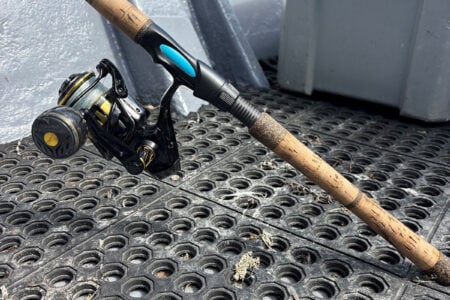
Our tackle is streamlined but deadly. Most of the time we’re fishing Century Inshore models from the Weapon series versatile sticks that can throw anything from a half-ounce jig to a 3.5-ounce Doc Spook when the topwater bite lights up. Reels in the 4000 to 6000 class give us the stopping power to turn big fish and bring them in fast for a healthy release.
We spool with 20- to 30-pound braid, tie on at least 40-pound leaders, and carry a tight spread of lures: soft plastics, metals, metal lips, spooks, bunker spoons, and a few oddballs to tempt picky bass. It’s a lean loadout, but it transforms a small skiff into a serious fishing platform.

North Or South?
The first decision of every striper trip comes before the throttle ever goes down. As the backwaters funnel toward open water, my mate and I trade the same look we’ve exchanged a hundred times before. The question is always the same, but never easy, “Which way do we go?”
Shark River Inlet makes the choice simple in theory but weighty in practice. Run north, and we’ll slide past Asbury, Deal, and Sea Bright before reaching Sandy Hook, just 16 to 18 nautical miles away. Head south, and it’s a longer run 27 to 30 miles past Mantoloking, Lavallette, Ortley, and Seaside before we reach the storied waters of Island Beach State Park. Once you commit, there’s no turning back. By the time the sun clears the horizon, the decision has already written the script for the day.
We start by piecing together the puzzle. Where were the fish yesterday? What bait was moving? Which way would a migrating striper travel if it wanted a full belly? It’s part science, part instinct, and part luck. Some captains joke about flipping a coin, but anyone who’s made the wrong call knows it feels more like flipping tails when everyone else flipped heads.
If we point the bow north, the strategy is simple: cruise at 12 to 15 knots, eyes scanning the water, Humminbird lit up. This time of year, success comes down to the “Three B’s”: bait, birds, and boats.
Find a bunker school and the adrenaline kicks in. We ease in cautiously, watching how the bait behaves. Nervous? Circling? Balled tight? If they’re under attack, the scene is unmistakable stripers detonating through the school, bait spraying skyward. That’s when rods fly from holders.
But not every school is lit up. Sometimes the surface is calm while the action happens below. That’s when we snag a bunker, rig it on a circle hook, and send it down. Few moments in of fishing with the anticipation of that thump, the line tightens, and you know a bass just made a mistake.

Birds & Boats
The second play is the classic run-and-gun. We scan for bird life—terns, gulls, even gannets diving hard. Birds mean bait, and bait means bass. But the trick is distance. Too close, and the feed scatters. Just right, and you slide into range for the perfect cast. As captain, my job shifts from finding fish to predicting their next move. If I can read the school’s direction, I can put my anglers in the strike zone.
And sometimes, it’s the blind cast into “empty” water that comes tight. More often than not, that’s a bigger, wiser fish, hanging back to mop up the stragglers.
The third option, and usually our last resort, is chasing the fleet. Binoculars help spot the armada clusters of boats, bent rods, a mate with a net, or a slick of scales on the water. The problem isn’t finding fish, it’s navigating the chaos. Too many boats in too small a space can turn a blitz into bedlam. Add a few inattentive captains, and you’ve got the recipe for disaster.
When we do slide in, it’s always on the outside edge, watching first. If the bite is hot and rods are bending all around, sometimes you can’t resist. But when we’re in the pack, I rarely touch a rod myself. My eyes are on every boat nearby, anticipating moves and avoiding tangles.
Heavier tackle is essential here. The faster you put a fish in the net, the less chance it has to cross lines. It’s not about brute force, it’s about control, safety, and respect.
At the end of the day, whether we choose north, south, or the fleet, the lesson stays the same: striper fishing isn’t just about catching. It’s about making the right call, respecting the bait, the birds, and especially the other boats.
Fall striper fishing is electric, the runs, the feeds, the chaos of it all. It’s the kind of high that keeps us coming back, season after season. But it always starts with that one, simple question at the inlet: Which way do we go?