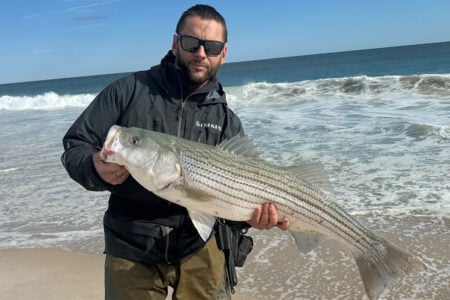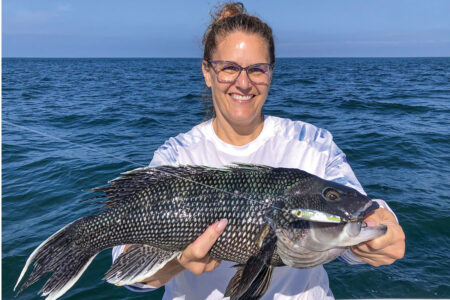

As winter’s chill knocks on the door, the high seas come alive with bottom brawling.
November and December bring out legions of black sea bass anglers to load coolers with tasty treats as the limits relax at a 15 fish bag limit and 12-1/2-inch minimum size and make it worthwhile to head out and spend the time and energy to score the sea biscuits.
Most activity resides further offshore, past the inshore reefs, out to the mid-range 40- to 60-mile wrecks and even further to the 60- to 80-mile mark, so trips are a commitment. Thus, head boats running out of ports along the Raritan all the way down to Cape May make a super option this month, but the rewards are more than satisfying.
Here’s one top captain’s tips on loading up with black sea bass, a name recognizable to The Fisherman readers over the years, former managing editor Chris Lido, now a captain of the party boat Gambler out of Point Pleasant.
Grounds To Pound
Capt. Lido and the Gambler crew run 18-hour trips offshore to the 40- to 60-mile range wrecks to find their fare this time of year. Like many captains running multi-passenger trips along the Jersey Shore, water temps are key to finding the best bite. “We’re usually heading south of Manasquan Inlet, looking for wrecks in 200 to 225 feet and water temps in the low 50s into the 40s as sea bass will feed aggressively through the colder temps,” said Lido, adding “Deeper depths are better served to use braided line with a top shot of 30- to 40-pound fluorocarbon leader attached to cut through the water faster and feel the nuances of sea bass strikes at deeper depths.”

Most structure that the Gambler finds are rock piles and shipwrecks offshore and they will generally only set out one anchor so they can swing a bit on the structure to cover more area in a scope span. “Party boats have a great advantage during the winter as we can deal with the unpredictable larger wintertime seas and have a heated cabin for comfort for the long ride,” Capt. Lido noted.
Most offshore sea bass are unlike smaller 1- to 3-pounders found inshore and are of larger caliber, meaning 3- to 8-pound fish, and both rods and reels should be equipped. A medium to heavy 7-foot conventional rod matched with a Shimano Torium or Okuma 16 or 20 class spooled with 50-pound braid should suffice when sending down baits. For jigging, Lido will scale down just a bit with a 7-foot stout spinning rod with a 6000 class Shimano Stradic or Daiwa Saltiga type reel spooled with 30-pound Power Pro braid and a 5 foot, 30-pound fluorocarbon top shot to which a jig is tied.
Bait rigs consists of a two-hook dropper rig on 40-pound monofilament leader with two 3- to 4-inch droppers fixed with size 4/0 Mustad #92641 Baitholder hooks spaced 16 inches apart with 6 inches left at the end for a dropper loop to affix an 8- to 10-ounce bank sinker on. One specific trick on a rig Lido swears by is a bit of blue/red Mylar flash like on Sabiki rigs above the hook. Then lance on a thin clam strip. Jigs will be hammered diamond jigs or slo-pitch metal jigs with a teaser tied 30 inches above where Lido loves sand eel imitations like the Berkley Gulp! Sand eel on a 4/0 Baitholder hook.

The Chew
“Sea bass feed all over the water column,” stated Lido, adding “Most times as soon as we set anchor and blow the horn, the first drop is lights out, with double headers coming up on nearly every line.” The captain went on to explain how sea bass are frenzy feeders and as soon as one feeds, they all seem to turn on fast. “There are very few sub legal fish out there, but if we do reel them in, the mates immediately vent the fish so they can get back to the depths unharmed,” he added.
To start, most anglers drop right to the bottom where sea bass generally lay down, but anglers should always ask the mates what the fishfinder is reading as they will feed throughout the water column. “We’ll tell people to drop down to the bottom, then reel up 10 to 15 cranks and hold the rig there where the sea bass might be stacking,” Capt. Lido noted, while adding “I’ve even witnessed sea bass feeding on the surface chasing sand eels all around the boat, so you never know exactly where they are at, but the captain and mates will direct you where to put the baits and jigs.”
When baits get bit, many anglers leave the one fish on and wait for the immediate strike from another two or three fish before reeling up a brace of fish instead of a single fish. Jigs are usually tap-bounced along the bottom, raising and lowering the jig only a foot off the bottom, but sometimes sea bass like it better 5 to 10 feet above the ground in slow swooping sweeps, hitting on the fall.
Jigs generally tend to attract the true knobheads over the 5-pound mark, so if you are looking for a true trophy, go with the jig. You may not get as many small hits, but the ones you get tend to be the right ones.
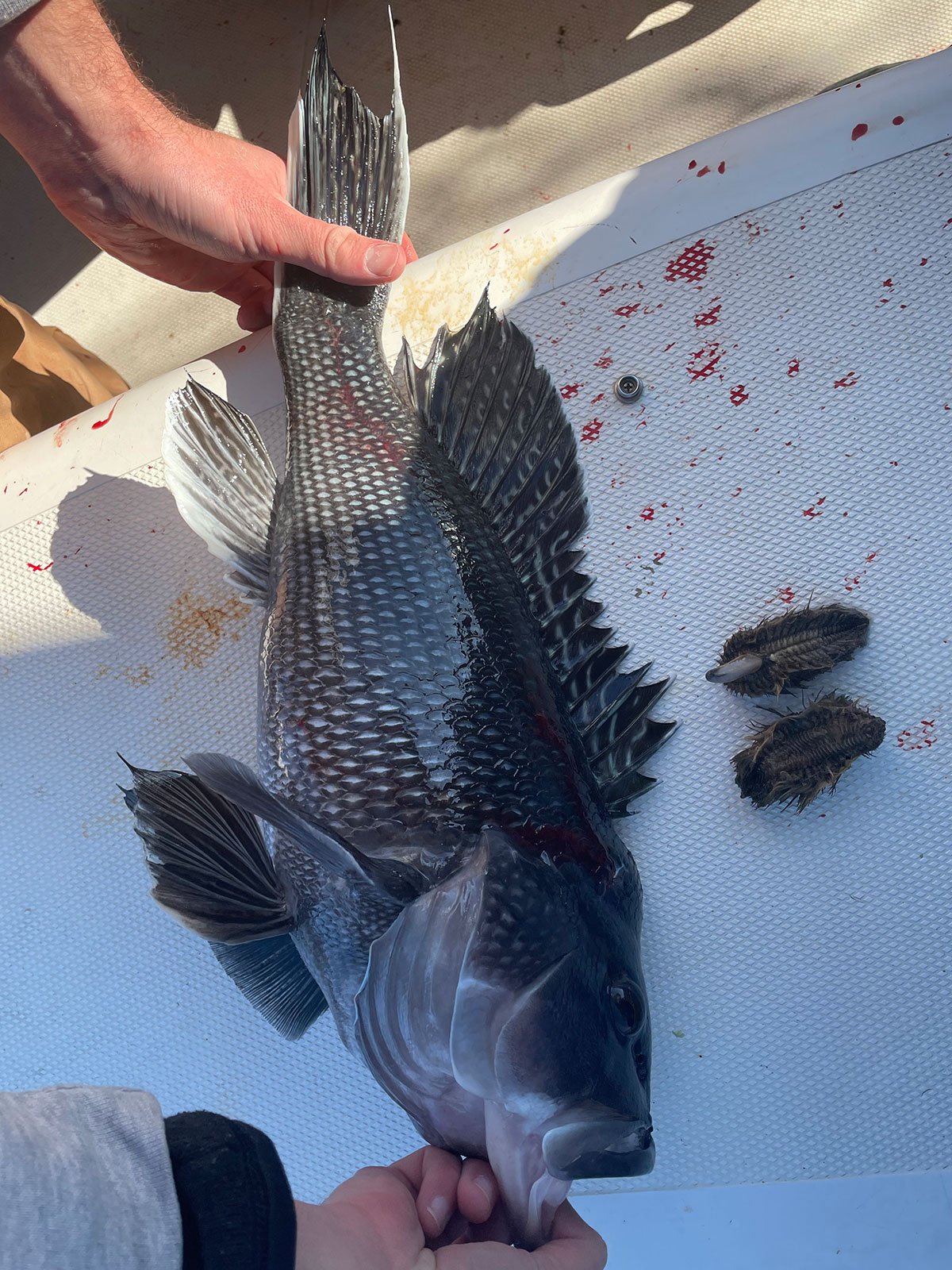
Prep Time
When fishing the head boats this season for black sea bass, I recommend bringing a large 128-quart cooler with you as fish will be flying over the rails and you need to keep them iced down for the long run. Don’t worry about bringing fillet knives as mates will do a heck of a job filleting your catch and bagging them to insure proper preservation for the long ride home.
| ‘25 SEA BASS REGS |
| In 2026 anglers can expect new and improved regulations for black sea bass, but for the rest of this year here’s what you’ll be fishing on in the tristate region.
New Jersey: 12-1/2-inch minimum size, open October 1 through October 31 (10 fish bag), and November 1 through December 31 (15 fish bag). Delaware: 13-inch minimum size, open from October 10 through December 31 (15 fish bag). New York: 16-1/2-inch minimum size, open September 1 through Dec 31. (6 fish bag). |
Offshore sea bass trips in the winter are not like summertime chilling, so be sure to dress accordingly for the cold weather with insulated tops and bottoms and hoodies and sock hats, waterproof boots and an insulated windbreaker to keep the winter chill and any rain off of you. Nothing is worse than being wet offshore. A pair of Grunden’s bibs keep you dry and keeps the mess of clam and squid bait juice off of you. Heated handwarmers and fleece gloves are also saviors offshore. Though most party boats will have a cooking galley firing up pork roll, eggs, bacon and such, it’s always good to have some sandwiches and beverages in a separate carry on cooler to keep the sea bass juice away from getting on your foodstuffs.
Any time you fish offshore wrecks for sea bass there’s always the opportunity to find other species on the structure such as pollock, cod, jumbo porgies and even weakfish and bluefish way offshore, so bring your favorite appropriate lures and jigs to target them if you achieve your sea bass limit quickly.
Nothing beats offshore sea bass fishing in November and December, and it’s usually lock and load type of action. Be sure to dial up the party boat packet and enjoy the fruits of the bounty leaving the hard work to the captain and the mates!