North shore striper strategy from a dual-generation team of sharpies.
“Whose sock is this?” Max Jaeger asked his dad, as he slipped his hand into a dry argyle sock, grabbed another eel out of the bucket, impaling a hook and flipping it toward the beach. Like any good fishing companion, Greg politely grunted a response as his line came tight and he leaned back on a decent fish.
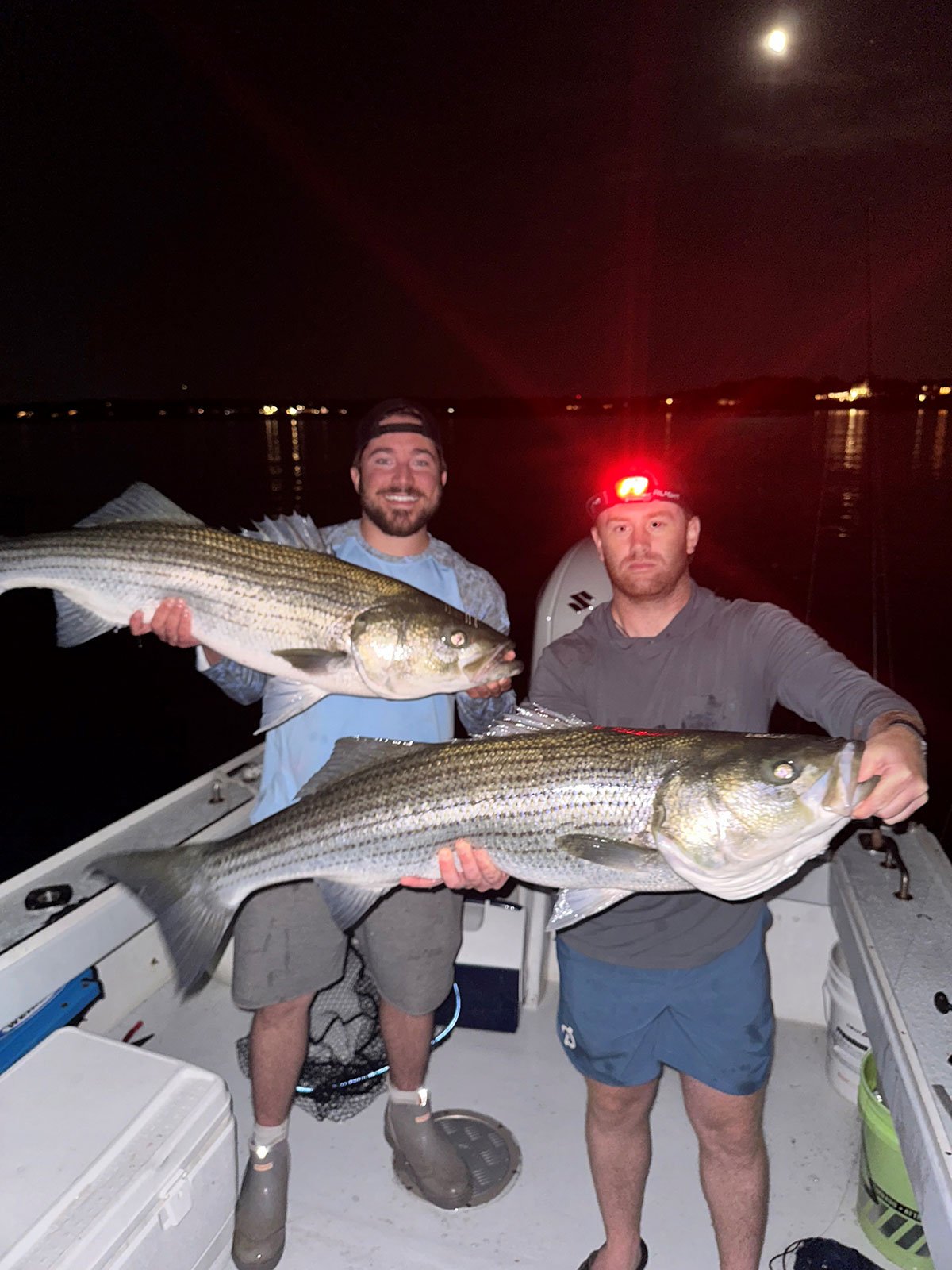
It was late July, a little past midnight on a calm and overcast night. Father and son were slowly working their way along the dark shore in their 22-foot Novi built center console. Max had had a hunch that they should head further east, prospecting for some fish that had not been worked over by other boats.
There had been an easterly swell for the prior three days and the full moon was two days ago, so they both realized that the bait and the bass had likely shifted to new locations since the prior week. They had picked up a couple fish, but kept moving, hoping to find more consistent action. Max had to be on the back deck of the offshore lobster boat at 3 a.m., ready for a full day of sorting the catch from hundreds of pots, so he and Greg knew they didn’t have a lot of time, but they reasoned, “if you don’t go, you won’t know.”

Of Fathers & Sons
How many of us have been lucky enough to grow up sharing the same passion for striped bass fishing as our fathers? It’s probably fair to say that when we think of well-known bass fishermen, we think of them as individually skillful fishermen, not the second or third generation of a family for whom bass fishing was important.
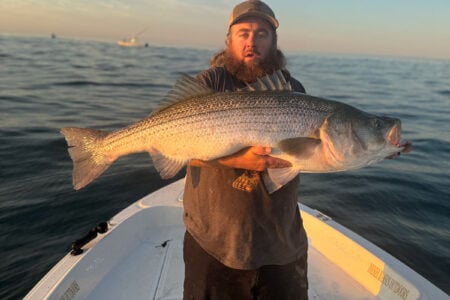
At 27, Max Jaeger is one of the lucky ones. He grew up learning the techniques and local striper fishing knowledge of his father Greg, then built on that knowledge to develop his own style of bass fishing that he and his dad now share. His earliest fishing memories involve being with his dad in the their center console, chumming and fishing whole herring just outside of Gloucester Harbor, catching bass that were almost as long as he was tall.
Max was 4 years old when Greg and his wife Kristine bought their 22-foot Maloney center console, a rugged Nova Scotian fiberglass boat, built for lobstering with a high bow and gunnels. Repowered two years ago with a 150-horsepower Suzuki outboard, the 5,000-pound boat tops out at 35 knots, not bad for such a heavy and stable hull. The Jaeger family boat is a great example of buying the best boat for your needs (including the high gunnels to keep Max onboard) and then taking good care of it and making it last. Sticking with the same boat for a decade or more means that everything now has its place on the boat, nice, neat and efficient.
Raising An Angler
As soon as Max was tall enough to see over the steering console, he was piloting the family boat in and out of the harbor under his dad’s watchful eye, as well as learning how to fish bass, shallow and deep. At 14 years old, he’d proved to have the cautious judgement necessary to run the boat on his own, so his parents allowed him to fish by himself, as long as it was within the confines of Gloucester’s large harbor.
Growing up close to Gloucester Harbor, Max enjoyed many of the same childhood experiences that his dad had, amid the wharves, boats and experienced fishermen of all types that were only a short walk away. Max got his college degree and started work in a sales role with a leading Boston-based company, while offshore lobstering on weekends. He just recently made the career decision to purchase his own 38-foot lobster boat and lobster full time with a pair of guys working the aft deck to help him go through the gear efficiently.

A Tradition Of Secrets
Traditional Cape Ann bass fishing was all about fishing discrete, small spots that would hold feeding fish during certain conditions of wind direction and stage of the tide. If you were 25 feet away from the ledge on a dropping tide, or from the prominent boulder just outside the up-tide side of X island, you would never know there were fish there. When Greg became serious about bass fishing, he already had the benefit of knowing the general lay of the bottom within a few miles of Gloucester Harbor, which was key to finding bait and bass. Because he was serious and put his time in on the water, he learned not only from direct experience which spots fished better on which tides and winds, but he also benefitted from the gentle guidance provided by more experienced bass fishermen.
The older fishermen appreciated that Greg was serious and most importantly was respectful, not edging in on another fisherman while they were fishing a particular location, nor broadcasting knowledge about the locations and conditions that made certain spots hold fish. Building a repertoire of these “living-room-sized” spots around Cape Ann and understanding the conditions that increased the likelihood that bass would be there, is a long and time-consuming process of trial and error. Understandably, someone who has invested the time to understand these small spots, (which can take only so much fishing pressure), Greg is reluctant to share specifics with others, particularly if those other anglers don’t know how to be respectful when using this new knowledge.
Over the last 50 years, those bass fishermen who’ve lived with abraded hands from de-hooking numerous fish and sleep deprivation from fishing back-to-back night tides, kept their hard-earned knowledge largely to themselves. It was into this world of smaller fishing spots, specific conditions and respectful fishing etiquette that Max began his striped bass fishing career, fishing with his dad on the Novi.
When they fish together, Max most often runs the boat, leaving Greg to concentrate on hooking up, but there is no fixed roles and Greg will in turn take the wheel, so that Max can enjoy fishing without being distracted as he pilots the boat through the boulders and ledges.
Max has learned to be a better fisherman, not only from his dad, but also from the highliner lobstermen that that he has worked the stern deck for. From lobstering, Max notes that he learned, “the most important rule in fishing is that you will be significantly more successful if you are on the water, fishing every day. There is no substitute for putting your time in, as you will develop a better sense for where the bass or lobsters are and where they might be tomorrow”.

Old school vs. New school
Like his father, Max is serious about his fishing and respectful to others, which for him as well, has garnered the respect and guidance from more experienced bass fishermen. Greg’s style is somewhat minimalist, as he typically brings one rod to catch bait and a second rod to catch bass. In contrast, Max likes to have more rod and reel options. Another lesson Max learned from the lobster boat captains was that, “when you go fishing, you go prepared”. The most successful lobster boats are most often the boats where extra effort is invested in boat and equipment maintenance every day. Everything needed to be as efficient as possible when working through several hundred pots in a day, and neatly stowed and well-maintained. Similarly, because bass have a “bad habit” of feeding then developing “lockjaw”, Max goes prepared to make the most of that window of opportunity. Equipment and terminal tackle are stowed within easy reach, so that a bent hook or a frayed leader does not stop the action.
Nothing stays the same in the natural world. Although we might like to believe that in the past, all fish were abundant and they always followed the same migration and feeding patterns – that is not the case. There have always been significant changes in the biomass and habits of different fish populations due to changes in predator/prey relationships, environmental conditions and human interactions (both water quality and fishing efforts). All populations of animals and plants are constantly in flux, expanding or shrinking, adapting to prey availability and often shifting their historical feeding grounds as part of the natural and human forces that are at play.
It may be that the feeding grounds for striped bass are shifting northward. Anecdotally it seems like the striped bass fishing in the Canadian Maritimes has improved because of a greater body of fish that take up residence there each summer. In a similar vein, the waters of Boston north to New Hampshire’s coast might now be the summer feeding grounds for many of the fish that would have traditionally summered south of Cape Cod. Cape Ann waters now seem to be home to schools of bass spread out over a wide area, rather than the smaller bunches of fish that had historically inhabited a myriad of small and discrete feeding stations.
This apparent change in bass schooling behavior has led to a new style of fishing with boats travelling and scouting over greater distances, looking for signs of activity whether it is an aggregation of other boats or birds working. Much has been said about younger boat fishermen’s instant communications via smart phones and their use of a buddy network to scout for fish, then share information and converge where the fish seem to be most concentrated. While that can result in some surprisingly large “scrums” of boats, with 40 or 50 boats catching bass in close proximity to each other, neither Max nor Greg find that type of fishing very satisfying.

No Network Connection
Although some of Max’s contemporaries are wired together in a network, looking for those larger bodies of bass wherever they might be, Max has found that spending the time to learn how bass relate to the bottom at night has given him relative independence from the groups of boats that can swarm into an area on the basis of a text or a cluster of running lights. In essence, Max has adapted Greg’s strategy of a nuanced understand of tides and bottom structure, while refining it to account for bass behavior at night. We all have our tide preferences. Max finds that some tidal current is preferable, while his dad tends to favor slack tides.
There are many advantages to being young including the ability to fish 6 hours in the dark for stripers, then show up to work a full day on the lobster boat starting at 3 am. Whereas Greg’s bass fishing was historically focused on fishing live bait in the shallows during the early morning and daytime hours, Max’s preference has been to fish nights. When father and son fish together, as they often do, they are pretty casual about whether they will fish live mackerel at daybreak or probe the dark with live eels, because they genuinely enjoy each other’s company.
Most of us sons were more concerned with being independent, than learning from our fathers until we were much older. How wonderful it is that Max and Greg found a balance of parenting and fishing, that has given them the ability to enjoy each other’s company and learn from each other in ways that many – if not most – fathers and sons, don’t realize until later in life or not at all.