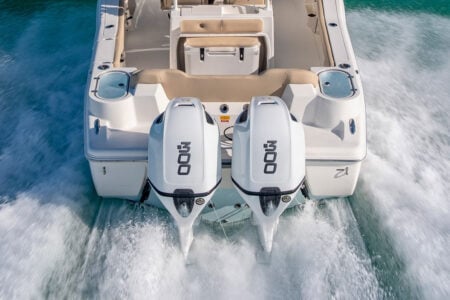
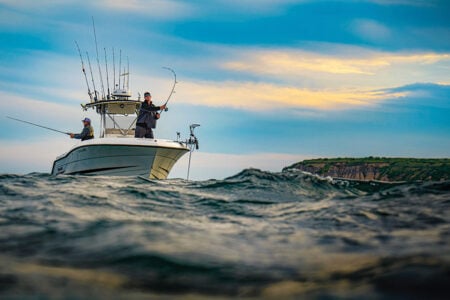
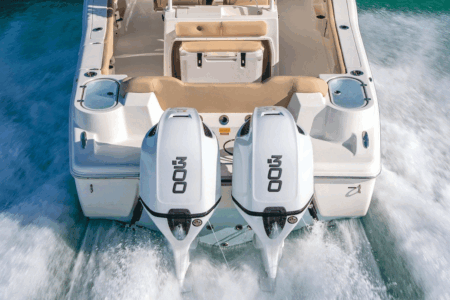
Over the past decade, I’ve been seeing more of Suzuki’s popular DF150/175/200 family of in-line four-cylinder, four-stroke outboards appearing everywhere—from the back bays and inlets to inshore waters and offshore grounds. Some of these show up as OEM (original equipment manufacturer) selections on a variety of new boats, while many others are chosen as repower replacements on “name brand” boats like Grady-White, Regulator, Contender, Boston Whaler and others that were originally launched with a different brand of outboard due to OEM arrangements. So, what’s contributing to this growing trend toward Suzuki outboards in the saltwater arena?
Family Values
Suzuki’s 2.9-liter in-line four family includes both mechanical and electronic throttle/shift versions of the DF150, DF175, and DF200 outboards. When choosing an outboard, balancing power and weight is critical. The mission here was to deliver the performance and punch of a larger engine in a lighter, more compact four-cylinder package. To achieve this, Suzuki engineers designed a 2.9-liter “Big Block” with a higher 10.2:1 compression ratio, generating strong acceleration and low-end torque. A specially-designed cowl and semi-direct air intake system deliver cooler air to a tuned long-track intake manifold, while the four-valve DOHC powerhead with Variable Valve Timing helps the engine breathe efficiently, boosting both hole-shot and top-end performance. Add in a fuel injection system and Suzuki’s Lean Burn Technology, and the result is improved fuel economy without sacrificing power.
These outboards weigh just over 500 pounds, are slim and compact, and balance beautifully on a transom—ideal for powering a wide range of boats. They’re also perfect for breathing new life into older hulls still rigged with outdated two-strokes, offering modern four-stroke technology and efficiency without adding excessive weight. Other standout features include a knock sensor, O2 sensor, and water-detecting system to enhance reliability. Suzuki’s AP Series “fly-by-wire” models feature the Precision Control digital system and Selective Rotation for twin-engine setups.
Performance Profile
To see how these 2.9-liter in-lines perform, I looked at a factory test of twin DF175As rigged on a SeaPro 259 deep-vee center console. With a pair of 16-inch x 21.5-inch stainless 3-blades, this setup hit a top speed of over 48 mph at 6,000 rpm. At cruising speeds, the efficiency was just as impressive—at 3,500 rpm the boat ran 27.7 mph while burning only 10.0 gph, translating to 2.77 mpg. That’s on par with what my 22-footer gets with a single 250. This wasn’t an outlier either—I ran a Bluewater 25 CC at the Miami Boat Show with twin DF200As and saw a nearly identical fuel economy with a slightly higher top end.
The combination of size, design, power-to-weight ratio, fuel efficiency, and the ability to fit standard 26-inch center lines for easy repowers makes the Suzuki 2.9-liter DF150/175/200 lineup a standout choice for both new builds and repower scenarios.