Trying different approaches for picky tog.
I don’t understand how a rugged, muscular fish like the blackfish—so thoroughly at home in the harshest environments—has evolved to be so deliberate and cautious about eating. Around inshore rock piles and wrecks, blackfish rule the roost. Offshore on wrecks, they must remain wary of giant cod, sharks, conger eels, and even the occasional trophy striped bass, since all of these can swallow them whole. Yet inshore, none of those predators exist, save perhaps a wandering cow bass—and even then, not often enough to justify the kind of fussiness blackfish display when it comes to food.
Long Life, Slow Growth
Perhaps their persistent wariness is an evolutionary strategy tied to their slow growth and long life. In that mode, what’s the hurry? However, I’ve never been fully convinced. I’ve come to the conclusion—probably in error—that blackfish are just deliberate about everything they do. They are careful, methodical, and frustratingly cautious.
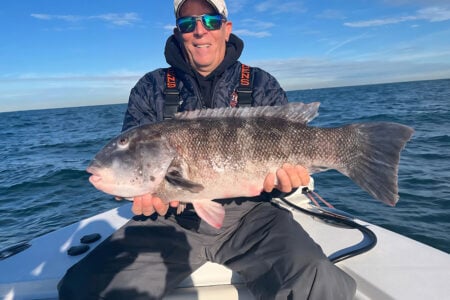
Those of us who target them are all too familiar with the pecking bites that convince everyone on board the fish must be small. Then, just as we’re about to pick up and move, someone hooks up with a bulldog. The irony is that there are occasional days when they strike with abandon and no coaxing is needed, but those days are the exception, not the rule.
Puzzles, Enigmas & Ideas
I enjoy solving puzzles, but enigmas are less appealing—and blackfishing is often an enigma. I’ve spent many trips scratching my head, plagued by tiny bites, unanswered questions, and the occasional big fish. Is it the bait? The chum? The rig? Or just the mood of the fish? The frustration builds. Then, suddenly, in the middle of a thought, a fish slams the crab, strips ten feet of line, and reminds me just how unpredictable they are.

Most species I can figure out. Blackfish are different. They are the most difficult bottom fish I know of to consistently hook, and it doesn’t help that their mood can change in an instant.
Over the years, I’ve heard or read countless theories—volumes, really—about the “right” way to turn picky blackfish into aggressive feeders. My friends and I have tried nearly all of them. Each trick or tip seems productive for a drop or two, then fails spectacularly. As the grandfather in Moonstruck lamented at the kitchen table, head in his hands, “I’m so confused.” That sentiment sums up blackfish perfectly.
Bait & The Shell Game
At times, one bait outperforms the others, but rarely for long. It’s like a magician’s rabbit pulled from a hat—impressive for the moment, but fleeting. I usually start with crab, the standard. If that slows, I’ll switch to clam. Sometimes clam makes all the difference—producing a fish immediately, convincing me I’ve solved the puzzle. Everyone switches, catches a fish or two, and then, like magic, the bite disappears.
Eventually, Rich switches back to crab, hooks a fish instantly, and the cycle repeats. It really is a version of the shell game, where the pea keeps disappearing just when you think you know where it is. Trying to predict which bait will draw the next bite is nearly impossible.
Rigs & Hooks
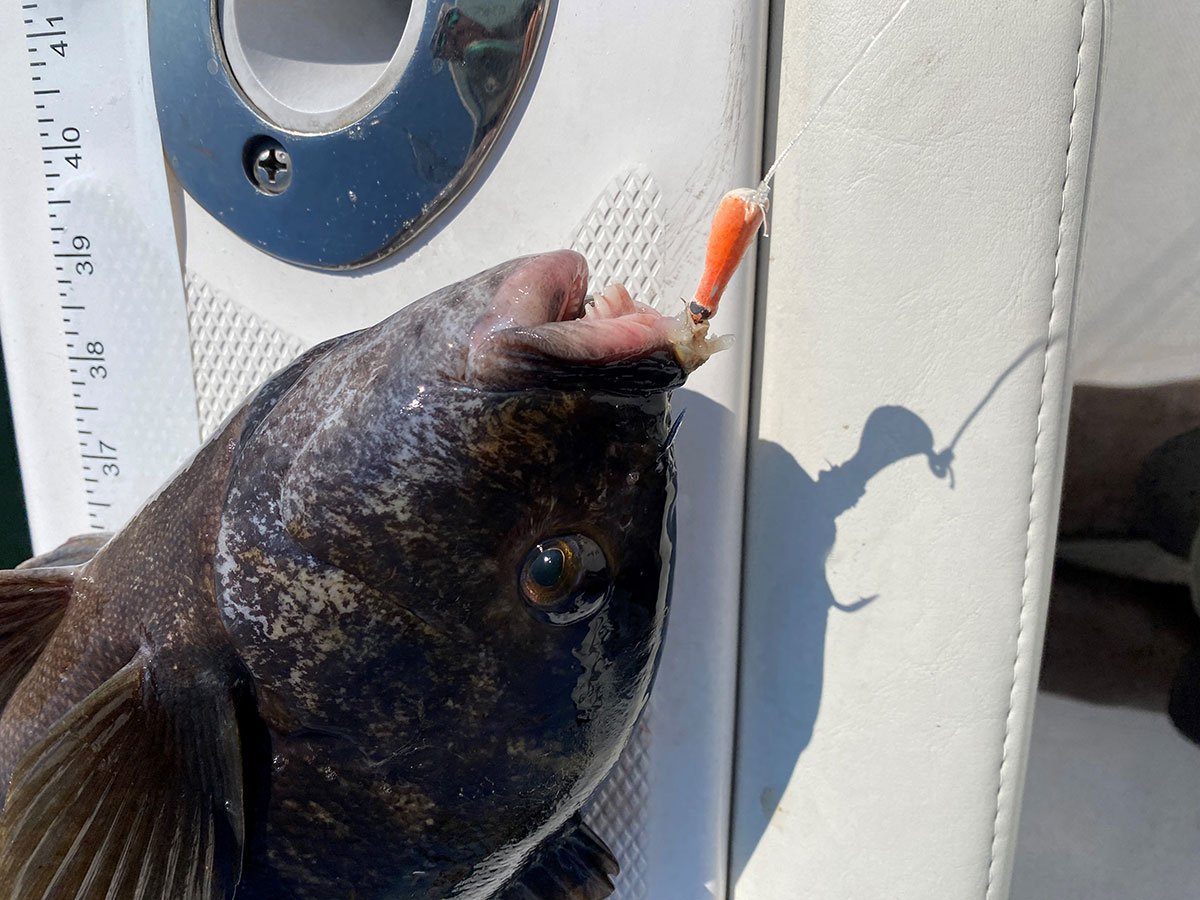
I make my own jigs and rigs because I enjoy it, not because I think they’re better. I tie my rigs with 30-pound mono or Perlon. Many blackfish specialists insist on two-hook rigs, and I wouldn’t argue against them, but I prefer one. Two hooks tangle too often, and nothing frustrates me more than a fish tossing the second bait while I’m already hooked up on the first. One hook keeps things simpler and wastes less bait.
Over time, I’ve tried Mustad 1/0 bait-savers, Virginia hooks, and VMC 1/0 Octopus hooks. All work, but I now lean toward the Octopus style. They’re strong yet thin, have a good gap, and unhook easily with a dehooker. The bait-saver hooks occasionally snap while removing fish, and the Virginia hooks are largely obsolete.
Line, Rod & Reel
Because I usually fish shallow waters with minimal structure, I rely on 20-pound braid. Don’t cringe. Around Orient Point, Montauk, or deep ocean wrecks, of course I’d go heavier. But in my haunts, braid is perfect. The sensitivity of braid is essential—I can feel the faintest nibble. With mono, too many of those light touches would go unnoticed.
I trust Sufix Performance Braid and Daiwa’s J-Braid for their reliability and suppleness. And as for fluorocarbon, I don’t use it. The water I fish is turbid enough that visibility isn’t an issue, and I don’t see the point in spending extra money.
For blackfish, I use the same setup I use for porgies, fluke, and sea bass: a 6.5-foot medium-power, fast-action spinning rod matched to a 3000-size reel. Light tackle makes the battle fun; I haven’t used heavy “meat tackle” in decades.
A Forgotten Habit
Chumming inspires debate. Most anglers say they don’t chum, but if you toss crab legs and shells overboard, you’re chumming. By that measure, nearly all of us chum to some degree.
Decades ago, we always used chum pots. These days, I rarely do. Each fall I promise myself I’ll bring one, and every fall I forget. Perhaps 2025 will finally be the year I keep that promise.
Usually, I’m the one tossing shells and legs because everyone else is intent on fishing. I don’t mind—it keeps the fish interested. I also throw in clam scraps: the soft parts too mushy for a hook. One of these seasons, I’ll finally collect ribbed mussels, salt them to toughen them, and see how blackfish react. Will they trigger aggression? Or am I grasping at straws? As the old saying goes, “we’ll see.”
Patience Above All
We can argue about hooks, rigs, baits, and chum endlessly, but technique matters most. Above all, blackfishing demands patience. Let me say it again—patience!
Blackfish peck and nibble, testing your resolve. Swinging at every touch is a fool’s game. Sometimes they’ll steal the bait outright. That’s something anglers must learn to live with, because snapping at every nibble results in far more misses than hookups.
I’ve seen anglers insist they’re patient, only to watch them strike at every tiny tap. I’ve seen smiles turn into frowns as they fail to connect. True patience is waiting them out, maintaining focus, and enduring their deliberate style of feeding.

Attention, Focus & The Pull-Down Method
Blackfish have a trick up their scales: they sometimes take bait with such finesse that you feel nothing. They’ll sit still with the bait in their mouths, neither swallowing it nor swimming off. If you’re not paying attention, you reel in only to find an empty hook. That’s why I occasionally lift the rod tip slowly. If I feel weight, I strike; if not, I reel up and rebait.
Focus matters. It’s not just about watching the rod tip but also monitoring line angle, feeling for movement, and adjusting for boat swing or wave action. For casual anglers, focus may fade after a while, but for the diehards, unwavering attention usually translates into more fish.
My friend Rich Lazar taught me one of the most effective techniques I’ve ever used: wait for the pull-down. Lower the bait, hold the rod tip just above the water, and ignore the small nibbles. Only when the fish takes the tip down hard do you strike. It doesn’t always work—sometimes the fish steals the bait—but it works often enough to put plenty of blackfish in the cooler.
Down or Out
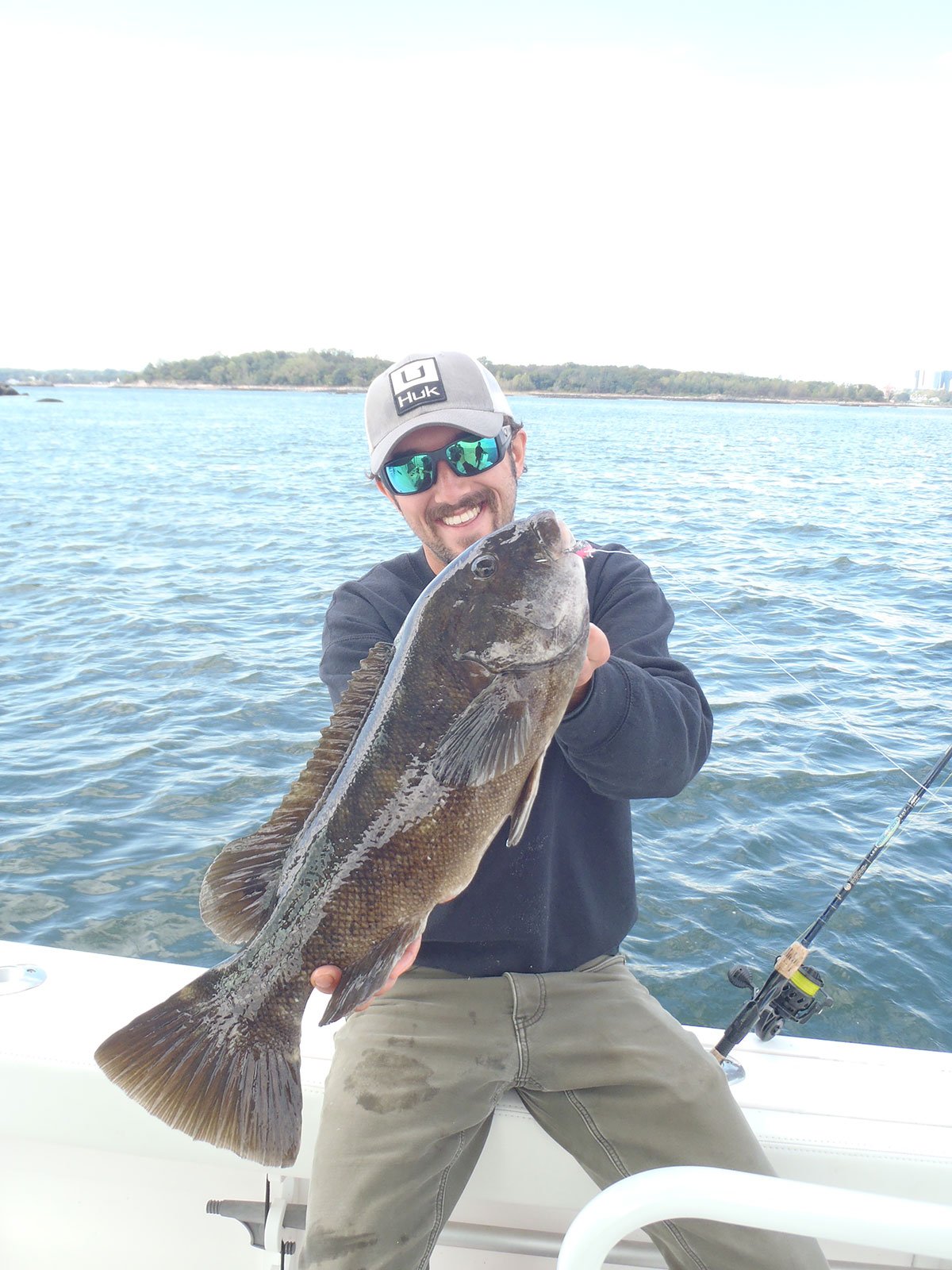
Hooking a blackfish is only half the battle. Smaller fish are easy to manage, but big ones will fight with every ounce of strength to dive back into the rocks. When I hook a brute, I lift the rod high and sometimes thumb the spool to prevent line from slipping. I do everything possible to convince the fish that “down” is not an option.
Once I pull a big fish five feet off the bottom, I usually land it. Of course, holding the spool too tightly risks a break-off, but I’d rather risk losing the fish up high than play a waiting game with one buried in the rocks. If a fish does reach a hole, don’t yank. Give slack. More often than not, patience wins again—the fish will swim out, and you’ll get another chance.
I suspect many of you have tried these approaches, with or without success, and I know many have developed strategies of their own. In the end, the best method is whatever works for you and brings satisfaction. Still, one nagging question lingers in my mind: if blackfish so often frustrate me, confuse me, and beat me at my own game—why do I look forward to blackfish season every single year?