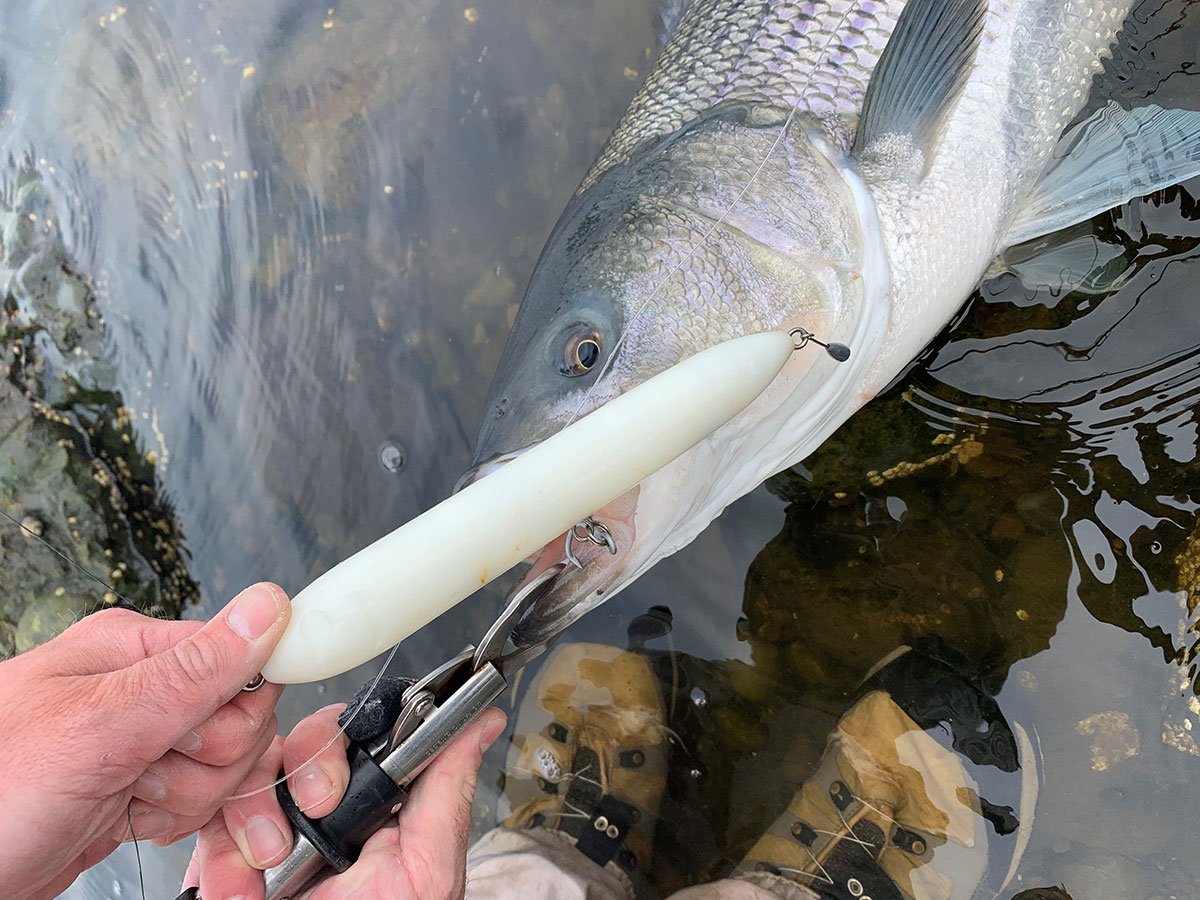
There’s a reason why some lures are kept secret.
New lures enter the market, quickly becoming the “hot” new thing. Slightly before my time was the needlefish and Redfin, then spooks, gliders, and soft plastics like the Slug-Go, all seemingly irresistible right after being introduced. What is it about these lures that makes them so effective?
The answer is complicated. One important reason is presentation. Needlefish, and later the weighted soft plastics, can be fished near the surface but also can get deep and work in current while offering different profiles, vibration level and movement from the previous options—bucktails and deep-diving metal lips.
Most new lures however are primarily different less in their presentational capacity than in their overall sensory profile. Needlefish have minimal motion and vibration. Spooks and glidebaits offer greater horizontal darting action than other lures. Red Fins present a slimmer profile and less commotion than traditional metal lips.
The best way to think about “hot” new lures is to adapt the old adage, “You can fool all of the people some of the time and some of the people all of the time…” Meaning that a new lure in its unique sensory profile (shape, swimming action, vibration, water displacement, noise type and level) offers something unique from every lure that preceded it. It has characteristics that appeal to the general fish population, although it is often especially appealing to a particular segment of it.
Any animal or fish population has a range of variation in terms of behavioral inclinations, sensitivities, capacities, hunting strategies and types of responsiveness. I’ve wondered if a new lure’s success is related to it being a different combination of sound, movement, noise, vibration and water displacement that unlocks the predatory response in a subset of the population. They’re a “match” between the particular inclinations of a segment of the striper population and the qualities of the lure.
Allow me a fanciful metaphor. Imagine a world in which pizza never existed and then someone suddenly introduces it. Almost everyone likes pizza, so it would entice a wide range of people, just as a new lure will attract most gamefish. More importantly for our purposes, there are those who can’t resist pizza. That may be what a new lure is to a specific segment of the striped bass or bluefish population: something they haven’t experienced before that tunes in just right to be near irresistible.
The SP Minnow is an example of a plug that looks similar to other minnow type lures, but its particular combination of sound underwater, vibration and swimming action make it exceptionally effective. Yet, many believe it is less appealing to truly big cow bass. The idea that a specific lure tunes into a specific portion of the striped bass population has gotten me thinking twice about sharing information. I don’t share information about spots for obvious reasons. However, I’ve thought that sharing lure choice is harmless since it doesn’t directly affect me. Now I’m less sure.
If a specific lure is exceptionally effective with a segment of the striped bass population then potentially two things can happen. One, over time they can learn to avoid it; two, they can be caught and culled out of population (less so now with slot restrictions), resulting in there being fewer of them. This reduces my future chances, even marginally.
A far wider implication is for organizing a plug bag and lure choice. Too many casters choose lures based on color, size or running depth. Instead, think of striped bass as existing along a continuum of what they’re responsive to, with some being more responsive to certain kinds of lures than others. Also think of their responsiveness changing according to their moods as well as situation and conditions. To catch more fish, or larger fish, it makes sense to have an array of lures with different sensory profiles to tune into different segments of striped bass population, different scenarios and moods.
Lures for different presentations also makes sense. Further, I always like to carry some oddball lure that offers something different. It might be the Madd Mantis Duck, a Magic Swimmer or the Livingston 10-inch Jerkmaster. A couple of times they’ve become my own private “hot” new lure.