Dissecting surf spots based on current and contour.
I loved Jerry Audet’s column from last week’s issue, “Tides by the Minute.” Not only does Audet’s story demonstrate the fact that surfcasters can take the sport as seriously as they want to and that you can never have too much (or enough) data to inform your understanding of how each spot works and fishes, but it also offered real-world examples of how Jerry’s analytical mind digests this data and makes it useable down to the moment. I’d be lying if I said I didn’t walk away from reading that with some new inspiration and a deeper understanding of some things I might be missing in my own fishing. Learning and improving as an angler are almost better than catching a big fish… almost.
In his real-world example about a spot that offers shots of different sizes of fish throughout the tide, and then a short window opens that might produce the kind of fish that can make an entire season, I found myself seeing some of my own favorite spots through Jerry’s eyes and it made me wonder if dissecting a spot the way I do and then timing it out the way Jerry does would end with similar conclusions. And after thinking about it, I don’t think they would and – to me – that is very exciting.
When I read that segment of his column, I pictured two specific spots that I know very well and what I have focused on in these locations is how the fish move as the tide progresses. So when I read that Jerry’s spot has a short window when big fish are likely to show, my inclination was to immediately to ask, “Where are those fish during the rest of the tide?”
Sometimes there’s just no useable answer to this question, because they might be sulking in a deep hole three casts from the beach, or they might only be drawn in by certain conditions. But in some cases, especially those where an area is rich in ‘reliable’ bait species, the fish are in the area and following a comfort zone of depth or current.

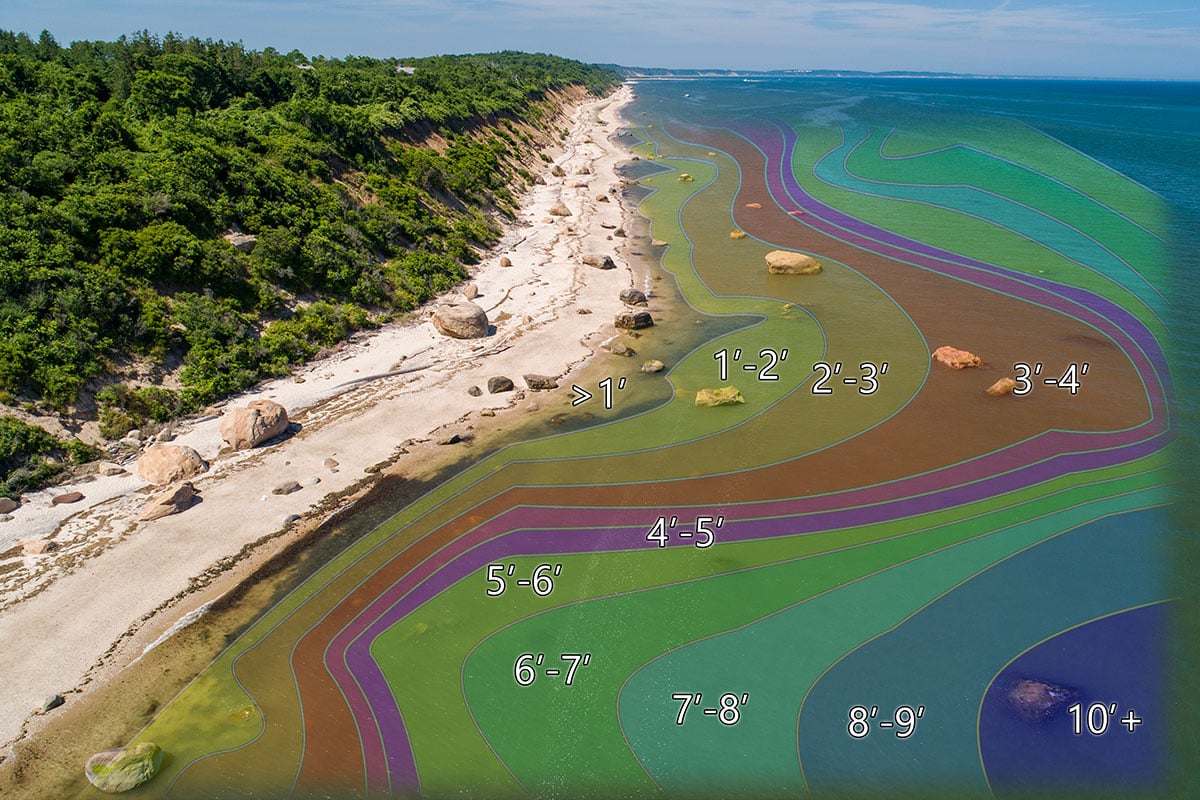
In the three spots I’m thinking of, I can follow the bite as the tide progresses, based on the water level or where the current is most concentrated. In one location, the bass move in along a shallow point at high water and they hug the deeper edge of the point, staying right along the line where the waves break along the shallower point. Once the water gets down to a certain level, the big fish leave and it’s all dinks after that. It took a daytime trip to reveal that the bigger fish were spilling off to the next deepest pocket, which is 250 yards down the beach. At the bottom of the tide, they will move again to the last nearshore deep hole, before I lose them. I like to say they “spill off” to each location.
At another spot, which has been one of my best all-time producers of fish over 40 pounds, the fish almost always relate to the area with the strongest current. Within an hour of high water (sometimes more, sometimes less depending on the height of the tide and the strength and direction of the wind) the fish will hold in a rip that forms off of a big gravel bar. When that rip flattens out, they push around to the complete opposite side of the short point and set up where the tide will then be pushing up against the shoreline and forming a pronounced set of smaller rips across a boulder field. Quite often, I lose them by the bottom of the tide, but on the nights when they’re in heavy and feeding well, I can wade way out and still reach them, this tells me that once the depth reaches a breaking point, they push out to deeper water, where my assumption is that they feel safer or more comfortable.
I think, at the end of the day, the best way to conquer a spot is a combination of both of these methods. And the cool thing is, that both methods are rooted in logic. For my dissection methodology, the logic is tied to looking at the topography of the greater area and making sense of how the fish will likely work though a tide cycle, or looking at a wider view of a spot for how the current will interact with it.
On the Audet side of the coin, the logic comes from gathering data and making informed decisions based on traceable patterns laid out in black and white. And all this lies at the root of why I love this sport so much, you can never, ever get so good that you have it nailed. There will always be new things to learn.
And I say, bring them on!