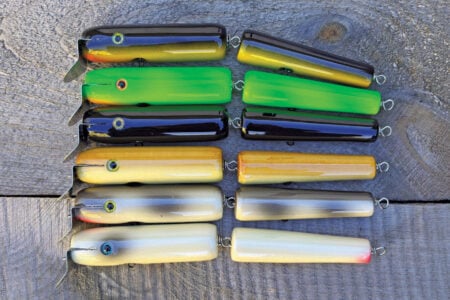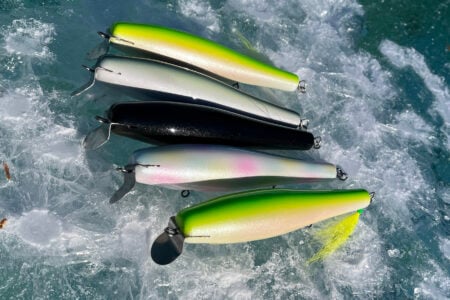
A true classic straight from the mind of a highline surfcaster from the 1940s.
I figured we’d wrap up this year’s plug building series with a fun one. You may remember that I outlined building the “Big Weasel” sometimes called the “Giant Weasel” in 2018; you might say that the Little Weasel is the Giant’s little brother. As rare as that larger version is, this smaller incarnation seems to be quite common in lure collections up and down the coast. And it would appear that the Little Weasel was one of Snook Bait Company’s flagship designs, even their color chart literature used the Little Weasel as the base for displaying each color.
Snook Bait Co. was the brainchild of Charles Russo, a well-known New York surfcaster in the 1940s and 1950s. He was heralded for his skill presenting plugs to striped bass, and was a regularly referenced in a fishing column in the New York Daily Mirror written by Jim Hurley. He was also a founding member of the Gramercy Surfcasters, a fishing club formed in 1938 by a group of hardcore surfcasters from that time. With only freshwater lures to fish with, some of the club members set their sights on creating beefed up versions for the surf and several offshoot tackle companies were formed in the 20 years that followed; one of them being Snook Bait Co.
Russo was said to be the most gifted painter in the group, and judging by the fact that he had his hands in four different lure companies over the years, it’s easy to see how passionate he was about plugs and surfcasting. The historical footprint of Charles Russo the man, is faint at best. The late plug historian Frank Pintauro said it best when he wrote, “Never has there been so much said about one person and yet we know so little.” A firsthand account I found online described Russo as “gruff”. His business partner in Snook Bait Co, Frank Evola, was said to not really trust Russo, saying he was an ‘unreliable and shady character.’ Unreliable and shady, that checks all the boxes for the stereotypical obsessed and secretive surfcaster, so let’s dive into his very cool design.

The Weasel
If I was asked to guess how the Weasel came to be, I would say that they were inspired by seeing bunker flipping, waking and being chased by stripers. It’s impossible, as an above-water observer, not to fixate on the tips of the tails as the baitfish wallow and splash, and I believe that the fanned tails of this design were born out of that observation. Any time I feel like I can see through the eyes of the originator, back to that moment of inspiration, it lights me up and makes me want to dig deeper into the design, and when it’s someone like Charlie Russo, who was known to be a gifted angler, I get really excited.
The Little Weasel measures 4 inches in length, and after doing some searching online and seeing a photo of an unpainted original, I’m pretty sure that they were made from pine. I’m also pretty confident that they did not have any added weights. At its widest point, this plug boasts a 1-3/16-inch diameter, so I used 5/4 pine and I cut it into 5-1/4-inch lengths. This is a little longer than what has become standard in these articles, but it will all make sense when it comes time to cut the tail. For this build to work perfectly, you will want match my specs as closely as possible and that includes where the plug begins and ends within your block of wood.
Begin by cutting your lip slot, centered in the block and about 1-1/4 inches deep. Now, find the center at both ends and set it spinning in your lathe. Use a gouge to round off the corners, leaving about 3/8-inch of each end square, shut your lathe off and lay out the following marks: the head should begin at 3/4-inch in from the head-end of the blank and the tail should fall 4 inches back from that. Measuring back from the head mark, make another at 1-1/2 inches (marking the widest point) and then another at 3 inches back (marking the ‘neck’ of the tail). Turn the lathe back on and touch each mark with your pencil to draw them all the way around, these are your reference points and should be refreshed as needed. Below are your target diameters…

Head mark: 5/16”
1-1/2-inch mark: 1-3/16”
3-inch mark: 5/8”
Tail mark: 1-3/16” (subsequently sanded down to 1-1/16)
I found this plug to be challenging to turn; it’s a short run and that seems to accentuate even small mistakes. I found my groove when I thought of it in two parts, the body, which I pictured as a slightly squashed egg shape, and the tail, which I thought of as a bell shape. A small (half-inch wide) rounded chisel is the best tool for the job.
Another tip, is to think of it as though you’re mirroring the aft portion of the body when you’re shaping the tail. And once you have this – sort of – elliptical wave shape roughed out, the last thing I would suggest doing is rounding off the edge of the tail so that it finishes at 1-1/16 inches at its widest point and rounds off to about 1-inch diameter at the rear cut line. Sand the whole thing down to 150 grit and we can move to the drill press.
Drilling & Milling
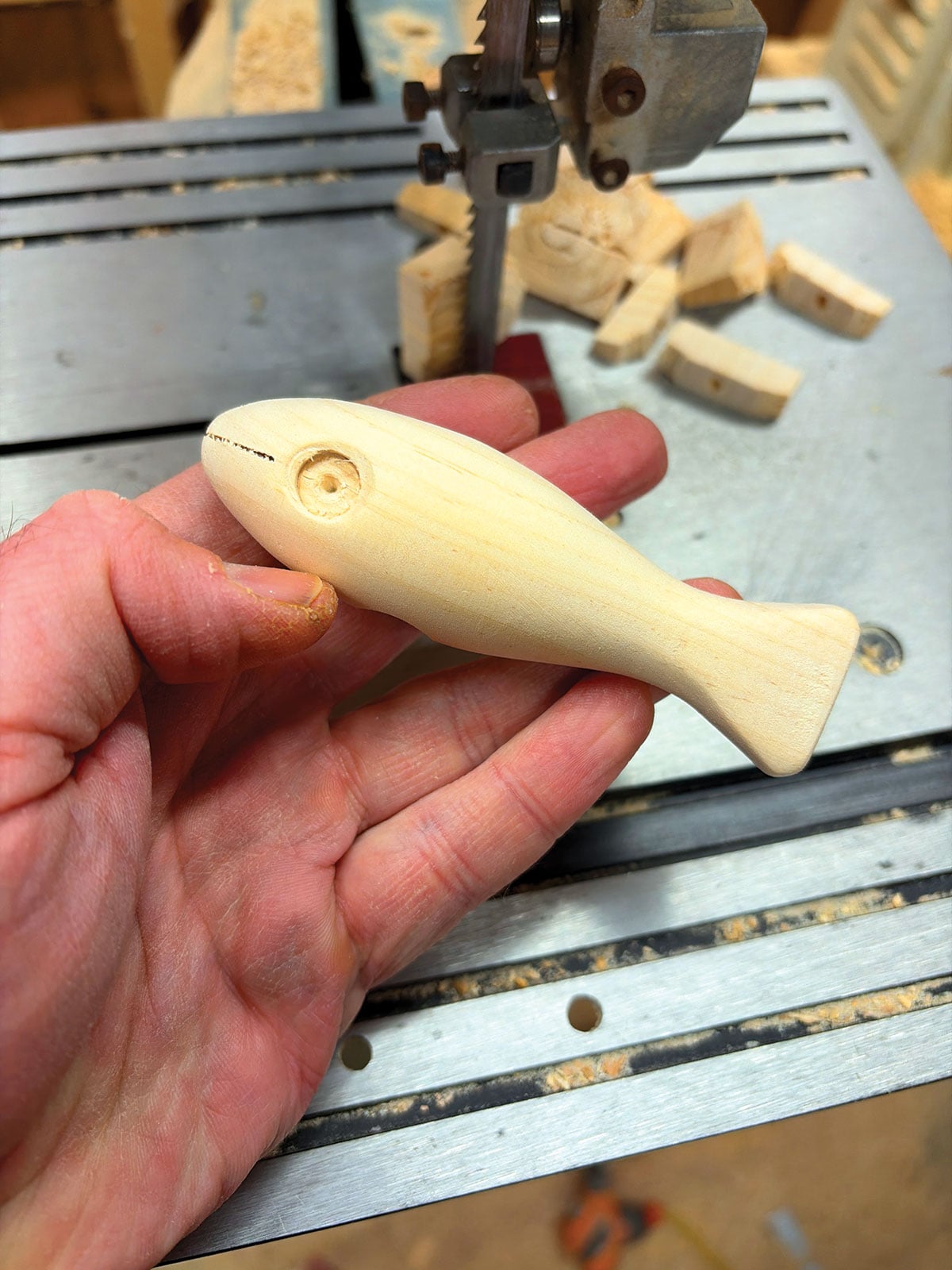
If you want to really “Cadillac” this thing, start with a 1/2-inch forstner bit and drill a centered hole, 1-1/2 inches back from the head, just about 1/16-inch deep, then drill a 1/4-inch hole right down the middle of that about 1/8-inch past halfway through, this will accommodate the neck and flange of a belly grommet and give the hook hole a really slick look. Or you can skip the grommet and just drill a 1/4-inch hole there. Now swap out a 3/8-inch forstner bit and drill the eyes at 7/8-inch back from the head,; drill these about 3/16-inch deep. (Tip: use the lip slot to help you center the eye). Now swap in a small 1-inch ball rasp or a round grinding stone and carefully plunge it down into the eye socket to cove it out, leaving the original hole around 1/16-inch deep.
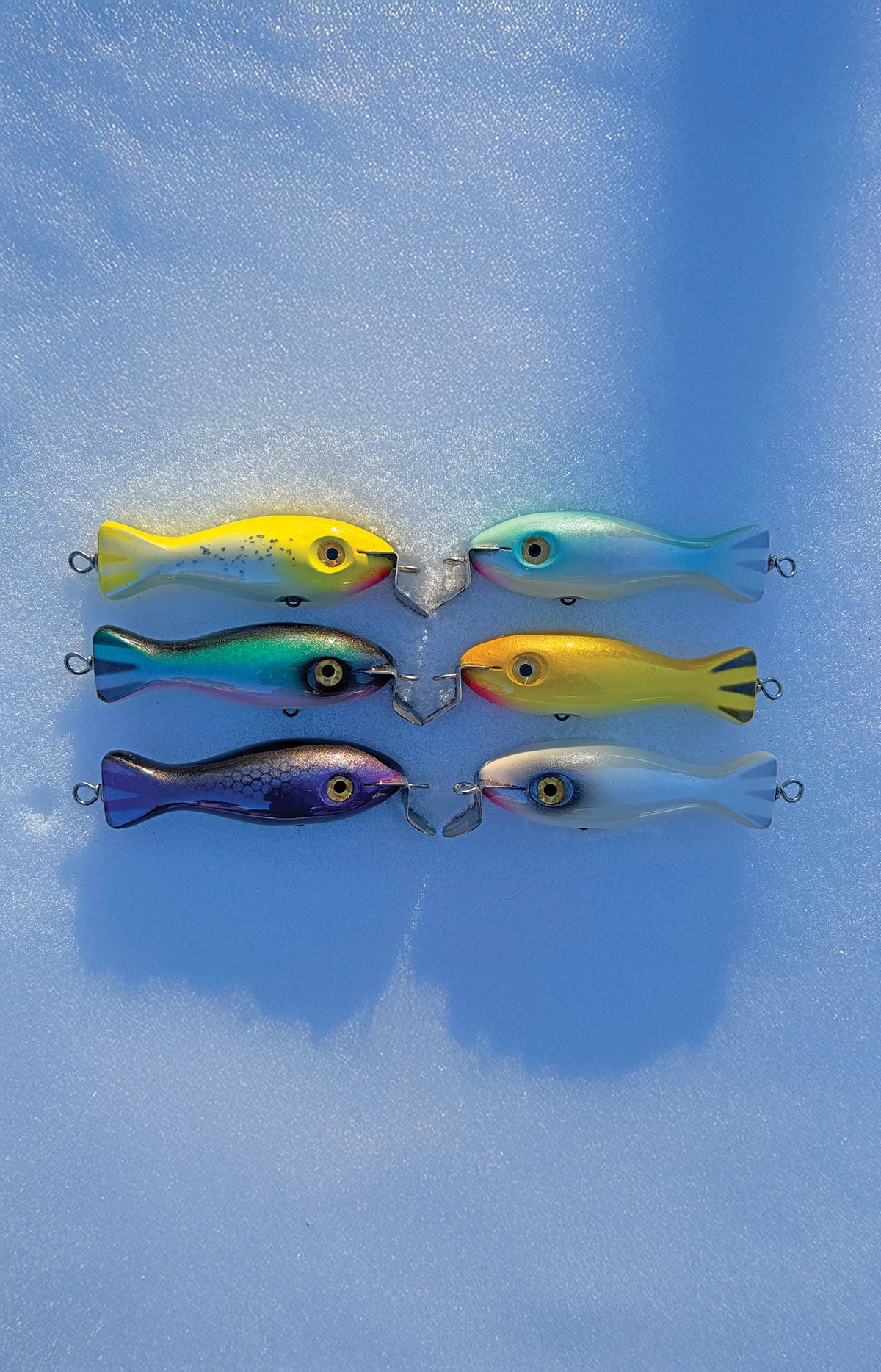
The tail is everything in this design, as it’s what draws collectors to originals; it’s what drew me in as a builder and, I’d guess, it’s what put the coins on the counter back in the 40s and 50s when they were being sold. It’s an unusual and unique flourish that goes hand-in-hand with Russo’s whimsical flair for creating imaginative paintjobs to replicate the bait species he was seeing in the surf. And you don’t see it on any other plugs.
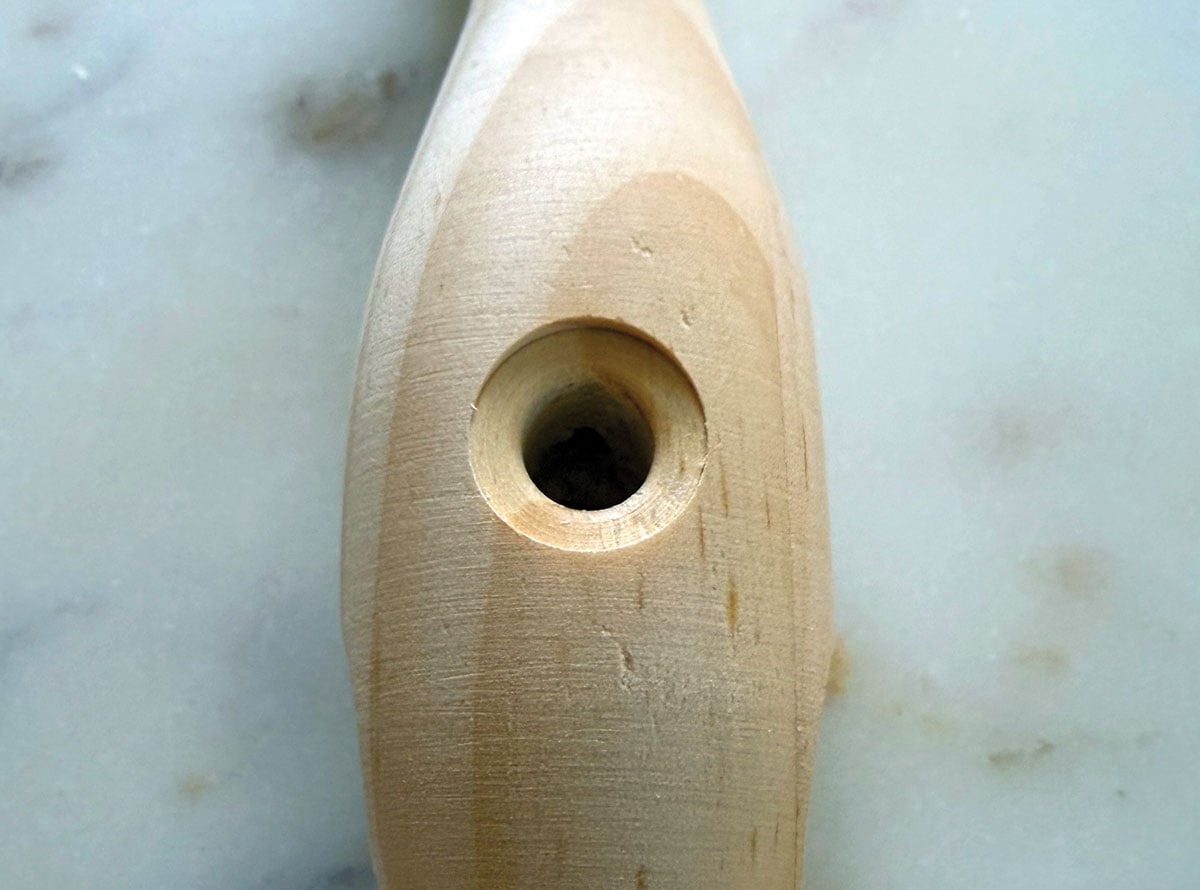
As you might imagine, cutting the tail requires a little voodoo. If you were going to make 100 of them, I’d recommend making a sled jig for your band saw that can repeat the cut over and over again. But if you’re making six, here’s the trick.
The reason I have been fussing about following the specs as closely as possible is because if everything is done to meet my standard, you will be able to make the cut relatively easily. You’ll need to use the mitre gauge on your band saw and set it to 9 degrees, then clamp a rigid and straight piece of wood to the gauge to extend it. Now, mark the center on the top and bottom of the square end left on the tail, now make marks 1/8-inch out from either side of your center marks. These outer marks are where the tail cuts will begin.
Position the plug belly-down and pinch the square on the head end of the plug against the mitre gauge extension; position it so the blade lines up just outside the mark, and make the cut, sliding the mitre gauge forward, until a little wedge falls off one side. Now flip the plug “belly up” and repeat the exact same procedure. Hopefully, it all worked out as planned, if it didn’t, you’re going to have to make angle adjustments to fit whatever layout deviations caused the issue. Now you can cut the square ends and off finish thru-drilling (place a Pikie 1 lip in the slot, mark the location of the hole and drill with a hand drill back into the hook hole).
Home Stretch
Now sand everything thoroughly, especially the flat faces of the tail. But also round off the nose to a ‘fishy’ point, round over all the sharp edges, the cut end of the tail, in the coves of the eye sockets, etc. Once you like what you see, give your Weasels a bath in the sealer of your choosing and let it dry completely before sanding the whole plug lightly one more time.
Next is primer and then paint. You will see in the photos that I mimicked five of the original Snook Bait Co. colorways and then tried to channel Charlie Russo for my blurple version. I cut a quick stencil out of some cardboard to vaguely mimic the original paintwork on the tail, but you certainly don’t have to do that. Glue a Pikie 1 lip into the slot, glue in a pair of eyes and the smaller belly grommet from NJ Tackle and you can add your clear coat.
To assemble, drop a size 3 swivel into the hook hole, slide a pre-bent thru-wire through, add a small tail grommet and wrap a neat tail loop. Originals carried two 3/0 trebles, I’ll be fishing mine with a cut 3/0 VMC on the belly and a weight or a flag on the tail, more testing will be required, but when I made these everywhere I looked was frozen over so I wasn’t able to conduct any final tweaks for action. So this time, that part is going to be up to you.
There were rumors, that have since been confirmed, that Russo was scouted by Heddon Lures because of his skill in building and painting and they wanted him to move to Dowagiac, Michigan to work as a plant manager. Russo declined the offer, leading some to wonder why a person would refuse such a position. Some cite the fact Russo was, allegedly, a bookie and may have been doing just fine on his own. As a surfcaster myself, my guess is that he couldn’t bear to leave the surf behind, I know I couldn’t.
Regardless of Russo’s rumored checkered past, and his personal history that seems to have been hidden from view and lost to time, we all owe him a huge debt or gratitude. Without his contributions to surfcasting history, and without his vison that brought these freshwater lure concepts into the surf and adapted them to stand up to striped bass and the unforgiving saltwater environment of the surf, plugging may have lagged behind or gone in a completely different direction.
One thing I feel like I can say with confidence, is that his artistic eye for replicating baitfish patterns has inspired every custom plug maker – directly or indirectly – who has picked up an airbrush since. And that in itself is truly something special.