Reflection on the past can improve an angler’s tactical toolbox for November madness.
Because Central Jersey has had stellar-to-epic fall striped bass runs for the last 3 to 4 years, I am always hesitant writing autumn prep pieces in fears of jinxing the upcoming bliss. The 2024 run started out slow (through all of October), suggesting a revocation to New Jersey’s recent ‘fall mecca’ title. Thank god the main biomass arrived, albeit late, at the start of November.
It’s necessary to reflect on the conditions and approaches that led to some anglers doing alright versus arms-dead great across these past years.
No two seasons are ever exactly the same, and fish arrival-time is a note-worthy difference. However, anglers can prepare themselves as best possible by reflecting on other pertinent contrasts and similarities across the recent seasons. A commonality across previous fall runs was weather and wind direction in October. Preceding the armies of bass was a nor’easter (short to a week’s duration), followed by consistent westerlies. Last October was a slight outlier, but the following month kicked off the same as years immediately preceding it.
Another difference across these recent falls was the baitfish; not exactly the amounts, but the percentage of type. The species of baitfish is critical because it dictates which optimal artificials to cast and if/how weather changes will affect the baits’ movements. Fall 2022 had hordes of peanut bunker, and in 2023 tons of peanuts returned, however, a good percentage of the overall bait was also adult bunker. This difference produced a larger range in size of bass landed from the fall 2023 blitzes.
Fast forward to the fall of 2024 where the same two characters arrived but with more company. This third bait joining the party, sand eels, were found in good abundance from Sea Girt to Seaside Heights. The mixed bag of abundant bait species allowed for a diverse array of angling strategies. Targeting bass around groups of peanut bunker vs adult bunker vs sand eels requires different tools and tactics. So to best prepare for what this fall may bring, let’s consider what’s best to do and to throw around each of these bass-candy baitfish!

Striper Smorgasbord
Many species of baitfish are predominant along the Jersey Shore during the fall migration. These include mullet which typically run through from mid-September to the middle of October, followed by the appearance of Atlantic herring which tends to happen late, often starting in December. These two types of baitfish have not had massive turnouts any of the last 5 years, certainly not when compared to the primary baits of the fall run.
Bunker come in different sizes, which we usually categorize into two groups, peanuts and adults. Same species of course, but just like humans they vary in age and size and show differences in their behavior and thus should be approached as separate types of baitfish for angling purposes. For example, there are nuances in how peanuts vs adults cluster together (and usually separately), how they travel, the extent to which they are affected by wind, and how they are preyed upon by bass. These distinctions are helpful to a surfcaster trying to decide upon their bass-hunting strategy.
Some anglers coined the term ‘cupcake’ for medium-sized menhaden. Somewhere in between juveniles and adults, these cupcake-sized bunker predominantly act more like adult bunker. They are usually fewer in amount compared to the other two sizes, possibly due to rapid growth into becoming adults. Peanut and adult bunker schools predominantly travel into the wind, though I’d argue adults do so to a greater extent. Such knowledge can help anglers anticipate their movements with weather changes.
Because of bunker color, white artificials are usually best, especially in daytime. This applies to all size-class bunker. Optimal lure type, though, varies when faced with fishing a peanut bunker vs adult menhaden scenario. When mimicking peanut bunker, go small and white with your offering. What further dictates the type of artificial is where the bass maybe around the bait pod and in the water column, and how finicky or active they may be feeding. Small white Tsunami storm shads were the MVP of the ’22 season, and working one slowly under and on the outskirts of bait pods will draw strikes when the bass are low and less active.
When striped bass are more active and higher in the water column, few things beat a small white Mag Darter. When casting at stripers in heavy piles of bait, switch out your trebles for inline singles and cast beyond the bait school. Such an approach prevents snagging any of the peanuts onto your plug.
Sometimes the bass are out far beyond the peanut cluster, maybe waiting for the baitfish to wash over the sandbar or simply traversing the waterways on their migration hoping for an opportunistic snack. In such cases, distance is the key. This may require either a small white glider (if fish are feeding mid-water column) or a small white pencil popper or spook (when fish are on the feed in the upper column). Having these five lures will help you squeeze any peanut bunker situation for all its worth!
Size Does Matter
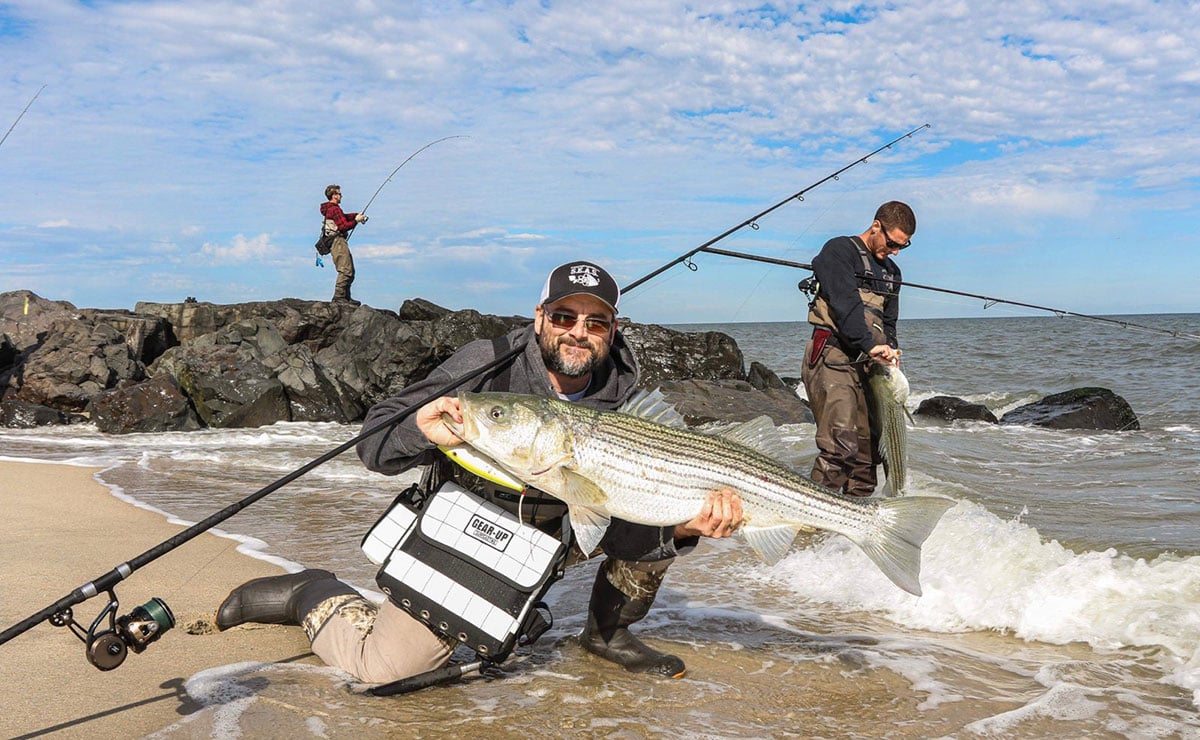
When mimicking adult menhaden, the same white color also applies, but prepare to go larger on the artificials to match their profile. When the bass are at a distance use a large white pencil popper or spook for fish higher in the water column, a larger white glider when fish are feeding down lower. If range is not an issue, and the stripers are not at an arms-breaking distance out, there is absolutely nothing better than a larger white jointed glider! I started using the Stridebait jointed gliders over a year ago, before jointed gliders became popular in the surfcasting community. Last fall I had five or six scenarios where I was the only one catching on the beach and guys were buzzing up like flies to see and ask what I was throwing.
My student from Stockton University, Grant Johnson (the one who put me onto these lures), had the same experience within the fall crowds. He reported that the jointed glider allowed him smash the most and largest bass within the crowds of people too. It works most optimally in slack-to-slow current, but it’s only true weakness is casting distance. However, when worked slowly the jointed glider’s oscillations will entice stripers up from even deep areas of the water column. If bass and adult bunker are both around, I will be bold enough to say that there is nothing that even compares to this lure!
Sand eels are a completely different monster. Behaviorally they are less transient and more stable to an area longer. Their presence is therefore more reliable across days. This is because they dig into sandbars to reside for certain periods of time. Last fall, while I was chasing bunker schools down the beach, I’d receive texts from Jim Hutchison gloating that he had already smashed stripers at sunrise on sand eel imitations. His consistent, reliable bites went on for well over a week at the same southern Monmouth County beach.
Unlike bunker, sand eels possess a long, thin body shape. This prescribes an angler’s use of different artificials. Because of their burrowing behavior, lures that access the lower water column are usually best. If the sand eels and bass are in close, the Tsunami sand eel is hard to rival. Make sure to check the hooks, though, as the parts within the plastic tend to rust between seasonal uses. If the fish are farther out, Avas, Deadly Dicks, and Needlefish are what to throw. Teasers tied up above where the lure sits will produce too. In fact, in decent sand eel raids, teaser additions commonly lead to double-headers. They can be anchored to the leader with a simple dropper loop knot.

Northern Crowds
The fall action in New Jersey has been concentrated to the beaches of Monmouth and Ocean counties, from Sandy Hook to southern LBI. The bunker blitzes, specifically, even seem to taper off at the ‘invisible fence’ of Barnegat Inlet. Because most of the blitz action is concentrated to these two counties, so too are the surfcasters.
During the 2011 sand eel raids, Tom Lynch (angryfishgallery.com) captured an iconic image of the Thanksgiving weekend crowds at Island Beach State Park. Up until recent years, that picture served as the standard for ultimate crowding. The 2024 season however set a new standard. November had weeks on end with anglers shoulder to shoulder, on the surf and sandbars, from Manasquan to Island Beach. Crowding can be a downer, but let’s think about how to best approach this reality.
Crowd-induced pessimism and frustration can erode anglers’ restraint from behaving like the respectable humans we strive to be. These negative mindsets, of which we can all be guilty, reduce the enjoyment of the fishing excursion and even distract away from catching fish. Instead, try to be positive in such situations. Find any silver linings, like witnessing how a plug or technique being used by another angler out-produces. Learn from this and incorporate the changes into your own arsenal.
Another perk that comes from cooperation with others is that it may lead to friendships and a growing information network for the blitzes. Even an anti-social hermit like this author has awesome friends that decrease his response time to blitzes by exchanging bite alerts. So denounce the combat mindset and adopt the cooperation mentality whenever it’s possible.
I should add that blitzes are not and should not be confused with spatial spots that require secrecy and reservation. Blitzes are moving fish, all of which are seen by passing crowds and anglers watching the surf cams anyway. For surfcasters in Atlantic and Cape May counties wondering “what about us,” if you’re not traveling above the line to partake in this fall fiesta in the upper half of the Garden State, you’ll have to rely more on traditional structure scouting. Occasional blitzes, however, may come later into December, possibly even January given water temperature and bait.
Sometimes, if our patience is running low from the other stressors of life, it’s can get a little tougher to play nice in the Ocean and Monmouth County crowds of November. Proper realization of this requires self-reflection, but in these instances there is no shame in cowering from crowds. It can boost the enjoyment of the outing, and may even help with fishing productivity when finding a vacant sandbar to exploit away from the masses. As these bass inevitably migrate past on their trek south, your lure being one of a few (versus one of many) greatly helps the chances of a fish attacking your offering. This can feel far more rewarding as well.
So resist any FOMO (Fear Of Missing Out) drawing you into the crowd, and be optimistic with catching in seclusion. Whichever sands on which we all find ourselves casting, let’s pray this fall is another banger!