Trout anglers return to action in many stocked waters in March.
Bob Dylan sang “For the times they are a-changin’.” And in terms of trout stocking in New Jersey, it’s been a longtime a-comin’ for sure!
Not since the youngest years of the 80s has there been a major revamp to the trout stocking program. “Revamp” might be a bit light in this context, with “cataclysmic” not that far off on the other end for the grey beard traditionalist.
Sure, there was the disastrous furunculosis outbreak in 2014 that necessitated the euthanizing somewhere in the neighborhood of 250,000 trout, primarily browns and brookies. Furunculosis is a serious, septicemic, bacterial disease found principally in salmonids. The name of the disease is derived from the presence of “blisters” or furuncules on the surface of chronically infected fish including trout.
Then came the COVID outbreak with an early two week catch-and-release prior to the official opening day of the 2020 season, one of the reasons being to spread angler participation because of spatial concerns (read: crowded waters).
Besides the alterations due to these two aforementioned events, there have been additions as well, including autumn and winter trout stockings, more Wild Trout Waters designations, establishment of assorted Trout Conservation Areas (TCAs), efforts to preserve and enhance native brook trout, and special brown trout management waters, to name just a few of New Jersey’s trout modifications.
However, the 2026 spring trout season brings significant changes, one which many consider a blockbuster, eliciting comments from praise to pillory. Indeed, this monumental overhaul took several years to establish, from initial conception to final approval by New Jersey’s Fish & Game Council.

New Trout Formula
Championed by New Jersey’s Bureau of Freshwater Fisheries chief Shawn Crouse – and buoyed by the tireless efforts of bureau biologists, techs and workers, with input from clubs, organizations, and comments from individual anglers – a new “Trout Formula” this season promises to deliver expanded trout fishing opportunities, including the addition of 20 small ponds in urban and suburban areas around New Jersey that will serve to introduce adults and youngsters alike to trout fishing. Three more of these “one-shot” stocking being added in ’27.
“We’re bringing the trout to the public where they haven’t had the chance to fish for them,” emphasized Crouse, adding that there are significantly higher catch rates on these more diminutive waters, with the youth and those not able to travel or have physical limitations now having the chance to go trout fishing.
| NEW FOR ‘26 |
| The new waters added to the 2026 stocking list, with the respective numbers of ‘bows released. North: Frelinghuysen Forest Preserve Pond (140), Lafayette Park Pond (140), Carteret Park Pond (170), Grover Cleveland Park Pond (100), Hughes Lake (260), Wood Dale Co. Park Pond (320).
Central: Best Lake (320), Edward A. Grekoski Park Pond (190), Cedar Brook Park Lake (350), Daley’s Pond (280), Demott’s Pond (320), J.F. K. Park Pond (170), Wargo Pond (360). South: Edgewater Park Pond (100), Stacy Park Pond (170), Northern Community Park Pond (100), Tippin’s Pond (520), Lake Takanassee (410), Patriot Lake (240), Corliss Park Lake (490). |
In addition, there will be boundary extensions on the Lopatcong Creek (Warren County), Pompton River (Passaic County) and the North Branch of the Raritan River (Somerset County), the tweaking of brown trout regulations on the Pequannock River (Passaic County), and adjustments to lake trout limits on Round Valley and Merrill Creek reservoirs, with no closed season.
Two previously long-stocked swims have been removed from the ‘26 roster. Colonial Lake (Mercer County) long plagued with poor catch rates and pronounced angler dissatisfaction, and Neldon Brook (Sussex County) because of a shrinking access and waning angler participation.
The second Saturday in April will be designated the Opening Day of the trout season starting this year, and the reasoning is sound; the first Saturday is normally too cold, with the third Saturday posing the long term possibility of waters being too warm during the seventh week of in-season stocking. Take a little, give a little, but mark your calendar for Saturday, April 11th.
Another change that is raising some eyebrows is the post Memorial Day limit of four being reduced to two. Why? “Consistency,” shared Crouse, explaining that with the new limit for the autumn trout stocking being reduced to two, it was better not to confuse the angling community with a third limit. Besides, there are now plenty of opportunity to exercise the vacuum sealer between the March through May stockings. Overall, the baseline number for the totality of the spring ’26 stocking schedule that concludes on Friday, May 29th is 570,010 (amounts subject to change).

No More Opener?
“They’re getting rid of opening day,” was the hue and crying out loud. Not quite that drastic and, in a master stroke, the new plan actually adds 19 days of trout fishing opportunities in 107 lakes and ponds. That’s more than 50% of the nearly 200 waters dosed with trout during the spring pre and in-season stocking schedule.
So here’s the blockbuster; the three week pre-season closure starting in mid-March on all stocked waters statewide has been transformed into an early Opening Day on lakes and ponds. Only brooks, streams and rivers will be restricted to the April 11 opening day mandate. Fishing for all species will be allowed, with the daily trout limit set at two.
The daily limit will return to six starting April 11. This avails non-trouters the chance to fish for bass, pickerel, panfish and other species when these venues were previously closed to fishing because of the pre-season stocking. In addition, the new plan will hopefully alleviate shoulder-to-shoulder opening day conditions which can often be discouraging, especially to youngsters.
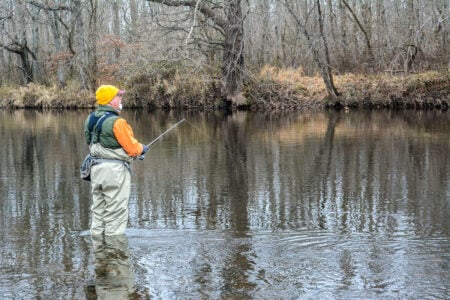
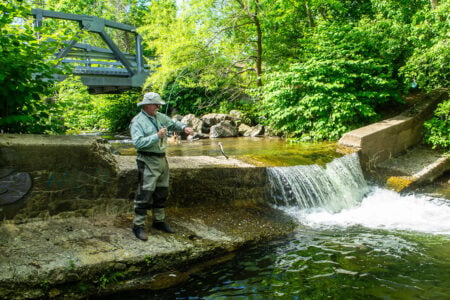
For those who equate trout fishing with flowing waters, you can still enjoy the wait until April 11, and chances are they’ll be reduced angling pressure. Additionally, it’s believed that the earlier access will provide more trout for anglers as opposed to the cormorants, that salmonid sucking machine that gobbles thousands of stocked trout every spring, especially from early April well into May on lakes and ponds. It’s exasperating for sure, and we’ve experienced this from when the problem first arose in the late 80s straight through last season on venues from Passaic County down through Cape May County. The early go significantly raises the odds of trout on the stringer rather than in the cormorants’ gullets.
| BONUS BROODSTOCK |
| The nine Bonus Broodstock lakes, with the number of breeders that are stocked with the initial load.
North: Barbour’s Pond (50/420), North Hudson Park Lake (50/540), Oldham Pond (50/440). Central: Echo Lake (30/370), Nomahegan Park Pond (30/400), Crystal Lake (50/550). South: Oak Pond (50/430), Giampietro Park Lake (60/430), Ponderlodge Pond (30/490). *Amounts/totals subject to change |
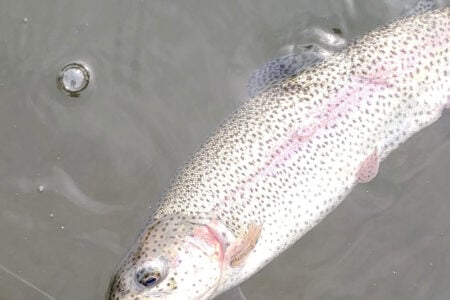
As since 2015, it will be all rainbows. The wildly popular Bonus Broodstock Program returns and includes nine lakes and ponds that will be dosed with buster ‘bows between 3 and 7 pounds. These will be in the respective first loads and can prove the trout of a lifetime.
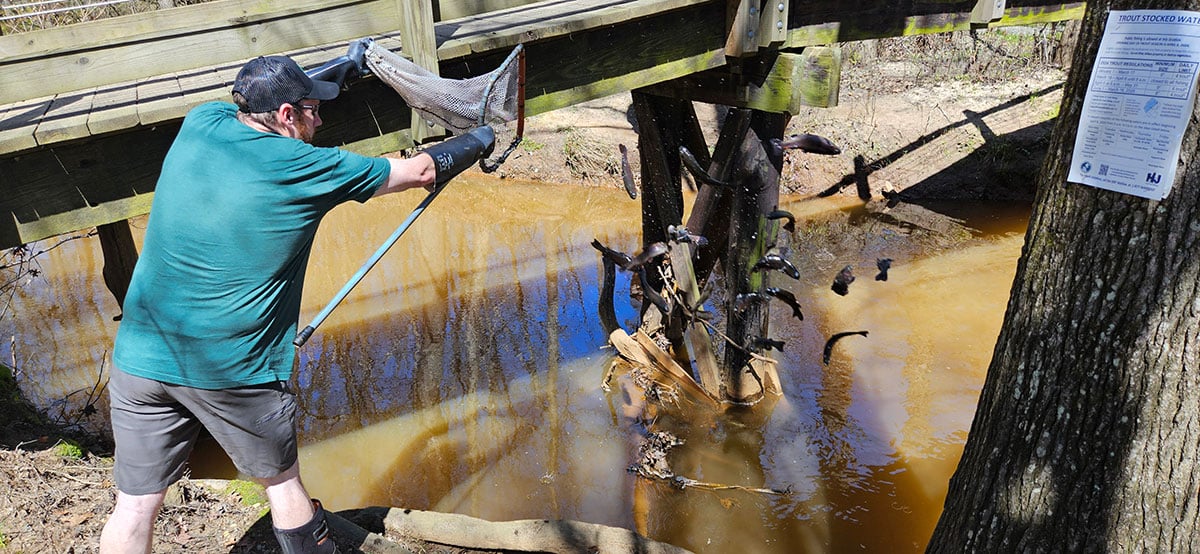
For the three week early “season” the trucks will be rolling starting March 23. Fishing will be allowed even as the trout are being released. The Bureau of Freshwater Fisheries will post the waters receiving rainbows on a particular day the evening they are stocked. Ostensibly this is to reduce truck chasing as well as giving the fish a chance to disperse, thereby equalizing opportunity. You can visit the New Jersey Division of Fish & Wildlife Facebook page (facebook.com/NewJerseyFishandWildlife) for stocking updates.
Change is good, if only for the sake of betterment and not simply for change’s sake. And from this corner, with a personal Garden State trout fishing history dating back to ’61 well, this is an exponential improvement that will not only enhance the progressive trout stocking management and resulting opportunities, from the mountains to the ‘burbs to the cities, to the trout fishing enjoyment of all.