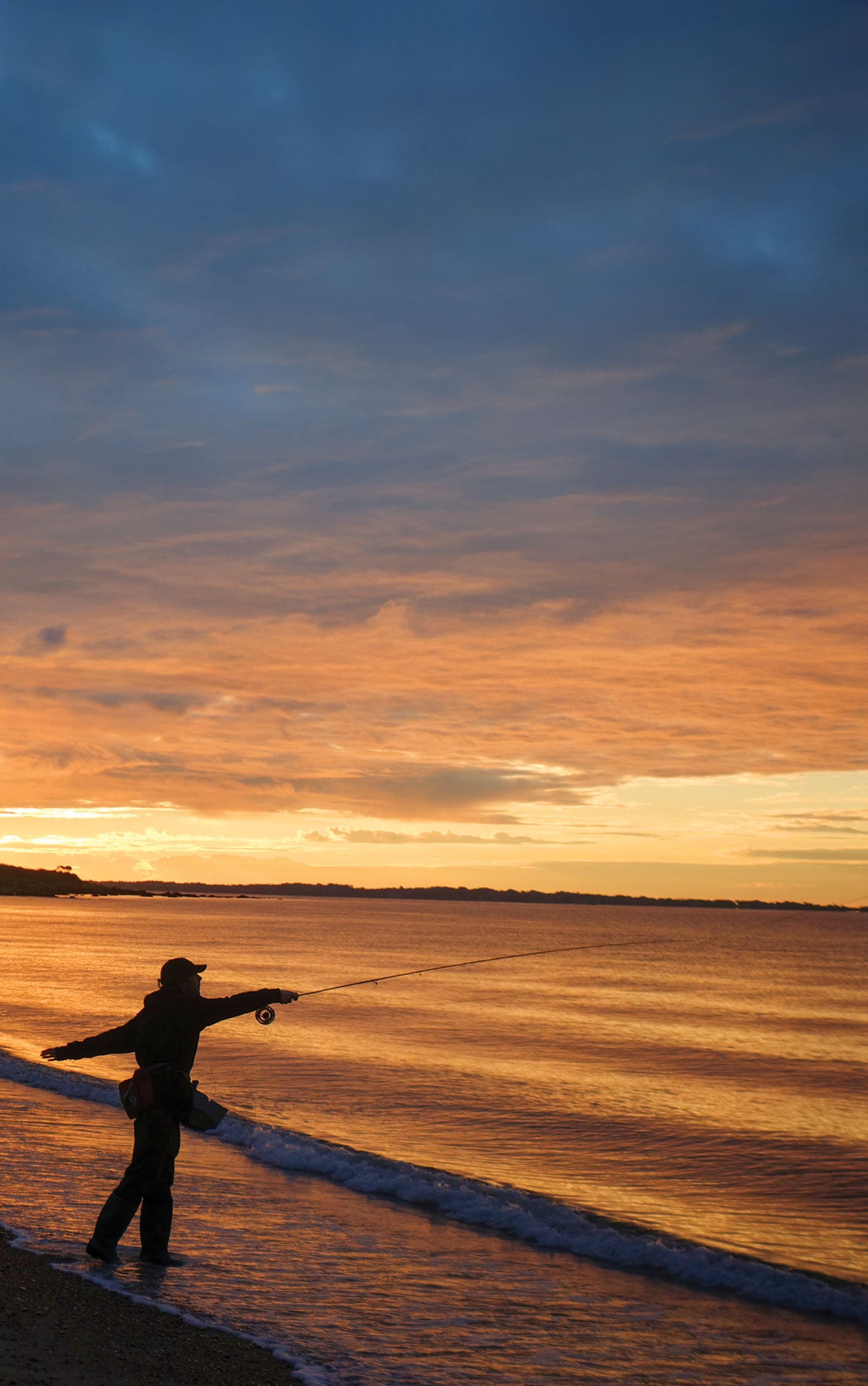
See the surf through the eyes of a flyrodder.
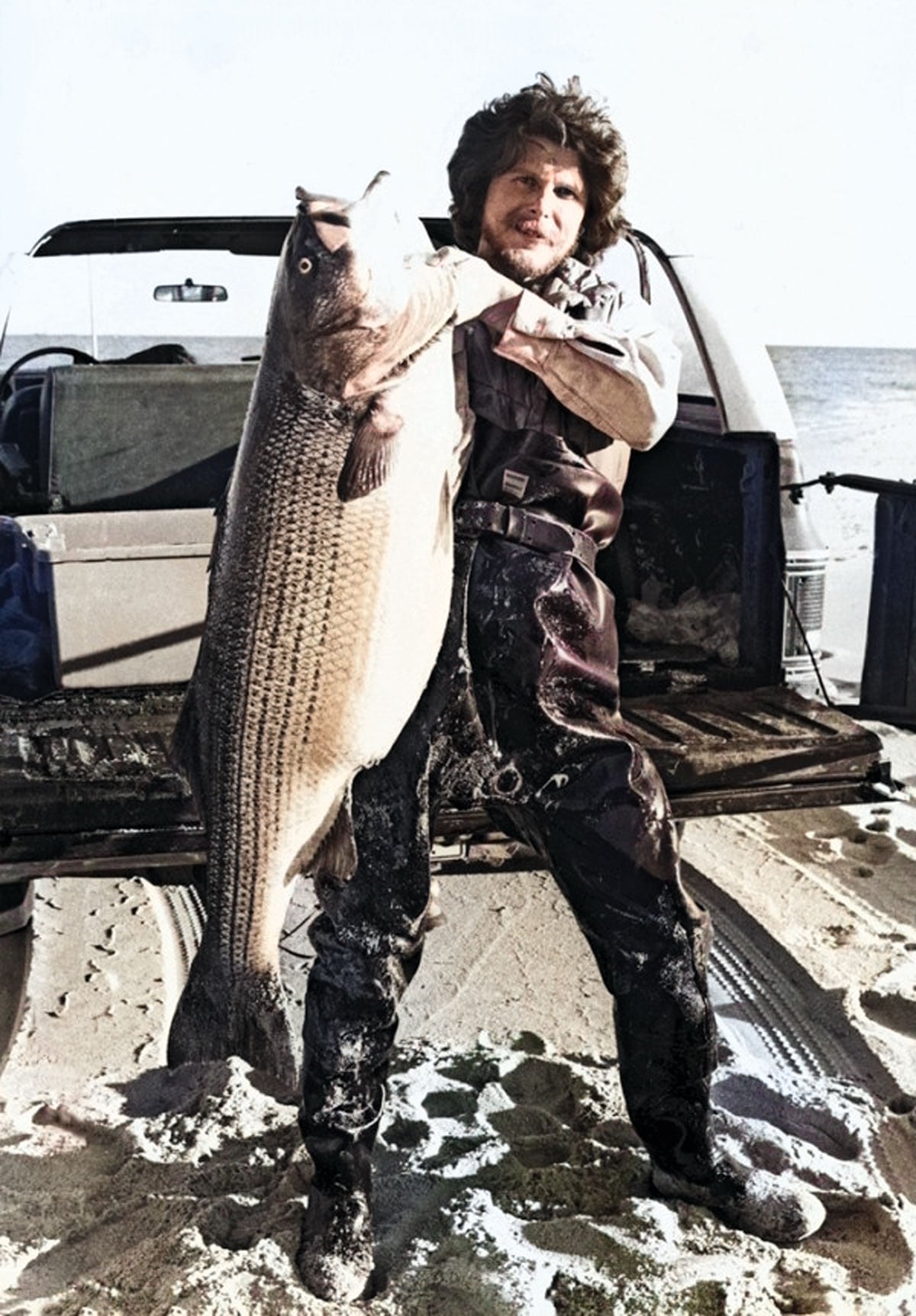
On an early November day in 1981, a gigantic striped bass made a rare, critical error. It had two choices; eat a live eel, or grab a bit of black hair. It chose the latter.
Tony Stetzko’s formerly IGFA holding record and current Massachusetts three-way tie is one of the most notable surf catches, ever, and it’s choice of what to eat defies some convention. It also stands as a symbol of hope for those of us that chose to ply the surf with the fly rod. If that monster was willing to eat a small, black teaser over a live eel, what does that say? To many of us, that fish suggests that what we’re throwing isn’t so illogical a presentation for even the largest of local surf query.
Perhaps more broadly applicable, it does sort of suggest that surfcasters aren’t foolish to take some cues from flyrodders. There is always a lot to be learned by looking to different styles of angling. Often, though, it’s fly anglers who are looking at the surfcasters to get their take on things.
This time, let’s flip the script.
1. Pocket Picking
Fly anglers are working from a compromised position in terms of casting distance. At our absolute best, most of us can only hope to attain distances approaching 100 feet. Some may manage to exceed that with well-tuned gear and lots of practice. But it isn’t all that rare when fishing the surf that fly fishers will spend time with barely half their fly line length out, and this isn’t a mistake. The fish aren’t always 300 feet away, sometimes they’re right at your feet. In slack water this isn’t consequential, a long cast can still cover that plenty effectively. But the water moves out there, and it moves your plug, too.
If every cast made is a long one with a sweeping crosswise current, you’re essentially fishing in the same basic lane and may be missing opportunities at varied distances. A good fly angler recognizes this, gradually lengthening their line to cover more and more new water, not just directly in line with the cast, but in the down-current direction as well. This is a mindset borrowed from picking apart pocket water in a river. Is it partly because we just can’t cast farther anyway? Yes, absolutely. That forced handicap makes us work the water we can reach more thoroughly, and there are plenty of cases where that actually give the fly angler the edge over the surfcaster.
2. Trough Runners
The same distance principle has a different application when fish run tight to an edge. It isn’t at all uncommon that striped bass, false albacore, snook, or many other surf targets are working right in the trough, or right off the beach lip. A surfcaster blasting jigs as far as possible may simply waste time with their presentation out in no-man’s land while fish swim under their line. Flyrodders, at force of ability as well as an often habitual interest in sight fishing, often recognize this edge cruising behavior and are quicker to adjust. Shorter casts save more time, keeping the lure in the zone where fish are working longer rather than wasting time dragging it through dead water.
Pay close attention to where fish are breaking most consistently, or watch for the fish themselves to determine the efficacy of this strategy. At times, it may even make sense to simply cast at a slight angle to shore in the direction the fish are coming from to maximize both distance and time in the zone. In any case, it pays to have your mind’s eye focused closer to dry ground rather than way out there.
3. Feathers Look Cool
Stetzko’s giant bass reportedly took a “black beauty” teaser tied with hackle feathers. Any fly-tier knows that there’s something about the way a schlappen or big hen hackle swims in the water. These feathers quiver, wave, and even twist as they’re pulled or swung through the current, each little swirl and ripple of water that courses over them makes them look alive. They can also be used so well to make the profile of a baitfish, by carefully tenting them to build a body shape. It has always surprised me, personally, that hackle feathers aren’t more widely used in both teasers and bucktail, in which the most common material is, of course, bucktail. Perhaps the most classic saltwater baitfish fly there is, Lefty’s Deceiver, sets a perfect template to use both. A well hackled bucktail does a much better job of fitting the profile of, say, a spike weakfish or a mullet, than does one with just bucktail and rind trailer alone. That realism certainly isn’t always necessary but there are circumstances in which it does seem to help.
It’s also possible to add nice contrast to a teaser or bucktail by using a couple feathers of different colors, or different colored feathers and bucktail, or both. Tying itself isn’t that difficult and gives anglers a lot more say in what they’re fishing. Ask any good surfcaster why they choose the plug colors they do and they’ll have some very interesting answers, but perhaps we ought to be thinking just as hard about the color hackles hanging off the back of our bucktail jigs!
4. Size Matters, But Think Small
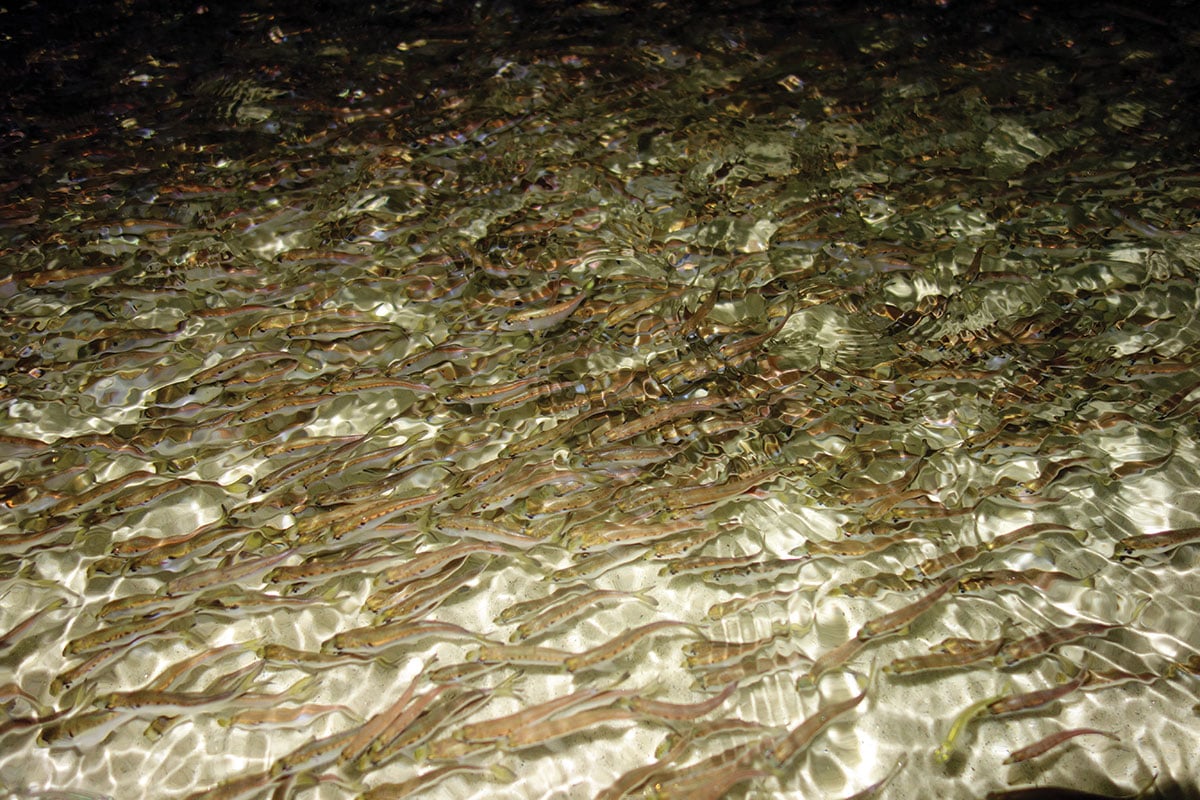
Elephants eat peanuts. And sometimes cow stripers eat krill. There are a plethora of tiny baits that, when abundant enough, focus the attentions of fish of all sizes. Bay anchovies, cinderworms, juvenile calico crabs, grass shrimp tiny squid, and even – on a couple of occasions – insects, are all things this angler has seen striped bass eat. None are particularly well represented and imitated by most things you’ll find in a plug bag. Unless, of course, you simply use flies as teasers.
Many of these events are predictable. Cinderworm breeding swarms occur May through June with scattered “hatches” around moons further into the summer and occasionally early fall. Micro anchovies are often on the menu in August and September. I’ve seen the bass lock focus on golden stoneflies and Hexagenia in the rivers as the herring run starts to stale, then summer resident fish feed on whiteflies in August. With some of these baits, you are just flat out best off imitating them with a fly and casting that fly with a fly rod. It is always possible to make do with teasers, but sometimes there’s just nothing better for feeding bass eating something small and subtle than the small and subtle fly rod presentation
5. Get Crabby
Beyond simply something small, flyrodders seem to have locked into a common striped bass snack that is less imitated by surfcasters…crabs. For many of us working sand beaches and flats, patterns that imitate green and calico crabs have long been staples, often called “confidence flies”. Though imitations of crabs in the form of soft plastic lures and some hard baits do exist, they’re being shown to tautog and sheepshead occasionally, but rarely striped bass. Perhaps that’s an error.
Stripers do eat a lot of crabs in some environments, as well juvenile lobsters and mantis shrimp. When the bottom is clean enough – hard mud or sand – why not try a crab lure?
6. By Sight
Fly fisherman really, really like sight fishing. Tarpon, permit, and bonefish top the list of saltwater fly fishing targets, and largely because they are very well targeted by spotting the fish and then casting at them. Naturally, this carried to the Northeast when the saltwater fly fishing boom hit here with anglers and guides figuring out that the Northeast flats and beaches were the perfect grounds to spot and stalk stripers. It isn’t only a striper game either, as bluefish often fin at the surface on deep flats and false albacore like to run the clear water along the trough some days.
There’s little more exciting in fishing than spotting a target, trying to head it off with an accurate cast, and watching the fish respond to your presentation. It has always surprised me that surfcasters haven’t gravitated toward this more. I’ve watched those that have snipe tailing striped bass on the flats with small jigs, and zing Albie Snax in front of cruising pods of green missiles in the morning light…it’s as exciting as anything whether there’s a spinning rod or a fly rod in your hand.
7. Reading Water
Fly fishermen often come to the surf with a perspective pulled from fishing trout streams, and at times that can be a massive handicap. Where it isn’t, though, is in reading the water laid out in front of you. There are currents at work in the surf just as much as in a river, and though these currents present differently and saltwater species use them a little differently than trout, there are enough parallels that a trout fisherman has a bit of an edge over someone that has never read a river.
Water carries food the same way in a tide-swept boulder field as it does in pocket water. Fish may set up in buckets behind or next to boulders, use seams and eddies as refuge from faster flow, and the currents will push baitfish through specific choke points. Understanding current seams and how fish sit in them is especially key. A big striper will often take advantage of the slow side of a seam, just close enough to faster moving water to dip in and grab food as it drifts by. Look for soft spots, places where foam collects, and both obvious and slight changes in current speed from depth changes and structure to decide where to cast.
8. Singles
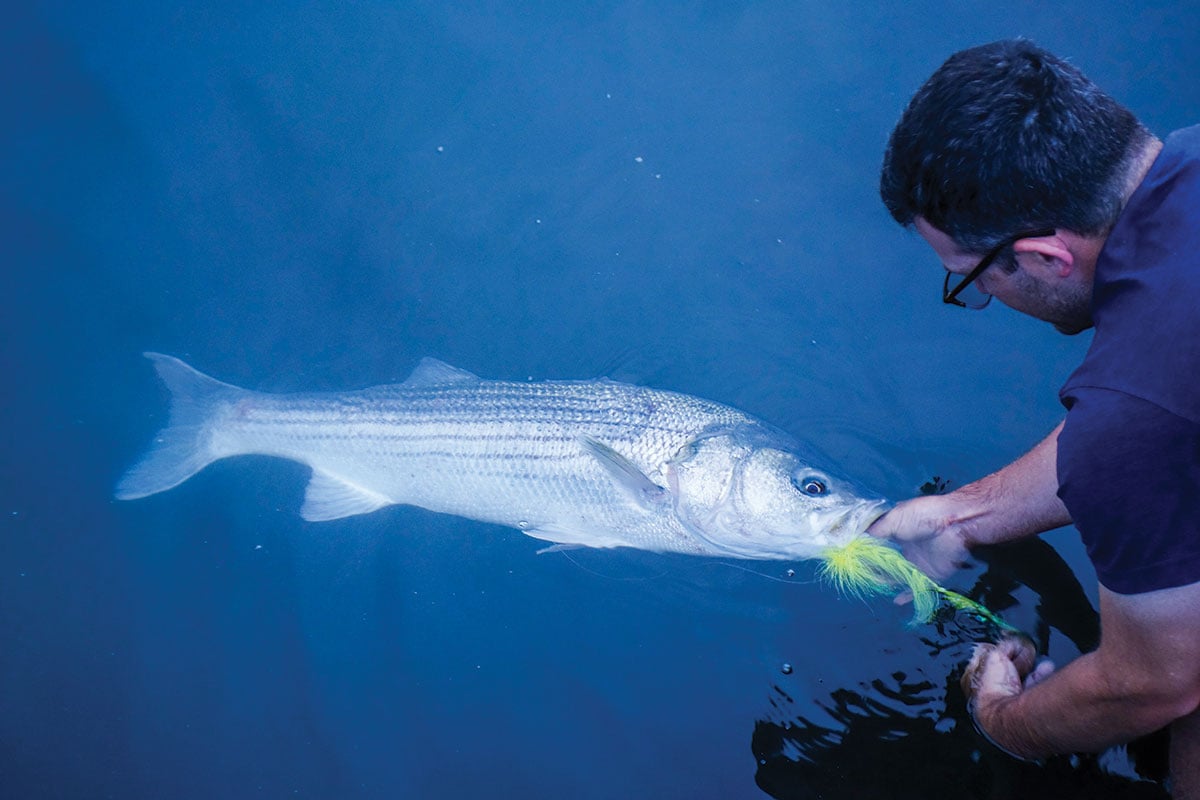
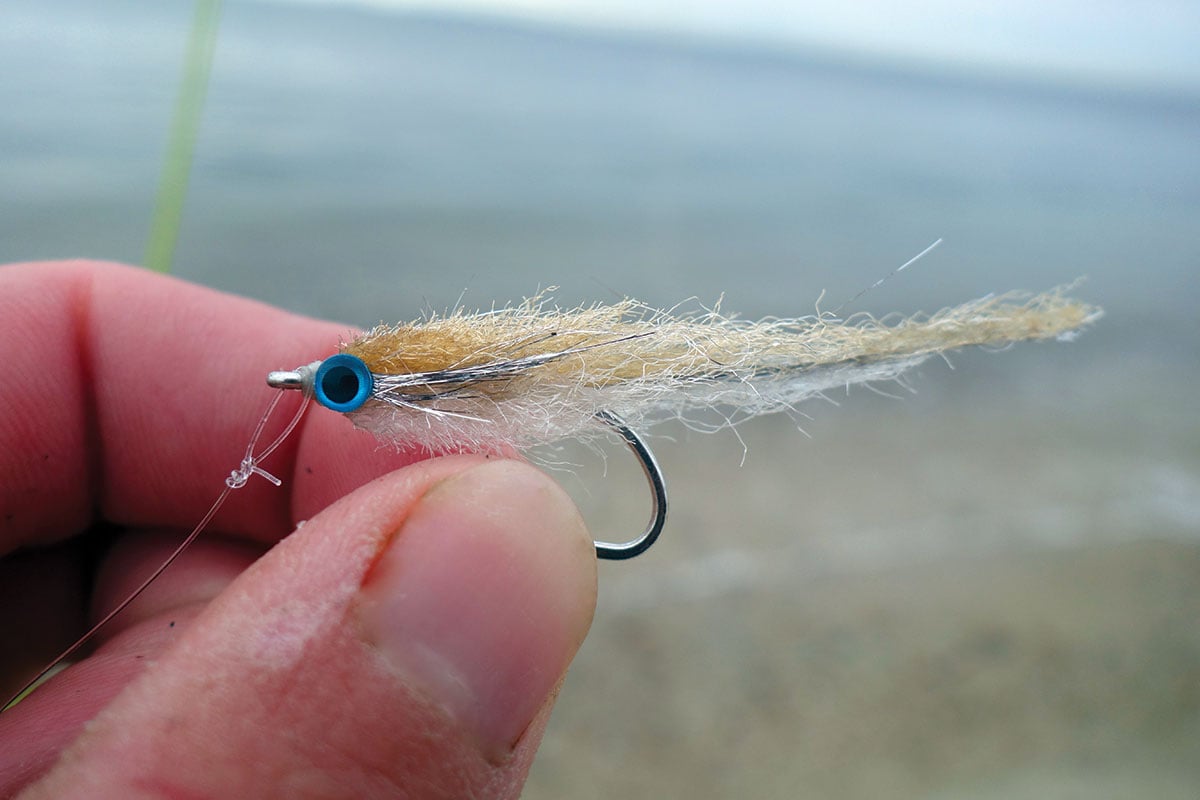
Though articulated and multi-hook flies are not uncommon at all, they are a bit rarer in saltwater and surf fly fishing. Fly designers have rightly realized that in most cases, striped bass eat prey fairly head-first, at least hitting large baits towards the front end. Bass have no cutting teeth and need a head first swallow to have a shot at getting a large bait down. Even giant, 12-inch long Beast Fleyes have a single hook way up front. When it comes to hooking large bass especially, this is all that’s necessary. It’s also far, far better – proven in recent mortality studies – for the fish than treble hooks. It’s even safer for the angler too.
It’s my opinion too that single hooks stay in the mouths of big striped bass better than multiple treble hooks both because of wider gaps reducing skin hooking, where a hook can be pulled easily on a heavy fish, and because multiple hooks result in multiple leverage points that a bass can leverage to get free. Trading trebles for assist hooks towards the front of topwater plugs has proven to me to be far superior not only for hooking big bass but keeping them hooked, as well, counterintuitive as it may seem. On the fly rod, I find I rarely lose big bass in any fashion that would have been saved with multiple hooks or treble hooks. Shed them where you can.
9. Embrace The Handicap
Surfcasters are already dealing themselves a more difficult hand. We insist on catching our fish from within the elements, only where we can reach them with walking or a bit of swimming, feet planted on rock, sand, mud, or grass. Giving the fish a chance is fun. The challenge is exciting, engaging and worth the time and effort involved. To me, and to many flyrodders like me, fly fishing provides this, as well. Sometimes, confining ourselves to the amount of line we can aerialize and the artificial imitation that line can carry gives the fish a massive edge. That’s fine. Humans have all the advantages. We have so many advantages, in fact, that we’ve managed to wipe out entire once-thriving fisheries.
So, through borrowing some thought processes and tactics from fly fishing and bringing them into the broader realm of surfcasting, you may find new advantages you didn’t know you had, it is my opinion that we should all also embrace and respect the personal choices to constrain ourselves. We win often enough, and those wins taste so much sweeter when they come through the effort and learning that comes of self-imposed handicaps.