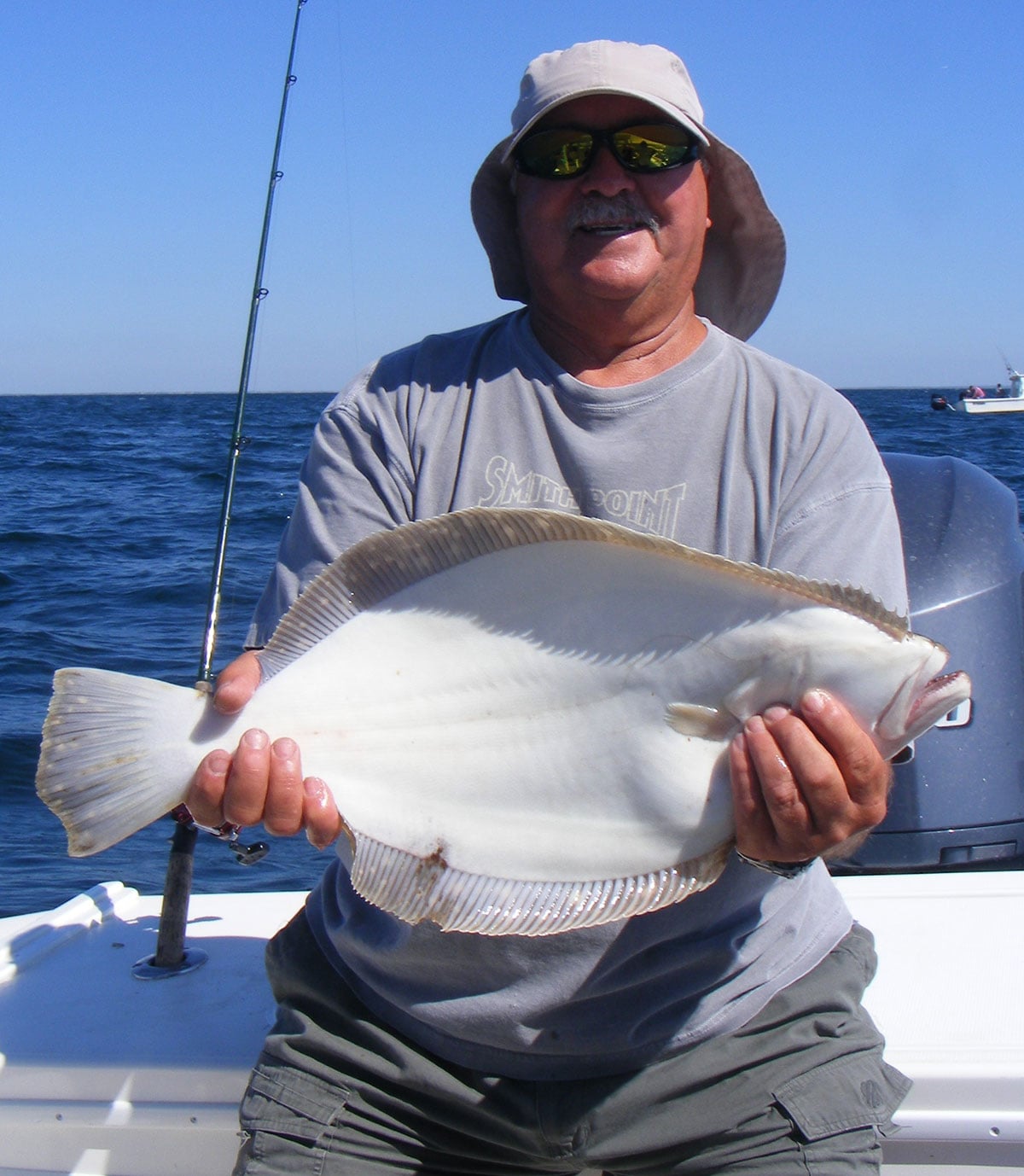
Late-season tactics for targeting trophy fluke around Long Island’s South Shore artificial reefs.
Along with the black flies that just love to bite down on your sweating arms and legs, the days of fall come with open arms. As the change of season brings more comfortable weather, it also brings the departure of the summer flatties as they begin to migrate out of the South Shore inlets. From there, they will spend their winters offshore along the deep Gulf Stream waters of the Continental Shelf.
However, before packing up and making that long haul to the deep blue, they’ll make a pit stop for a week or two at one of eight fish resorts better known as artificial reefs. Here, they will hang out along the sandy fringes, feasting on a myriad of baitfish and juvenile fish before making that long voyage to their wintering grounds.
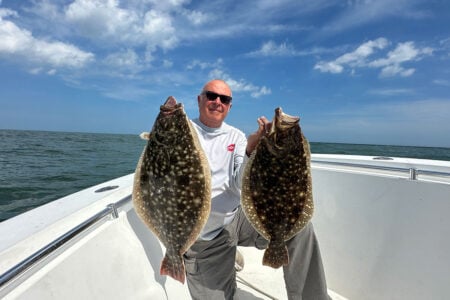
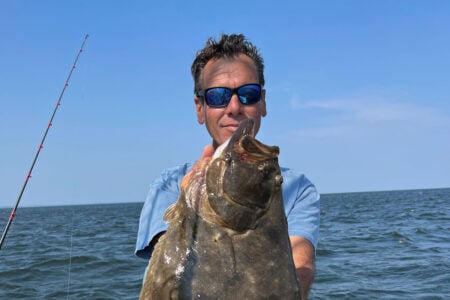
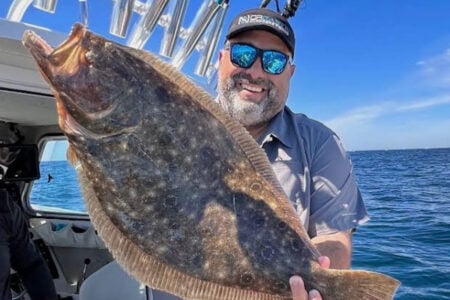
For fishermen and divers, it’s one of the best times of the season, as many fluke in the 7- to 10-pound range end up on the fillet table. After a summer filled with plenty of short fluke, the reefs can produce some nice surprises. Therefore, if nailing a semi-doormat or two appeals to you, read on to increase your odds of doing so.
Long Island Sunken Treasure
Located within a few miles of the South Shore inlets are Long Island’s “sunken treasures,” in the form of eight artificial reefs developed by New York State to improve sport fishing and provide exciting diving destinations.
In 2018, most of the South Shore reefs received an overhaul as New York State commenced the largest expansion of artificial reefs in state history. Recycled materials, including boats, barges, old Tappan Zee Bridge materials, steel trusses, pipes, girders, concrete panels and much more, have been deployed on existing reef sites to enhance marine habitat.
These materials are selected to provide suitable habitat for marine life that is safe, effective and long-lasting. Artificial reefs create complex habitat in areas that lack intricate hard-bottom structure, which is common off Long Island, where much of the seafloor consists primarily of flat sand and silt.
Artificial reefs enhance the marine environment by creating biologically diverse areas that provide food and shelter for a range of marine organisms. Over time, the hard structures are covered with algae, mussels, barnacles, sponges, anemones, hydroids, temperate corals and other encrusting organisms.
Many fish and crustacean species, including black sea bass, blackfish, porgies and fluke, as well as lobsters and Jonah crabs, are attracted to the reefs and surrounding areas for food and shelter. Artificial reefs are also used by some species for spawning. As a reef matures, it begins to resemble a natural reef and provides increased opportunities for both saltwater fishing and scuba diving.
Fluke At The Reefs
Don’t let the mild-mannered appearance of a fluke fool you. In actuality, this species is both carnivorous and voracious. Fluke are bottom-dwelling predators that camouflage themselves by matching the color of the surrounding bottom and burying themselves in the sand while waiting to ambush unsuspecting prey.
All of the artificial reefs have plenty of sandy fringes both inside and outside the reef structures where summer flatties can set up shop. Anglers who know their local reefs will often make short drifts through the open pockets between obstructions, picking up their rigs and jigs before getting hung up on a wreck or other structure. Quite often, these inside pockets produce some of the biggest fluke.
If you’re unfamiliar with the reef you plan to fish, start by working the outer edges to minimize snags. During September and into October, these outer edges are often paved with mixed-size fluke.
The challenge at times is that the fluke may be lying tight to the edges of the structure, making it difficult to drift directly over the targets. Capt. James Russo, former captain of the Moriches-based open boat Rosie, would take his small boat and anchor along the edges of Moriches Reef with a spinning rod in hand, using a Spro Bucktail and teaser baited with fresh fish belly strips. James would cast into the reef and catch fluke after fluke, including fish to 9 pounds.
I strongly suggest employing a similar tactic. Anchor on the side of the reef where the wind and current will hold the boat in position, allowing you to cast along the edges where many of the fluke will be situated.
During peak periods, when large numbers of fluke have exited the bays, you may also encounter massive concentrations of flatties feasting on squid, anchovies and sand eels near the reefs. Drifting over schools of baitfish marked on your fishfinder can produce fast-paced action with mixed-size fish.
You will often find these bait schools within a half-mile radius of the reefs, so don’t ignore those marks, especially when bait is holding close to the bottom.
Choice Of Armor
Since depths at the reefs range from approximately 45 to 105 feet, it is important to carry tackle capable of handling the conditions. Rods should have fast-tapered tips with the sensitivity and backbone necessary to handle weights up to 8 ounces.
Reels, whether conventional, baitcasting or spinning, should be quality models loaded with fresh braid or fluorocarbon line. When drifting near or along the reefs, a 7-foot conventional or baitcasting rod equipped with a 3/0-size reel should handle the task just fine.
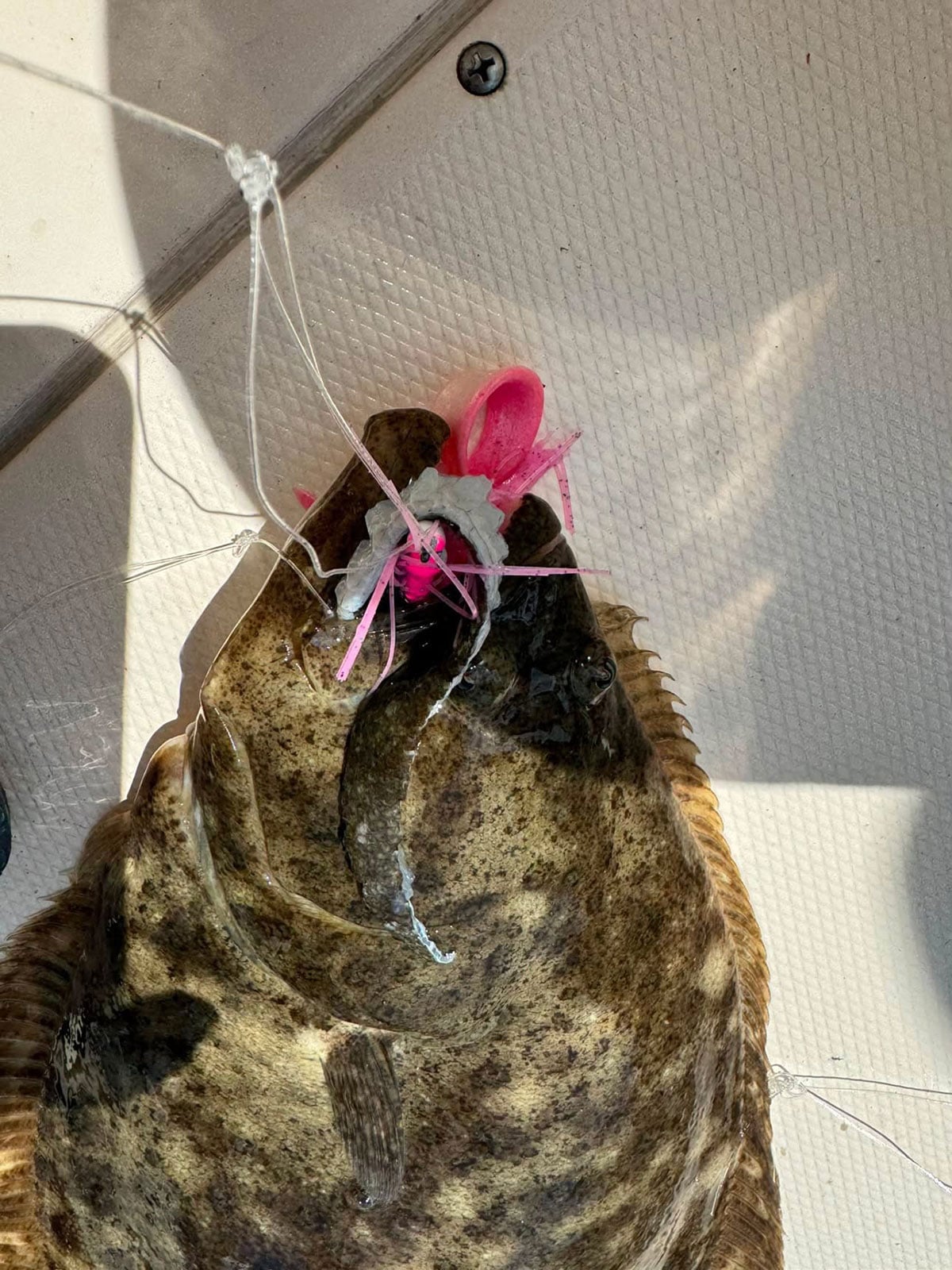
If you decide to anchor and cast into the reef, a 7-foot spinning rod paired with a 3000-size spinning reel will suit the application. My favorite spinning combination for the task is a 7-foot Spro Fluker Rod paired with a Spro Vortex-E 3000 GR reel loaded with 12-pound Spro Gouken Fluorocarbon Line, which has an ultra-thin 150m/0.285mm diameter. My lure of choice is the Spro Prime Bucktail from 1 to 4 ounces, depending on the strength of the current. White, glow, pink and spearing blue are all fluke killers.
As the old saying goes, “If it isn’t broken, don’t fix it.”
I will usually place a Spro Teaser in white or glow approximately 18 to 24 inches above the Prime Bucktail via a dropper loop. If you prefer, traditional fluke rigs will also work well, especially when the flatties are stacked along the edges of the reefs or when making longer drifts.
Fresh Baits That Stink
Traditional baits such as squid, spearing and sand eels, as well as Berkley Gulp, will certainly fit the bill. However, when it comes to ocean fluke fishing, nothing beats fresh or previously frozen fish bellies and strips.
If you want big fluke in the 6- to 10-pound range or better, an 8- to 9-inch strip of fluke ribbon or a 6- to 8-inch strip of sea robin belly or body can prove deadly. If dogfish are around, a strip of dogfish belly can also be extremely effective.
Bluefish, mackerel and fresh-caught bunker strips all give off plenty of scent that jumbo fluke have a difficult time resisting. With the exception of bunker, you can freeze unused strips and still have effective bait, provided they are frozen only once and used within about a month when vacuum-packed.
Have A Backup Plan
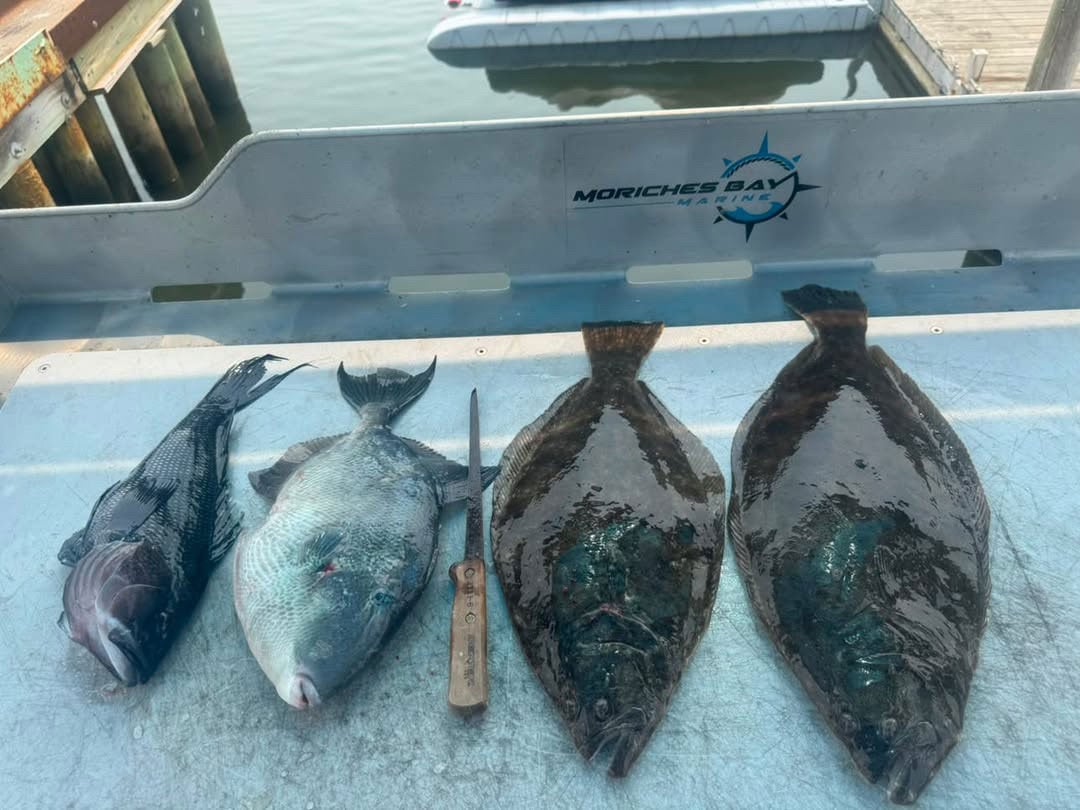
Remember, if for some reason the fluke decide to take the day off, include some hi-low rigs and clam bait in your arsenal. There will likely be sea bass, porgies and some southern bottom dwellers waiting around one of the countless pieces of reef structure to keep your rod bent.
Also remember to carefully watch the weather and sea conditions when traveling in and out of any of the South Shore inlets. Breakers this time of year can be challenging, and conditions can change quickly.
Lastly, make sure to be a Fisherman subscriber, as the chances of nailing a Dream Boat Challenge fluke are better than good, and I would hate to see you miss out on a shot at a 2026 Steiger Craft.
South Shore Artificial Reefs
ATLANTIC BEACH REEF
Size: 850 acres (3,085 yards x 1,335 yards)
Depth: 62 to 73 feet
Materials: 5 vessels, 13 barges, 2 boat hulls, 6 pontoons, surplus armored vehicles, 2 drydocks, Tappan Zee Bridge materials, 16 steel center-beam railcars, 2 steel miter gates, 1 steel Tainter gate, steel bridge girders, steel lift-bridge sections, steel pipe, steel lifting towers, rock, concrete cesspool rings, slabs and rubble.
Coordinates:
40.32.020 / 73.43.700
40.32.020 / 73.42.400
40.31.530 / 73.43.700
FIRE ISLAND REEF
Location: Atlantic Ocean, 2.0 nautical miles south of the Fire Island Lighthouse
Size: 850 acres (3,085 yards x 1,335 yards)
Depth: 62 to 73 feet
Materials: 5 vessels, 13 barges, 2 boat hulls, 6 pontoons, surplus armored vehicles, 2 drydocks, Tappan Zee Bridge materials, 16 steel center-beam railcars, 2 steel miter gates, 1 steel Tainter gate, steel bridge girders, steel lift-bridge sections, steel pipe, steel lifting towers, rock, concrete cesspool rings, slabs and rubble.
Coordinates:
40.36.100 / 73.13.500
40.36.100 / 73.11.500
40.35.440 / 73.13.500
HEMPSTEAD REEF
Location: Atlantic Ocean, 3.3 nautical miles south of Jones Beach State Park
Size: 850 acres (3,085 yards x 1,335 yards)
Depth: 50 to 72 feet
Materials: 14 vessels, 2 barges, 3 steel power plant turbines, 16 steel center-beam railcars, surplus armored vehicles, 1 drydock, Tappan Zee Bridge materials, City Island Bridge materials, Mill Basin Bridge materials and steel bridge trusses.
Coordinates:
40.31.250 / 73.33.350
40.31.500 / 73.31.370
40.30.553 / 73.33.555
McALLISTER GROUNDS
Location: Atlantic Ocean, 2.8 nautical miles south of Long Beach
Size: 425 acres (2,036 yards x 1,020 yards)
Depth: 48 to 53 feet
Materials: 4 vessels, 4 barges, 7 pieces of a 100-foot scow, 2 steel miter gates, 3 steel dam gates, 1 steel power plant turbine, rock, concrete barriers and concrete bridge rubble.
Coordinates:
40.32.488 / 73.38.892
40.31.985 / 73.38.940
40.32.547 / 73.40.209
MORICHES REEF
Location: Atlantic Ocean, 2.4 nautical miles south of Moriches Inlet
Size: 850 acres (2,025 yards x 2,025 yards)
Depth: 70 to 80 feet
Materials: 12 vessels, 5 barges, surplus armored vehicles, Tappan Zee Bridge materials, 4 steel center-beam railcars, steel floor beams and concrete pipes. Fish pots are banned by New York State law.
Coordinates:
40.43.700 / 73.46.820
40.43.700 / 73.45.500
40.42.700 / 73.46.820
ROCKAWAY REEF
Location: Atlantic Ocean, 1.6 nautical miles south of Rockaway Beach
Size: 635 acres (2,639 yards x 1,173 yards)
Depth: 32 to 40 feet
Materials: 1 barge, 60 steel buoys, Tappan Zee Bridge materials, rock, concrete slabs, pipes, culvert, decking and rubble. Rock rubble is scattered throughout the reef site. Fish pots are banned by New York State law.
Coordinates:
40.32.780 / 73.51.380
40.32.200 / 73.49.670
40.32.200 / 73.51.380
SHINNECOCK REEF
Location: Atlantic Ocean, 2.0 nautical miles south of Shinnecock Inlet
Size: 850 acres (2,025 yards x 2,025 yards)
Depth: 76 to 84 feet
Materials: 8 vessels, 5 barges, surplus armored vehicles, 7 steel center-beam railcars, 1 drydock, rock, Tappan Zee Bridge materials, a steel and concrete tower, steel and concrete bridge rubble, steel pipes, steel beams and steel bridge trusses. Fish pots are banned by New York State law.
Coordinates:
40.48.600 / 72.28.930
40.48.600 / 72.27.600
40.47.600 / 72.28.930