Fall into winter, a post stock analysis with tips and tactics.
The surest way to know the difference between a stocker and a trout becoming wild is to observe where it holds in a river. If the trout swims randomly through a stretch, that trout is looking for the raceway walls it has oriented to all its life. But when it begins to take up favorable holds, it’s behaving in the wild as a trout should behave.
Trout are drawn to features of a river they relate to. There may be more than a dozen trout in a deepwater stretch, but each of those fish finds its own familiar lie, even though it does things like swim short distances with other trout.
In the fall and on through January, I’ve caught trout from shallows where holding water was differentiated from the rest of the stretches by no more than a foot of depth. Nothing arbitrary or random exists about these spots. They are objective, as is all of nature, and they produce trout year after year to prove they are. It’s no surprise that the surrounding shallows of the stretches I’ll mention again, don’t produce.
Post Stocking
In October, our rivers receive a fresh dose of trout, including the South Branch and North Branch, the main stem Raritan, Toms River, Lamington, Pohatcong, Musconetcong, Rockaway, Pequest, Paulinskill, and Flat Brook. The trout swim around disoriented, but hit jigs and other lures, and they’ll take bait. They congregate a stretch without spreading out into others, swimming aimlessly for a week or two, maybe three.
I have too much respect for those fish to not look forward to colder weather when they’ve become sane. Where trout hold defines them as fish worthy of our rivers, and since it takes less than a month for most of them to adjust, my river fishing, for the most part, gets underway with black marabou jigs in November. Fishing in December and January, there’s even more of a sense that the fish are natural.
On into March, I continue to use black marabou jigs. I tried white under sunny conditions supposedly good for light colors, and although I caught one trout, I observed six or seven in a clear hole refuse that jig, only to immediately take interest after I switched to a black one. I have a lot of confidence in black.
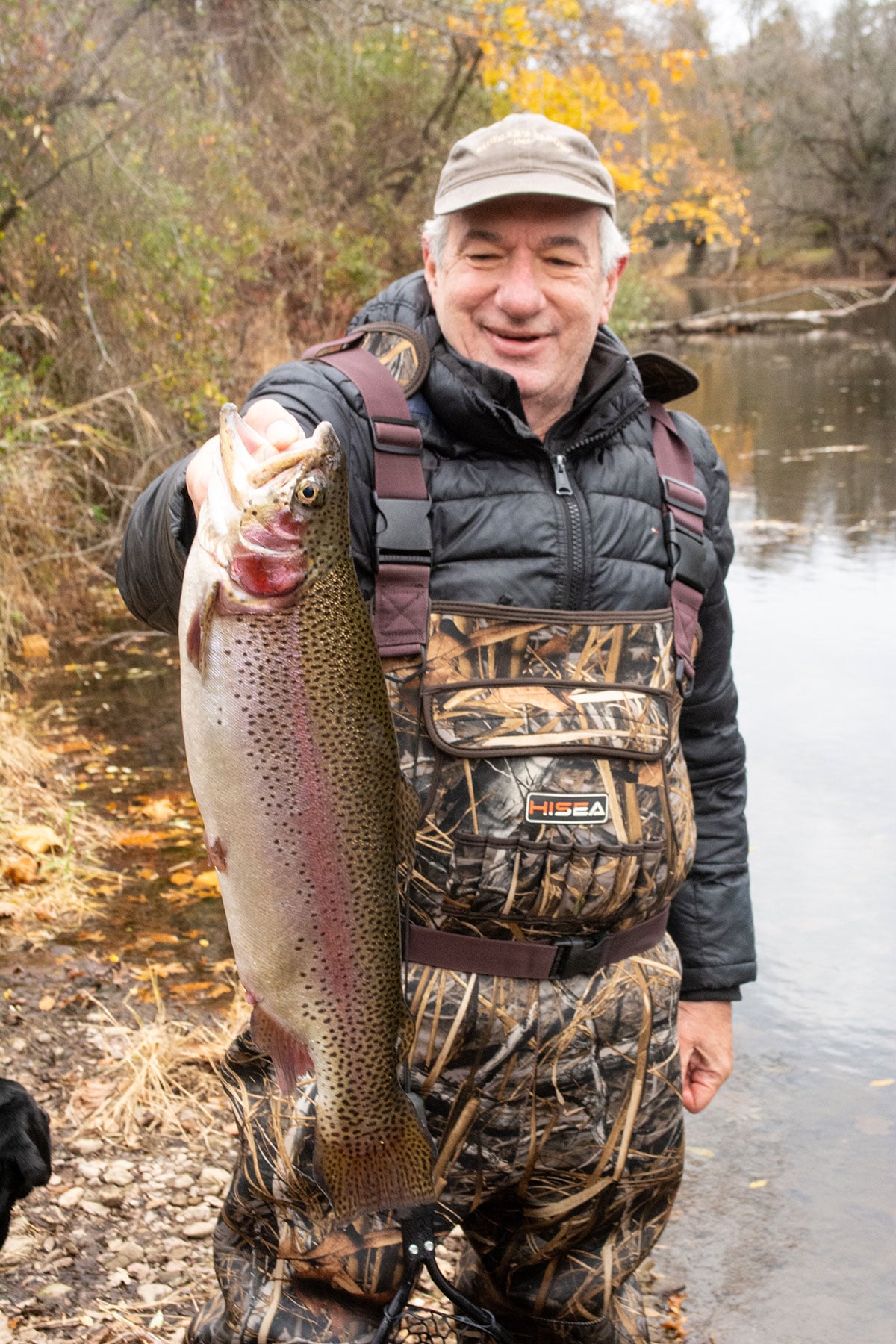
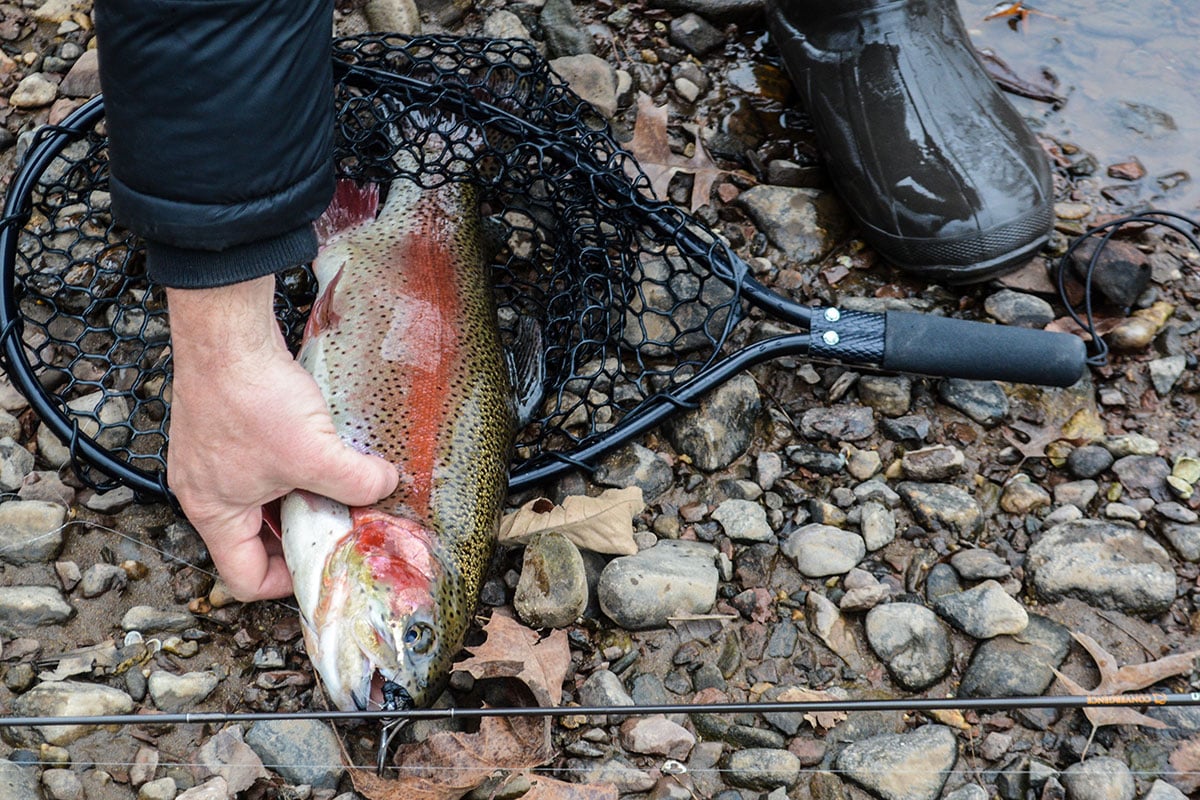
What does discourage me is raceway-damaged fins, especially the tailfin. I caught a rainbow this past December that weighed 3.88 pounds. It didn’t fight much on my 4-foot, 6-inch St. Croix, and about that, I’ll offer you some food for thought. People who ice fish muskies use live suckers under tip-ups. Imagine how one of those stanchions supporting a spool in a hole would perform without cutting off the sucker’s tailfin. You couldn’t keep the flag from tripping.
Late fall and winter trout fishing is a two-tiered story. It can be understood as a manifold story, but let’s focus on shallow and deep. Middling depths also exist, but dividing the flow into two simplifies the matter. Besides, a lot of fishermen – unable to get deep holes off their minds – are blind to all else besides deep water. They don’t see shallows as offering them any prospect. I bet you’re a little hung up that way. I am. So, let’s consider deep water first.
I never forget a friend at work telling me about a spot. In hushed tones, he divulged the location of a Pequest River hole. I imagined catching a winter rainbow weighing 10 pounds. A fish I believed I would need to coax with a live shiner. Since the time I held the job, I did catch a 5-pounder from deep water on a black marabou jig, but I’m not bragging, because at least one man has caught more 5-pound winter trout than he can probably remember. Some 10-pounders, too. Shiners or jigs? Out of the question. He uses center-pin outfits.
But if you don’t want to get involved in a whole new way of tackle and technique – I don’t, besides interviewing the guy, maybe – plenty of other winter fishermen will back you on the effectiveness of jigs. They’re not the only way to go, but they’re what I find time for, and I love ‘em.
To finish my story about that mysterious Pequest hole, sure enough, one comfortable day during the spring of 2017, another friend and I found what I felt sure was that hole, only it seemed plain and ordinary. Mike Maxwell has since gone into business as a mechanic, so we haven’t been fishing, but during that afternoon, we caught a lot of stockers on salmon eggs.
From Deep To Shallow
Holes hold fall-stocked trout through the winter. They’re not spots to pass up, even if they’re not laden with honey. Despite the promise any of us feel, usually they’re a tough sell. Probably most anglers quit before hooking up. But winter, and the size of the trout stocked, have the effect of making even catching one fish feel fulfilling. Almost every time out, I do catch at least one, sometimes three, but even though I’ve done this for years, I always feel astonished at catching any. I fish maybe three hours. It’s not an all-day quest for me.
But back to that question of just how productive these holes are, you might have to plumb a deep hole long and hard before you get hit. Once, I fished a hole I know holds trout. More than a full hour passed before my rod doubled over. Black marabou jigs, they’re the thing. Usually 1/16-ounce, but even 1/8-ounce when needed, worked through the mid-column and near the bottom. The retrieve does not need to be as slow as you probably think.
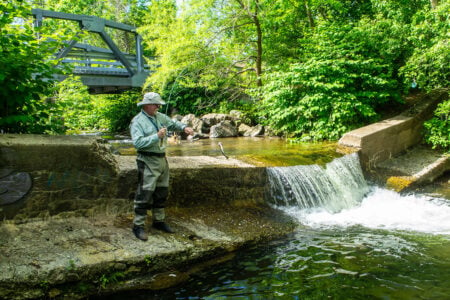
That being said, I catch as many winter trout from shallows as I do from deep water, even when ice covers most of a stretch. By “shallow” I mean thigh-deep when the river has a normal flow. One spot always produced for me, until I tried it when the level was especially low. Possibly, someone had fished it out, but my mind later leapt to imagine the fish finding comfort in the 4-foot depths downstream a hundred yards.
That situation would make anyone wonder why the trout don’t always go downstream to those depths, but at least until February, some inhabit water about 1-1/2 feet shallower. Three or four stay there, rainbows always at the ready to nab a jig. Maybe it’s because of a copious population of scuds, but the important consideration is that the water is 6 inches, maybe a foot deeper than surrounding water. Naturally, trout fill in the space. Probably scuds, too. I like to bring some of my river trout home to my wife, and when I clean them, I find they’re full of those scuds. Gammarus is the genus of some 200 species of these freshwater, estuarine and marine crustaceans. The ones our river trout feed on are sometimes called freshwater shrimp.
I catch trout from another thigh-deep spot surrounded by some 500 yards or more of knee-deep shallows. On downstream, there’s a small hole 4 or 5 feet deep where I once got hit. The trout back upstream have no clue to its existence. They find water 6 inches, maybe a foot deeper than they got tossed into, and they stay there at least through December. I stand knee-deep and cast into water 10 inches deeper. They’re not just average stockers I catch. A couple weighed nearly 4 pounds; another was well over 4 pounds.
Waders & Tackle
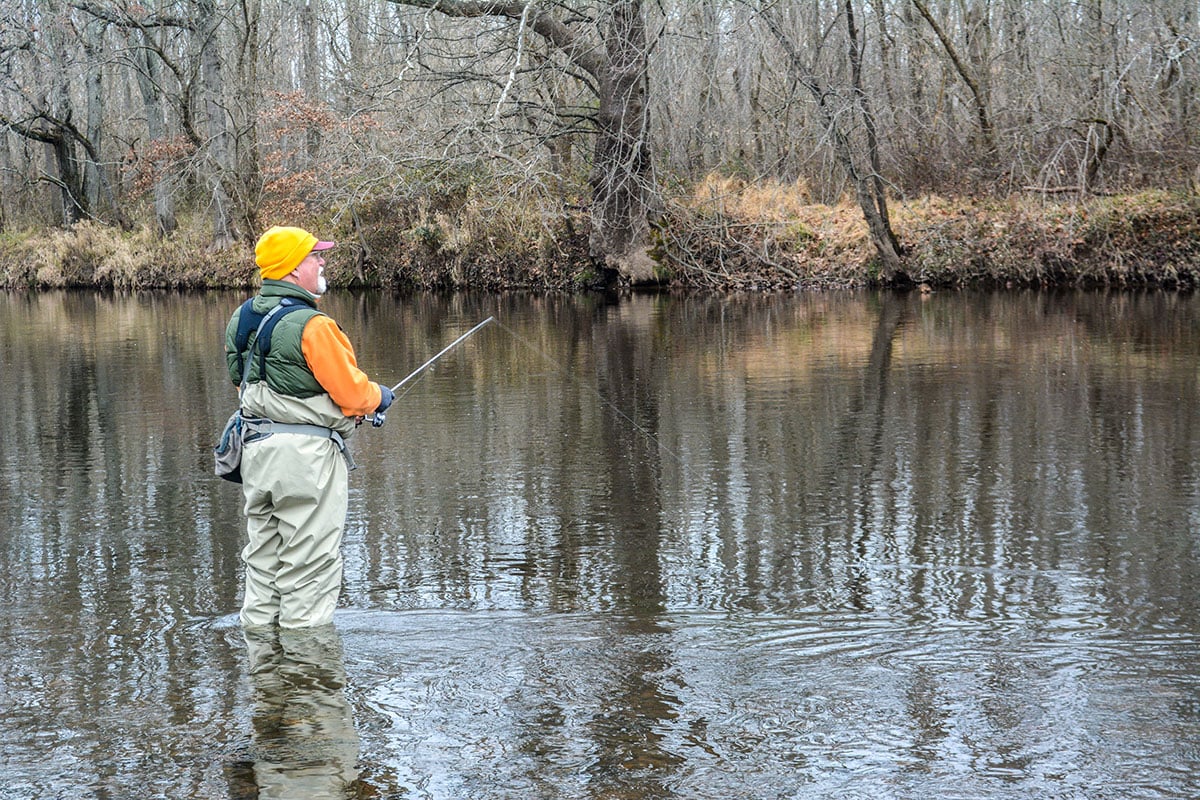
If you have only breathable waders, consider neoprene. You won’t regret owning a new pair, if you take up winter trout as a habit. It’s that factor of wanting to do it. It took me a couple years before I committed. For about $150, you can probably get a set to last many seasons. I’m assuming that for now, you have breathable waders. The booties go into separate wading boots, but neoprene waders have boots attached to them. Make sure the Thinsulate is no less than 600 grams. Mine are 600 grams, and I’m into my sixth season without complaint.
All my boots are size 14, except size 13 hikers. Sized-up boots for my neoprene waders leave me some room for warm socks. And, during spring, for those neoprene booties in my wading boots. During winter, the neoprene wader fabric reaching to my chest is the most comfortable fit of all my clothing items.
In keeping with being comfortable – and just as important as the rod and reel – is the right line to cut the difference between frustration and freedom. I tried Berkley XT because I figured a tough line will protect against abrasions, but especially due to the cold – when the wrong monofilament can be unmanageable – it was a mess to cast. Stiff and uncooperative, it only moved me to rip it off the spool of my reel and retire the rest. It’s never served me any further purpose, and for the trout, I’ve used XL ever since. If you don’t like Berkley, go with a limp, castable, 4-pound test monofilament line of another brand. I know a lot of fluorocarbon lines advertise being limp, but you can be assured limp monofilament is that. A limper line will cast further, and the diameter of fluorocarbon line may be no less than mono of the same test.
My line is spooled onto a 500 series and a 1000 series reel. The rods are a 4-1/2-foot St. Croix ultralight and a 5-1/2-foot Shimano ultralight. While I much prefer the tiny reel and St. Croix, sometimes I need extra casting distance. With the Shimano, I get a jig all the way across the river where I’ve hooked up at least once. I get, at most, three-fourths of the way across with the smaller rod. I can punch a 1/8-ounce jig with the long rod, but most of the time, 1/16-ounce is better. It’s critical to use the smaller jigs when piecing out the shallows.
The author is working on his latest book, “The Microlight Quest: Trout, Adventure, Renewal”.