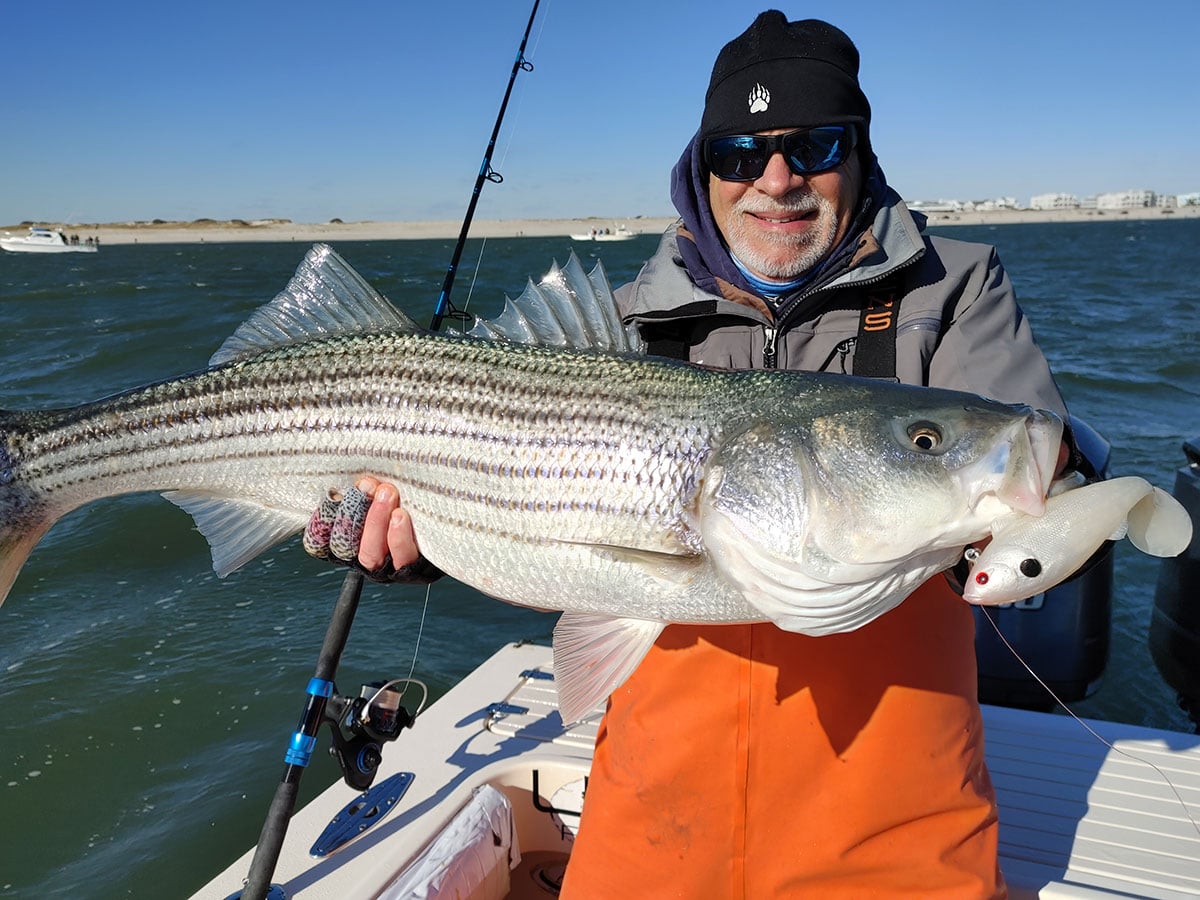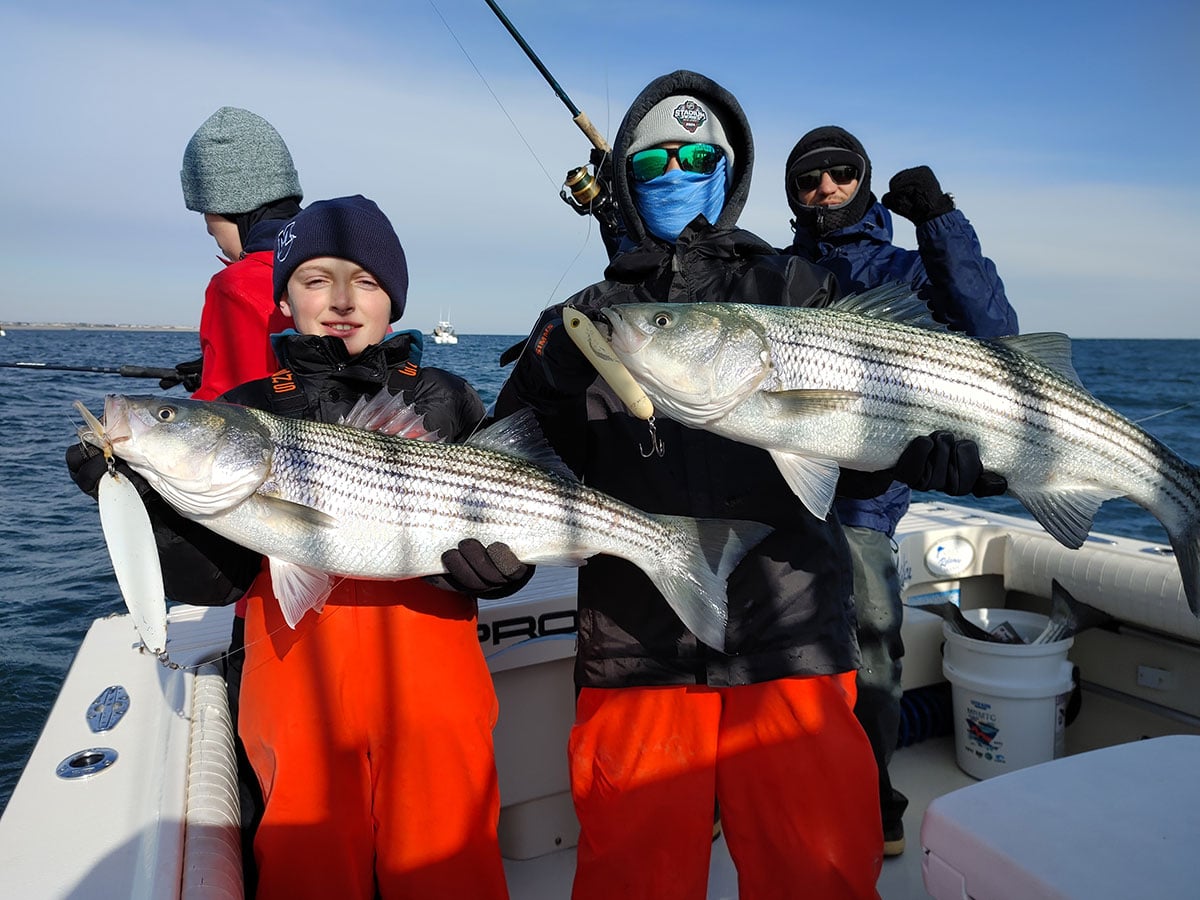
A moveable striper feast, transitioning from bunker to sea herring.
One of the things I like about December is that big baits can give us one more shot at big bass. Having the opportunity to catch bass from 20 to 40 pounds for a couple of weeks is a great way to end a season. Many of the no fish days of the fall are soon forgotten and these December memories and photos are enough to get you through a long cold winter.
The big bait that appears coming from the north, carrying the migratory bass that are on their way to their wintering grounds to the south, is the sea herring. These herring are different from their anadromous spring cousins the alewife and bluebacks and are the Atlantic herring that many anglers will jig with Sabiki rigs and then pickle, can, and eat.
Ultimately, what extends our season and keeps bait and striped bass in our area are tolerable water temperatures. Looking back and checking my temperature logs for the month of December we usually see ocean temperatures drop from 50 degrees at the beginning of the month to 44 degrees by Christmas time during a mild winter. In fact, during a mild winter I have noticed that water temperatures drop about 2 degrees a week, which should give the bait and bass plenty of acclimation time to settle in.
If, however, we have icy cold fronts with below freezing temperatures dropping down out of Canada lasting for a week or more, ocean temperatures can plummet quickly into the lower 40-degree ranges, and our December run of sea herring and big bass will end quickly.
The sea herring run because of their pelagic nature – meaning open ocean – as they travel in schools by the thousands and rarely come in the surf zone. Finding where the major concentrations of sea herring are located outside of your home port is key to getting on the big bass as they will stay tightly packed with them. It is not difficult however as bass will push these baits to the surface causing all kinds of surface commotion and attracting a multitude of gulls and gannets in Hitchcock style fashion. With a good pair of binoculars, or possibly by using your radar, one can spot birds working over the school from a good distance away.
Boats, Bait & Bass
Catching big bass at this time of year is as fun and easy as it is multidimensional. It is easy because the bass are fueling up and gorging themselves this time of year as they prepare for their final migratory run south for the winter. As a result they will hit a variety of offerings; there is no one magic artificial, there are many. It is multidimensional because you can catch them on the surface, mid-level below the surface, and down deep. This is because sea herring will be spread from top to bottom in the water column simply because there are so many of them stacked on top of each other. And it’s fun because the bass are big and we target them with relatively lighter tackle.
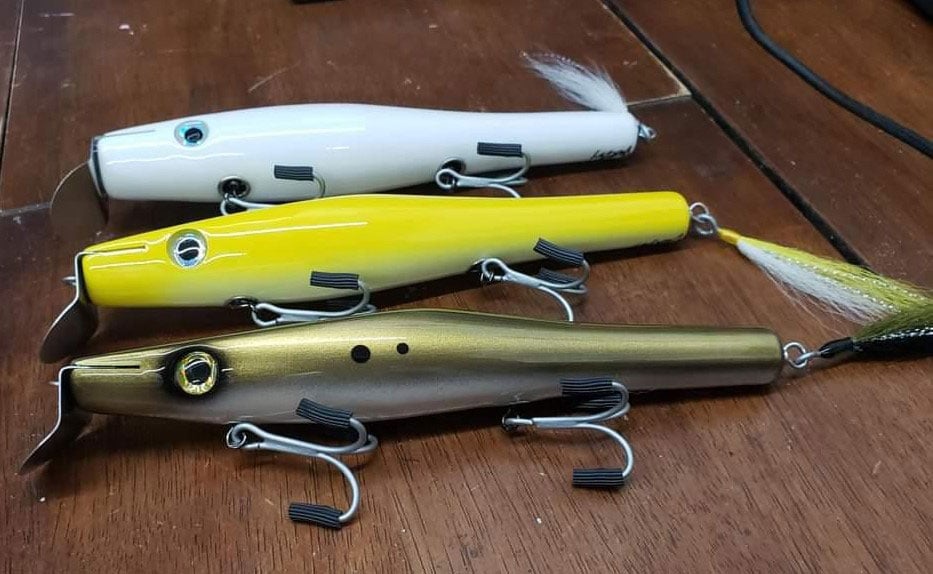
Pulling into a visual melee of bass blowing up on top amidst the bird play, a “surround sound” of bird chorale, is one of the most exciting ways to end your season. In situations like this I will cast my topwater favorites Mantis Planks, J.P. Spooks, and Docs. One can usually see a big bass waking behind the artificial and then exploding on it. All three are “walk the dog” style artificials, lures that move across the top of the surface darting side-to-side. This motion gives the appearance of an injured herring struggling on the surface. My favorite colors to use are bone and yellow. And of course, don’t forget the glide baits!
When the bass are subsurface down to 20 feet this is when I love to throw metal lips and deep diving plugs. My son, Capt. Tommy who also runs charters on my 28 Parker Sport Cabin, advises “Big metal lips are very versatile plugs because you can get them to do different things with distinct types of retrieves. Hard cranking retrieves will put more pressure on the lip and get them to dive deeper up to twelve feet while slower retrieves will have them run shallower and impart more of a wider wobble. You can also add in a quick jerk on the retrieve as this will make the plug dive quickly imitating a fleeing sounding herring.”
We live in an area with some of the best custom plug builders in the Northeast, so there are many metal lips that are available, and all of them will work. Keep in mind that you may pay a premium price for them! Major manufacturers like Tsunami and Gibbs also produce metal lips at a much more affordable price. The Yo-Zuri Hydro Minnow with its plastic lip will also work fine and is very affordable. Some of my favorite metal lips to use are the deep diving Back Bay plugs, Salty C’s, RM Smith, and the JP Surfster. My go to colors are all white, yellow, chartreuse, and gold.
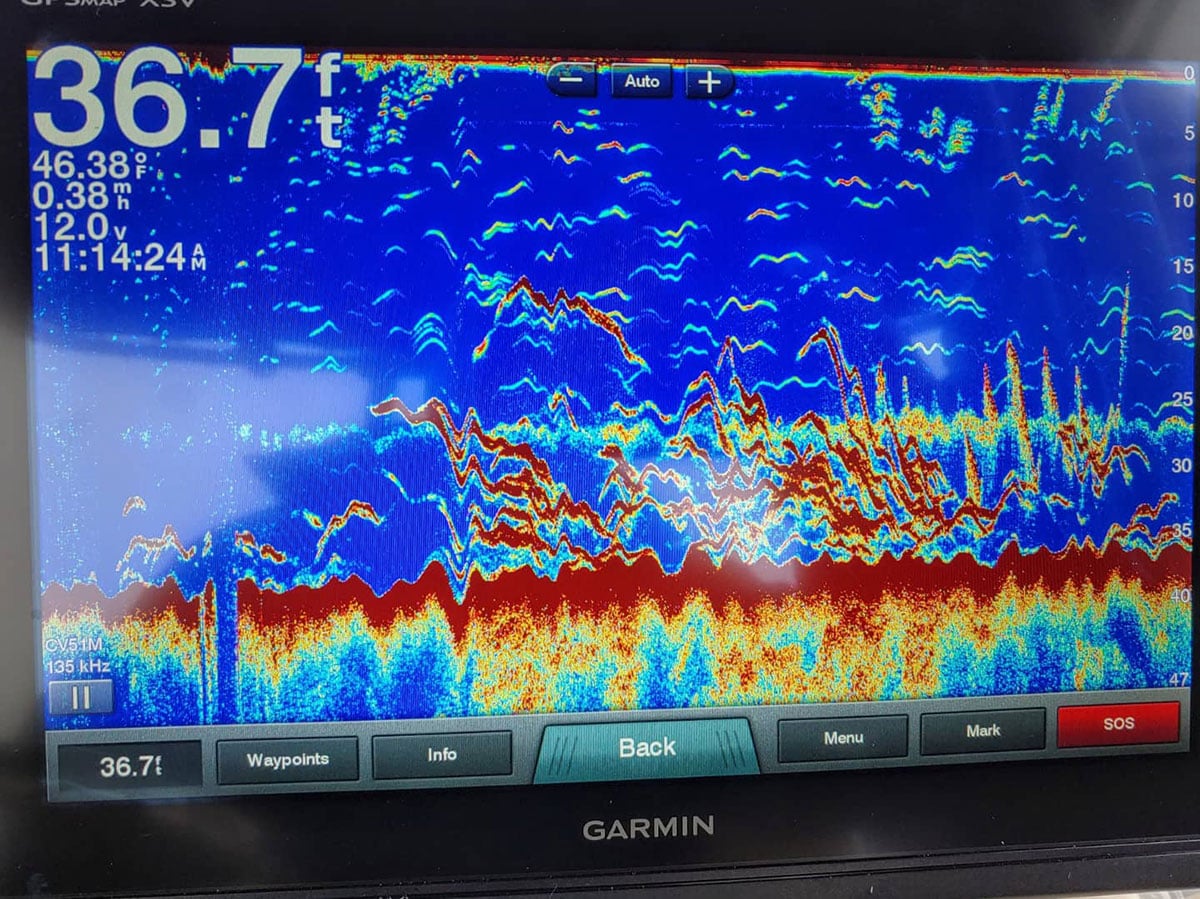
Down Deep
If we do not have surface action but the gulls and gannets are hovering up high spotting the herring we will fish deep. Once again many artificials will work. I like to use the Tsunami 6-1/2-inch internally weighted deep shad and the Tsunami 9-inch holographic swim shads with a 1- to 3-ounce MagicTail Killshot heavy-duty jighead. Also the 8-inch NLBN straight tail or paddletail, the Hogy Pro Tail paddles, and the new FishLab Mack Attack soft swimbait and Nomad Live Ops Dozer Paddle Tail Swimbait are also excellent choices. The colors I like are pearl, holographic green, or chartreuse.
With all these weighted shads I like to have clients cast them out as far away from the boat as they can and then have them sink to the bottom. They are then worked back to the boat in an erratic stop and drop type of motion. I prefer a slow to medium type of retrieve rather than ripping the bait through the water column.
Jigging flutter spoons near the bottom is also an option as these large pieces of polished metal mimics an injured herring that makes for an easy meal. I like to use spoons in the 8- to 11-inch range in white, chartreuse, or gold. My go to spoons are the Tony Maja Drift spoon, Tsunami Pro, Ben Parker Magnum, TAK, Aherns, and AllPro Flutter Pro.
For most of my applications from top to bottom I like to use the Okuma 7-foot heavy Silver Slayer paired with the 6000 Tesoro spinning reel. For flutter spoons I use the Okuma 8-foot PCH conventional rod paired with the Cavalla 5-II lever drag reel. All my reels are spooled with 50-pound Nomad Panderra X8 braid with an FG knot connecting a 6-foot stretch of 40-pound fluorocarbon leader. Also my artificials are connected to my leader with a 175-pound Tactical Angler (TA) power clip. The TA clip allows for a quick and easy change of an artificial making no retying necessary. With all the different artificials that will work this clip is ideal to use.
On The Fly
Fly anglers can really have an adrenaline rush now and catch big bass that can make magazine covers. Casting Bob Popovics’s Beast Fleyes, bucktail deceivers, or hollow fleyes or Dave Skoks’s yak hair flies, big half and halfs, and wide bodied deceivers will all work when cast on ten weight rods. I like to use flies that are dressed in a lot of white blended in along their ventral aspect with blonde, yellow, or chartreuse on top. One can use a floating, intermediate, or a sinking line since the bass are present throughout the water column.
When a big bass hits the fly do not be fooled into thinking that you have a solid hook-up as it will hit hard. You will still need to impart a series of short powerful strip strikes while pulling your rod to the side. This motion will drive the hook into the fleshy corner of the mouth penetrating through it. Striking upward will put the hook into the upper bony palate of the bass where the bass can easily shake it out. Crushing the barbs down on your hooks will also deliver better penetration.
| A SAFE RELEASE |
| Take extreme care in releasing these big bass. Use a rubber coated net if you are bringing them in the boat for a quick photo. Cradle them horizontally – do not hold them vertically – and keep your hands out of the gills. After a quick photo, revive big fish by the side of the boat before you release them. Be sure to keep the bass’s mouth under the water when you do this as this will keep any more air from being inhaled. Wait for the bass to begin to kick before you give it a push and let it go. – Capt. Freda |
Finally keep safety in mind when you go down to the dock. Be aware that there can be a thin layer of skim ice on the dock or on the deck of your boat. On some days you may even have to shovel snow out of your boat. If so, use a plastic or PVC shovel for this. More than likely your marina will have the water turned off by this time, unless they have a well, so look to see if your gas dock has freshwater running when you fuel up and ask to use it.
And dress to stay warm for hours. I tell clients that if you go skiing in the winter then you probable have the right clothing to be outside all day, so do the same when fishing. Make the investment in good quality outerwear. My winter dress consists of five upper layers in this order. A tee shirt, long sleeve tee, a light fleece vest, a heavy hooded sweatshirt, and then a wind resistant waterproof insulated outer jacket. I will also put handwarmers or body warmers in my shirt pockets between the layers of my clothing but never directly on my body. I will also wear a pair of high quality Simms bibs under my last outer layer.
Wear waterproof gloves or have extra pairs of gloves with you in case one pair gets wet. I carry dry towels on board in a bucket with hand-warmers mixed in with them. This way a client can grab a warm towel and apply it to their hands for a while if they want to. Also I cover my head with a wool watch cap and the back of my neck with a neck gator.