Mastering the bunker blitz requires a blend of behavioral science & adaptability.
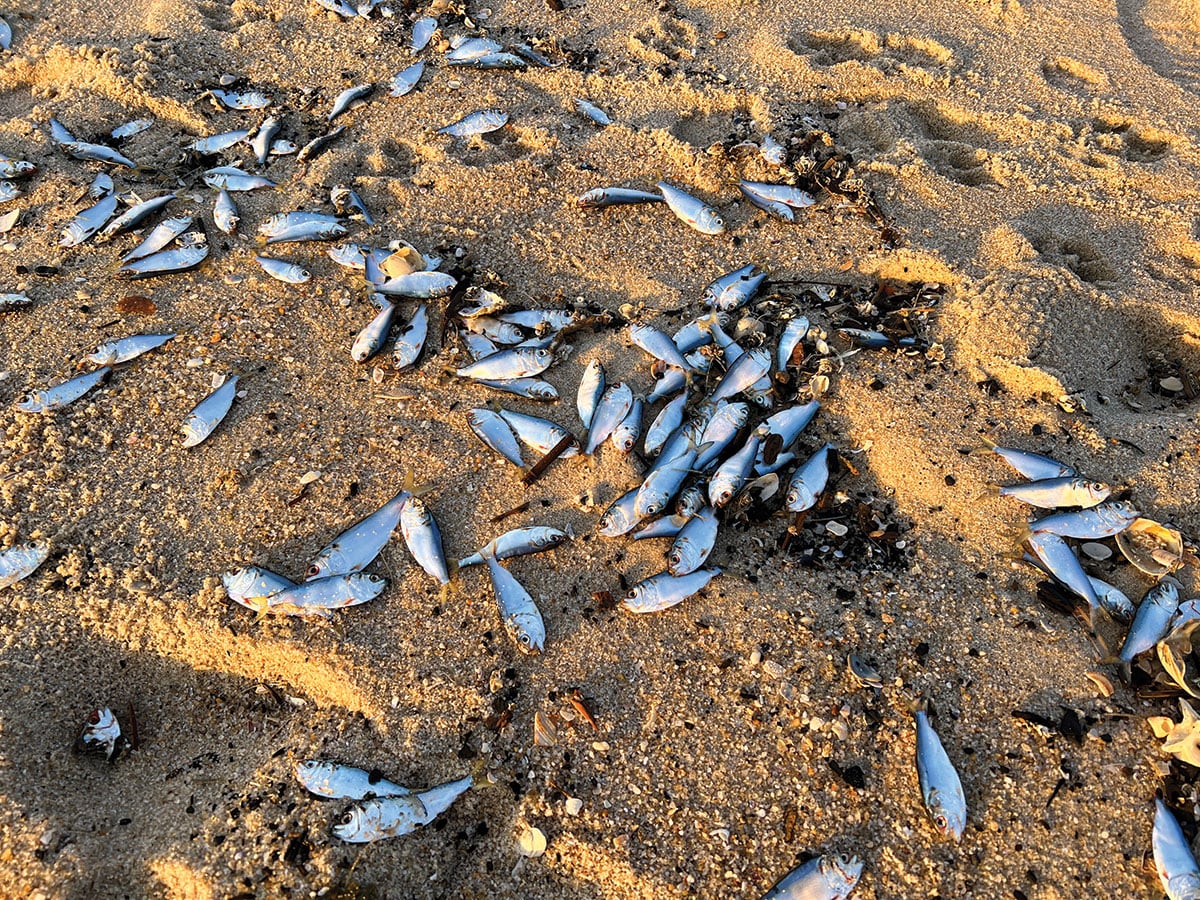
Although adult bunker pods and their associated blitzes have existed since the first striper fishermen spooled their reels, such occurrences were a rarity in the 1990s. During those years, seeing a bunker pod felt like hitting the lottery. This scarcity of menhaden prompted the government to establish tighter regulations on the fishery, which ultimately triggered a population explosion around 2003–2004. This better-regulated, massive body of menhaden changed not only the favored tactics for trophy striped bass but also the standard for who was catching them.
Bluntly put, subduing a monster bass from a bunker pod is much less of a challenge than doing so by other conventional means, such as chunking the surf at night or plugging away over bottom structure alone.
Even with this style of fishing, however, anglers armed with specific knowledge can optimize their results and improve the likelihood of a successful release.
It is important to understand that all modifications are dependent upon alterations in bunker and/or bass behavior from season to season, spring through fall. However, a few behavioral tendencies of these baitfish and their corresponding blitzes remain more or less the same. Two recurring themes shape the overall context of a bunker pod scenario:
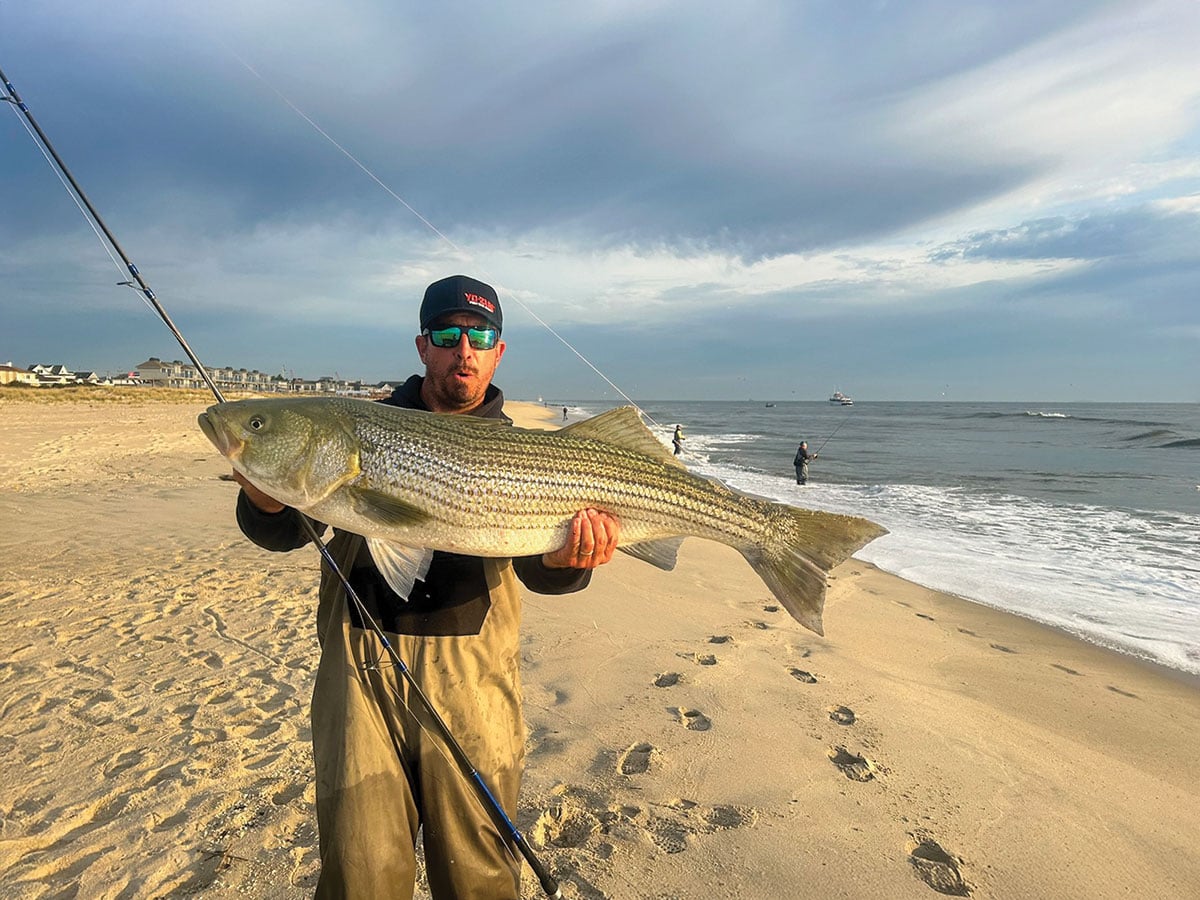
- Bunker schools almost always travel into the wind. This allows shore-based fishermen to better tailor their strategies in advance. For example, during a string of days with offshore winds, a big-bass fisherman expects potential bunker pods to move within casting distance of the surf. With few exceptions, covering more ground and looking for such schools is more effective than isolating oneself in a single location. Conversely, during a string of onshore winds from the ocean, one’s time may be better spent on other strategies (e.g., chunking or eeling), as bunker schools are less likely to come within range. Regardless, knowing how wind affects bait movement helps an angler plan accordingly.
- Blitz conditions depend almost entirely on daylight hours. This is likely because sight is the primary sense by which a bass zeroes in on a single bunker in a tight pod of thousands. Offshore winds – blowing from land to sea – combined with bunker abundance, thus entice big-bass fishermen to refocus their efforts on the daytime hours.
Pod Activity Continuum
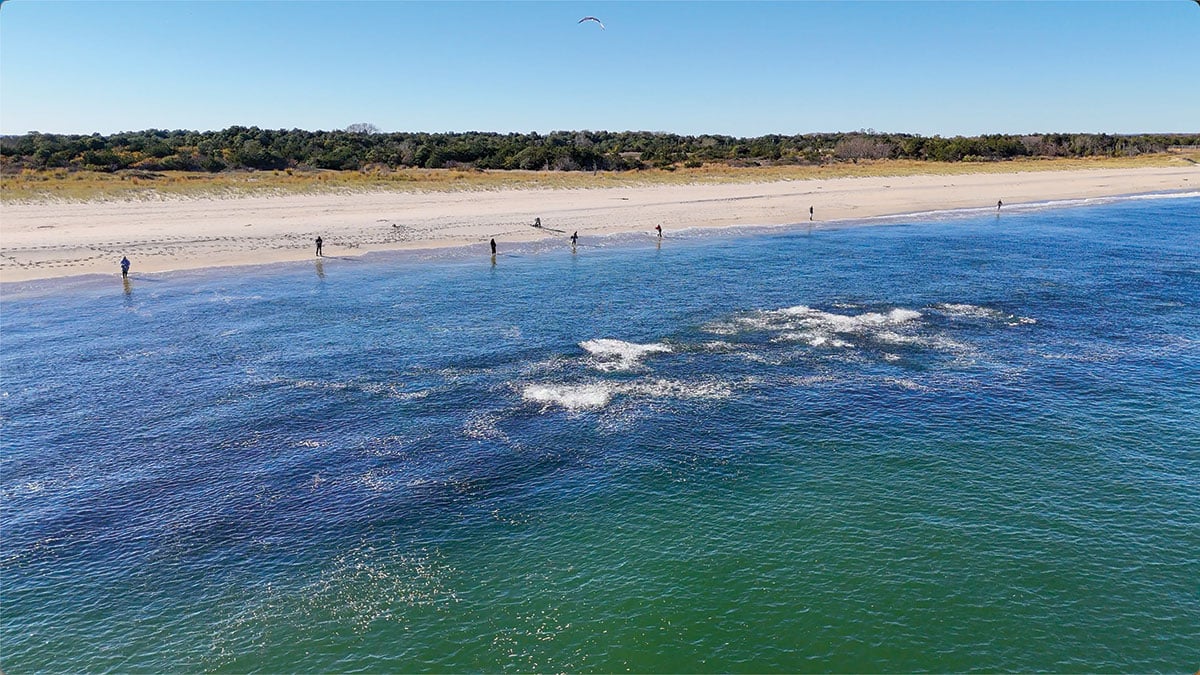
Keep in mind that the term “bunker blitz” is not entirely synonymous with a “great bass bite,” but is instead a specific subset of it. A true bunker blitz requires high predation activity on corralled, fleeing bait. This activity exists on a spectrum, carrying various nuanced contexts that many anglers overlook, leading to a loose misuse of the term. Some label a predominantly inactive pod that produces two 40-pounders in two hours a “bunker blitz,” while others reserve the phrase for when dozens of 30-pounders are being beached.
Such ambiguity in a precise definition stems from bunker pod activity falling on a continuum. For this reason, bunker blitzes cannot be defined by binary categories like “blitz” or “no blitz.” I prefer to assign bunker pods to a level on a 0 to 10 scale. A pod’s level is determined by the frequency of pops on the water, any bass breaking the surface or being caught, the pod’s size, and the speed at which it is moving.
A level 0 represents a completely inactive small pod with no fish caught for hours at a time, while a level 10 is an extremely active large pod with both bunker and bass spraying the surface for hours on end. A small pod moving fast implies a heightened potential for predators pushing them. When comparing two different small pods that are similar in all other characteristics, the faster-moving pod has a higher probability of producing bass.
It is harder to draw clear conclusions when comparing a small, fast-moving pod to a large, slow-moving pod. The larger pod may have more (and larger) stripers in its midst, yet it may move slowly because bunker feel safer in higher numbers; statistically, it is less likely that any specific individual will be taken. For example, it is more difficult for a farmer to herd and move 1,000 sheep than it is 50. It is also possible there are no bass in the large pod at all. Therefore, when determining a pod’s potential, factors like speed and size can inversely affect one another. Assessments of bass potential derived from speed may be masked or skewed by significant size differences between pods, and vice versa.
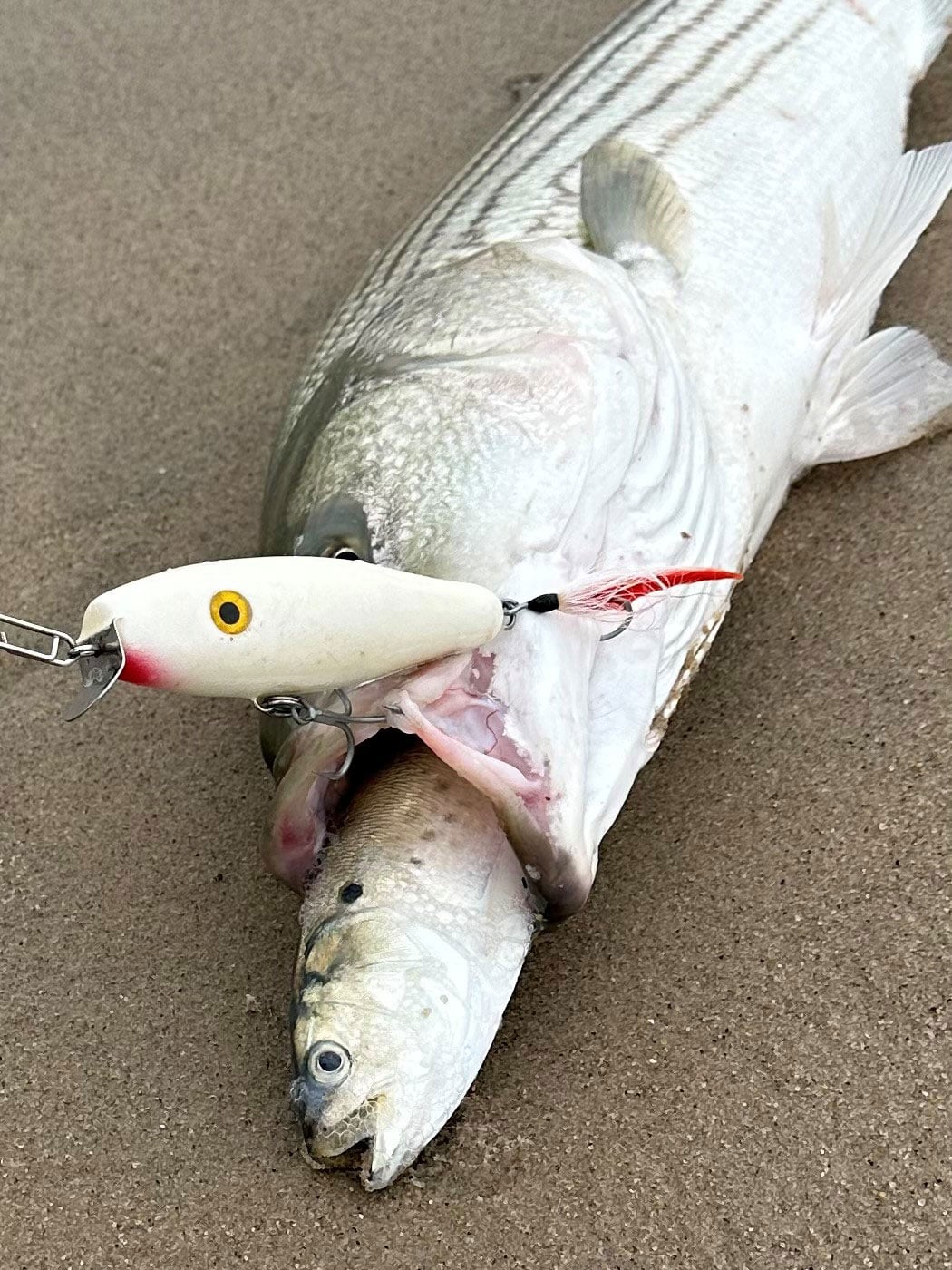
Ultimately, surface activity is a much better gauge of bass potential than pod speed or size. A few bunker popping every couple of minutes often implies there are few, if any, stripers actively feeding in the school. In a seemingly inactive pod, a snag-and-drop (with a modified circle-hook snag) or a chunk setup may entice any less-actively feeding bass that are following deep below. A different approach should be taken when fishing pods of higher activity levels.
In highly active pods where multiple bunker are simultaneously spraying to evade bass breaking the water, the former tactics can be detrimental for several reasons:
Feeding Depth: The feeding bass here are hyperactive and looking for moving bait high in the water column. Snagging—and certainly chunking—will drop your offering well below the bass’s line of sight. Doing this, however, does provide a slight opportunity to entice an even larger, lazier bass trailing beneath the surface frenzy.
Crowd Management: True blitz conditions like these invariably attract a crowd. In these high-pressure situations, chunking or even snag-and-drop fishing is completely impractical, as it drastically increases the likelihood of crossed lines and tangles.
Mobility: Hyperactive pods (levels 7 to 10) often move quickly, so it’s best to stay as mobile as possible. Lugging around chunks or managing a snagged bait is detrimental to mobility. To stay mobile, remain in the strike zone, and stay out of other anglers’ way, you should rely on large plugs. During the most crowded and intense parts of the blitz, large pencil poppers work best because they can be retrieved quickly.
As conditions calm and the bunker disperse, so does the crowd. At this juncture, switch to a large swimmer. Any less-active, straggling bass may commit to its slower, wider action. A swimmer still allows for great mobility and can be retrieved slowly now without worrying about crowd-induced tangles
Because your chances of catching a bass in a bunker pod depend largely on the ratio of feeding bass to the number of baitfish, any numbers discussed above must be viewed proportionally. Statistically, you have a much better probability of a hookup in a small pod of 50 bunker with five active bass than in a massive school of 500,000 bunker with 50 active bass.
Blitz Mentality & Etiquette
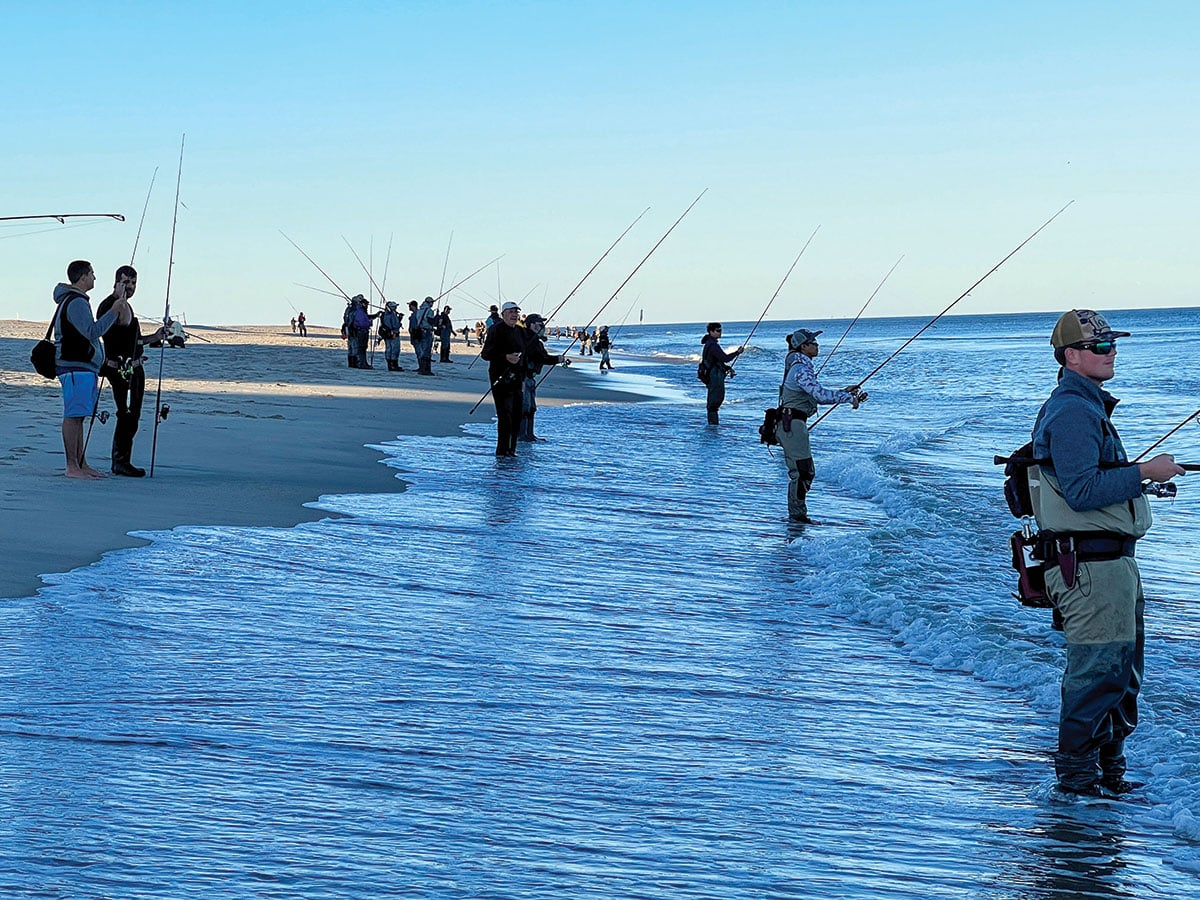
The ease and daylight hours associated with this type of fishing attract even the most inexperienced fishermen to the action. This ultimately leads to crowds, making the situation favor first-responders even more so than other types of big-bass fishing. The mix of personalities and experience levels varies across gatherings. Some crowds handle fishing inactive pods without the fishermen inhibiting or aggravating each other, while others are far more contentious. Crowded settings mixed with fast-paced blitz conditions are a guaranteed recipe for what I call “chaos fishing.”
Unlike other types of bait-oriented blitzes, fish marauding adult menhaden are often the exact trophy bass that anglers dream of. The close proximity of a potential personal best, fierce competition, and limited space create an intense sense of urgency. This elicits haste, subsequent carelessness, and hurried action. Lines snap, cross, and tangle. Anglers get hooked, argue, or even come to blows. Yet, these chaotic scenarios can be mitigated—or entirely circumvented—by a crowd composed purely of cooperative, seasoned anglers.
Both cooperation and experience are essential to ensure a balanced, coordinated effort. While confined to a small space on a pier, my friends and I developed a rotation where one would cast, then move down for the next person to cast in a fluid, synchronized manner. At times, 10 to 12 guys would all catch 25- to 45-pound fish without a single tangle or crossover. These rare – yet functional – systems are often used by angling authors to prove that proper communication and respect are prerequisites for success. And though this is true, they are not the only qualities required for an individual to thrive in the midst of blitz chaos.
In an ideal world, or under those rare conditions where the entire crowd is experienced and familiar with one another, communication and respect are the primary requirements. Unfortunately, the majority of chaos blitzes involve a mixed crowd that includes inexperienced, disrespectful, or aggressive anglers. The same applies to other crowded areas of life where excitement and urgency collide—like a packed concert or a Philadelphia Eagles home game. Such circumstances naturally favor the respectfully assertive and disfavor the meek or overly polite.
Not overcasting someone with a fish on, and looking out for people too close to you before casting, are obvious points of etiquette. But waiting until the crowd dissipates before casting your line, or until someone says “it’s your turn to cast,” makes an angler a polite, fishless doormat. Traditionally, after a blitz, such hesitant anglers would storm away unsatisfied and disgruntled, while the more assertive anglers dragged their 25- to 50-pound bass back to their trucks. So don’t sacrifice a chance at a monster out of fear of making waves.
The adoption of a respectful assertiveness, tailored to the uniqueness of bunker-pod fishing, benefits both the individual and the collective. In such instances, help other anglers as best you can, provided you aren’t being submissively subservient to the crowd. Helping others land a fish or lending pliers for unhooking a bass are easy, quick actions that don’t cost you much. They are not only kind things to do, but they indirectly assist you too, by increasing the camaraderie and cooperation within the crowd. These behaviors are completely distinct, however, from just sitting back and refusing to cast when there is plenty of room to do so.
Some anglers’ default setting is “recoil mode” when a blitz hits. This is understandable if their own tensions are too high and they’re worried about their own responses to potentially contentious developments within the chaos. In such cases, walking away to another locale is the more mature route to take.
However, some anglers default to “recoil mode” even though there is still plenty of room for them to cast. They then justify it as not wanting to be rude, when really, it stems from a fear of interaction and disapproval. To be completely transparent, I say this out of personal experience. But a temporary daytime blitz is not a spatial or temporal secret on any level, so if there were ever a circumstance to push those boundaries of your own assertiveness—albeit in a respectful way—this is it.