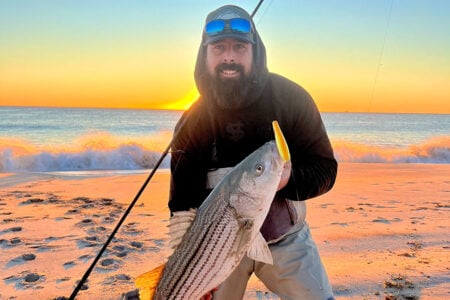

Daytime surfcasting requires a different mindset and a willingness to read the attitude of the situation.
“Nighttime is the right time” is an idiom that has become synonymous with surfcasting, and it guides the habits of most of the surfcasters that fish for striped bass up and down the East Coast. It is only further-driven into our minds by the photos posted on the internet by today’s surfcasting heroes; fat, glistening fish resting in the arms of smiling anglers, the whole scene framed in the anonymous blackness of night.
It’s inviting for a whole slew of reasons that run the gamut from fishing guilt-free while wives, girlfriends and children sleep, to savoring that look of astonishment that comes after describing a night in the surf to someone who doesn’t get it. The romance that so many of us feel with the idea of being labeled ‘hardcore’ seems to come quicker and easier when most of our fishing is done at night.
I can’t claim that I don’t feel the same pull from fishing the night surf. I get all of these things and a lot more from practicing the art of surfcasting in full darkness. Personally, I used to get something very unique from night fishing, because the darkness would rub out so much of the manmade junk that sullies our oceans, looking out over the Atlantic under a black sky allowed me to see the ocean as our distant ancestors did. The fields of flickering red lights that top the New England wind turbines have stolen that, but I still love it. And I always will. (I hate that I feel like I have to say this, but that is not a political statement, it stems from environmental concern and that – and only that – is why I bring it up.)

A Day In The Life
Daytime surf fishing often gets a bad rap, and I think that stems from the fact that – historically – daytime fishing, particularly in the fall, has become known for producing blitzes of schoolie stripers. Yes, that can be a lot of fun, but it is less likely to produce that fat cow that we all seem to want for our social media satiation. My experiences over the past 25 seasons certainly could drum up enough evidence to support this claim, but we’re fishing through a time where schoolie stripers are actually fairly scarce.
As an example, I fished a river this spring, early in April, a time when history said would only small stripers would be caught, with maybe a rogue slot; I didn’t land a single fish under 30 inches, yet if I were to time-travel back to 2010, I’d have been celebrating a 30-incher in April. With all the reports I hear, almost daily, I’d say that in 2025, daytime surfcasting is far more likely to produce larger fish, perhaps than any other time this decade.
With so much emphasis put on targeting larger surf stripers after dark, some surf fishermen might find themselves at a loss when making the transition to targeting bigger fish in daylight. I put the word ‘targeting’ in italic print because there’s a difference between chasing blitzes and hoping to ‘luck into’ a big fish and actually taking a focused approach to try and catch one. You may be assuming that I’m going to cop out and go off on a tangent about throwing huge plugs to cull out the little ones, but that’s not where I’m headed.

It’s A Head Game
There is a fundamental shift that takes place when chasing a big fish during daylight and that shift has everything to do with how these fish hunt. At night their eyes are last in line when it comes to finding, hunting and attacking baitfish. In daylight, the eyes take over the lead role. Their tactics also flip 180 degrees. While in darkness, I believe a striped bass comes into the shallow surf zone to hunt for food, methodically covering an area while sensing for bait with its ears and lateral line, in daylight these fish shift to using their eyes and – since their prey can clearly see them too – it becomes a real cat-and-mouse game. This means the actions and reactions of baitfish are not only different than they are at night, but it also means that, as surfcasters throwing plugs and plastics, our presentations have to be on point when it comes to how these baitfish act and react to the predator/prey relationship. And since the stripers are using their eyes as their primary mode of hunting their prey, we have to sell it hard, all the time, to be successful.
This is where the attitude of the situation becomes a huge part of how I present my artificials. It’s a two-part read; you have the basics of the pursuit; which boils down to making your bait react in a familiar way when a bass shows interest. Then there’s the situational read, which boils down to making common sense decisions about how a baitfish would act in the situation at hand. This is a huge part of how I fish, regardless of target species, freshwater, saltwater or tactics used.
Regarding the basics of the pursuit, if you’re going to sell an unconvinced predator on eating your plug or plastic you’re going to have to show it something it expects to see. Any striped bass that rolls on your plug or swirls behind it, is interested but not convinced. I believe they track your plug and swirl at it to see how it reacts. If a live baitfish were swimming along the surface and a large predator rushed up behind it, it would obviously freak out and try to escape by whatever means possible.
And that’s how I play the simple side of this situation, I increase the speed of the retrieve and I bump up the erratic maneuvers, as well.

Situational Awareness
On the subject of reading the attitude of the broader situation, there are many factors that may come into play. The first is visible activity. If there are baitfish being chased, intermittently on the surface, I assume that there is a school of competitive predators in front on me who are working on a school of scattered baitfish. So I try to think like a singled out baitfish that knows it is vulnerable; without the safety of their school, these baitfish can either hide in cover, hang motionless near the surface, or try to make a beeline for the safety of the shallows. But taking advantage of the competitive nature of the predators would be my thought process. So I would fish splashy topwaters, or fast-moving subsurface plugs that give off lots of vibration.
If the situation in front of you is all-out mayhem, you may not have to even think. But sometimes blitzing fish will actually ignore the classic blitz baits like pencils, poppers and spooks. In my experience, the thing that usually turns the bite on is something you can fish faster, and a good second play is to use something that matches the size and shape of the bait as closely as possible if they’re still finicky. But high-speed offerings in a picky blitz bite are the key, more often than not. So paddletail plastics ripped through the feed, bucktails, reeled straight and fast or something like a heavy needlefish reeled so fast it’s skimming the surface will usually draw vicious hits when your usual topwaters aren’t. And it’s all because of the attitude of the bite. Those baitfish are in full on freak mode, swimming as fast they possibly can, and plugs or plastics that aren’t replicating that will – sometimes – be largely ignored.
But the attitude if the situation isn’t only revealed by baitfish and predators. Sometimes it’s just the water. If the water is rough and running hard, a bigger, splashier plug like a giant pencil or a big spook like a Doc or a Yo-Zuri Mag Pencil will be the thing you need to draw strikes from hunting stripers searching for dislodged baitfish behind the break. But you may also find that you need to go deeper with plastic on a jighead or a bucktail, but again, the roughness of the water will often dictate a faster presentation. In calm water, I tend to go smaller and slower and I also tend to stick to places where the water is moving. But in any case, I’m always trying to think about how a baitfish, dropped into the situation at hand, would react and that’s how I present my artificials.

Bait Profiles
In the fall we may see dozens, if not hundreds, of bait species in the surf, especially if you stretch the map to include the coast from Delaware to Maine, and while it would be fun to list them all, it’s not feasible. The following five are probably the most common across the widest swath of our coverage area.
Peanut Bunker. Peanuts are often considered the catalyst of the fall run, regardless of where you live or cast your line, the fall run kicks into gear when the peanuts begin to exit the estuaries. I can remember wild peanut blitzes where it looked like the stripers were tossing handfuls of quarters into the air with each break as the frightened baitfish scattered. Peanuts present a unique challenge in that matching the profile can sometimes be a detriment to your success, simply because your offering blends in with the thousands of the real thing. So I typically, at least, double the size of the peanuts I’m seeing. My two killers are the Super Strike 2-3/8-ounce popper in white or chartreuse and the simple 1-ounce bucktail in white with a short Fat Cow trailer.

Mullet. There’s something magical about a mullet blitz, and mullet blitzes are made for the surfcaster. These baits travel in schools that range in size from a 50 to thousands and they tend to stay in very tight to the beach. They drop out of tidal rivers and estuaries in the late-summer and early fall and the action that fires up when they are intercepted by stripers has the potential to reach core memory status. The daytime action tends to be frantic and the mullet can often be seen streaking across the surface in laser-straight lines. My baits for mullet blitzes are the NLBN K-Tail, the NLBN 5-inch Paddletail and the Super Strike Bullet, all of them fished fast enough to leave a wake.
Adult Bunker. In my little corner of New England we may not see a lot of adult bunker in the fall surf as those along the South Shore of Long Island or along the Jersey Shore beaches, but when we do the bite tends to be all daytime and it often ends up being somewhere between great and amazing. What I typically see is spot schools of bunker being corralled on the surface by bass and giant bluefish and very often, it doesn’t matter much what you throw, as long as it reaches the school and throws some water. My favorite plugs for bunker schools are big spooks like the Mag Pencil from Yo-Zuri and vibration baits like the Sebile Stick Shadd, or my favorite the Banana Plug, which is only made by a few custom builders. Attitude becomes paramount in this surf situation, you want your plug to act like it’s singled out and trying to get away: fast, erratic and not slowing down. If you find that you need to get a little deeper, the 9-inch Tsunami Swim Shad fished with a fast retrieve and periodic sharp jerks of the rod, will also draw vicious strikes.
Squid. The mysterious squid has been the subject of many inspired and ingenious attempts at replication going back at least to the 1930s, and I still don’t think anyone has truly nailed it. Squid have so many idiosyncrasies that make them very difficult to accurately mimic. From the textural element, to the fact that they change from white to pink to red when they’re stressed, to their wildly unpredictable movements in the water… it’s hard to feel like anything is an easy sell when squid are the main course. I have had good luck with white pencil poppers when squid were present and the bite was competitive. When the action has been more intermittent, I’ve done better with baits that sink slowly enough that I can hang them in the water column, but also have an erratic action that I can impart with the rod.
Soft plastic jerkbaits, like a Slug-Go, also fit the bill when trying to match squid. I typically throw white in this situation, but I bet the ‘squid’ color would work well, too. I try to pick the bait that comes close to the size of the squid I’m seeing, leaning a bit larger, and rig them on a swimbait hook. The play is to cast it out there and let it settle for several seconds and then bring it back to the surface with a series of erratic pops of the rod, before allowing it to settle again. The hits usually come on the pause.

Sand Eels. Sand eels are a bait species that I don’t see very often in the areas I typically fish during the fall run. I’ve heard many supposed explanations for this from local old timers that range from hard-packed sand to too much fresh water coming from the rivers. One thing sand eel bites have taught me is that we give these fish way too much credit. From Cape Cod to Long Island’s South Shore to the endless beaches of New Jersey, the Ava Jig with a green tube is probably the majority favorite for fall run sand eel blitzes and that thing really doesn’t look like a sand eel at all. But it works!
My choices when sand eels have shown up has had more to do with how the fish were feeding. When they’ve been up on top, a small needlefish – yes in daylight – fished fast and scared has worked; the slower the sink, the better. If the fish are rooting the sand eels out of the sand, I throw a lightweight Ron-Z. Color has not been super important, white or silver has been my go-to. And, like the squid, I typically try to get close to the size of the natural feed, but I like to stand out by being a little bigger. I’ll try two methods with the Ron-Z, dragging it in 1-foot increments through the sand and swimming with constant – short – jigs of the rod tip; almost a vibration, rather than a jerking action. They both draw strikes, but sometimes one works better than the other.
For way too long, I blew off the daytime bites during the fall run believing that I had a much better shot at bigger fish in the dark. And while I still believe that your odds are much better for consistent catches of bigger fish in the dark, I also know for a fact that my unwillingness to keep the day bite honest cost me some memorable experiences and yes, even some really nice fish.