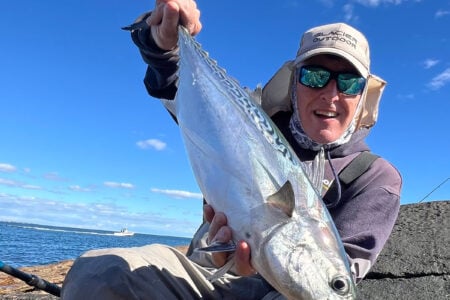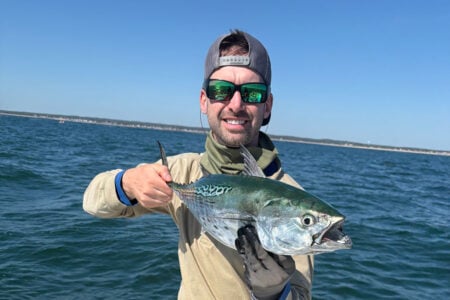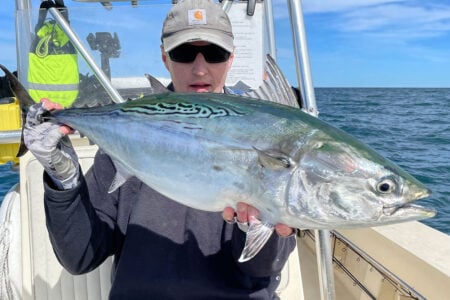
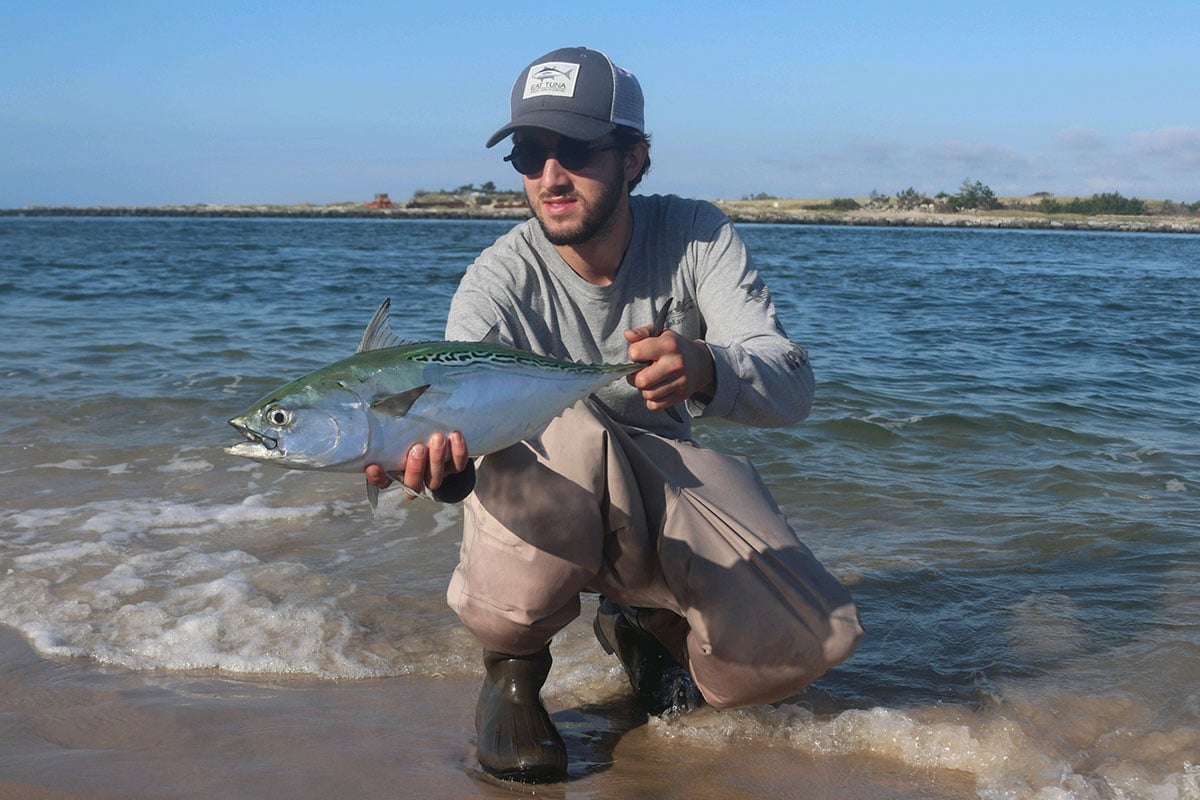
Honing in on falsies from the surf during the last part of summer and beginning of fall.
If there’s a month that turns calm, rational surfcasters into sprinting, breathless optimists, it’s September. Anchovies and spearing pile up along Long Island’s rips and bars, peanut bunker gather in tight rafts, and then—like ghosts with afterburners—false albacore materialize. One second the ocean is a blank slate, the next it’s a boil of dimples, flickering terns, and screaming drags. From Montauk’s rock fields to the South Shore’s inlets and the open stretches of Robert Moses, Jones and beyond, September is primetime to feed the fever.
Where And When They Show
Early September often favors open-beach scenarios along the South Shore and the East End. Bait roams the outside troughs at first light and again late in the day, with packs of albies running fast lanes parallel to the outer bar. In this early window, look for calm, glassy mornings before the wind kicks up; the visibility makes it easier to track small pods as they work the beach.
As the month deepens and the first cool nights stiffen the breeze, more fish push into the mouths of Shinnecock, Moriches, and Fire Island, riding the edges of rips and current seams where rain bait and peanuts have nowhere to hide. On a hard-running ebb, you’ll often see the bait tumble around the inlet corner, with albies patrolling just outside the seam.
Montauk is its own planet: the north side lights up on an easterly or northeast breeze, when clear water stacks against the ledges and sweeping tide sets up clean seams; the south side can explode on southwest wind when bait washes along the coves and points. On the North Fork, Orient and the gut passes see short but savage windows around the turns of the tide—often only ten minutes of chaos, but worth the wait.

Finding Fish Before They Show
Everyone rushes to birds and foamers, but most September albies give you a sign before the obvious blow-up. Watch for a tight “peppery” dimple on slick water that appears, fades, and reappears 30 yards down-current; that’s rain bait being pushed by a pack running a line.
Single terns that hover and crab sideways over a seam usually mark fish beneath them even if they aren’t diving. Inlets telegraph action through the shape of the rip: clean, glassy shoulders with a thin texture of nervous water along their inside edge are money. On the open beach, a faint color shift where slightly greener ocean pushes over clear troughs can be the runway albies choose for an hour and then abandon.
Read and move—this is a walking hunt, not an anchor-up fishery. The more water you cover, the better your odds of being in the right place when the first blow-up happens.
Tackle That Wins
You don’t need heavy surf gear; you need efficient gear. An 8- to 9-foot medium or medium-light surf rod rated roughly half to 1-1/2 ounces with a crisp tip and fast recovery lets you throw small resin jigs a country mile without tangling. Pair it with a 4000- or 5000-size saltwater spinner with a high gear ratio (around 6:1) for line pickup when fish charge the beach.
Spool with 15- to 20-pound braid in a round, slick weave; a thin diameter is your friend for distance and quick cuts through crosswind. Fill the spool close to the lip for maximum cast and manually close the bail to prevent wind knots.
Leaders are a balancing act between stealth and abrasion. In clear, calm water with anchovies on top, a 20- to 25-pound fluorocarbon leader, 4 to 6 feet long, often gets more bites. Around jetty rocks, Montauk boulders, or when peanuts are thick and the water’s chalky, bump to 25–30. Use a compact knot (FG or PR) to shoot cleanly through guides, and tie your lure on with a loop knot to give it life.
Lures That Convert Picky Fish
Match the hatch in size first, profile second, color third. If anchovies and micro spearing are the fuel, 5/8- to 1-ounce resin/epoxy jigs with a slim, translucent body are the day savers. Olive back/pearl belly, bone, and “clear with glitter” cover most conditions; pink comes alive in dirty water and under gloomy skies.
Slim metals—narrow spoons and casting jigs—cut wind and punch long to reach edge fish. When peanuts dominate, a slightly chubbier 1 to 1-1/4-ounce resin jig or a small metal-lip casting plug can separate your offering from a cloud of identical bait.
Soft plastics shine in glassy water or when fish pin bait right on the lip: rig a 4- to 5-inch straight-tail on a light, strong jig head or a keel-weighted hook and swim it just subsurface.
Retrieve cadence should always start fast—truly fast. Point the rod at the lure and wind until your forearm protests, then add short bursts and kills. Albies often eat on the pause if bait is tight, but they also track and inhale a steady bolt. If you’re getting follows or swirls, switch sizes before colors, then adjust retrieve speed.
Tactics By Venue
Open Beach (Robert Moses to Jones) – These fish run lanes just outside the bar early and late. Get elevation where you can and scan ahead; you’re trying to intercept a route, not chase a splash that’s already over. Cast at a 45-degree angle up-current and burn across the trough lip.
Inlets (Shinnecock, Moriches, Fire Island, Jones) – Fish the shoulders on an ebb, where bait stacks before spilling into the ocean. On the flood, albies often shoot into the cut for a short, furious feed. A heavier jig helps here; precision matters more than distance.
Montauk – On an easterly, the north side ledges load up with bait. Cast into the clean edge of the seam and burn through it. On a southwest, the south side coves and points turn into ambush lanes. Mobility is everything; the bite can switch sides mid-tide.
North Fork/Guts – Short, intense windows. Be rigged and ready before tide turns; here, seconds matter.
Reading September’s Moods
Clear, calm mornings with anchovy slicks call for finesse: long casts, small translucent jigs, light leaders, and a high, steady burn. Midday sun and a light breeze can help by breaking up the surface. After a blow when the water’s muddled, find the color edge—the first clean green water is the highway.
When peanuts are the main bait, move off the center of the melee and offer something slightly larger or smaller than average. Standing out just a bit often matters more than color.
Hooking, Fighting, Releasing
Albies are sprinters, not sumo wrestlers. Set drag at about a third of leader strength, keep the rod low, and angle them away from rocks. They release best when they never leave the water: guide them into the wash, pop the hook, and let the next wave carry them back.
Single inline hooks speed the release and preserve the fish. Most Long Island anglers release false albacore—check current New York and federal regulations before targeting any tunas.
The Mobile Plan
Travel light. One rod, a spare leader spool, cutters, and a small jig box is better than a heavy surf bag when you need to sprint 200 yards to a blitz. Keep duplicates of your best jig in two or three weights for changing wind and tide.
A finger guard saves your skin during a dawn blitz, and studs or cleats are a must on rock. Hydrate—running and casting for hours in the September sun can drain you before you notice.
Common Mistakes (And Fixes)
Chasing the last splash is the classic error—predict the line of travel instead. Throwing too big when fish are on micro bait is another; downsize and go translucent. Dropping leader diameter too far in rocky or inlet scenarios leads to breakoffs; know when to go heavier. And never stick to one retrieve—speed and variation trigger strikes.
The September Routine
Beat the sun, keep moving, and trust your eyes. Make a few casts to a lane and move on; when they chew, it happens fast. Log the wind, tide stage, and water color when you connect—September has patterns under the chaos.
When it all comes together—birds tipping sideways over a seam, a flash of anchovies, a green torpedo burning 60 yards of braid—you’ll remember why you laced up the cleats and chased the rumor at first light.
This is Long Island in September: fast water, tiny bait, and albies that make the whole surf feel plugged into a socket.