Sorry Kermit, but there are big, hungry fish in those small ponds.
I have a lot of respect for Booyah baits. They’re not the only weedless topwaters, but I bought a few at big box retailer more than a decade ago. Then they sat in a box for years.
During that time, I did fish pad fields by throwing smaller hollow-bodied frogs made of the same sort of flexible plastic. They have a texture somewhere in between that of plastic worms and hard-bodied plugs. Double hooks turn inward on that plastic, so they collect no weeds. Unless they’re cast on top of algae.
They’ve worked for me on pads, other aquatic vegetation, and on top of those algae mats, even though that algae can be problematic. The line tie sometimes digs in and the frog starts collecting that stuff. An alternative is a plastic worm on an inset hook. What it collects may be less of a problem because it’s retrieved in a clean line.
All the bass I caught when using the smaller frog were small. Even though smaller frogs will catch large bass, a large frog will catch more of them. I like the whole Booyah assortment, including the Phat Rats, but any larger weedless plastic is better for big bass. If I had begun using one sooner, I might have caught some of those big ones, but I’ve found since then that they certainly do work on them. Weedless frogs are like any other lures. The smaller might work better on smaller bass, but the bigger attract larger.
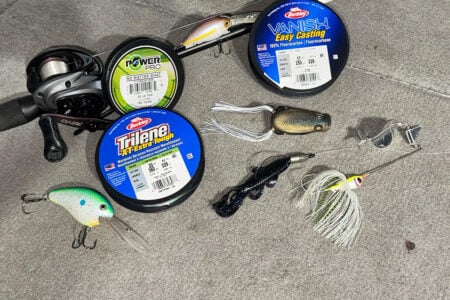
Some ponds get completely weeded in over the summer; ponds full of bass willing to break through the stuff. But the bass may average about a foot long and not want a big bait. If a 10-incher were to hit one, it might not get its mouth around it. But put a smaller weedless frog out there, retrieve it by leaps or steadily, and you can catch a lot of bass, even in the afternoon. I recommend using 10-pound-test braid ending in 2 feet of fluorocarbon leader of the same test, connected by uni-to-uni splice. It’s always possible you’ll hook an outsized bass and not get it out of the weeds, but heavy tackle is limited when casting smaller lures.
It’s better to use a 6-1/2-foot light-medium power rod. It will not only cast farther than shorter rods will; it will give you more leverage at working bass out of the slop. A 2000 series reel is enough. For large frogs, I do recommend a 7-foot, medium-heavy power rod with a 2000 or 3000 series reel.
I like the rubberband-like tendrils at the rear on both sides of the Phat Frogs. Retrieve one into an open pocket. Pause an otherwise steady retrieve and let those tendrils spread out. Just make sure the reel’s spool is loaded with 20-pound-test braid, and use a fluorocarbon leader of the same test.
I’ve caught bass on top of weed mats on sunny afternoons, but you can’t beat fishing from sundown into dusk. Most anglers seem to think that when light gets low, bass come out of the thick to cruise the weedline edges and spread over flats, and I’ll be the first to agree they usually do. But not always. A couple of years ago, my son and I fished with Brenden Kuprel late in September. Matt had caught a 13-incher up against the bank on a topwater plug, Brenden, a 15-incher. After six hours, I had missed a couple hits on a topwater plug after sunset, and I thought maybe I could boat a bass by keeping to the edges.
“I’m going to try a weedless frog,” Matt said.
“Good idea.”
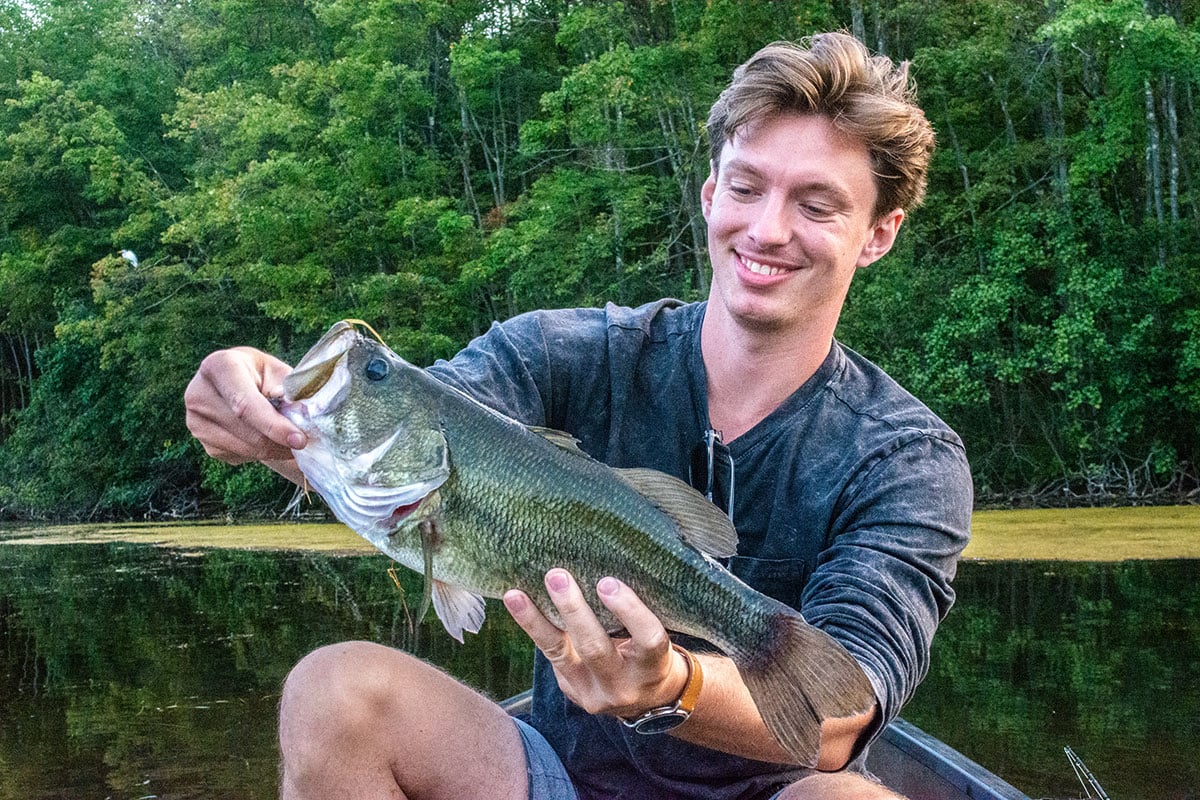
His first cast made me feel certain that more than one bass occupied the mass of that stuff. The strike was like the kerplunk of a beaver tail. He missed it, but he soon caught one of about 18 inches.
I don’t remember which frog or rat Matt used. After all, smaller weedless frogs will catch big ones. I tied on a Phat Frog and caught a 16- and a 19-incher.