21st Century plugging, how & where it all began!
Sitting down at the kitchen table to crimp the barbs on some new plugs, I popped on YouTube to watch Van Campen Heilner’s 1956 short film Striper Time for the nth time. As the film’s narrator highlighted striper fishing off Cuttyhunk aboard local fisherman Coot Hall’s skiff, the lures hanging in the background on Coot’s boat caught my eye this time. There was an assortment of plugs and poppers that I recognized as some of the same designs spread out in front of me and my thoughts wandered as I contemplated the origins and evolution of the artificials we use today in our quest for stripers.
The activity of catching fish has been around since antiquity. And, while the earliest ‘fishermen’ caught fish with their bare hands, eventually primitive tools like spears, traps, nets, and hooks emerged.
According to archeologists, the earliest hooks date back to ancient civilizations like the Chinese, Egyptians, Greeks, and Romans who were using animal bones, shorebird and wading bird bills, raptor talons, shells, stones, and wood to make crude hooks. In Polynesia, James Cook’s journals mention that, along with nets set along the shore or spears made from hardwood, when fishing from their outrigger canoes native Polynesians used hooks carved from ivory and turtle shells along with bones and wood.
Eventually, hooks were added to pieces of bone, wood, and shells to create primitive lures. For example, the Ancient Romans used polished clam shells fashioned with stone hooks, sometimes adding horsehair or feathers like an early version of today’s fly. However, once metal alloy was discovered, metal quickly became the material of choice for making hooks and lures.
Heavy Metal
The Chinese may have been the first to use metal to fashion lures, initially using bronze to shape crudely carved metal discs with hooks as early as 400 AD. During the Medieval (around 475 to mid-1400s) and Renaissance periods (14th to 17th Centuries) the Greeks and Romans were making lures out of bronze and lead.
Records of artificial minnow baits made of metal date back to the 1700s. One of the first to catch on with anglers was the “Devon-Style” minnow created by F. Angel of Exeter, England. Made from brass, Angel added fins to the body to make the lure spin. The lure’s action was so successful, English tackle shops began selling Angel’s Devon-Style tin minnows shortly thereafter.
The ancestors of metal spoons and jigs probably originated in Scandinavia in the late 1700s when Nordic seafarers raided the galley and hammered spoons and other metal items into lures they could use as they plied the waters of the North Atlantic. By the 1800s, they had perfected various shapes and fishing techniques and spoons and jigs were widely being used throughout the Scandinavia region.
The industrial revolution ushered in the commercial production of fishing tackle. In the U.S., the first artificial spoon marketed to anglers was developed by Joseph Buel in the mid-1800s. Supposedly Buel was sitting by a lake in Vermont enjoying his lunch when he dropped his spoon into the water. Watching it flutter toward the bottom he was startled when a fish emerged from the depths and snatched the spoon. Inspired by what he observed, he began to experiment with shaping kitchen spoons into lures.
Once he perfected the design, he named his new lure the Buel Spoon which receive the first U.S. patent awarded for a fishing lure in 1852. Buel went on to secure several other patents for various stamped metal spoons and spinners over the next several decades.
In 1893, a plumber named John J. Hildebrant flattened and reshaped a dime, drilled an offset hole in it, added a hairpin through the hole and attached a hook. The result? A primitive spinner bait! By 1899, Hildebrant had perfected his design and began manufacturing and selling the first commercially produced spinner baits in the U.S. as the Hildebrant Lure Company.
Into The Woods
The late 1800s and early 1900s are often hailed as the heyday for the production of lures. This era not only saw a surge in innovation and production of a diversity of metal lures but also saw the emergence of wooden lures designed to target freshwater gamefish.
For example, legend has it that sometime around 1898, James Heddon, of Dowagiac, Michigan was whittling a stick on the bank of a mill pond; like Buel’s spoon experience, when he tossed the stick into the pond, a bass rose from the depths and engulfed it, leading him to experiment with various shapes carved out of wood and testing them as bass lures. However, it has also been recounted that Heddon’s son later claimed that his father’s lures were actually fashioned after wooden minnows that his grandfather used to troll for pickerel in Lake Michigan. Either way, once refined, Heddon’s were perhaps the first wooden body lures to be dubbed ‘plugs.’
By the early 1900s Heddon had established the James J. Heddon Company in Dowagiac, and he began manufacturing lures, initially producing the Heddon Dowagiac minnow designed for freshwater bass fishing. In the 1920s Heddon introduced some of the first metal lip, shallow diving wooden lures – the Pike-Oreno and Wooden Gamefisher. Other Heddon classics from that era include the Zig Wag, Lucky 13 and “spook” baits like his River Runt Spook and Zara Spook.
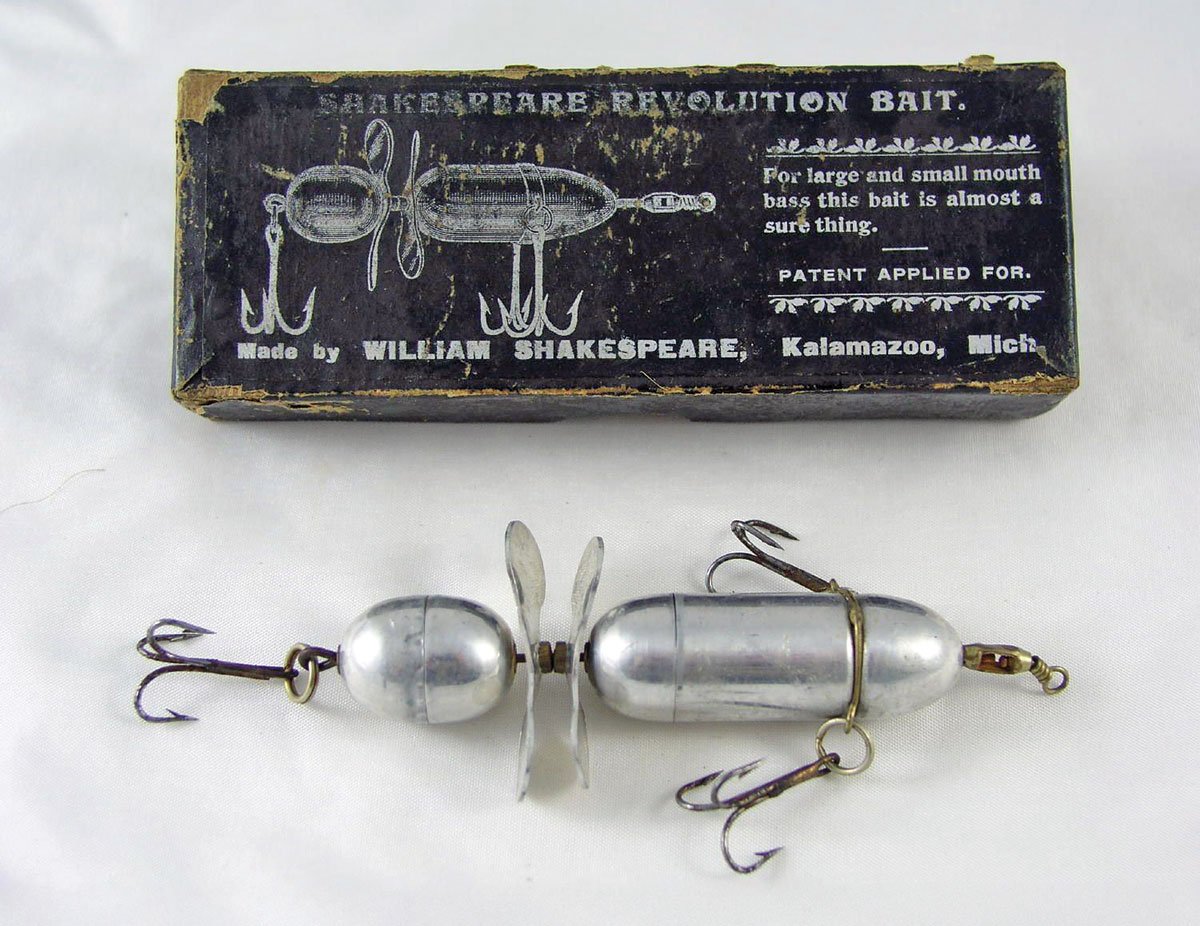
In 1897, William Shakespeare, Jr. established the Shakespeare Fishing Tackle Company in Kalamazoo, Michigan with a goal “to manufacture the finest obtainable tackle with every man in mind.” In 1901, Shakespeare received the first U.S. patent for a wooden minnow lure he named the Revolution Lure. Other early creations by Shakespeare included the Musky, Bass Kazoo, and Slim Jim. He is also credited with innovations in lure design such as through wiring and use of glass eyes.
In South Bend, Indiana, Frank Worden started the Worden Bait Company in the 1890s, later renaming it the South Bend Bait Company in 1910. Worden is credited as being the originator of wooden minnows with props added to enhance their swimming action. He later sold the company to Jacob Kuntz, who went on to produce classics like the Bass Oreno, the Pike Oreno, and the Crippled Minnow.
Crossing Over
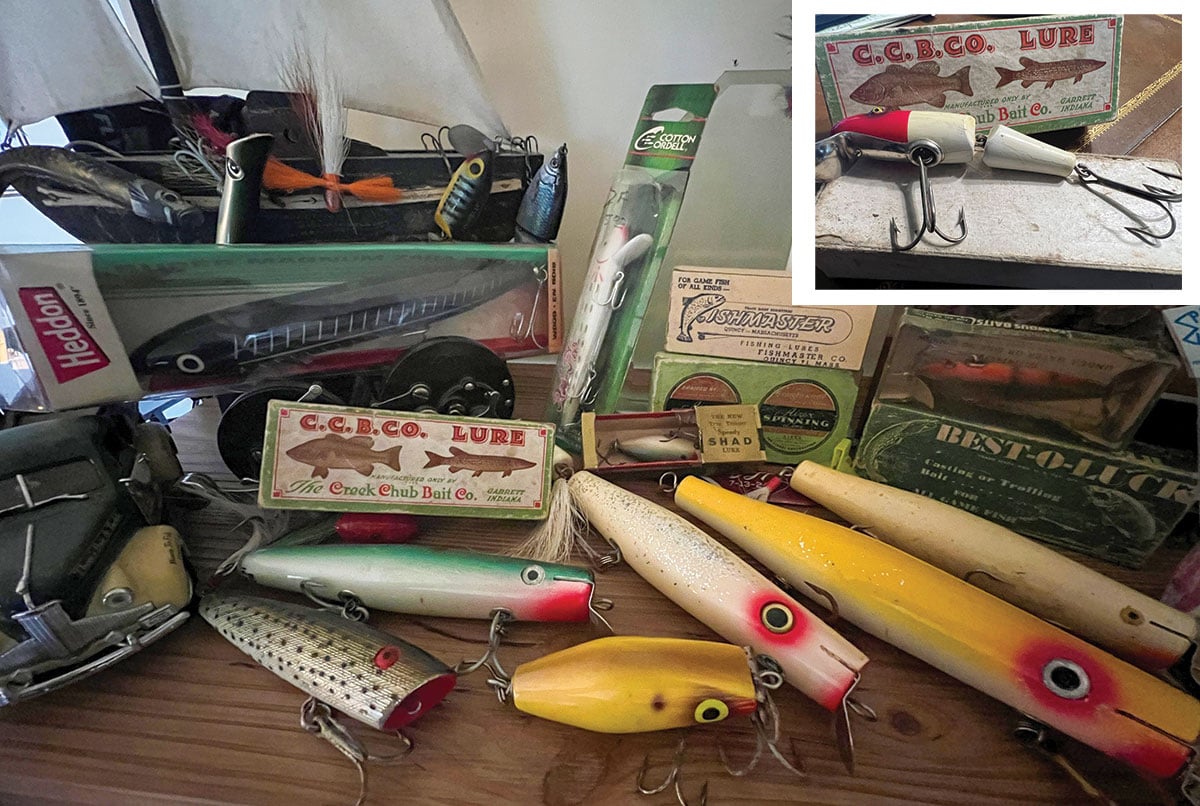
In the early 1900s, three angling buddies in Garrett, Indiana, Henry Dills, Carl Heinzerly, and George Shuttens, formed the Creek Chub Bait Company. Creek Chub made wooden lures known as the Plunker, Wiggler, and the Injured Minnow, as well as early versions of darter-style lures. In 1921, their classic Pikie Minnow, or Pikie, hit the market and became one of their most successful offerings.
Around the same time, Ernest Pfleuger formed the Enterprise Manufacturing Company in Akron, Ohio, later renaming it the EA Pfleuger Company. In 1883, Pflueger received a patent for the use of phosphorescent paint on lures which revolutionized the lure market, as lures could now be offered in an assortment of colors. Over the years, Pfleuger went on to produce such classics as the Electric Minnow, Surprise Minnow, Kingfisher Minnow, and Neverfail Minnow.
Also hailing from Akron, Ohio, Fred Arbogast began carving wood lures in the 1920s, adding a metal lip and a rubber skirt to his designs, eventually receiving a patent for the lure skirt in 1938. Over the years, Arbogast created several deadly bass baits that became known as the Hula Popper, Hawaiian Wiggler, Hula Diver and Jitterbug.
Based on the success of Heddon, Shakespeare and the other lure makers in the Michigan-Ohio-Illinois region, the area became known as Plug Alley. Not only did the companies in Plug Alley establish themselves as leaders in creating and producing state-of-the-art lures, but their legacy continues to influence the modern fishing industry today.
Meanwhile, another notable plug was evolving in Finland in the 1930’s made by Lauri Rapala. After observing how predators attack schools of baitfish by singling out the weaker, wounded members he began experimenting with designs that would better mimic wounded minnows. His goal was “to produce a lure that fish can’t pass up.” In 1936, he made a floating cork lure coated with foil that, after considerable experimentation and modification, became the first Floating Rapala. Once perfected, the lure’s success in Finland led to its introduction in North America by Finnish immigrants and by the 1950’s, the Rapala Original Floater was being sold throughout the U.S.
Many of the iconic lures discussed above as well as other early lure designs were some of the earliest to be experimented with in saltwater and their influence on the shapes and outlines live on in today’s saltwater plugs.
The Striper Coast
Striper fishing has its roots in the northeast. In the early days, one of the primary techniques used to catch stripers was trolling. As Frank Forester’s 1859 Fisherman’s Guide described “Trolling for bass is excellent sport and artificial bait is used with good success. This consists of a silver plated spoon or bits of mother of pearl worked into proper shape, and other ingenious contrivances.”
At the time, shore-based striper fishing was primarily a bait fishery but, as noted in Forester’s 1849 book Fish and Fishing of the US, “in the heaviest of surfs of the Atlantic on the outer beaches, they [striped bass] are captured of great size with a bone fashioned with hooks or a metal squid.”
| STRIPER TIME |

Striper Time is a 1956 short film released in theaters by RKO-Pathe Sportscope. Directed by legendary outdoor writer/producer Van Campen Heilner, the online Internet Movie Database (IMDb) describes the movie as “Sportsman Coot Hall fishes for striped bass (aka striper) off the coast of Cuttyhunk Island, MA using a boat. Sportsman Harry A. Watkins surf fishes for striper along the beaches of Montauk Point, Long Island, NY using a Jeep to change locations. Both men display their lures, equipment, fish locating methods, casting techniques, and catch.” Click the link to see the 8-minute clip posted at YouTube. |
By the early 20th Century, while some savvy anglers threw tin squids, metal jigs, lead bucktails, or homemade plugs from shore bait still dominated the scene. However, during the same time, fishermen in the southeast targeting species like seatrout, snook, and tarpon were beginning to experiment with freshwater plugs in local estuaries. Anglers visiting from the north saw the success of these lures in the salt and when they returned home started to experiment with freshwater lures for targeting stripers. Their initial success resulted in individuals making their own versions of these freshwater lures in larger sizes with stronger hooks and hardware and by the mid-1900s, lures made specifically for saltwater angling – in particular for striper fishing – began to appear.
Perhaps the most famous lure maker associated with striper fishing is Stan Gibbs from Sagamore, Massachusetts. Gibbs began manufacturing wooden lures designed specifically for targeting stripers in the 1940s, using the Cape Cod Canal as the testing grounds for his designs. Gibbs is credited with creating and perfecting such familiar saltwater plugs as the Pencil Popper, Darter, Polaris Popper and Bottle Plug. His designs have had a lasting impact on striped bass fishing, influencing plug builders for decades and many of his classic lures remain popular today.
In the mid-1940s, another Massachusetts striper angler, Bob Pond, further pioneered the evolution of striper plugs, forming the Atom Manufacturing Co. in Attleboro, Massachusetts. Inspired by seeing an angler using a Creek Chub Pikie in saltwater during the fall run, Pond’s first lure, the “Atomizer” was modeled after the Pikie. And, while his earliest lures like the Atomizer and Atom Wooden Swimmer were made from wood, one of Pond’s greatest innovations was the use of hardened, pressurized Styrofoam as a core material for his lures. He later switched production to plastic, producing such classics as the Atom 40, and his flat-nosed Striper Swiper popper.
It was these pioneers, along with others like Charlie Russo from Long Island, Jerry Sylvester from Rhode Island and many early lure companies like Masterlure, Lido Lures and Cap’n Bill’s, among many others, that laid the foundation for the builders that would bridge the generation gap, leading to the coveted wooden lures of today. Two of those builders stand out in front of the rest; Danny Pichney, who’s credited with inventing the Danny Plug, and Donny Musso whose designs make up the wildly popular lineup still made today by his son Steve at Super Strike Lures.
Wood continues to play a leading role in the production of striper lures today. In fact, the last few decades have seen both the rise of wooden saltwater plugs offered by major tackle companies as well as the return of individual craftsman creating wooden lures of all genres, many influenced by the tried and true designs of the early pioneers like Gibbs and Pond.
As the Striper Time video ended, my thoughts snapped back to the crimping chore at hand. And, wouldn’t you know it, the next plug up was none other than a Gibbs Danny. As I admired its outline and colors, I reflected on the fact that there is definitely a science behind designing a lure that looks good and swims naturally in the water.
However, I also recalled something O.H.P. Rodman wrote in his 1944 book Striped Bass: Where, When, and How to Catch Them. As Rodman noted “When all is said and done as most experienced anglers know, you can use the best plug on the market, but unless you work it right when retrieving, you might as well be using a clothespin without any hooks on it.”