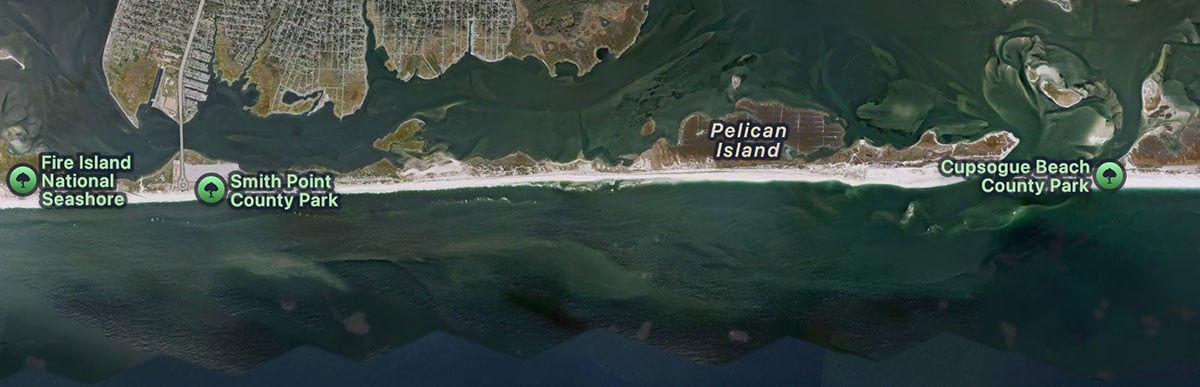
October and surfcasting go hand in hand on Long Island, and one stretch that deserves attention during the fall migration is Smith Point Outer Beach. Located along the Fire Island barrier beach, Smith Point offers miles of shoreline where stripers, bluefish and late-season hardtails intercept baitfish moving west.
One of the biggest advantages Smith Point offers is room to explore. Instead of committing to one jetty or isolated piece of structure, anglers can work the beach looking for cuts, troughs, bars and other changes that concentrate bait. Those features can change after heavy surf, so productive water can look different from week to week.
October is when this stretch really comes into its own. Water temperatures fall, bait starts moving with more urgency, and predators take advantage. Peanut bunker, mullet, rain bait and sand eels can all matter. Find one of these forage species tight to the beach and bass and blues are usually not far behind.
One way to fish Smith Point in October is to chase visible activity. Birds dipping over the water, nervous bait along the edge or fish breaking the surface can quickly turn a quiet stretch into a full-blown blitz. Small tins, epoxy jigs, bucktails and slender swimming plugs are excellent choices when bass and blues are feeding on smaller bait.
Sand eels can create a different situation. When they are prevalent, needlefish, sand-eel-style soft plastics and narrow-bodied metals become effective. At times the action is not obvious. Bass may simply settle into a trough and pick away at bait moving down the beach, which is why it is worth making a few casts at every promising piece of water instead of spending the day chasing birds.
The key to consistently catching fish at Smith Point is learning to recognize structure. On a seemingly featureless sand beach, even a small depression can make a difference. Look for areas where waves stop breaking, deeper pockets close to shore, cuts through an outer bar and pronounced troughs running parallel to the beach. Whitewater is also worth watching. Bass frequently use turbulent water as cover while feeding, and some of the best water might only be a cast or two from dry sand.
Mobility is extremely valuable here. Whether driving permitted portions of the outer beach or walking, keep looking until you find life. Some of the best fall catches occur on sections other anglers pass by.
Dawn is always worth fishing during October, particularly when bait is concentrated along the shoreline. Bass, blues and albies can all become active as daylight breaks. After dark, Smith Point changes. Surface activity disappears, crowds thin out and larger stripers can slide into troughs close to shore. This is when swimmers, needlefish, darters, bottle plugs and bucktails deserve more time in the rotation. A slow retrieve can be effective at night.
October weather can change Smith Point overnight. A hard blow can carve new cuts, fill old troughs and rearrange the beach. Moderate wind and some whitewater are often beneficial. A flat ocean can produce, especially around dawn or after dark, but stirred-up water gives bass cover and can push bait into predictable areas. After rough weather, scout before making the first cast.
Moving water is generally preferable, but there is no single magic tide across the entire outer beach. One piece might fish best as water fills a trough while another becomes productive as the tide falls and bait is funneled through a cut. Keep notes on specific stretches and patterns begin to develop.
A versatile Smith Point setup does not have to be complicated. A 9- to 11-foot surf rod matched with 20- to 30-pound braid will handle most October situations. Carry bucktails, metals, swimming plugs, topwaters and a few soft plastics, along with leaders appropriate for bass and toothy bluefish.
More important than carrying dozens of lures is being willing to move. Smith Point is not a place where anglers should plant themselves on one stretch simply because it produced last October. Drive, walk and study the water. Watch the birds, watch the bait and pay attention to every change in the beach.
That is ultimately what makes Smith Point such a compelling October hotspot. You never know whether the next stretch will hold a quiet trough with a few bass cruising through it or acres of bait erupting under feeding stripers and blues. During the heart of the Long Island fall run, either scenario is possible.