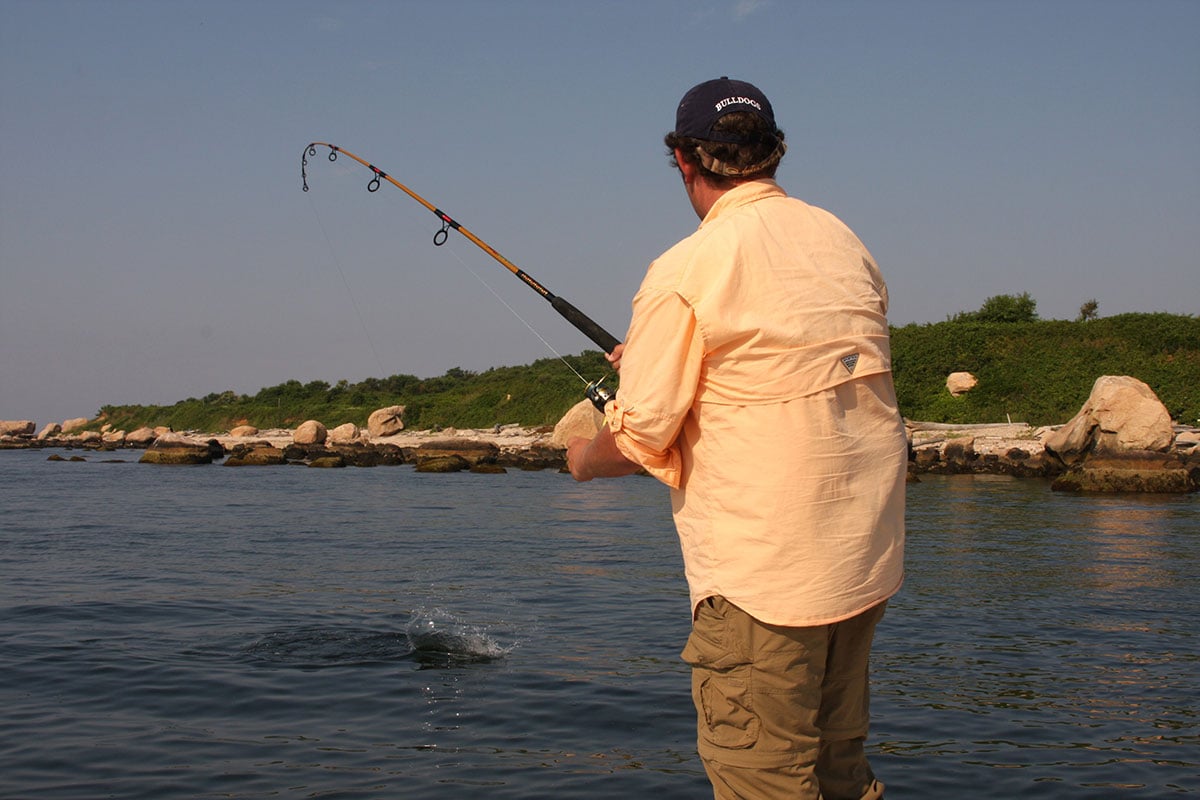
Understanding how rocks and current create feeding zones for striped bass and bluefish.
Boulder fields in a tidal current are to bluefish and striped bass what rocks in a stream are to brook and brown trout. These random obstacles disturb water flow and create resting and feeding stations for predators and prey.
“Big rocks provide optimal structure and divert currents,” says Capt. Chris Elser, a shallow-water expert from southwest Connecticut with over 40 years of experience fishing coastal shorelines and islands. “The water around boulder fields becomes oxygenated from wave action and currents coursing between and over large rocks, which attracts crustaceans, eels and various other baitfish.”
Rocks also draw baits because they host seaweed, which in turn provides forage and sanctuary for prey species. “Stripers and blues stalk these baits by holding near boulders,” says Elser, adding “they lurk there in ambush mode. The sheltered areas also allow large fish to expend minimal energy in a highly productive feeding environment, and they feel protected in the vast structure.”
When searching for prime casting stretches, pros always study the dry land contours; for example, if the shore is flat and gradual they expect adjacent shallow water with a clear bottom. Conversely, if the shoreline banks are steep and rocky they expect an abrupt bottom drop-off with boulders. The more rugged the structure the better the chance of finding large fish.
This same principle applies from Cape Ann to Cape May, and some of the most overlooked boulder fields are the ones that show above the tide line, like the the jetties and groins of the New Jersey coast. Whether you’re plugging the submerged rocks outside of Barnegat Inlet, probing the rocks around Manasquan and Atlantic City, or casting plugs against the rubble on Raritan Bay, you’ll find the same predator behavior as you would off the Montauk bluffs or the Watch Hill reefs.
Upon idling into a promising area, experts work the outer edges of a boulder field first – where the water is deepest – and progressively move and cast closer on each drift. Points, corners and pockets are key target zones because they’re near strong currents but also provide eddies where fish stage and hunt.
“Dominant fish usually own the territory near the biggest rock,” says Elser, “so it’s key to find the largest piece of structure within that group of rocks. I prefer to fish structure on the up-wind side because it adds to the speed of the upper currents and creates whirlpools in the boulder fields. Small baits struggle here and make easy prey. The current and wind both wash crabs, shrimp, eels, and other baitfish into the surf creating feeding opportunities.”
Ned Kittredge, a retired charter captain from Westport, MA with 40 years of experience looks for shallows of 2 to 20 feet over rocky shoreline structure with moving water. “I’ve found them in as little as 18 inches of water,” he says, explaining how it’s not necessarily fast water. “The current I look for is more subtle. On the deep end, if there’s bait present and the fish are active, they’ll come up from 20 feet to grab a plug. But not much more,” he added.
Kittredge starts a drift in approximately 25 feet of water and slowly works toward shore, casting over as much area as possible until he locates fish. “I’ve sometimes used a drift sock to slow the boat,” he says. “Or, if necessary, I’ll use my engine to slow the pace. A running 4-stroke engine doesn’t bother these fish if there’s enough surf noise from tide rips or breaking waves.”
Capt. Dixon Merkt (retired), a light-tackle specialist along the tide-swept islands, shores, and rips of eastern Long Island Sound, says that you need to learn how to read the water. Look for “nervous” water created by the current moving over submerged structure. Start fishing ahead of it and work your way down through it. Never hesitate to cast way beyond that nervous water and retrieve the plug back over it so it looks like an escaping baitfish traveling over a distance.
Any retrieve works for blues and bass when they’re aggressive and hungry. But when they’re fussy you’ll need to vary your technique until you find one that produces. For bluefish, a steady, fast and noisy retrieve is effective. But for stripers, most pros slowly work a spook or pencil popper “walk-the-dog” style. Occasionally changing speed or pausing will often prompt a strike. “If you get a blue that ‘short hits’ and misses the plug several times,” says Merkt, adding “stop and then start the fast retrieve again. You’re likely to get the hit on the next attack.”
Once a fish grabs your topwater, you’ll need to put some backbone into the set because a slow-moving lure won’t set itself. “Blues and big stripers have a mouth as hard as Tupperware,” says Kittredge, adding “and you need to punch a hole in it.” Kittredge advices to use plenty of pressure on a hooked fish to work it out of the rocks as quickly as possible, using the motor if necessary.