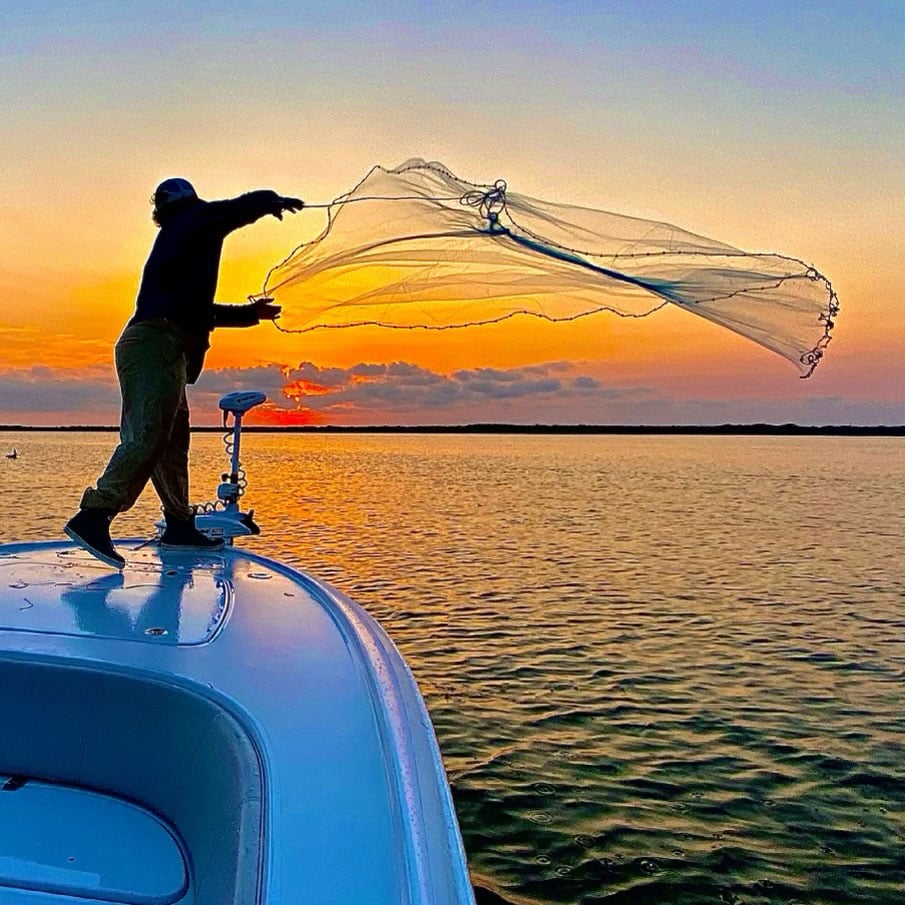
A cast net is a serious asset for any fisherman’s arsenal.
One of the coolest feelings in fishing, without even reeling in a fish, is securing a cast net chock-full of frisky bait. When an angler hurls a net over a nervous pod of peanut menhaden, there’s a brief, suspended moment of anticipation. Will the throw land clean? Will the net close in time? Then comes that unmistakable signal of success: the fluttering sensation of panicked baitfish hitting the mesh. It’s a simple thrill – but one that never gets old.
Many anglers become cast net experts, because they realize that the best bait for their target species is often what they can catch themselves. Tackle shops rarely keep menhaden or mullet for long – when they do, the baits tend to go red-nosed, soft, and lifeless. But when you gather your own fresh bait? You gain a serious edge – especially if you’re the only boat in the fleet offering that particular forage. That advantage can make all the difference in a tournament setting or even just a day when the bite is tough.
No single cast net fits every situation. For adult menhaden, or bunker, used as striped bass bait, you’ll want a net with wide mesh and a heavy lead line. A sink rate of 1-1/2 pounds per foot around the perimeter is ideal to drop fast enough on these fast-swimming baits. Adult bunker are more evasive in open water than in creeks or canals, where they tend to stay balled up, making them easier to trap.
Peanut menhaden, on the other hand, are much smaller and require a finer mesh. Using adult-sized mesh on peanuts often results in the baits getting gilled – wedged by the gills in the net –which is one of the more frustrating scenarios in cast netting. Trust me: after a hot summer day, there’s nothing fun about plucking rotting baits from a tangled net at the dock. That’s why a smaller mesh is key for small baitfish. Just make sure you maintain the same lead weight along the edge to preserve your sink speed – don’t be tempted by a lightweight net unless you’re in very shallow water.
Finger mullet and spot are also prized baits in the Northeast that respond well to throw nets. Again, small mesh is your friend. Mullet will eagerly poke their heads through wider mesh, gilling themselves in the process. Once netted, always shake your catch out directly into your bait bucket or livewell, rather than dragging them out of the mesh by hand. And be vigilant – boat cleats, hooks, and deck latches can easily snag and tear your net.
Lighter cast nets have their place – specifically in water less than a couple of feet deep. Along shallow marsh edges and back bays, they’re great for scooping up mullet, killies, croakers, baby blues, spot, and other bait species. I’ll use my older, more beat-up nets in these environments, especially around rocks, stumps, or oyster shells where a snag can ruin an expensive setup. All holes should be repaired quickly to keep the net functional – any escape route, and your bait’s gone. I keep one “hazard net” specifically for this kind of work so I can preserve my newer ones for clean throws in open water.
I remember learning to throw my first five-foot net as a kid, right in a Myrtle Beach parking lot. A local tackle shop manager showed me the ropes, step by step. Later in my teens, I learned to throw a twelve-footer in a buddy’s front yard – we stood side by side, loading and tossing our nets into the grass over and over again until the motion clicked. It was a blast –followed by burgers on the grill and a few laughs. That’s still one of the best ways to learn.
Trying to figure it out for the first time on a boat is asking for frustration. YouTube videos are helpful, but repetition is key. I always recommend bringing your laptop outside, loading up a video, and practicing on the lawn or driveway.
Be sure to check your local regulations – net size limits vary from state to state. My home state allows up to a ten-foot radius. On the boat, I almost always opt for my full 10-footer. But when I’m walking the shallows and sneaking up on bait sunning themselves on sandbars, I downsize to a 6-footer – easier to manage one-handed when I’ve got a bucket in the other.
Once you get the hang of it, throwing a cast net becomes second nature. More importantly, it becomes a serious asset in your fishing arsenal. From the excitement of the catch to the increased hookups that follow, there’s nothing quite like stacking your livewell with fresh, hand-caught bait, and knowing you earned every flip of the tail.