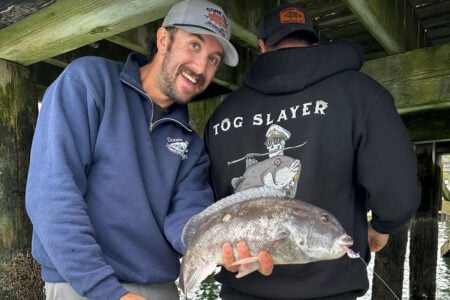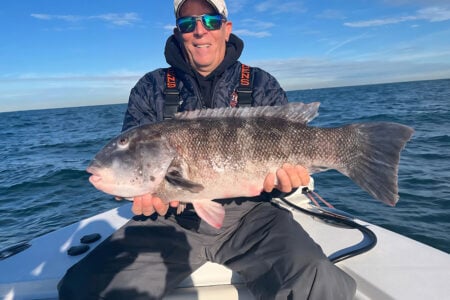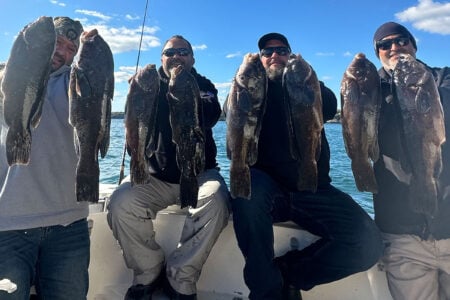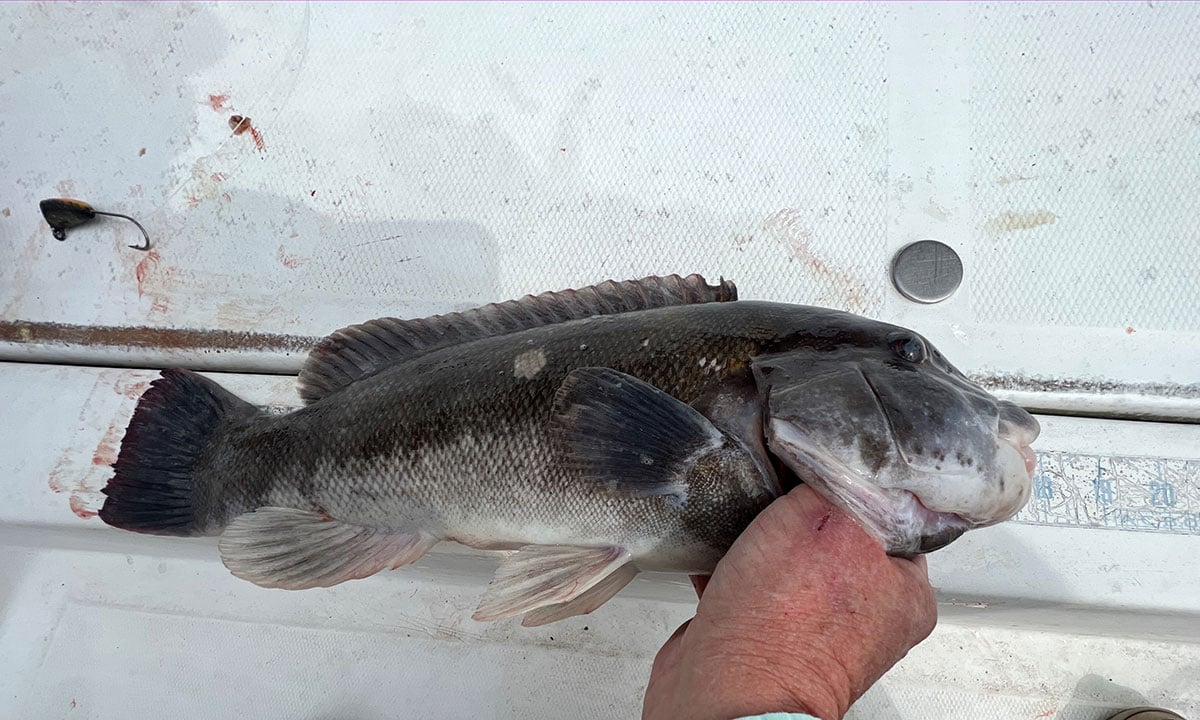
Get your one-tautog limit now, as the summer season of blackfish could soon end.
About 25 years ago I was anchored up behind Holgate with my father and good friend Dave, a bucket of frozen clam belly resting along the shelf below the boat, baiting up with globs of fresh-shucked surf clam. This particular stretch of sod bank boasted a ledge at roughly 12 or so feet, an area of shallow water above it close to the bank, below a precipitous drop to more than 30 feet. When all conditions were perfect, good-sized stripers would follow that clam scent along that ledge from a good distance away.
While waiting for a bite, we began to deal with bait-stealers; rather than a good runoff using that fish-finder rig setup, we only found pecks and nibbles. On a hunch, I went into my tackle box and re-rigged with a standard three-way, and rather than a big 9/0 circle (yes, I started using circle hooks for stripers pretty early on) I opted for smaller 2/0 octopus style hooks with smaller pieces of clam. It didn’t take long to land the first keeper tautog, and then a second in short order soon after.
Before my crewmates were able to re-rig, I had a third keeper tautog in the box. “That’s it boys, we have our three-man limit now,” I remember saying snidely. Not sure if we actually landed any stripers that day, but the shoulder season blackfish from the bay capped a great afternoon with my mentors.
Spring and fall still provide a great opportunity to snare a tautog from back bay sod banks, bridges and inlet jetties, but that one-fish bag and 15-inch minimum size that we currently enjoy from August 1 through November 15 may be a thing of the past at some point in the near future as the Atlantic States Marine Fisheries Commission (ASMFC) looks to reduce blackfish mortality in the next season or two.
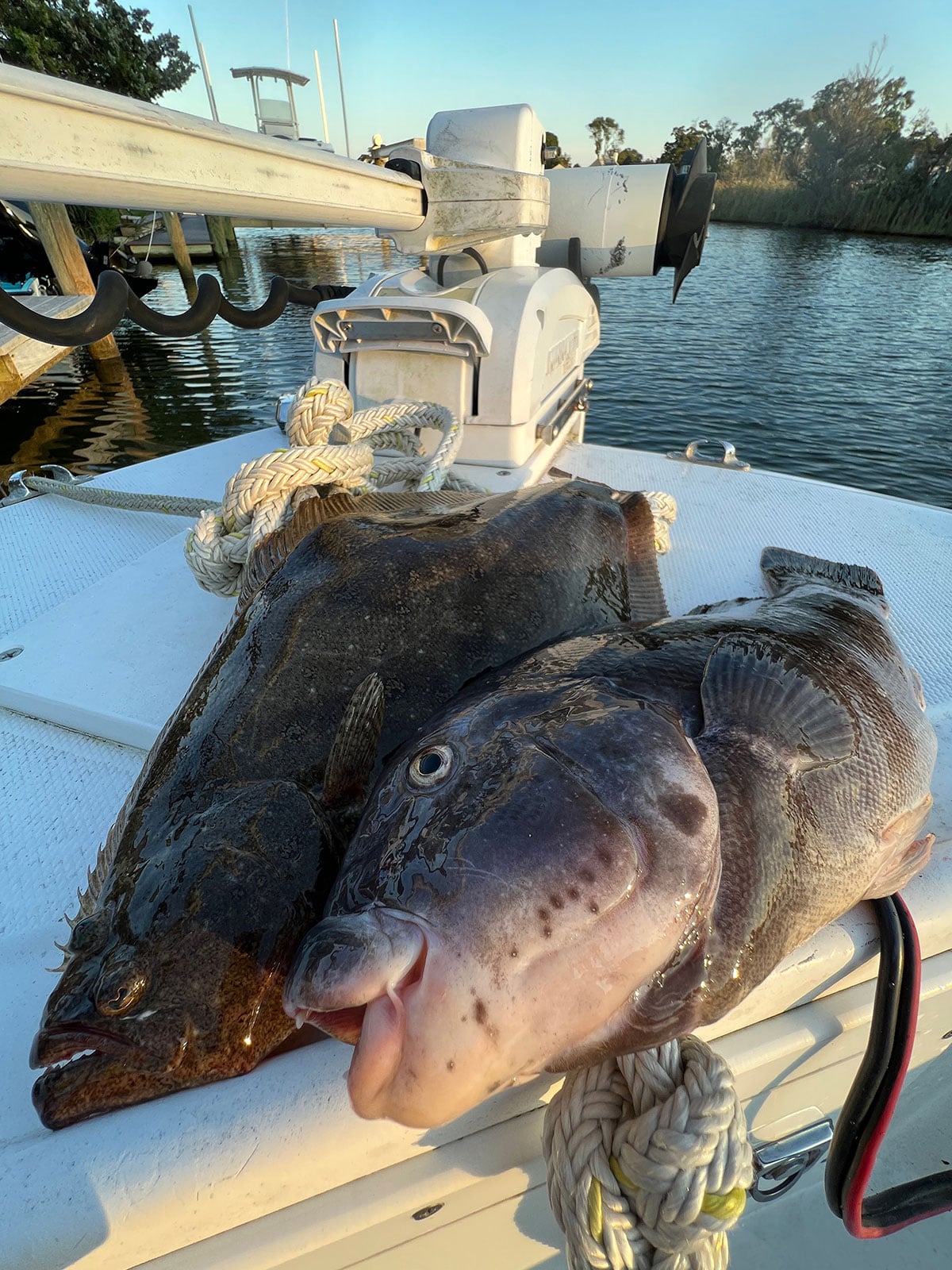
So, if you haven’t taken advantage of this unique fishery, or even if you already have, I highly recommend getting in your first and last licks today.
Rigs & Jigs
This late summer fishery has been a boon to tackle shops at the Jersey Shore, as it provides another option to go with fluke, croaker, triggerfish and kingfish for those looking to fish from shore. It’s also been embraced by divers and spearfishermen. During this timeframe, shops in the crab business have stocked up on green crabs and sand fleas in particular, though you might also be able to find shedder crab at some New Jersey outlets; Dave Showell at Absecon Bay Sportsman Center sheds crabs during the season.
While a lot of anglers take the bridge, jetty and bulkhead route, tautog in the back bays of New Jersey will also set up along the deeper sod bank ledges during the warmer months; also look for old rubble from long-abandoned piers or perhaps Superstorm Sandy relics along the bottom. I’ve been fishing that type of bottom structure for several years now, from the Little Egg Harbor and Great Bay waters, all the way up into the upper Barnegat Bay with relative success. Of course, 10 years ago I was anchoring up on these small patches, whereas my Minn Kota Terrova and the Spot Lock feature allows me to anchor and fish alone with solid precision. Same can be said for kayakers under pedal-power.
The areas I target for “outback” tautog seem to fish best around the slack tide. I’ve been using a Century Weapon Jr. Mag for this shallower water action. It’s 7 feet, 3 inches in length with fast action rated for quarter- to 2-ounce lures and I’ve paired it to a PENN Authority 4500 series reel spooled with 30-pound braid with 20-pound Yo-Zuri HD fluoro. Honestly, a good 3000 series reel works just fine. The fight typically isn’t very long in shallower water once you horse the fish away from the structure.
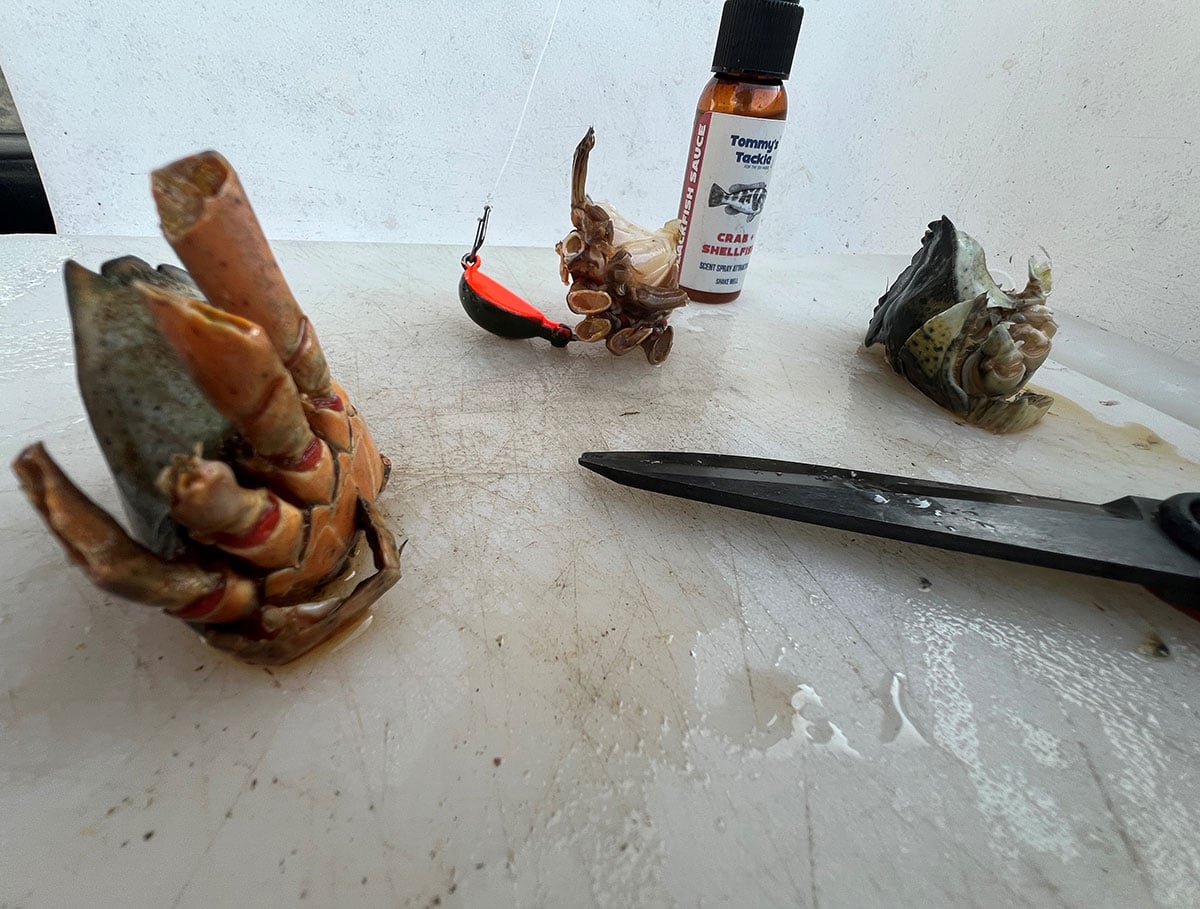
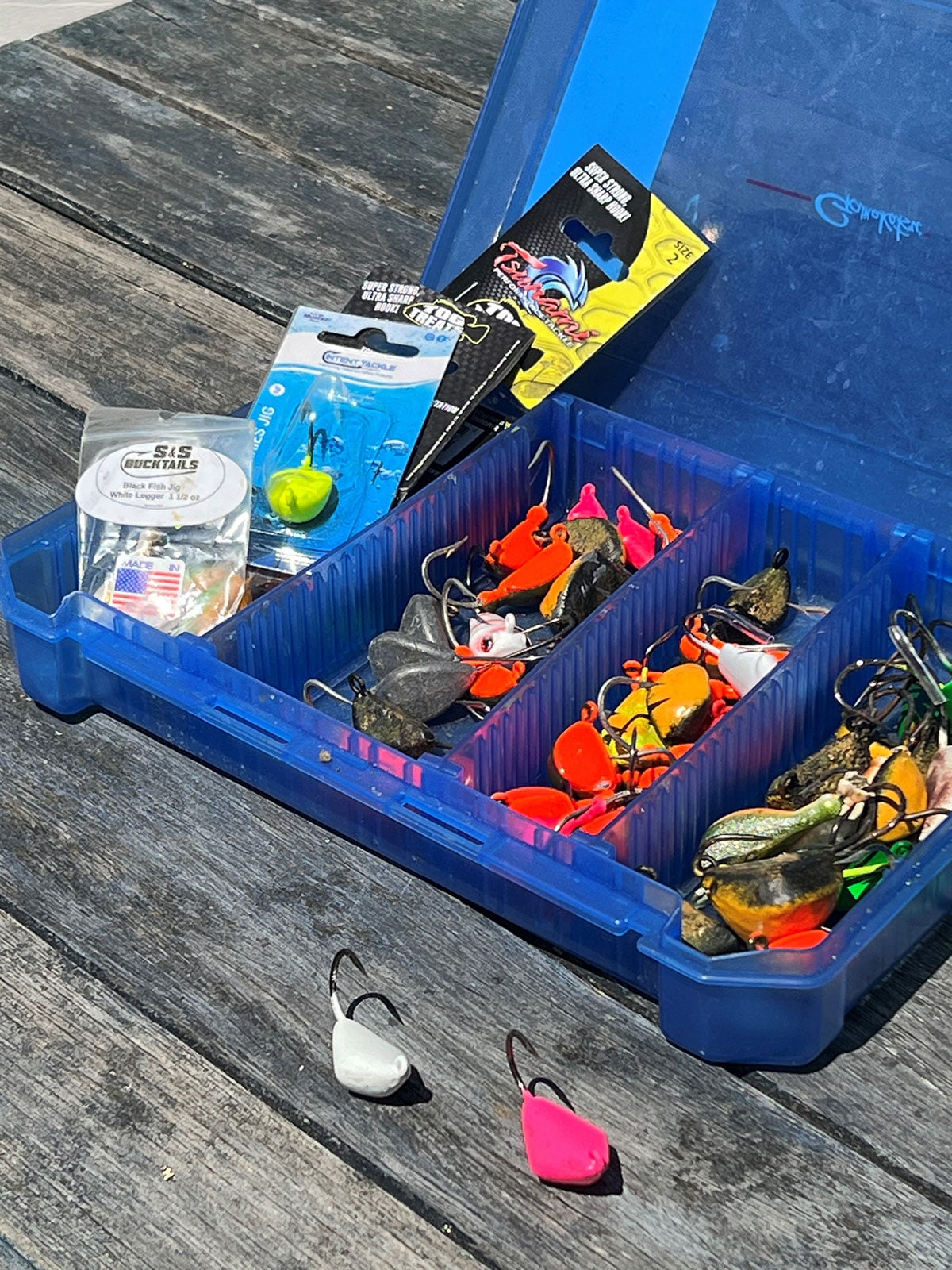
Tautog jigs in this arena are varied; I have no real personal preference on manufacturer as I have a bunch in my jig tray; Bottom Sweeper Jigs were designed by Capt. Dan Schafer of Cape May County especially for sheepshead, and I find they stand upright rather quite well with the crab deployed on the hook. It’s typically a quick session, I’ll take two dozen greenies for myself, each halved with the legs and claws cut off and thrown overboard; 48 baits can go rather quickly when fishing is good, as slack tide on a small pimple of a piece sees a lot of smaller tautog stealing baits. Once the tide begins to swing, I’ve found that I often get a quick shot at those keeper-sized blackfish that seem to join the feed on first-moving water.
You can certainly utilize a lighter-leader tautog rig over the jig, but light tackle tautog jigging in shallower waters around any structure – inlet jetties and bridges too – can also be helpful with getting the “feel” right when it’s time to head deeper for bigger fish and larger bag limits come November 16. Other species you’re apt to hook up with this month include sheepshead, triggerfish and black drum.
Management Timeline
Results of the 2025 regional stock assessments update show that tautog were experiencing overfishing in New Jersey-New York Bight region even as the stock is not currently considered overfished, however tautog was considered both overfished and experiencing overfishing in the Delaware/Maryland/Virginia regions. According to the ASMFC, the data shows the tautog fishery is neither overfished nor experiencing overfishing in Massachusetts-Rhode Island and Long Island Sound regions.
According to the ASMFC, total blackfish removals have increased in all regions, driven primarily by increases in recreational harvest. “If the current fishing mortality exceeds the regional threshold level (i.e., overfishing is occurring), Amendment 1 directs the Board to initiate management action, via a management document, within one year of receiving an overfishing determination, with new management measures implemented in the second year,” the ASMFC noted in a recent bulletin.
Last October, the ASMFC’s Tautog Management Board (Board) initiated an addendum to address changes in stock status for the New Jersey-New York Bight and Delaware/Maryland/Virginia regions. The Draft Addendum to consider options to reduce mortality in the tautog fishery at some point over the next couple of years.
In August of 2026, the Board voted 8-1 to delay releasing Tautog Addendum I to the public for comment the harvest reduction projections over the next 3 to 5 years are updated using the most recent three-year average removals from 2023-2025. Essentially, the management body would like to see management projections updated using the final 2025 data from the Marine Recreational Information Program, or MRIP. Of particular note, the Board noted how tautog 2025 harvest in New York and New Jersey was lower than projected using 2022-2024 average removals.
The ASMFC will take up tautog discussion again from November 9-12 during their Annual Meeting which this year is being held in Newport, RI. We could be seeing changes as early as 2027, but for now let’s wait and see.
Summer Fishery?
On July 7, the New Jersey Marine Fisheries Council’s Tautog Committee met to discuss management options to achieve up to a 40% reduction in harvest as has been projected under the latest ASMFC deliberations over blackfish. According to the committee meeting summary that was presented at the council’s July meeting, there seemed to be overall support amongst members of the committee for increasing size limit and reducing bag limits rather than cutting seasons.
“Broadly, there was interest expressed by recreational anglers in maintaining the summer season as is, citing ease and enjoyability of fishing during this season,” the committee report noted, adding “However, staff and advisors raised a notable concern about poaching in the tautog fishery, with excessive harvest numbers reported by law enforcement.” According to the committee report, poaching is more common during the warm weather months, so if decreasing illegal take of tautog is a goal then reducing the summer season would be the target for management.
According to the ASMFC, an illegal live tautog market has developed in the New York City and Philadelphia Chinatowns over the last 15 years, with the commission implementing a commercial tagging program to combat the illegal harvest and trade of tautog. “Most of the states implemented the tagging program in 2020; only New York and Connecticut did not implement the program due to challenges posed by the COVID-19 pandemic,” said ASMFC, adding that all states from Massachusetts to Virginia had implemented the commercial tagging program as of 2021.
While both commercial and recreational sectors are available for cutbacks in the tautog fishery as this new addendum is being discussed, given the recreational sector is so much greater than the legal commercial fishery for tautog, not taking any commercial harvest cuts when it comes time to act would only lead to an estimated 0.1% added burden to the recreational sector in New Jersey, according to the data. Additionally, the January-February season would not factor into the projection scenarios, so although that season could be cut, there would be no credit given in terms of any estimated reductions. “Likewise, it is not thought that there is significant harvest in this season, so it would not provide much savings,” the committee noted.
The committee will review available options presented by the ASMFC and its Board, prioritizing for advisor review and input at a future New Jersey meeting. But for now, enjoy this late season “outback” option while you can.