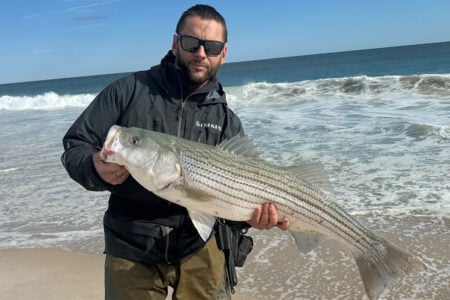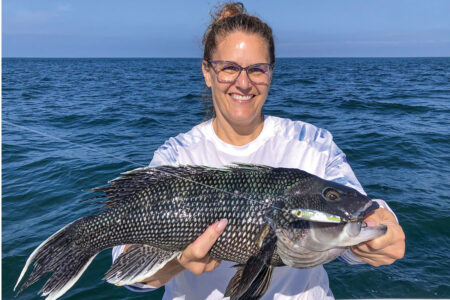
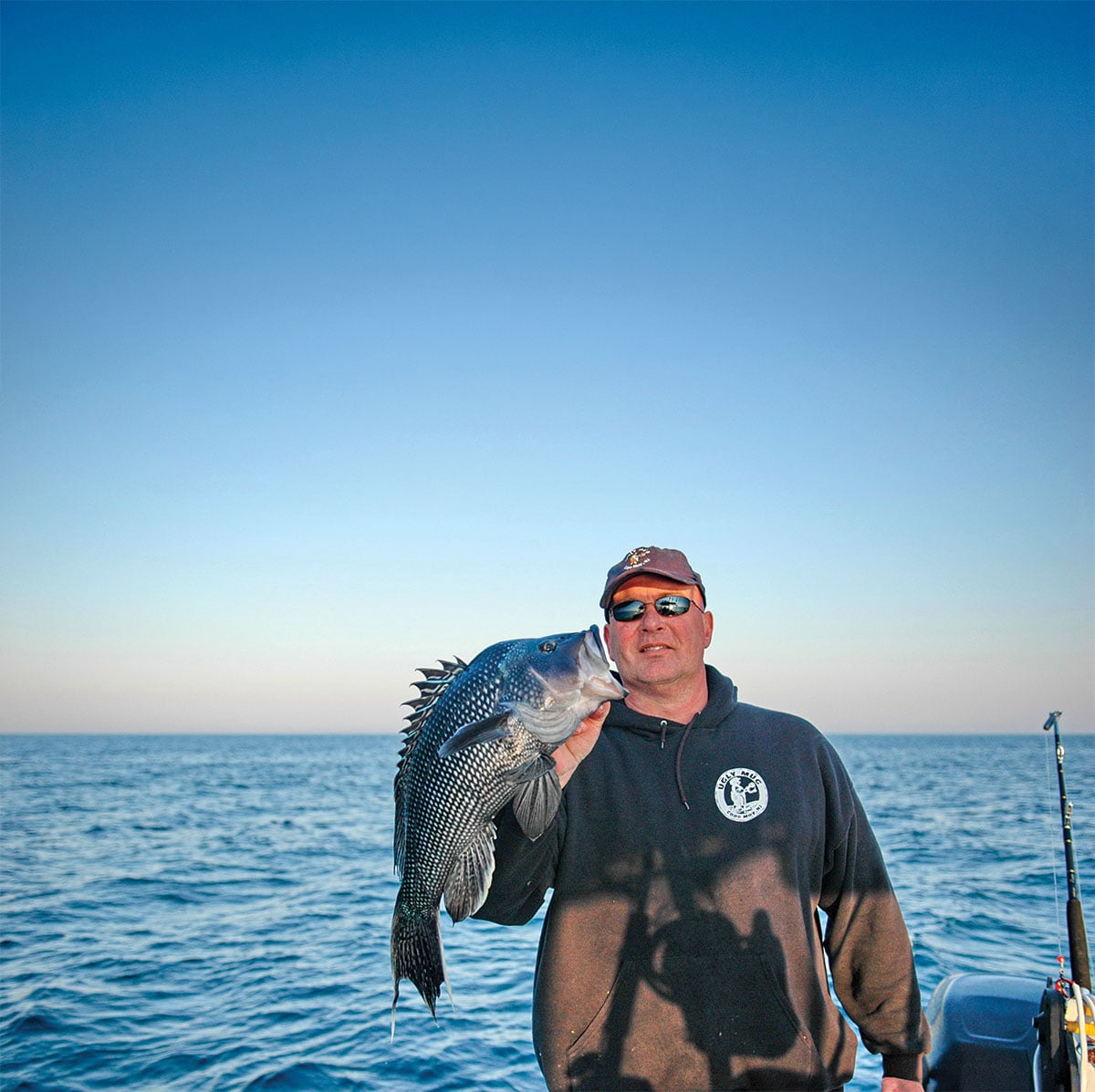
Slow pitch conventional or bucktails and spinning tackle, take your pick.
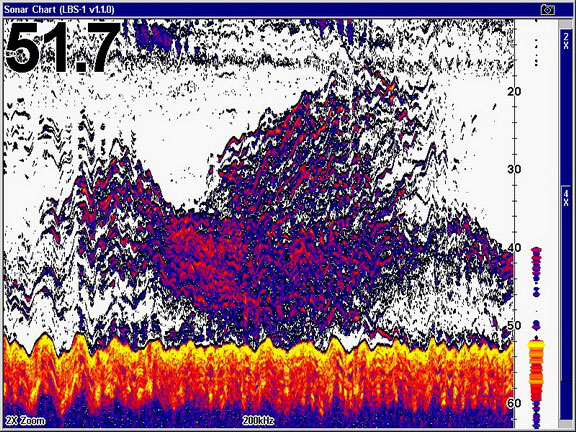
“You could drive over this spot a hundred times, but without sidescan you’d never recognize what was down there,” I said by way of informing my guests about what I was seeing on the sonar display. “The low-lying structure is debris from a long-since disintegrated wood wreck and it’s a great black sea bass spot because it gets so little attention.” After a 360-degree look around the boat for prying eyes, I deployed the trolling motor, put it in anchor mode, and we dropped bucktails on ultralight spinning tackle and a center-weighted jig on a slow-pitch jigging outfit.
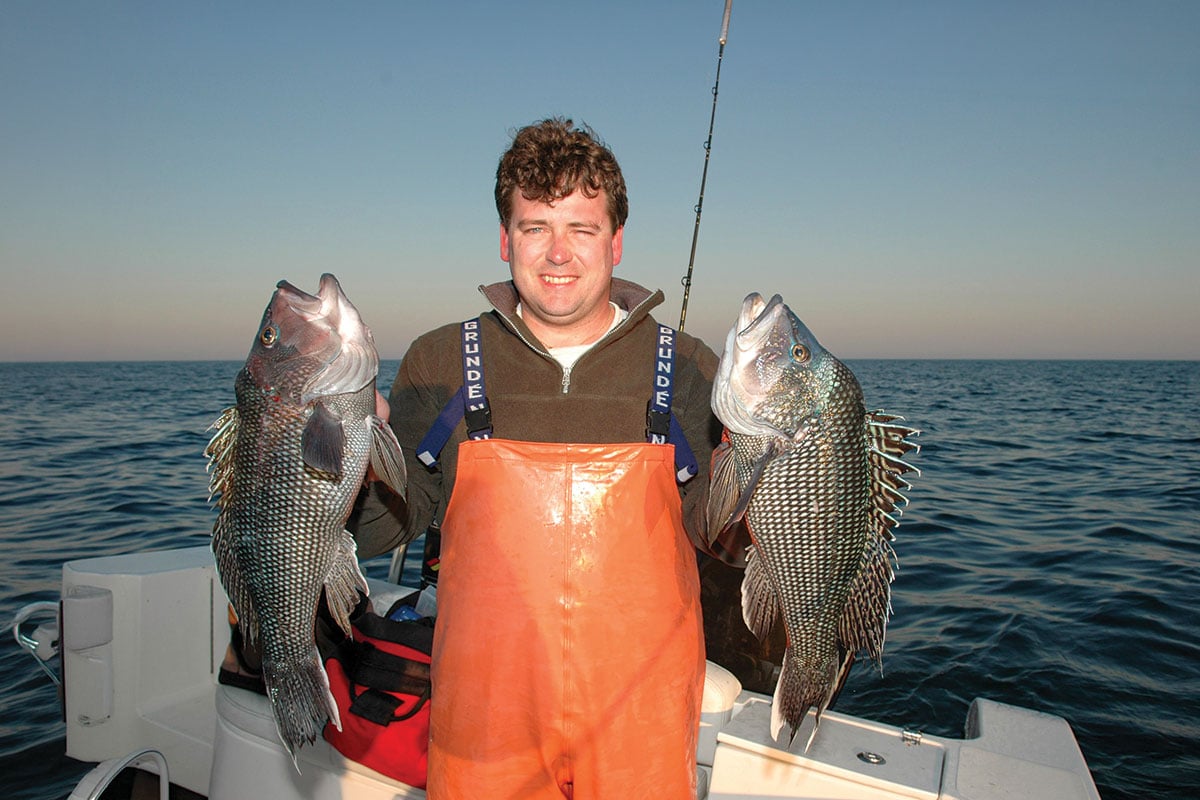
As soon as it neared the bottom 65 feet below, one of the bucktails got smacked and the skinny rod bent over double. There’s no mistaking the solid bite followed by the rhythmic bouncing imparted by the fight of a substantial black sea bass. The fish took a little drag several times as it dug hard to get back to the bottom. Then the slow pitch rod bent over as another biscuit tried to make off with what it thought was an easy meal. After some spirited give and take a pair of humpbacks came over the rail and into the pail – on ice in the cooler actually – destined for the dinner table. A bunch more would fall to our light tackle efforts that morning.
Fishing for biscuits, as we affectionately call them, is usually easy pickins’ and lots of fun.
Management Patchwork
Black sea bass have been popular with Mid-Atlantic anglers since the first party boats started taking passengers bottom fishing over a hundred years ago. They were sought after for their tasty white fillets and that hasn’t changed, but angler access to the fishery has changed dramatically over the years. For the last decade or so fishermen have been caught between a burgeoning stock and a draconian management regime. While there was worry about the stock as far back as my 9 years on the Mid Atlantic Fishery Management Council (Council) in the late 1990s and early 2000s, the population has rebounded rapidly to a size that outpaced even the most optimistic projections of managers and scientists alike. Yet, even today, anglers are dealing with a ridiculous patchwork of confusing seasonal openings and closures and shifting bag limits that should have been done away with years ago.
The most recent stock assessment was so strong that the Council and Atlantic States Marine Fisheries Commission (Commission) could no longer hold the line on the minimalist recreational annual quotas, but still only increased the recreational harvest limit by a measly 20%. With the stock at levels well above the rebuilding target set in the fishery management plan, or FMP, I can see no reason why there is any seasonal closure at all. Black seas bass should be a year-round fishery with just reasonable bag and size limits to moderate harvest levels. Not only would this approach not damage the stocks, it would offer benefits to the for-hire sector that finds itself with weeks on end when seasonal closures leave them with little to fish for, and it would also help alleviate some of the pressure on other species like striped bass and fluke.
Alas, that’s just too much common sense for fisheries managers to wrap their heads around. They still work under the assumption that the more fish in the ocean, the more restrictive the regs must be.
Another consideration is the prevalence of black sea bass much further north in the past. These “biscuits” are fueling recreational landings well into New England due to warmer ocean temperatures and a stock that is so large it is simply expanding its range. Only a few years ago anglers in Rhode Island and Massachusetts rarely saw a black sea bass, but more recently they have become the predominant recreational catch.
Black sea bass are typically structure oriented but will often venture considerable distances from hard bottom and at times well up in the water column to feed. They forage on mussels, small crabs, shrimp and fish, but the bigger they grow the more predatory they become with small fish making up a much larger portion of their diet. They have big heads with a large mouth and will eat pretty much anything that fits. They are a mainstay on the many artificial reefs off the New York-New Jersey coastline and can range well offshore. I’ve caught small ones in tidal rivers and bays, and they can range out to the canyon edges. They seem to have no problem with depth because I have caught them while deep dropping for tilefish in 600 feet of water.
Sticking with the nearshore spots where anglers spend most of their time in pursuit of biscuits, here are the light tackle techniques I use for these voracious predators. Interestingly, both techniques wouldn’t be possible without braided line which makes it possible to use light bucktails and jigs to entice them in water 50 to 80 feet deep.
Twitch & Shout
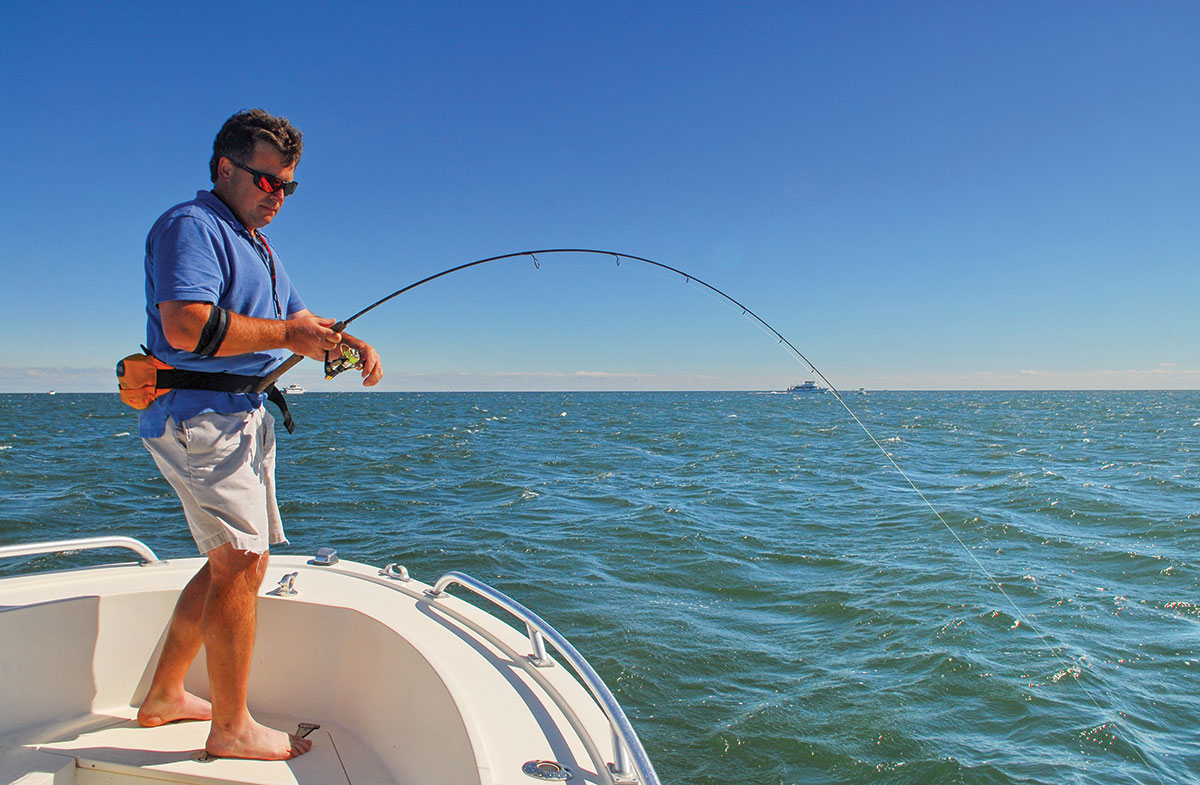
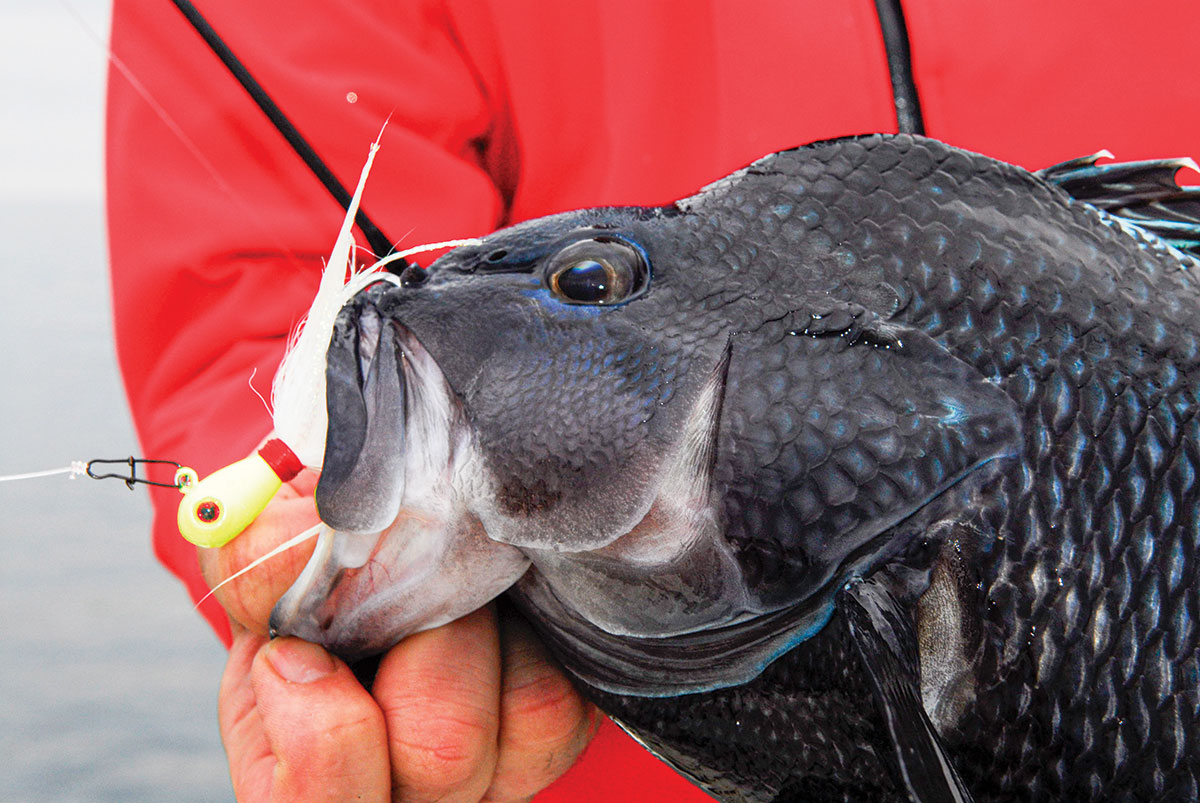
I stumbled on the first technique quite a few years ago in an effort to tease more bites from bigger sea bass while squeezing more enjoyment out of catching them. A few of my friends and I were early converts to using 5-1/2-foot, ultralight spinning rods and 2000 size spinning reels loaded with 4- to 8-pound test braid. The braid makes it possible to fish one half to 2-ounce bucktails over relatively deep structure, feel even the lightest bites and really enjoy the fight once hooked up. The bucktails always include some form of Gulp, which adds that magic scent and taste, and a strip bait like squid to add more movement to the offering. When we first started using this setup the black sea bass went nuts for it, and it almost always accounted for bigger fish than the typical high-low bait rig. Not only does it catch more and bigger fish, it also makes catching them so much more fun. Matching the tackle to the size of the quarry is a no-brainer and you might be surprised by the spirited fight a 3-pound plus biscuit will put up on tiny tackle.
I like to use a double bucktail rig unless the fishing is very fast, at which point I will unclip the top bucktail and fish a bigger single. The rig is almost identical to the rig I use for fluke fishing. Start by tying a minimum 6-foot length of 12- to 20-pound test fluorocarbon leader to the braid and then tie a 50-pound test Tactical Angler Power Clip to the tag end. Add a large dropper loop about 18 inches up from the bottom, snip one leg close to the knot and tie another Power Clip to it so the dropper stands out from the main line 6 inches or more. The clips make changing out bucktail sizes and colors quick and easy because you will find that both factors can matter. The bottom position gets a 3/4- to 2-ounce bucktail, and the dropper is 1/4- to 1/2-ounce bucktail. Dress both bucktails with Gulp swimming minnows, mullets or shrimp bodies for scent and taste and I like to add a slender squid strip a few inches long to provide more action. When the bite is hot the squid isn’t always necessary.
After you drop your rig to the bottom reel up a turn or two and bring the bucktails to life. A slow, rhythmic lift and drop of the rod tip will swim the bucktails with a gentle up and down motion sort of like a synchronized swimming program. This is particularly effective when drifting but can also work when fishing vertically while hovering over structure. You can cast around the structure using the same lift and drop by adding a turn of the reel handle after each to work it back to the boat. Another method is to hold the rod horizontal to the water and twitch the tip rapidly which makes the lighter bucktail on top dance while the heavier bucktail barely moves. It can attract violent strikes even when the fish are not feeding aggressively. Here’s one you might not have seen coming. At times when the biscuits are being picky just holding the bucktails a few feet off the bottom without imparting any movement will get bites.
Keep an eye on the depthfinder to see where fish are in the water column and to note when fish are passing under the boat. If you’re drifting, mark and spots where you see concentrations of fish on your chart plotter so you can go back and short drift it. Most of the time biscuits will be close to the bottom, especially bigger fish, but for taller structure like wrecks or rockpiles on artificial reefs they can be anywhere from around the sides to hovering above. Adjust the depth of your lures accordingly and get ready for action.
Slow Pitch & Pull
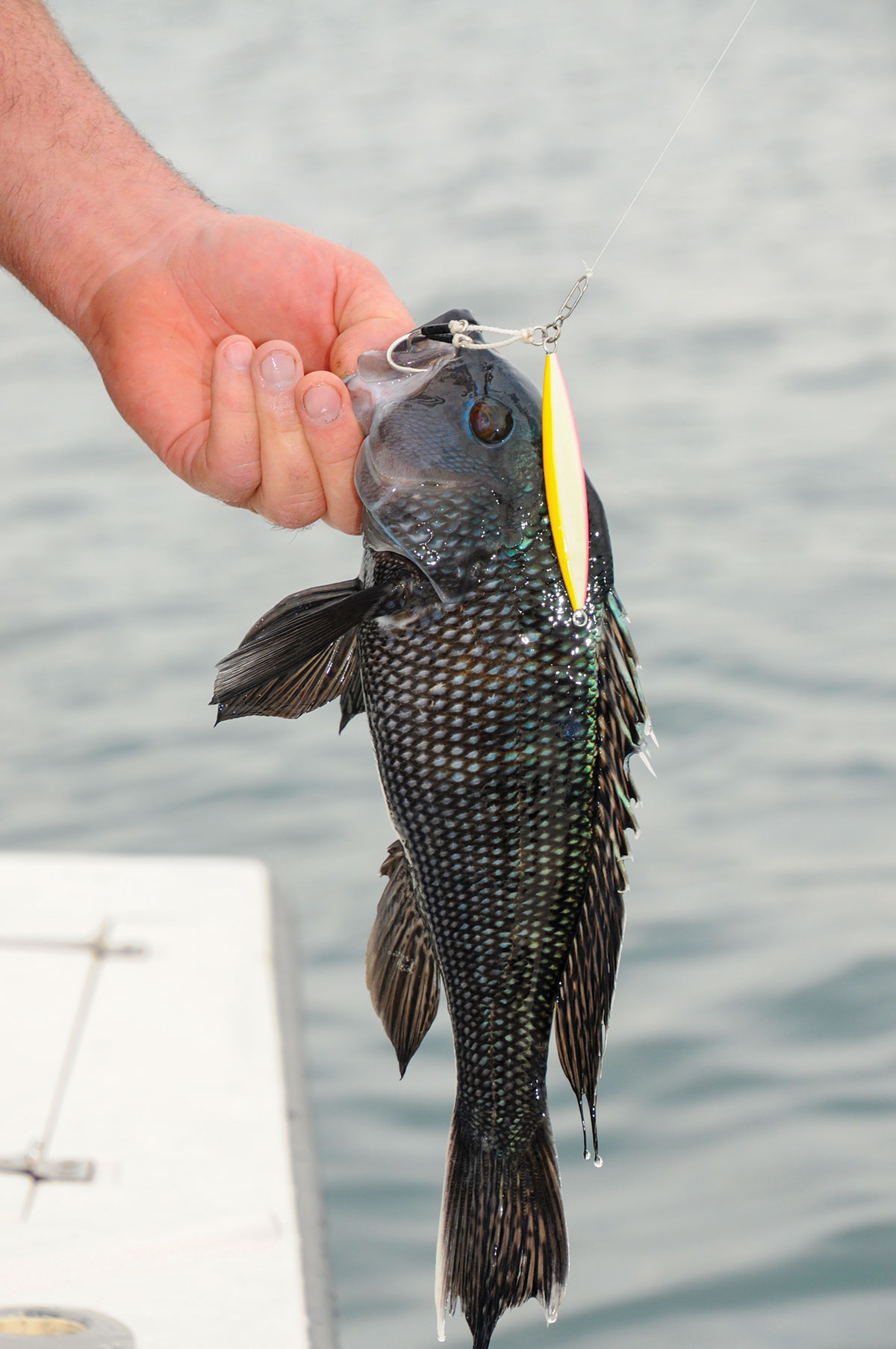
Twenty years ago, the Japanese gave us the butterfly jigging craze for pelagic fish like tuna and more recently they gave us the slow-pitch technique which can be scaled up for big fish or scaled down for smaller species. At times it works quite well for sea bass. I was introduced to slow-pitch by the late Dave Arbeitman of the Reel Seat in Brielle, NJ who guided me through picking the right outfit and jigs for biscuits. The basic concept is offering gamefish a target that glides and flutters enticingly. Done correctly, it keeps the jig in the strike zone. Most of the strikes will come as the jig is dropping so it requires attention to the line between the rod tip and water to watch for subtle bites.
The tackle is specialized, very light fast action spiral-wrapped rods that bend from tip to reel seat and tiny high-speed reels with long handles that pick up a lot of line with each turn. These are paired with slow-pitch jigs that are center-weighted, so they glide on the drop. Action is generated either by reeling and pausing or using a lift and drop action with the rod. The pause after each turn or lift allows the jig to glide as it falls begging to be eaten. Both styles and others you can learn by checking out the hundreds of videos on the subject on the Web will help develop your proficiency.
Fighting fish on these noodle-like slow-pitch rods is a little different, too. The rod butt is kept tucked under your arm and very little lift and reel is used. Just turn the reel handle and let the deep flex of the rod tire the fish.
The popularity of fishing for sea bass continues to grow with the stocks at historic levels and the range expanding northward. With the increase in recreational quote this year, be sure to check the seasons, size and bag limits for your state because like the times, they are a changin’.
Biscuits can be found on artificial and natural reef areas, wrecks and rock piles nearshore, and in the winter offshore on hard bottom areas much further offshore in much deeper water. These techniques will add more fun to the catching by giving these aggressive critters the ability to show off their fighting prowess.
Give either technique a try and I’m sure you’ll retire any old fashion sea bass bait rigs you might have left lying around.