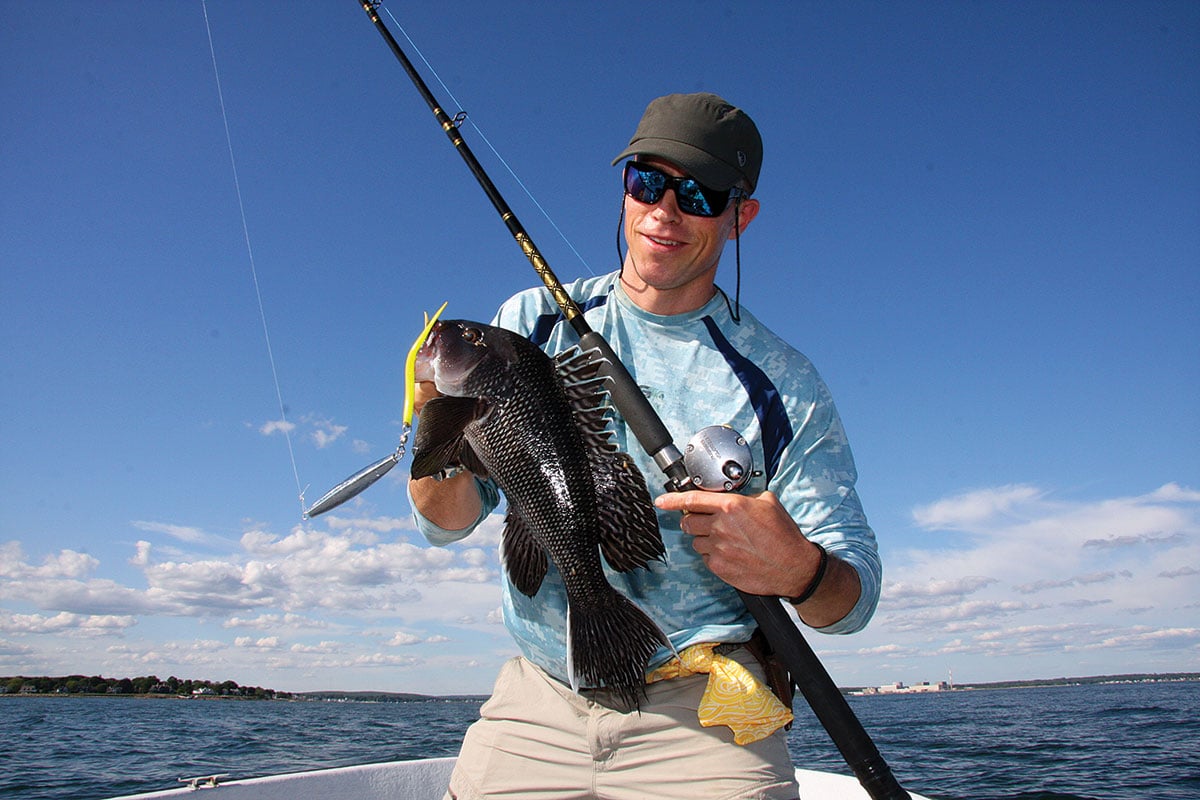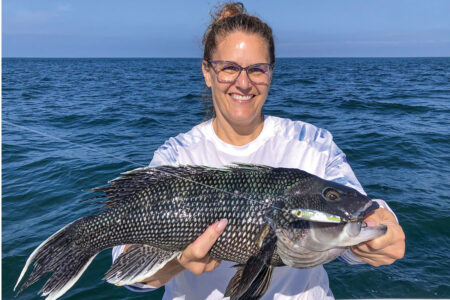

Targeting fall humpbacks with diamond jigs and teaser tails.
Do you tire of the work and mess of cutting bait for black sea bass? Do swarms of dink sea bass and porgies pick your hooks clean when your sinker bumps bottom? If your answer is yes, then it’s time to eliminate the small bycatch by switching from bait to heavy metal lures.
Late-season humpback sea bass are aggressive, boast bucket mouths, and eagerly inhale large, fleeing forage as they prepare for the winter ahead. The most efficient way to simulate that prey in deep water is with diamond jigs.
For handling, a diamond jig’s naked chrome-over-lead construction makes it extremely efficient. Diamond jigs are simple, clean, fast, and tooth-proof. Using diamonds for sea bass means no messy cutting boards, no hooks to rebait, and no gut-hooked fish. A diamond jig’s body affords a sturdy and safe “handle” for lifting, holding, and unhooking feisty fish.
Diamond jigs can plummet in the strongest current or flutter downward like wounded prey, yet they wobble irresistibly like fleeing baitfish when retrieved. During hot action, jigs offer a speedy turnaround time. As quickly as you can wrestle a diamond’s hook from the maw of a big sea bass, you can immediately drop it back down to the strike zone. Diamonds are also less expensive than many other types of lures. A few tackle shops carry “seconds” (lures with minor defects) and non-brand-name or homemade jigs, as well as some that are bagged in bulk without hooks, making purchases even cheaper.

On sunny days in clear water, baitfish appear mirror-like – that is, bright silver and highly reflective. However, in murky water during low-light conditions, or in the depths, baitfish become dull. The surfaces of diamond jigs perform the same way, reflecting the ambient light and therefore more closely imitating baitfish than painted lures. Experts use the lightest jig possible given the wind, current, and depth, which allows for the most action and feel. However, in deep late-season habitat spots, carry jigs from 8 to 12 ounces. In sheltered waters with less current, a 4- to 6-ounce diamond is perfect because it weighs enough to tend bottom in deep water and resembles prey like squid and herring.
Tubes And Bucktails
Sea bass make excellent sportfish because they’re opportunistic feeders, strike aggressively, and fight hard all the way to the surface. Their varied diet includes small herring, peanut bunker, baby butterfish, juvenile porgies, tiny lobsters, and small crabs. Two of their favorite targets are sand eels and squid, which is why diamond jigs rigged with a split tube tail or bucktail work so well.
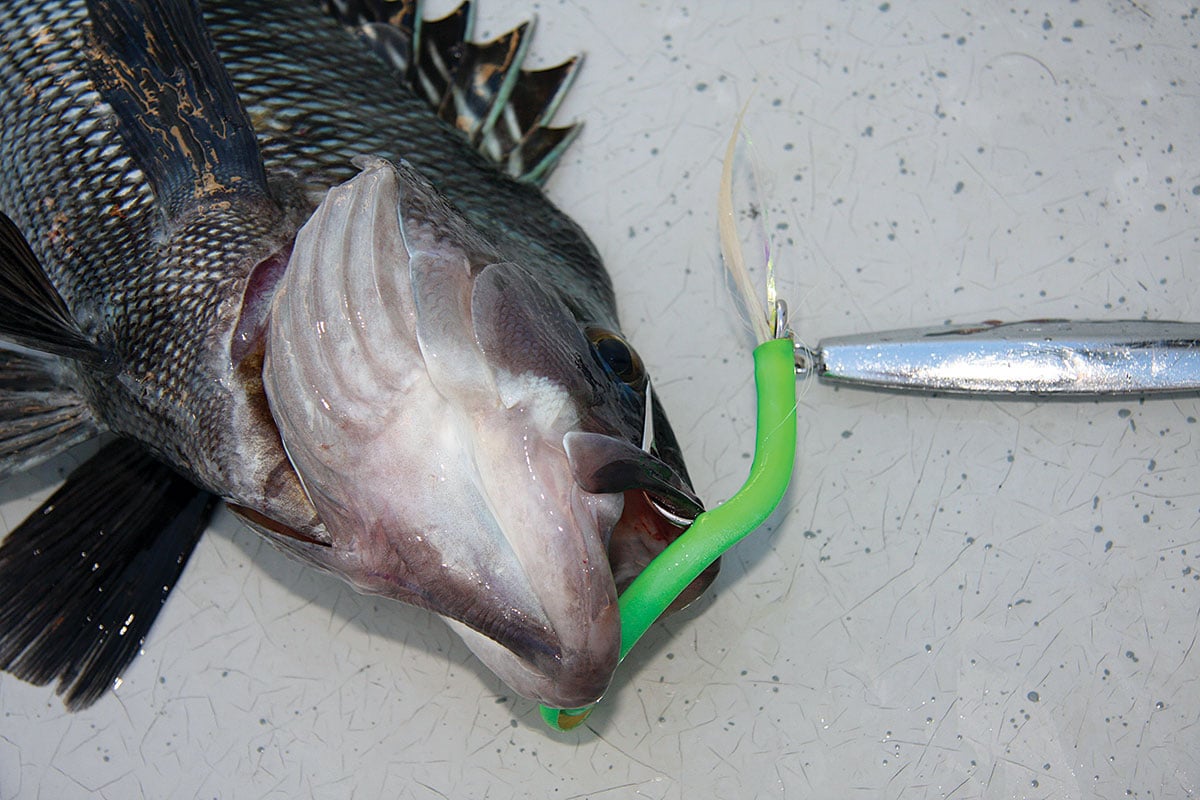
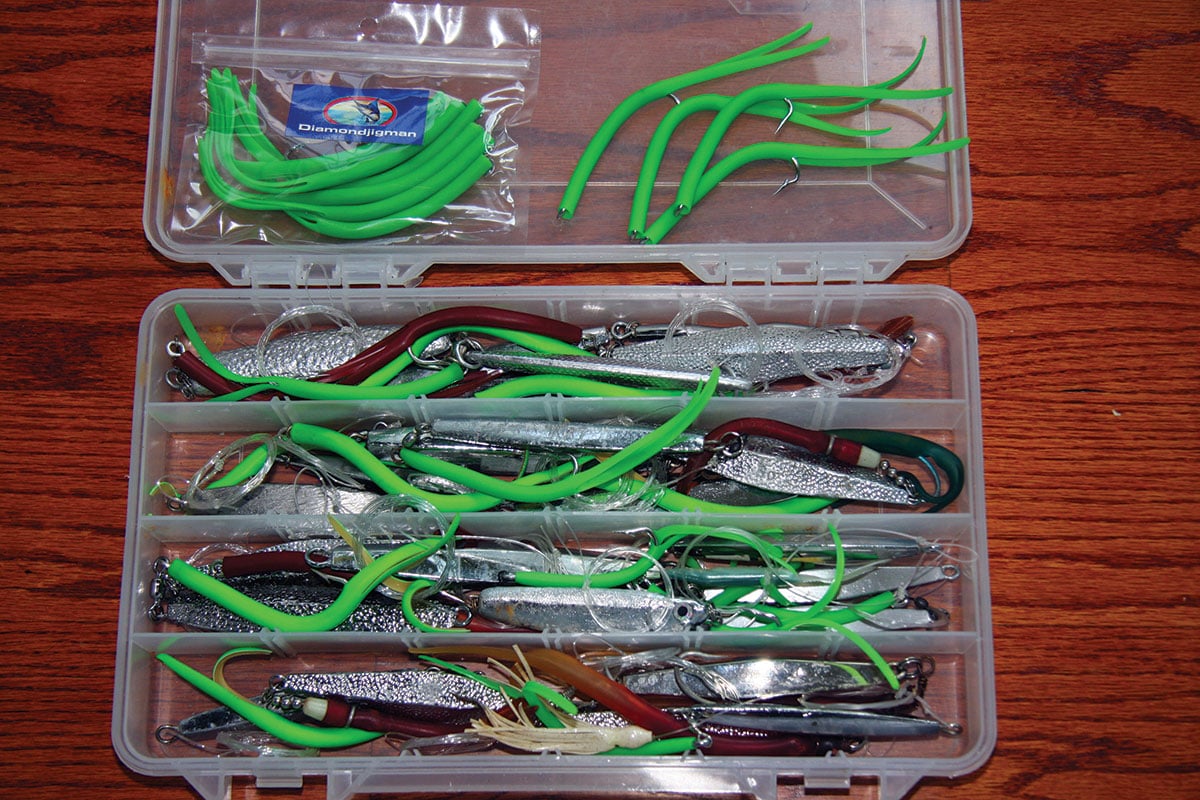
The chrome body of a diamond jig is a major attractor on its own, but when coupled with a colorful surgical tube fitted over a 6/0 to 8/0 bent Limerick hook, the tube tail resembles a sand eel or squid’s tentacles. The tube then becomes the primary target rather than the body of the jig. Even a 16-inch sea bass will eagerly attack a 6- to 8-ounce diamond jig and tube.
Surgical tubing is an extremely elastic and durable product made from latex rubber or silicone. It’s flexible, strong, and has great recovery properties after stretching. Such tubing is also commonly used for exercise and physical therapy. Tubing designed for fishing is produced in a variety of colors and diameters, and you may have seen it used for umbrella rigs, sabikis, and tube-and-worm rigs.
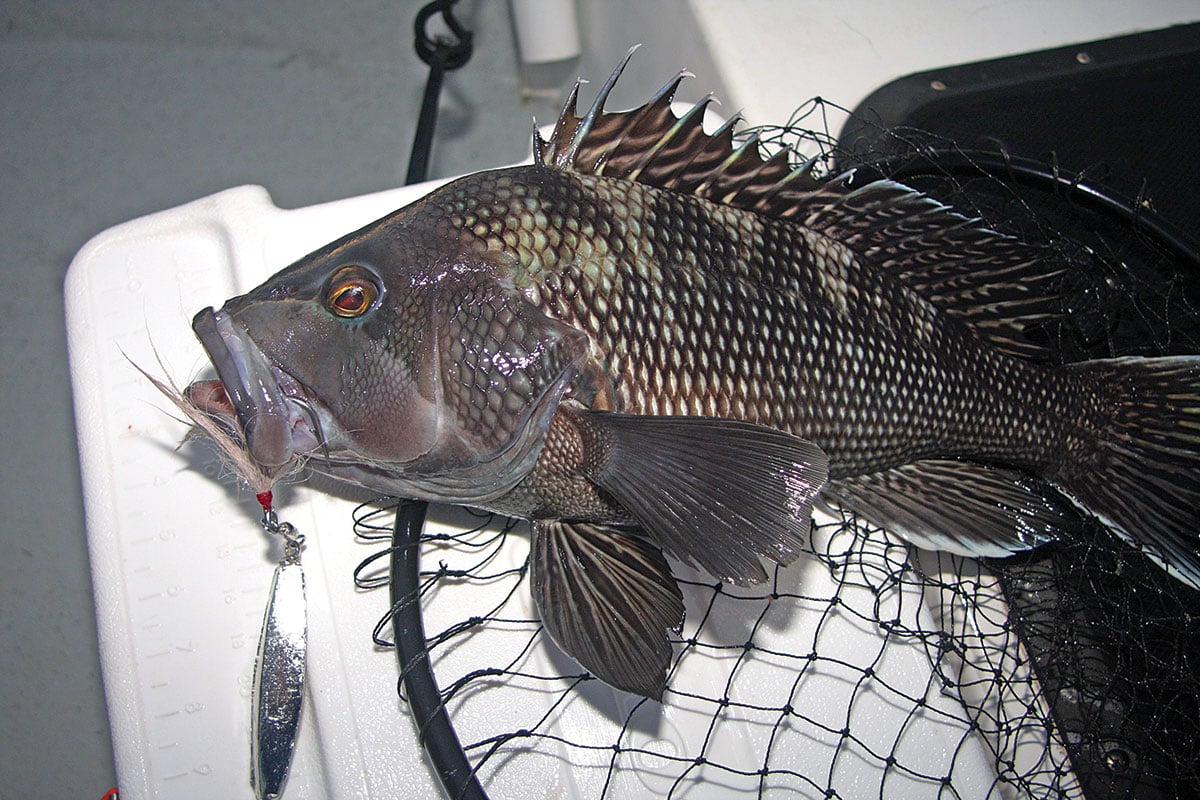
Crucial to the performance of a diamond jig’s tube tail is its placement on the lure. Some tackle shops and online sites sell hookless diamond jigs with only a swivel attached. The swivel end is the hook end, not the line end. A few shops sell diamond jigs rigged “backwards” with the hook attached directly to the eye of the jig. In either case, you simply add a tube tail by removing the existing hook, which is typically a 7/0 or 8/0 O’Shaughnessy, and attaching an open-eye 6/0 to 8/0 bent Limerick to the swivel. Close the hook eye with vise grips.
The purpose of a bent-shaft Limerick hook is that the length accommodates the body of the tube, while the bend causes the tail to spin as the jig is retrieved. The twirling motion simulates a wobbling sand eel or fleeing squid. When possible, purchase Limericks in stainless steel, which prevents rust from staining the tubes and also allows damaged tubes to be smoothly changed out.
Bucktails are another excellent option to adorn a diamond jig for sea bass. A white bucktail tied to a 6/0 or 7/0 single changes a diamond jig’s bare hook into a teaser resembling the beating tail of an injured or escaping baitfish. A good option is a VMC Siwash White Bucktail Hook in a 6/0. If you have fly-tying skills, you can easily tie your own with heavy-duty thread.
Dancing The Jig
| REGIONAL REGS |
| Connecticut: May 18 to June 23 and July 8 to November 28; five-fish bag limit; 16-inch minimum size. (Closed June 24 – July 7)
Delaware: May 15 to September 30 and October 10 to December 31; 15-fish bag limit; 13-inch minimum size. Maryland: May 15 to December 31; 15-fish bag limit; 12.5-inch minimum size. Massachusetts: May 20 to September 7; four-fish bag limit; 16.5-inch minimum size. New Jersey: 12.5-inch minimum size;
New York: 16.5-inch minimum size;
Rhode Island:
|
Depending on the species you’re targeting, there are many ways to fish a diamond jig. For sea bass, however, bluefish-style speed-jigging or “squidding” isn’t the most productive method because you’re quickly and constantly retrieving the jig out of the strike zone. Also ineffective is the swing-for-the-fences approach with long and fast upward rod sweeps, which may be ideal for stripers and cod but is too exaggerated for sea bass.
When fishing with a bucktail teaser hook, the right technique is subtler, keeping the metal bouncing right along the bottom as if tending a sinker, but using short, 12- to 18-inch strokes by snapping the rod tip up and imparting a motion like a fluttering baitfish just inches off the bottom.
A diamond jig’s drop is just as vital as the lift. Because of its unique shape, it can flutter sideways toward the bottom, an action that resembles a wounded or spawning baitfish. You can achieve this action by quickly dropping the rod tip. If you drop your tip too slowly, however, line resistance will hold your jig vertical with no horizontal fluttering motion.
“It’s important to keep your jig near the bottom,” advised Capt. Ned Kittredge, a retired Massachusetts charter pro, who went ton to add “or no more than a ‘rod tip’ off the bottom, imparting a short-but-exact and fairly swift jigging motion. These fish prefer structure and rarely venture too far up the water column to feed. But don’t lose complete contact with the jig, as the strike often comes on the drop. It requires practice and touch to achieve consistent hookups on deep-water sea bass.”
When fishing with a split tube tail, however, change your jigging style to accentuate the tube. Free-spool the jig to the bottom, engage the reel, and make 6 to 8 slow turns up, then drop again, bump bottom, and repeat the process. This is highly productive because it allows the tube to spin and resemble wiggling sand eels or undulating squid.
Where To Find Sea Bass
| OTHER JIG OPTIONS |
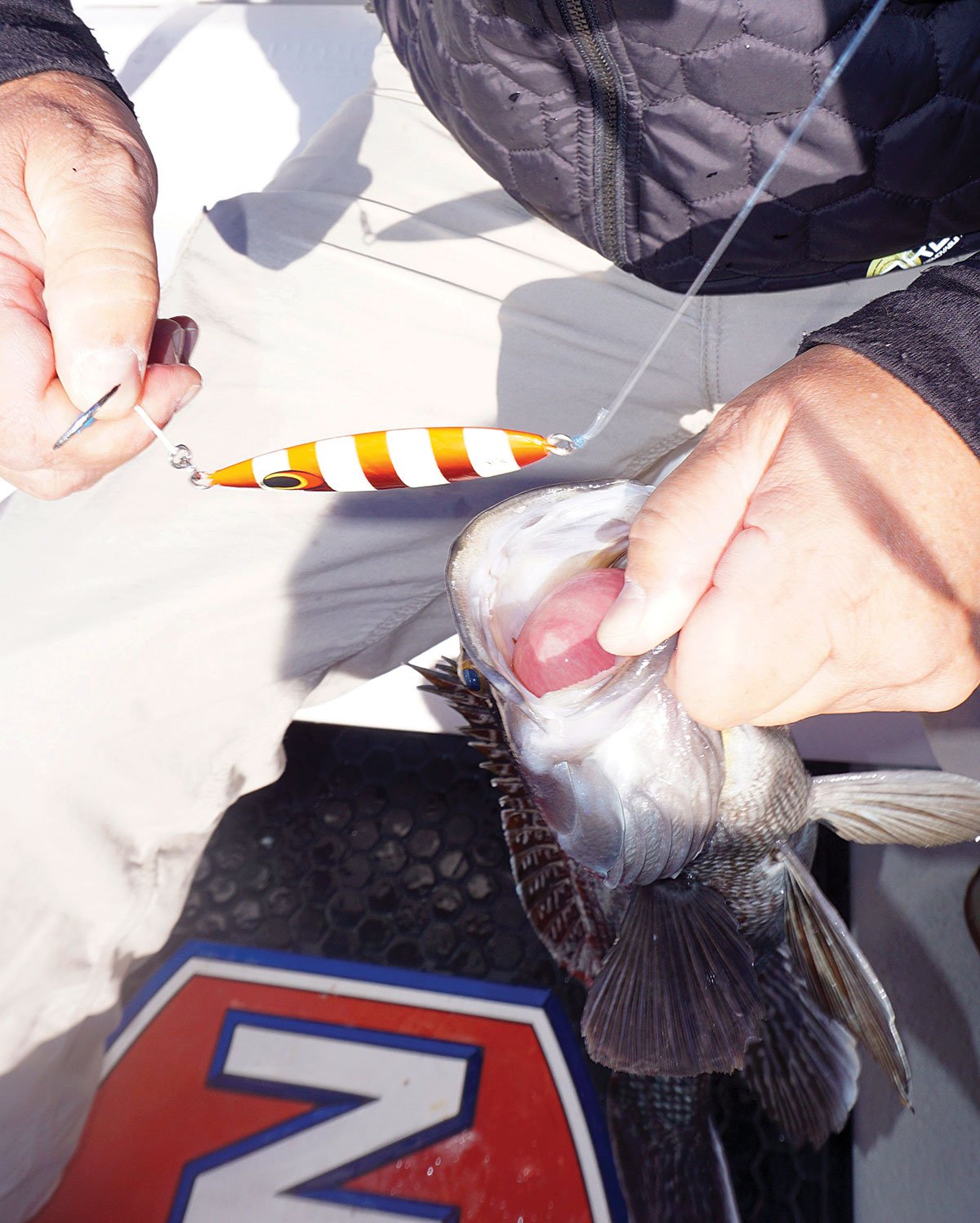
While diamond jigs remain a classic choice, other jig styles can also be highly effective for black sea bass. Butterfly jigs excel when fish are holding tight to structure, fluttering on the drop to trigger reaction strikes. Slow-pitch jigs are designed to stay in the strike zone longer, imitating a wounded baitfish with a wide, deliberate action that sea bass find irresistible in deeper water. And bucktail jigs, with their hair-dressed hooks and natural pulsing action, imitate small baitfish or squid while providing just enough bulk to draw strikes, especially when tipped with Gulp or squid strips. Mixing these jig types into your spread keeps presentations fresh and can turn a steady bite into a full-on feed. |
Although sea bass are not true schooling fish, experts find them in clusters on structure like wrecks, reefs, and rock piles during spawning, staging, and migration periods. Adults migrate inshore and northward as water temperatures warm in the spring. The northern population of black sea bass spawns inshore from mid-May to August between Massachusetts and New Jersey. The fish then gradually return to deeper water, moving south and offshore as ocean temperatures drop in the fall. That means your last shot to target them is now and in gradually deeper water.
Almost any deep structure is a potential sea bass jackpot. Sharpies closely guard their hotspots because a fleet of boats on a patch of ground can pick it clean of big fish. But there are hundreds of productive spots along the coast, and many are seldom fished. Your best bet is to study a chart and your depthfinder to locate and mark your own sea bass hangouts. Don’t just follow the fleet.
Sea bass favor the up-current slope of structure like reefs and rock piles, as well as directly above the peak. Less often they’re located on the down-current side of structure. Generally, once you drift to the rip line of a reef, it’s time to run back uptide to the calm water and start the next drift. Try different spots on a reef and mark those that are productive. Typically, they’ll be good next season, too.
Tackle selection, like jig size, is determined by the waters and conditions you expect, as you can target sea bass in depths of only 30 to 60 feet with light gear in spring and summer, but in late fall you may be seeking depths from 70 to 200 feet with heavier tackle. “I jig sea bass with lighter gear than most people,” said Kittredge, adding “I can fish all day with such a setup, and still land the occasional striper or bluefish that falls for the jig.”
For deep water with heavy jigs, try a conventional 6-1/2- to 7-foot, 15- to 30-pound, medium-fast action rod matched to a 3/0 to 4/0 high-ratio conventional reel like the Daiwa Seagate SGT35H. Avoid levelwinds in deep water because the mechanism slows the free-spool drop. For maximum sensitivity and low drag in deep water, spool up with 30-pound smooth braid topshot over 40 to 50-pound mono or Dacron backing. Over bony structure, run 36 to 40 inches of 50 to 60-pound mono abrasion leader, especially if bluefish might be mixed in. Use a loop knot, rather than a clinch, to connect the leader to the jig for better wobbling action. Then hang on for some big hits.