On October 15, the Maryland Department of Natural Resources (DNR) released their annual juvenile striped bass survey for 2025, recording a young-of-year index of 4.0. “This is an improvement over recent years, but still well below the long-term survey average of 11,” noted DNR in the official release marking the seventh consecutive year of low striped bass spawning success in Maryland’s Chesapeake survey.
The annual survey tracks reproductive success of striped bass by sampling 22 sites with a 100-foot beach seine net in four major striped bass spawning areas including the Choptank, Nanticoke, and Potomac rivers, and the upper Chesapeake Bay. The index represents the average number of 3-inch or less juvenile striped bass caught in each sweep of the net.
Similar fish surveys were also conducted in the Patapsco, Magothy, Severn, Rhode, West, and Tred Avon rivers, and St. Clements and Breton bays. According to the DNR bulletin, those surveys found even fewer young-of-year striped bass. The Virginia Institute of Marine Science conducts a similar survey in the southern portion of Chesapeake Bay, while New Jersey and New York also conduct young-of-year (YOY) surveys on both the Delaware and Hudson rivers respectively.
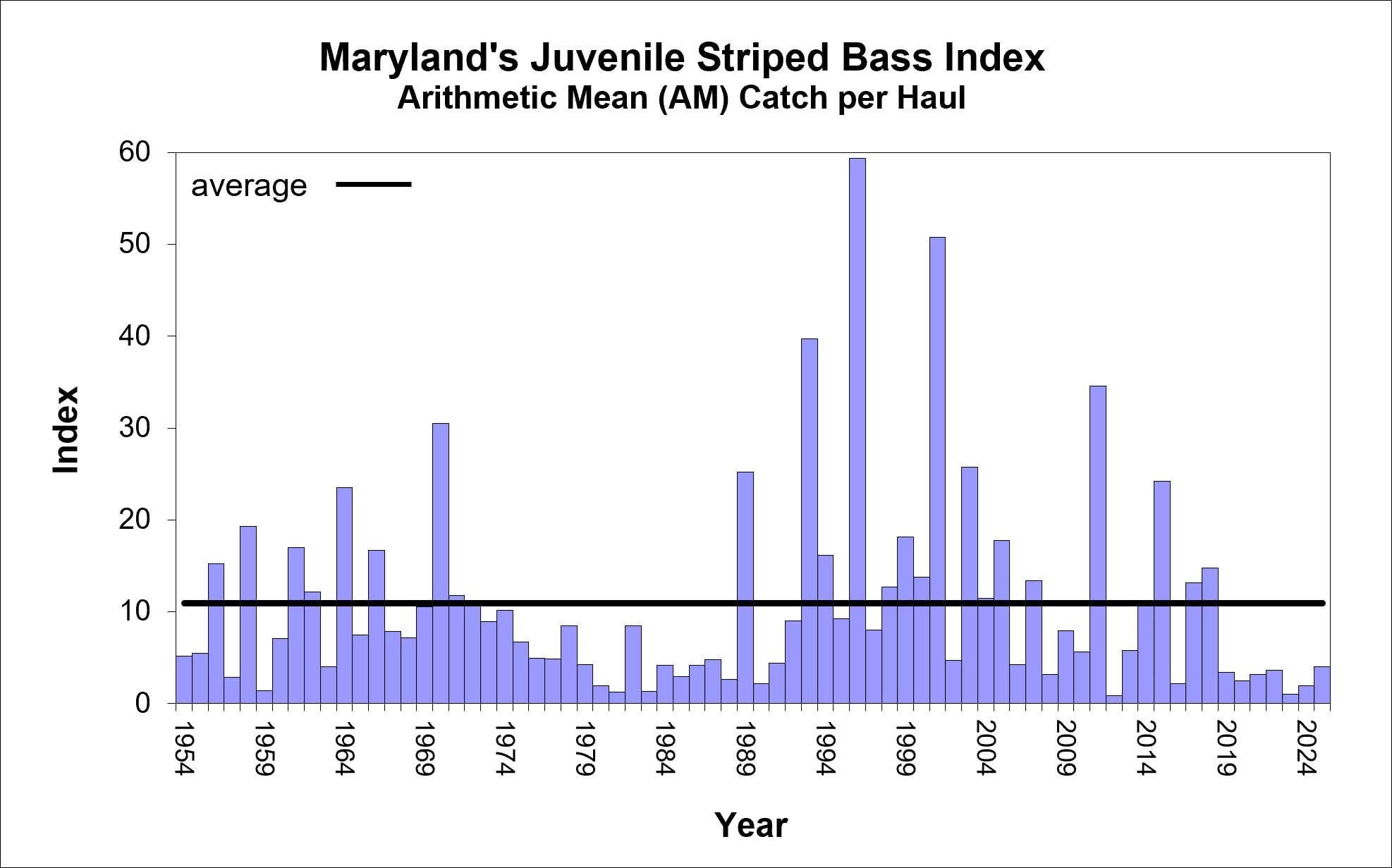
“Management actions taken over the last decade have resulted in a healthy population of spawning-age striped bass,” said Maryland DNR Fishing and Boating Services Director Lynn Fegley. “However, continued low numbers of striped bass entering the population is a threat to this progress as there are fewer juveniles growing into spawning adults,” she added.
Maryland’s DNR report explained how recent population estimates indicate healthy adult populations of striped bass, despite the downturn in juvenile spawning rates. “Droughts and warm conditions in winter continue to negatively impact the survival of striped bass eggs and larvae, which are very sensitive to water conditions and food availability in the first several weeks after hatching,” DNR added.
In a social media post just prior to Maryland’s announcement, Martin Gary with the New York Department of Environmental Conservation noted five variables that could impact striped bass reproduction including flow rates of key tributaries, water temperature profile with a focus on the 12- to 16-degree (Celsius) window, timing of the spawn based on temperature, zooplankton hatch/timing, and blue catfish predation impacts.