Is it too much to ask that more research be conducted to determine what effects these windfarms will have on critically important coastal fisheries like summer flounder?
Should President Donald Trump be impeached? Or should Hillary Clinton be jailed for espionage? Those questions should probably get folks’ attention, don’t you think? Well before your blood begins to boil, I ask that you consider this – the polarization of positions has gotten worse by the day, with everyone, everywhere expected to choose an absolute side. Elections, sports teams, fisheries, climate change, offshore wind development – it’s all pretty much the same, isn’t it?
While the president himself may have been the one who coined the term “fake news,” don’t think that’s just a battle cry for the right against CNN, or lefties piling on FOX. Whenever someone today is confronted by a message that counters their own core belief or financial stake, simply stammering “fake news” and stabbing a pitchfork towards the messenger has become standard operating procedure in this first quarter of the 21st century.
So here’s a message that should have a few folks running towards the tool shed for sharper implements of destruction; it’s from professor John King from the University of Rhode Island’s (URI) Graduate School of Oceanography and a member on the Rhode Island Coastal Resources Management Council’s Habitat Advisory Board for offshore wind development.
“So the question becomes, if you build offshore power facilities, will migratory organisms cross the cables or not,” King said of marine life like sharks and stakes, which are sensitive to electromagnetic fields (EMF), adding “Will it affect eels that migrate to the Sargasso Sea or lobsters that have an onshore-offshore annual migration?”
That’s professor King’s quote; and so is this. “The concern is that DC (direct) currents generate permanent electromagnetic fields, and we don’t really know how organisms will relate to them.”
This is taken from an article written by Todd McLeish, a contributor to ecoRI News (www.ecori.org). The article details how professor King and a postdoctoral research fellow named Zoe Hutchison (no relation, different spelling) have been conducting field experiments around the Cross Sound Cable that carries electricity from New Haven, CT to Long Island, NY. They attached acoustic tags to skates and lobsters and placed them in an enclosure around the cable. An array of hydrophones in the enclosure detected the animals’ movements. Additional animals were placed in a second enclosure farther from the cable to compare the results.
“We definitely saw effects in behavior in both lobsters and skates, though it was more dramatic in the skates,” said King of EMF.
Shooting the Messenger
I’ve written a couple of editorials on the subject in the past year pointing out the need for additional research like this. As one would expect as messenger, I’ve had a couple of forked jabs launched my way, particularly by way of the Jersey Coast Anglers Association (JCAA). In their June of 2019 newsletter, JCAA ran a piece called Debunking the Offshore Wind EMF Barrier Myth, which was co-authored by Capt. Paul Eidman and Kyle Kingman. The JCAA piece calls Kingman a “submarine cable systems expert.” More specifically however, Mr. Kingman is president of Offshore Power LLC (www.offshorepower.net), a company that claims to specialize in power cables and offshore construction.
“Very few studies have been done on the effects of submarine power EMF on bottom-dwelling fish such as flounder because no significant observable impacts have ever been reported with the existing offshore wind farms or submarine power cable systems, anywhere around the world,” Eidman and Kingman wrote in the JCAA newsletter, adding “The irony to me (us) is this EMF concern is being raised by a recreational fishing magazine that relies on selling advertising space to marine manufacturers and tackle trades.”
And there’s the “fake news” stab at The Fisherman. Sadly, no one at JCAA ever asked for a response or even provided a heads up that Mr. Eidman and Mr. Kingman would be attacking both message and messenger. Mr. Kingman of course would seem to have potential stake in offshore wind development through his company, Offshore Power LLC. As for Mr. Eidman, he’s told me personally how his windfarm promotional efforts are being supported through a project of the National Wildlife Federation called Anglers for Offshore Wind Power.
After a recent congressional field hearing in Wildwood where several coastal fishermen urged regulators to slow down the offshore windfarm development process until more studies could be conducted on the effects of submarine power EMF on bottom-dwelling fish like summer flounder, Mr. Eidman was quoted in a Cape May County newspaper as saying, “We have found the species the recreational fisherman is after are not affected by the wind farms, and offshore fish like sea bass and mahi actually use the platforms as habitat.”
We? Is that “we” as in he and Kingman? Is it “we” as in the National Wildlife Federation or JCAA? Or is it “we” in terms of the actual research community? Scientifically speaking, there doesn’t seem to really be much of a “we” consensus there.
Reviewing Existing Data
When I first began delving into the subject of offshore wind development and its impact on coastal fisheries and fishermen, one of the first reports I found was authored by staff at the Massachusetts Division of Marine Fisheries titled Recommended Regional Scale Studies Related To Fisheries In The Massachusetts And Rhode Island-Massachusetts Offshore Wind Energy Areas from November of 2018. The information was comprised of input and review provided by individual staff members at the Rhode Island Division of Marine Fisheries, NOAA National Marine Fisheries Service, and the Bureau of Ocean Energy Management (BOEM). At the top of page 8 of that report, inside a description box on the right hand side of the page, is the following passage related to wind energy areas (WEAs):
“Winter flounder spawn in this region in the winter/spring and have demersal eggs, strongly demersal so they are more vulnerable to prey changes and damage to seafloor. This species is resident in the WEAs, so this is a good indicator species. Summer flounder spawn in this region in the summer and fall and are found in higher abundances in various places at certain times of year, but are present year-round. Yellowtail flounder spawn in this region. YT catches have gone down (The stock is overfished and overfishing is occurring.) and disrupting spawning could be more negative for this species. Flounder species were some of the only species to show correlations between the strength of electromagnetic fields from cables and increasing avoidance behaviors around cables, as their catches decreased around charged cables in Denmark (McCann, 2012).”
So that line in bold above seems to stand out in opposition to comments like Mr. Eidman’s “no significant observable impacts have ever been reported with the existing offshore wind farms or submarine power cable systems, anywhere around the world.” And then there’s a Danish study called Fish Benefits From Offshore Wind Farm Development published in 2013, where researchers Leonhard, Stenberg, Støttrup, van Deurs, Christensen, and Pederson found “Data documented some effects from the cable route on fish behaviour, with some species avoiding the cable, while other species were attracted.” According to this particular report on offshore windfarms near Denmark, researchers noted “only flounder (Platichthys flesus) showed correlation between the phenomena observed and the strength of the magnetic fields.”
Yet another study produced for the U.S. Department of Energy called Effects of Electromagnetic Fields on Fish and Invertebrates, researchers Woodruff, Ward, Schultz, Cullinan and Marshall provided a 2011 status report to the government that found Atlantic halibut larvae exposed to EMF “were slightly smaller” than those in the control portion of the experiment, with development of that larvae exposed to EMF showing “slightly delayed larval development.” Those researchers found that the results were “not statistically significant,” though also said “Further testing and replication is needed to verify and expand on these results.”
In Search of Science
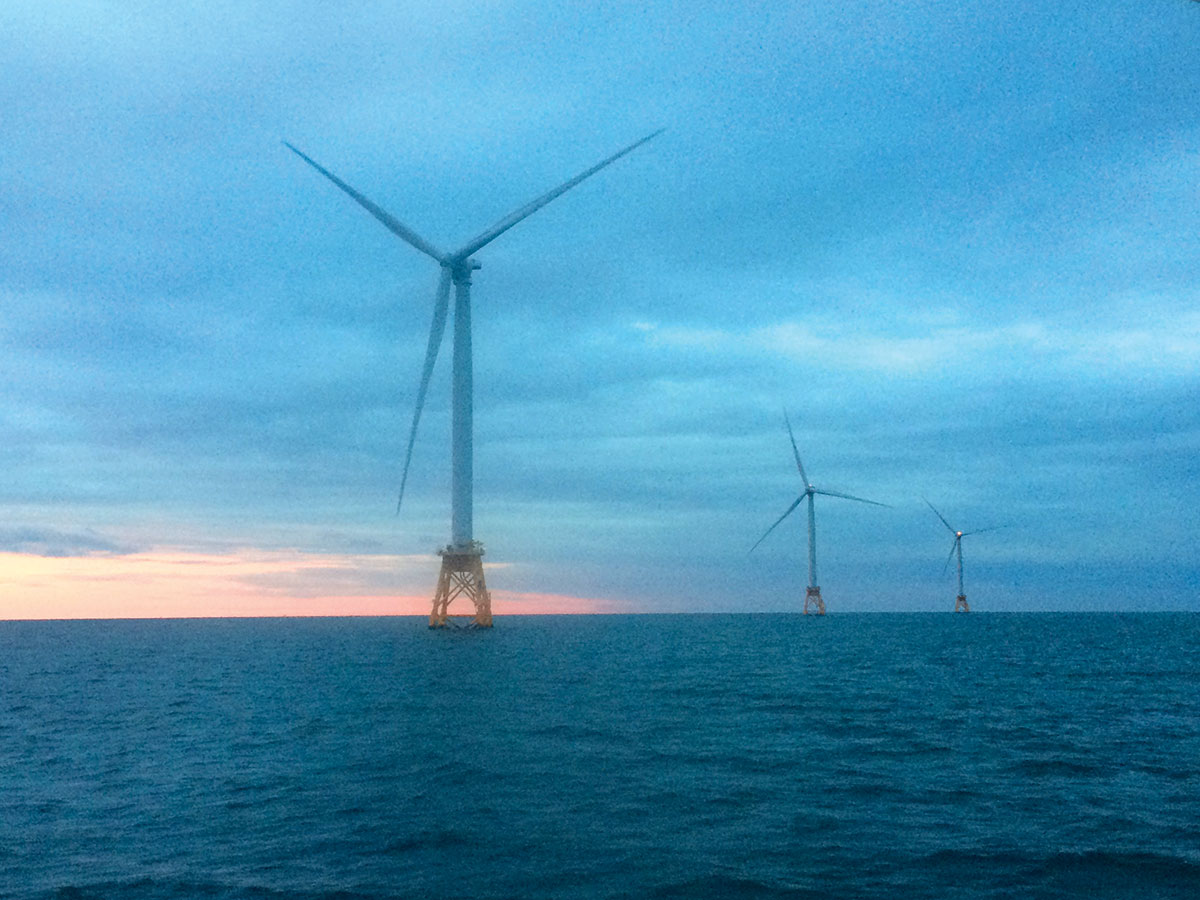
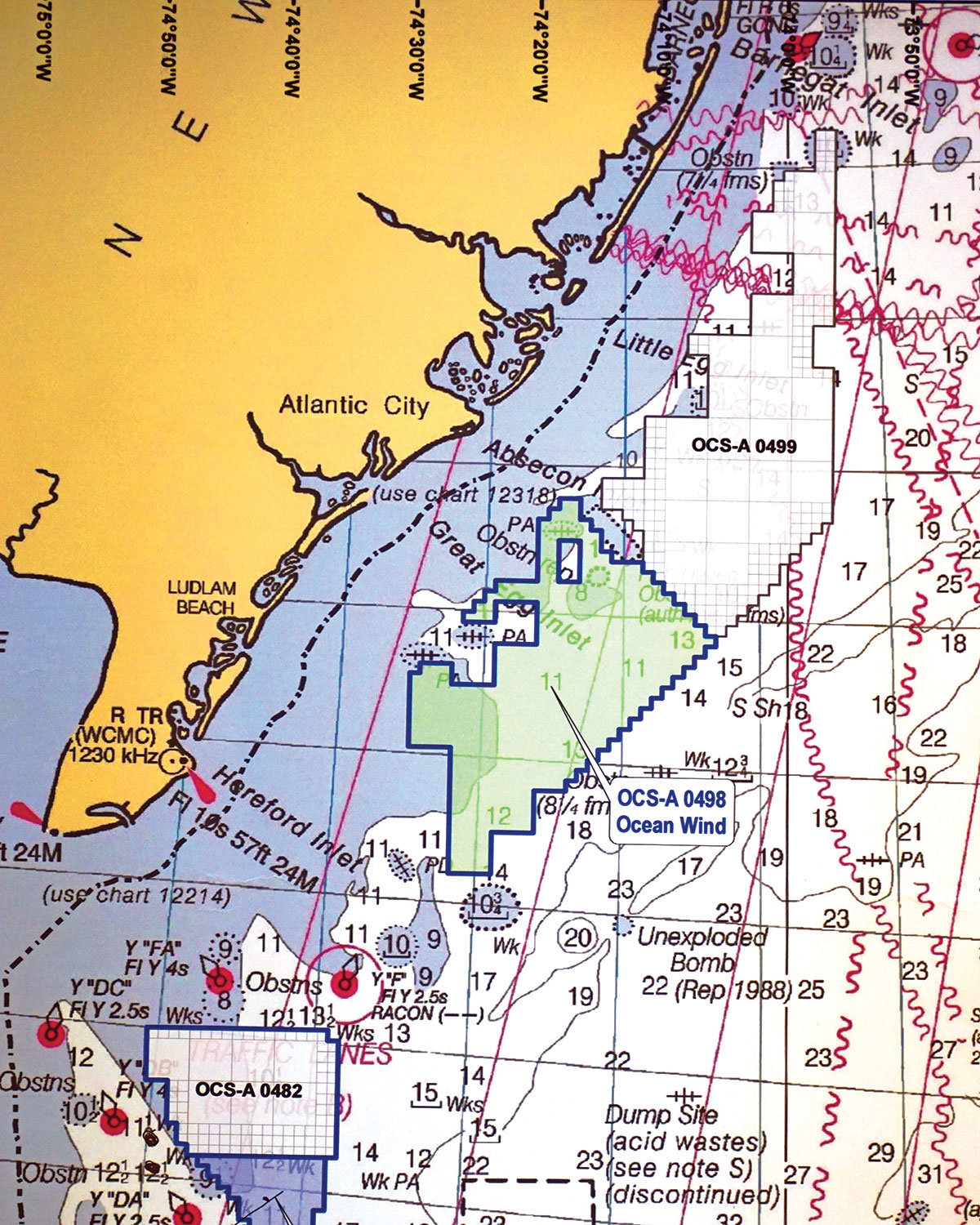
So the question is, if New York and New Jersey build 500+ windmills offshore in federal waters with a spiderweb complex of seafloor cables that link up to one junction pushing all of that energy through massive pipes transmitting EMF inshore to substations on land, will summer flounder, for example, display avoidance behaviors? Will it affect their migration patterns back and forth from the canyons to the estuaries? How about the larval transport, will growth be affected? I don’t know the answers; based on the existing research, it doesn’t appear that any one person has all the answers, scientifically speaking anyway. But saying definitively “yes” or “no” is simply choosing sides without much rational, independent thought and analysis from the middle.
Which is precisely where professor King up at the URI seems be aligned.
“There’s going to be hundreds or thousands of turbines off the East Coast, so it would be nice to understand these effects and how it translates into impacts before they get built,” King said. “Right now the government is pushing full speed ahead to get these things built, and I don’t think they really care that much about their impacts. The environmental reviews are being done really fast.”
King says in the ecoRI News article that the results of his studies have been downplayed by the Bureau of Ocean Energy Management (BOEM), which funded the research; research demanded and ultimately coordinated due to ongoing political pressure.
“They hired a consulting company to produce a public document about our studies, and they minimized EMF as a concern and misinterpreted our study,” he said. “We didn’t say that we saw something that needed to be addressed immediately, but we also didn’t say that what we saw is OK and not to worry about it.”
King believes more studies need to be done before any conclusions can be drawn about the effect of electromagnetic fields from power cables on marine life.
This isn’t Jim Hutchinson from The Fisherman saying that more research needs to be done on EMF effects on marine life; this is a researcher who is actually doing EMF research with measurable results in the field. And as King noted, the studies funded by the Department of Interior and its Bureau of Ocean Energy Management only “minimized EMF as a concern and misinterpreted our study.”
Put the pitchfork down people; those are his words, not mine.
This past August, BOEM released a study called Evaluation of Potential EMF Effects on Fish Species of Commercial or Recreational Fishing Importance in Southern New England in which our own government stated “surveys have overwhelmingly shown that offshore wind energy projects and undersea power cables have no effect on fish populations,” while citing a 2006 study by researcher A. Vattenfall for DONG Energy in Denmark.
However, in personally reviewing the Vattenfall study (Danish Offshore Wind – Key Environmental Issues) referenced by our own federal government, researchers actually found direct correlation between the strength of the EMF field and the behavior in one critically important species in particular. “A significant correlation was found only for flounder,” the study noted, adding “Flounder primarily crossed the cable when the strength of the electromagnetic fields was estimated to be low, ie during calm periods.”
Summer flounder, it should be noted, would traverse the New Jersey sited wind areas during late fall and early spring migrations, the so-called “shoulder” seasons when average wind speeds have been statistically proven to be above the annual average. The Vattenfall researchers also noted “In the extreme case the cable could act as a barrier to the migration of fish, especially for species that use the Earth’s magnetic field for navigation and orientation.”
Is it too much to ask that more research be conducted to determine what effects these windfarms will have on critically important coastal fisheries like summer flounder? At the very least, are we even looking at the existing research in any reasonable fashion?
That of course all depends on who you ask!
| CITATIONS & FOOTNOTES |
|---|
|
Where cited in this story, quotes and references attributed to various sources can be found at the corresponding downloadable PDF files below. It should be noted that the author twice tried reaching University of Rhode Island professor John King for comment but messages were not returned. As for studies referenced in the article, the actual research papers are posted in their entirety below. BOEM 2019 049 Evaluation of Potential EMF Effects on Fish Species of Commercial or Recreational Fishing Importance in Southern New England DONG 2006 Danish Offshore Wind – Key Environmental Issues MASSDMF 2018– Recommended Regional Scale Studies Related To Fisheries In The Massachusetts And Rhode Island-Massachusetts Offshore Wind Energy Areas FBOWFD 2013.pdf– Fish Benefits From Offshore Wind Farm Development PNNL 20813 – Effects of Electromagnetic Fields on Fish and Invertebrates For another take on the New England windfarms, see Windfarm Developers Refusing To Study Effects On Recreational Fishing in the October, 2019 edition of the Rhode Island Saltwater Anglers Association (RISAA) newsletter. For even more information on wind studies in the ocean and Great Lakes environment visit the Alliance For Wise Energy Decision. |