Bluefin tuna season is officially underway as of June 1, 2026.
In an email blast from NOAA Fisheries on May 27, 2026, bluefin anglers were greeted with some good news (for a change) with the new seasonal retention limit for this year’s angling category fishery.
“NOAA Fisheries is adjusting the Atlantic bluefin tuna daily retention limits for recreational fishermen,” the alert stated, explaining how these adjusted limits take effect as of Monday, June 1, and extend through December 31, 2026, “unless modified by later action.”
The devil’s always in the details; as we learned in August of 2025, NOAA Fisheries may need to quote, “take additional action later in the year to further adjust the retention limits or close the fishery.” This of course is because bluefin tuna and other highly migratory species (HMS) are managed on a pound-for-pound basis based on international quotas.
As noted in the May 2026 edition of The Fisherman Magazine in article called Bluefin Tuna: What’s up with our U.S. Quota? authored by Capt. Mike Pierdinock, the United States has roughly 300 metric tons of recreational bluefin tuna quota allotted to our 2026 season (commercial and recreational), which is an increase over previous years.
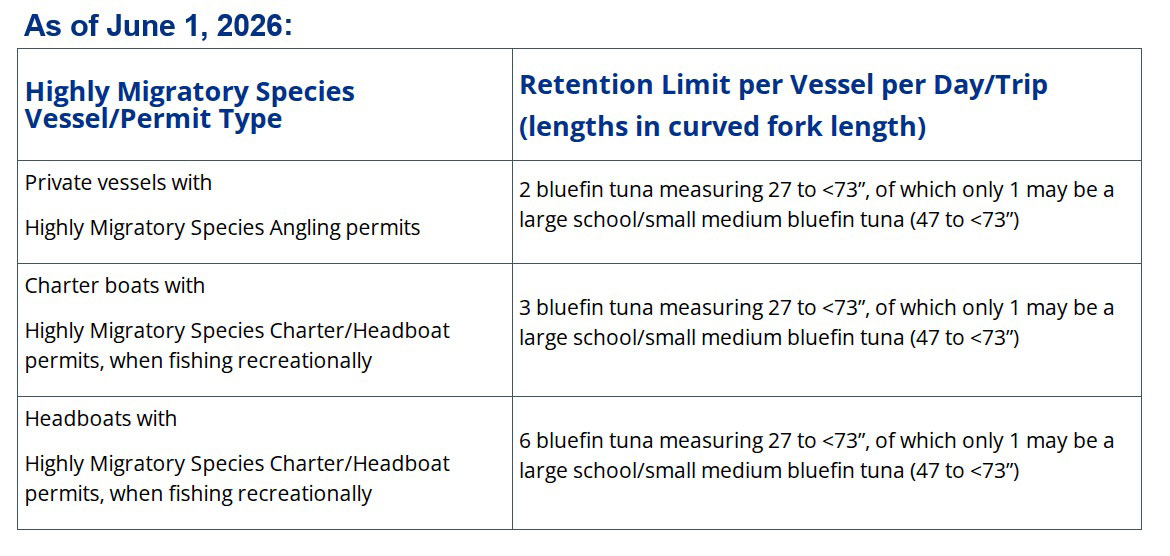
As such, the retention limits for 2026 along the Atlantic Coast for HMS Permit holders break down as follows – for private vessels holding HMS Angling permits, it’s two bluefin tuna from 27 to less than 73 inches, of which only one may be a large school/small medium bluefin tuna measuring 47 to less than 73 inches.
For Atlantic Coast charter boats with HMS Charter/Headboat permits when fishing recreationally, it’s three bluefin tuna measuring 27 to less than 73 inches, of which only one may be a large school/small medium bluefin tuna measuring 47 to less than 73 inches.
Finally, for head boats with the HMS Charter/Headboat permits when fishing recreationally, the retention limit as of June 1 is six bluefin tuna measuring 27 to less than 73 inches, of which only one may be a large school/small medium bluefin tuna measuring 47 to less than 73 inches.
Bluefin tuna are measured in curved fork length, and retention limits are per vessel per day/trip. Regardless of the duration of a fishing trip, no more than a single day’s retention limit may be possessed or retained at the end of the trip upon landing. For example, whether a private vessel (fishing under the Angling category retention limit) takes a two-day trip or makes two trips in one day, the day/trip retention limit of two bluefin tuna, of which only one may be a large school/small medium, applies and may not be exceeded upon landing.
The changes occurring this week apply to HMS Angling and Highly Migratory Species Charter/Headboat permitted vessels when fishing recreationally. The daily retention limits are effective for all areas except for the Gulf of America (nee Mexico), where NOAA Fisheries does not allow targeted fishing for bluefin tuna at this time.
Keep in mind that an HMS Permit is required (go to hmspermits.noaa.gov) on the vessel targeting highly migratory species like bluefin, yellowfin, longfin, and billfish. Also, all HMS Permit holders are required to report the catch of all bluefin tuna retained or discarded dead within 24 hours of landing or the end of trip by:
- Accessing the Highly Migratory Species Permit Shop
- Using the Highly Migratory Species Catch Reporting app
- Calling 888-872-8862 (Monday through Friday 8 a.m.-4:30 p.m.)
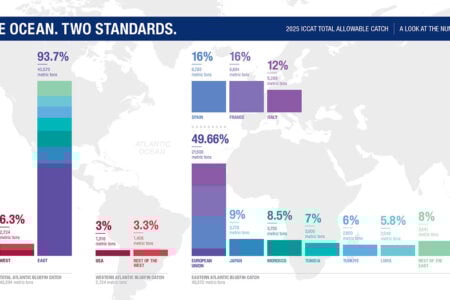
In addition to the required HMS Permit, to help with the scientific efforts to better understand the spawning and migratory patterns of Atlantic bluefin tuna, order your bluefin fin clip kits to support the close kin mark recapture (CKMR) science. Order your kit now, and make sure to get your bluefin fin clips to Dr. Walt Golet and his research team at the University of Maine. The scientific research these folks in Maine are undertaking contributes greatly to U.S. efforts overseas during International Commission for the Conservation of Atlantic Tunas (ICCAT) meetings.
“The U.S. and other ICCAT contracting parties are required to comply with ICCAT fishery-management measures,” explained Capt. Pierdinock in his May edition write-up, explaining how the United States is required to abide by the decisions of ICCAT consistent with the Atlantic Tunas Convention Act. “Measures adopted by ICCAT are then implemented by the National Marine Fisheries Service’s (NMFS) Highly Migratory Species (HMS) Management Division,” he added.
Bottom line is this – we’re back in recreational bluefin this week along the Atlantic Coast, the season is underway and we have tuna to catch and retain. But if Atlantic Coast anglers are going to see future increases as opposed to closures (think 2025), it means keeping up with the mandatory reporting requirements, and helping American scientists get a better understanding of bluefin biology and migration.
Catch ‘em up!