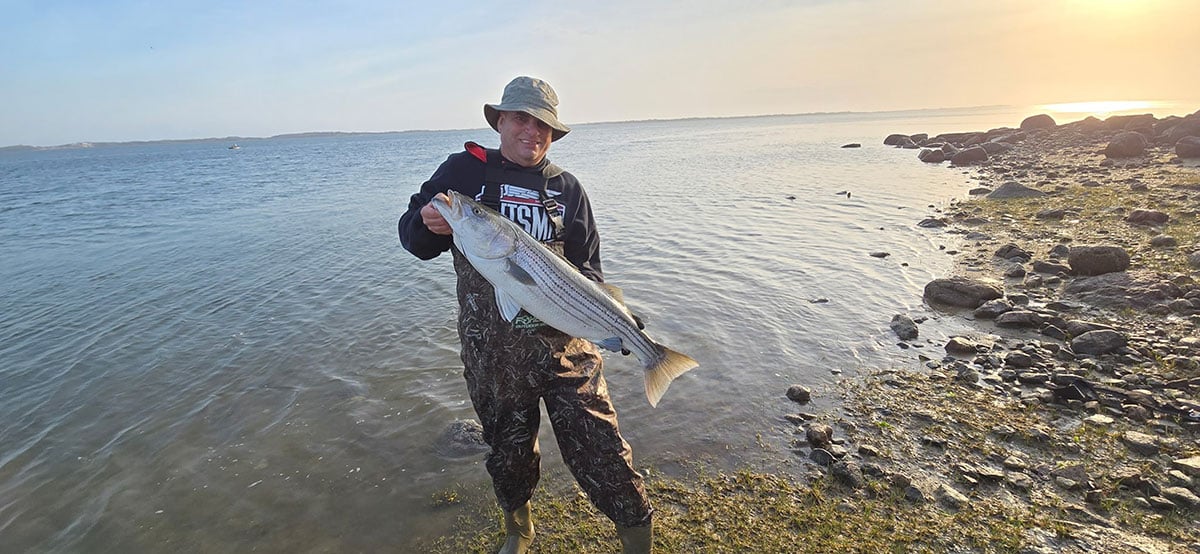
For him, striper plugs have become a lifelong obsession.
It was a Wednesday night and the late-September wind was blowing hard from the south west. The day’s wind had created a steep 4-foot chop that slammed against the jetty that Dave Manzi from Harwich, MA wanted to fish, but he was headed there to try a few casts. You can’t catch bass from your living room, so you need to go as often as your schedule will allow, to maximize your success and to understand finding fish in different conditions. Once on the jetty, a wave surged over the granite lifting Dave’s cork-soled boots, pushing him back a couple steps. He chose to leave the jetty, go home and get some sleep. All day Thursday and Friday, a strong northwest wind snapped and straightened any flag that was flying, but at about dinner time on Friday, it seemed to let up some.
The Surfcasting Mind
Skipping dinner, Dave quickly packed his jeep with three lure bags, grabbed a 10-foot rod for casting and a second combo as a backup. Twenty minutes later, it was dark and he was on the beach facing an inward curving point of sand to his left, with a trough and cut right in front of him. There was a slightly deeper bar in the form of a point to his right that was submerged a bit more than the other. A 10-knot, northerly breeze nudged the incoming swells over both bars, then across the trough, before they tumbled onto the lip of the beach.
Two weeks ago, on the same tide, there were good numbers of bass cruising the inside edges of both bars. The moon was in its third quarter and wouldn’t rise till 3 a.m., so Dave tied on a black and gold needlefish, then began fan casting to the turbulent water where the waves slid over the bar into the deeper water to his left. “I really like needlefish for fishing in that 2- to 3-foot turbulent water at the edge of a bar”, says Dave. The current was running right to left, so he cast to the inside edge of the bar and let the action of the waves alternately pull the plug up onto the bar, then release it back into the deeper water as the current swept the plug along the edge of the shallow water.
Plug Obsessed
“A lot of guys say the only thing that is important is the action of a plug, but I believe color is a really important part of a good plug design” says Dave. “Depending on the strength of the moon’s light, I’ll swap out a black and gold needlefish for an olive one or even a bone white one as the moon’s light gets stronger, or go from a white plug to a darker plug as the moon sets during the night.”

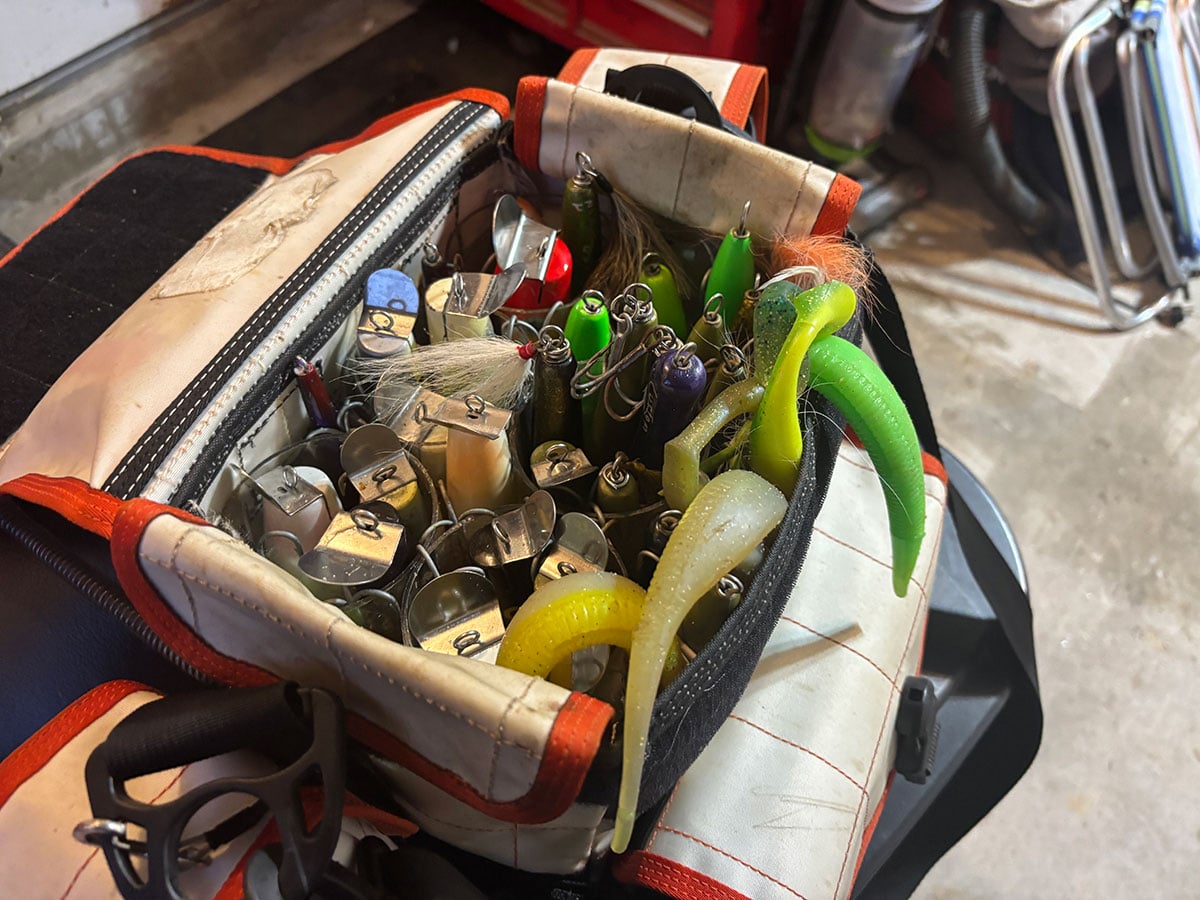
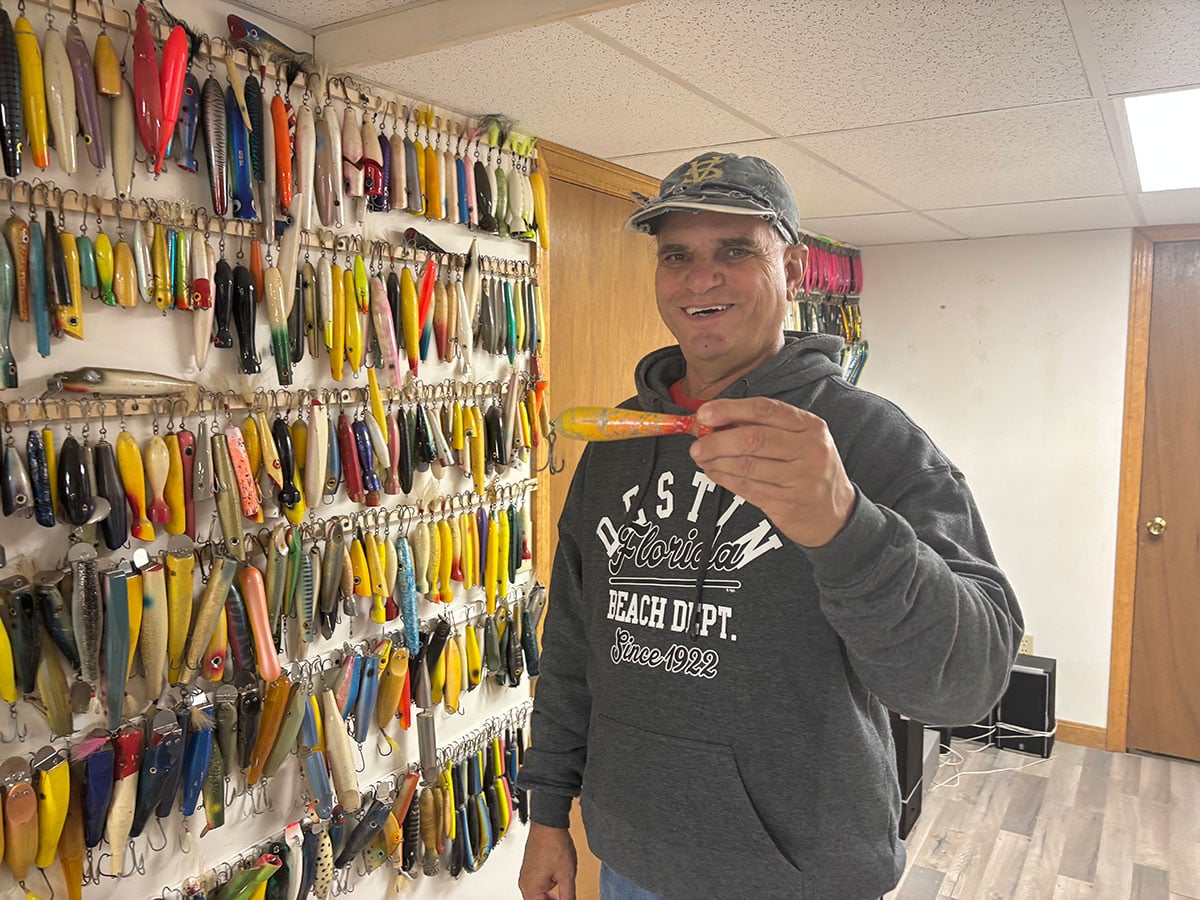
Many of us hang some of our tools on the wall of our shop, but very few, if any, have a 30-foot wall with over 1000 plugs neatly hung on the wall for easy access. In 1992, a time when there were a lot of big bluefish in the surf, Dave was burning through Gibbs poppers at $5 a pop and finding that his love of bluefishing was kind of an expensive habit. As they say, “necessity is the mother of invention”, so he tried his hand at turning some popper bodies on a neighbor’s lathe and they caught fish.
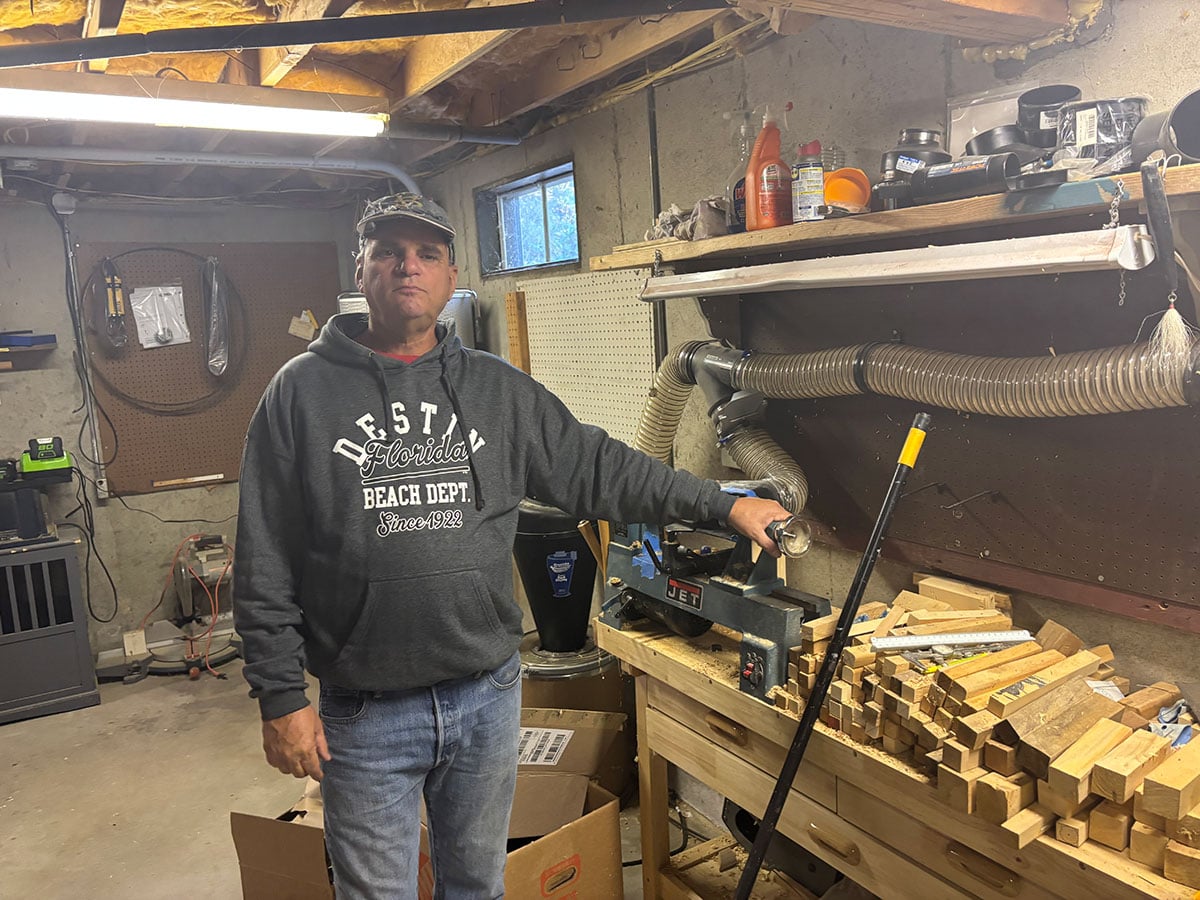
By the year 2000, he was pretty serious about his plug making, having outfitted his shop with a lathe, table sander, jig saw and the other tools required to make what he wanted. Soon, other anglers liked how his plugs fished and his plug making business, Bassmaster Lures was born.
Dave’s current basement includes a shop area kept neat by a dust collection system on all the power tools, a 30-foot room that includes the “wall of plugs” opposite his ham radio equipment and a separate smaller room that includes a paint booth for air brush painting plugs, as well as drying racks.
Walking along Dave’s plug wall, a trained eye can see the evolution of his designs over the last 25 years in the needlefish, Dannys, his Challenger plugs and countless other designs that he has continued to improve over the years. If you are “wise in the ways of plugs”, you can see and feel subtle nuances in the evolving designs of these plugs, such as the taper of the nose, the size and shape of the metal lips and how each plug is weighted.
“I mix my own colors”, says Dave. “In addition to the “standard” bone white, Block Island green, yellow with red gills, black and purple formats, I am really happy with the iridescence and depth of color that I can now get using my air brush and multiple coats. I want all the odds in my favor, so that a bass won’t hesitate, but rather rushes to make a feeding decision.”
Banan-O-Rama
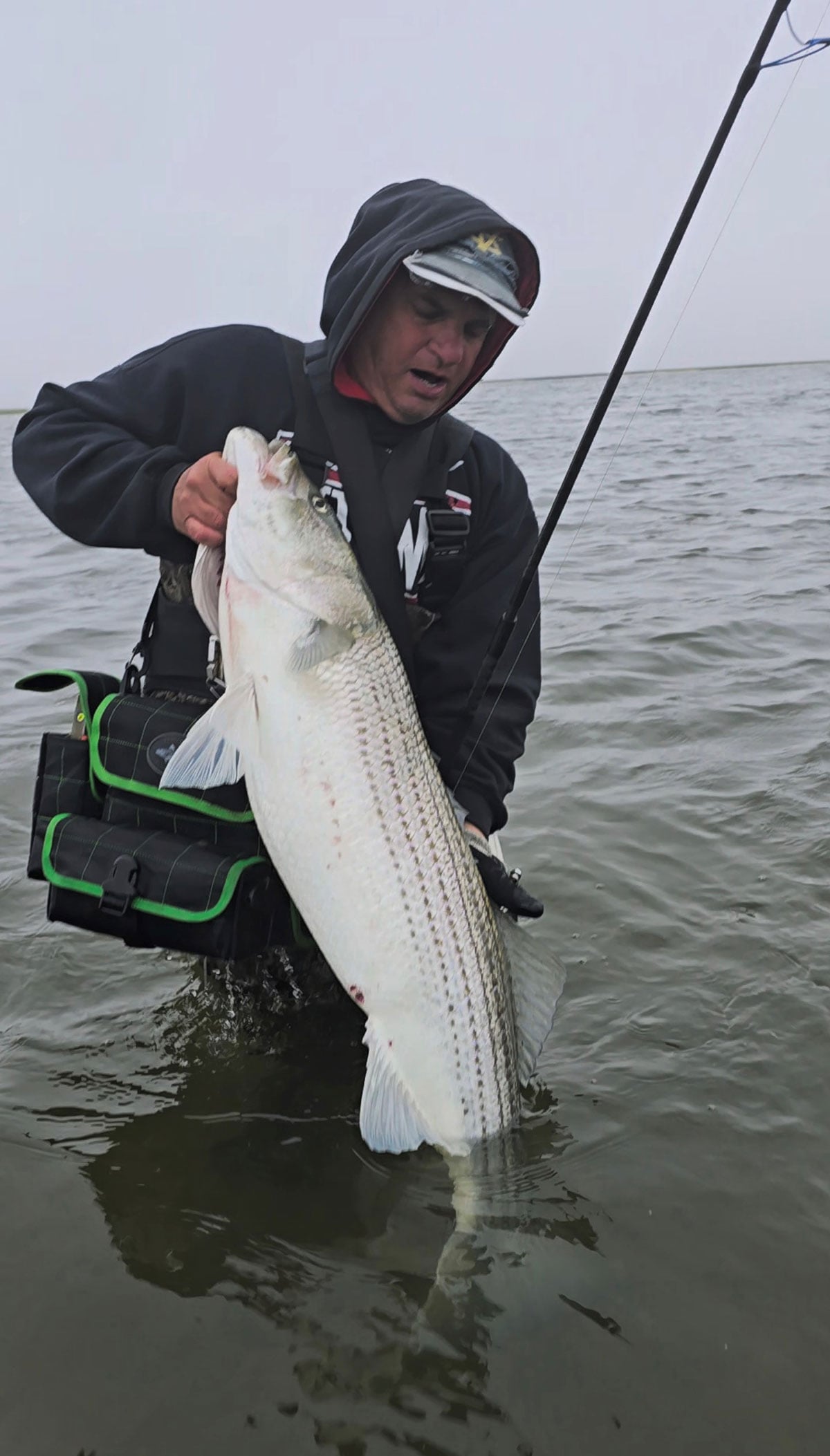
Dave is known for his banana plugs, which are extremely difficult to build. This plug is incredibly effective in drawing big bass away from a pogie school to crush a plug that looks like a wounded pogie, alternately swimming on its side, then right side up. With its thin tapered belly and wedge-like cross-section, a banana plug body can’t be turned on a lathe, making it a time consuming and very difficult plug to build.
Dave got hooked on the banana plug one hot August afternoon, late in the day, standing on the edge of an eel grass bed of a “not to be disclosed” Cape harbor location. He was by himself at the time and observed a small school of pogies milling around not far from shore. It was the bottom of the tide and in a way he had somewhat low expectations. He made a few casts with a Danny plug and nailed a nice 25-pounder. A Danny plug is a good pogie imitation, but Dave thought to swap it out for an even better pogie imitator, a banana plug made by famed plug maker Paul Moriarty.
There was apparently a school of large bass trailing the pogies and he ended up landing a bunch of 20- to 35-pound bass on that plug, once he replaced the split rings with a 4/0 Wolverine triple split ring. Two of the fish he hooked at the start of the bite were so strong that they straightened the original split rings, so he was thankful to have those heavy duty split rings in his bag.
Needless to say, Dave returned to that location for the next few days. To say that the fishing was “epic” is appropriate as the banana plug accounted for over 20 fish almost every day. On the third day, two younger fishermen were 50 yards down the bank watching Dave hook up on almost every cast. One turned to the other and said, “I guess, what they say is true about that guy.”
Later that same day, Dave hooked and landed a fish just over 50 pounds. Some bystanders came up to him and asked if he’d like them to take a picture of him and his fish. With the banana plug hanging out of the bass’s mouth, Dave thought better of that idea and gracefully declined, releasing the fish and putting the banana plug away.
Eye Of Experience
It’s one thing to look at a plug and have a rough idea for how it will swim, it is something more to be able to pick up a plug and understand how it is weighted and how that weight and weight placement will affect the action. Weighting a plug is an art that Dave Manzi excels in. Depending on the profile and lip of the plug, weighting can help “keep the wiggle” and “prevent the roll”. Some of his plugs will have three different weights in the length of the plug. Moving one weight an eighth of an inch can make all the difference in how it fishes. When Dave picks up a plug “it seems to talk to him”.
Dave credits Mike Fixter from Santa Cruz, CA for advancing the craft of plug building here on the East Coast. In particular, Mike led Dave to Alaskan yellow cedar as a superior wood for plug building, with its great durability, good weight and just the right amount of buoyancy.
Generally, the more you know about a subject, the more you realize how little you know. With all the variables to consider when building a plug, it may seem easier and more effective to buy a brand name plug, then to build some of your own. The flip side of that is that we learn as much or more from our failures than do our successes. Dave says, “Build a simple plug, then take it to the beach, see what it does, then tune it. The process of tuning a plug you’ve built will teach you how to be a better plug fisherman, whether you are using your own plugs or that of a brand name.”
There are some who believe that using live bait to catch bass is somehow unsportsmanlike. Another perspective, is that fishing live bait will make you a better plug fisherman, because you learn how a baitfish moves through the water, particularly when it is vulnerable. When herring stocks were healthier, Dave would sometimes use a Danny plug to get bass charged up, then flip a live herring into the same spot for an immediate hook-up.
Boat To Surf
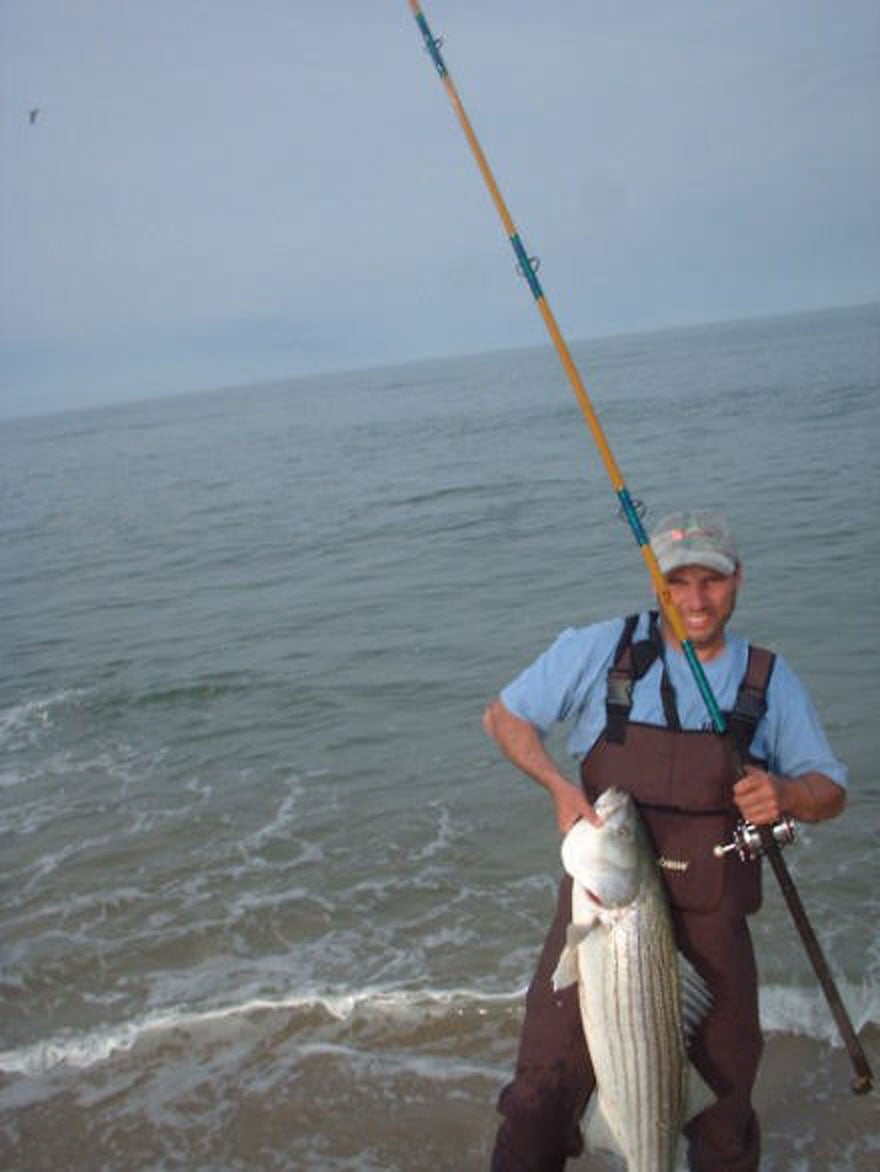
Many of us gravitate to boat fishing and Dave was no exception. Most of his boat fishing was from a 20-foot Grady White. He was a night owl, largely fishing the water between Woods Hole and Martha’s Vineyard. Sometimes the bite was in the deep water and sometimes it was tight to the beach. Dave began to spend more time fishing from the beach as part of what might have been loosely called “the Nauset gang” which travelled from Chatham to the tip of Provincetown to stay on the fish. Fish move and travelling to find the most consistent bass fishing is part of the game. A jeep is much faster than a boat and fishing from the surf was so good, that Dave ended up selling his boats some 15 years ago, largely fishing from shore ever since.
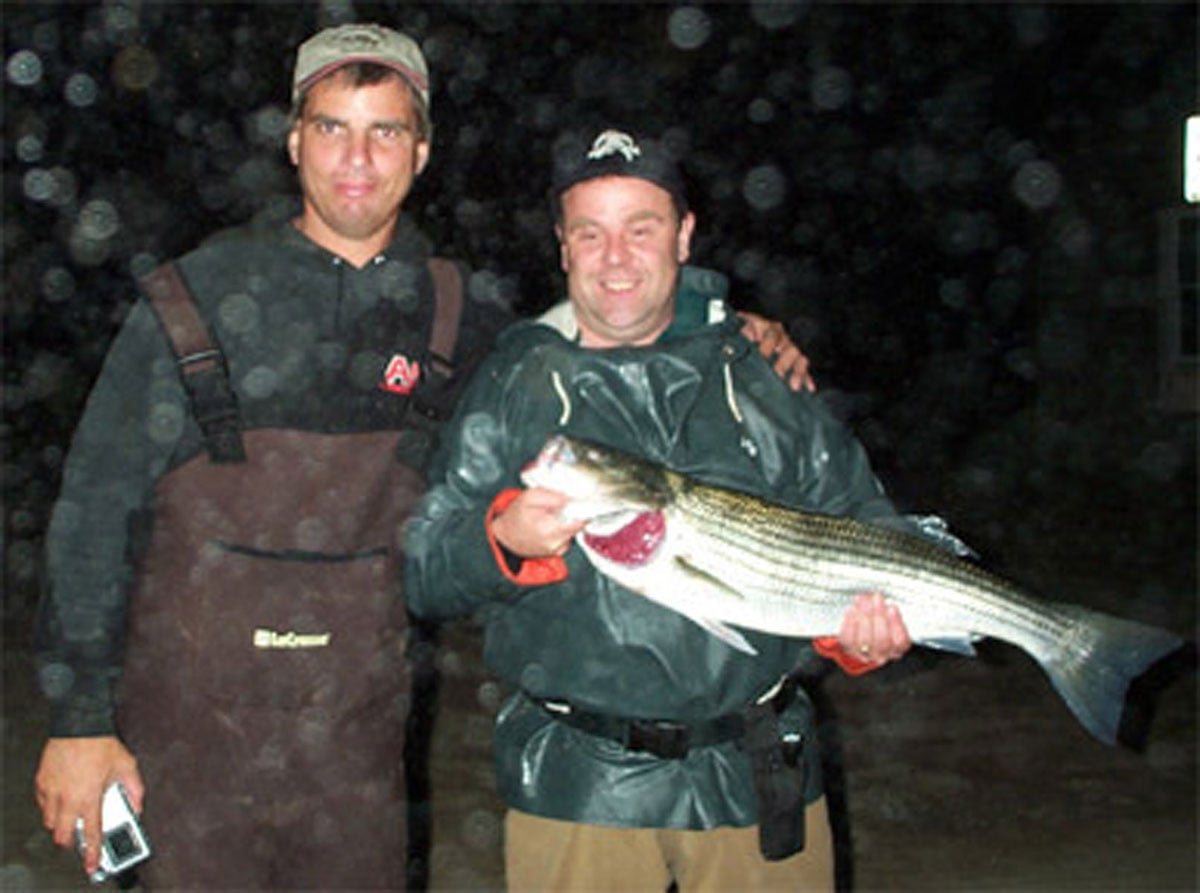
Dave guided surf-fishing anglers on the Cape during the early 2000s, but now fishes for his own enjoyment, along with partners such as Mike Burke. Back on the beach, Dave worked his dark needlefish in and out of the wash on both bars without a bump. “Sometimes a plug change will make all the difference”, says Dave. “It sort of doesn’t make sense that a tried-and-true plug design won’t get at least a bump and a look if there are fish there, but I’ve seen it happen too many times”. He snapped on one of his 8” Challenger plugs in a deep purple color and worked it through all the edges, then tried a dark green paddletail on a jig head before moving down the beach.
Two hours later, the conditions still looked good, but he hadn’t had a sniff and his partner had stuck just a single fish, so they gave it up with a plan to meet just before daylight on Saturday.
“As much as I enjoy fishing at night because of the solitude and the fact that I can get some sleep before work starts the next morning, I tend to think that the fall bite does generally become more of a low light, daytime proposition”, Dave said after he got home on Saturday morning, having fished a couple hours and caught four nice fish. “Fact is,” Dave laughed, “two fish fell for a Wonderbread Danny plug and I caught the other two on chartreuse soft baits! “Go figure.”