A Rhode Island surf legend who’s been plying the rocks for more than 50 years!
By any measure, surf fishing is a physical sport. It requires many skills, including the strength and agility to hike through areas that are most often dark and wet. The ground under your boots might be wet cobblestones, soft sand, weed covered granite or loose gravel. Even with a headlamp, you can’t see everything underfoot and it is easy to stumble.
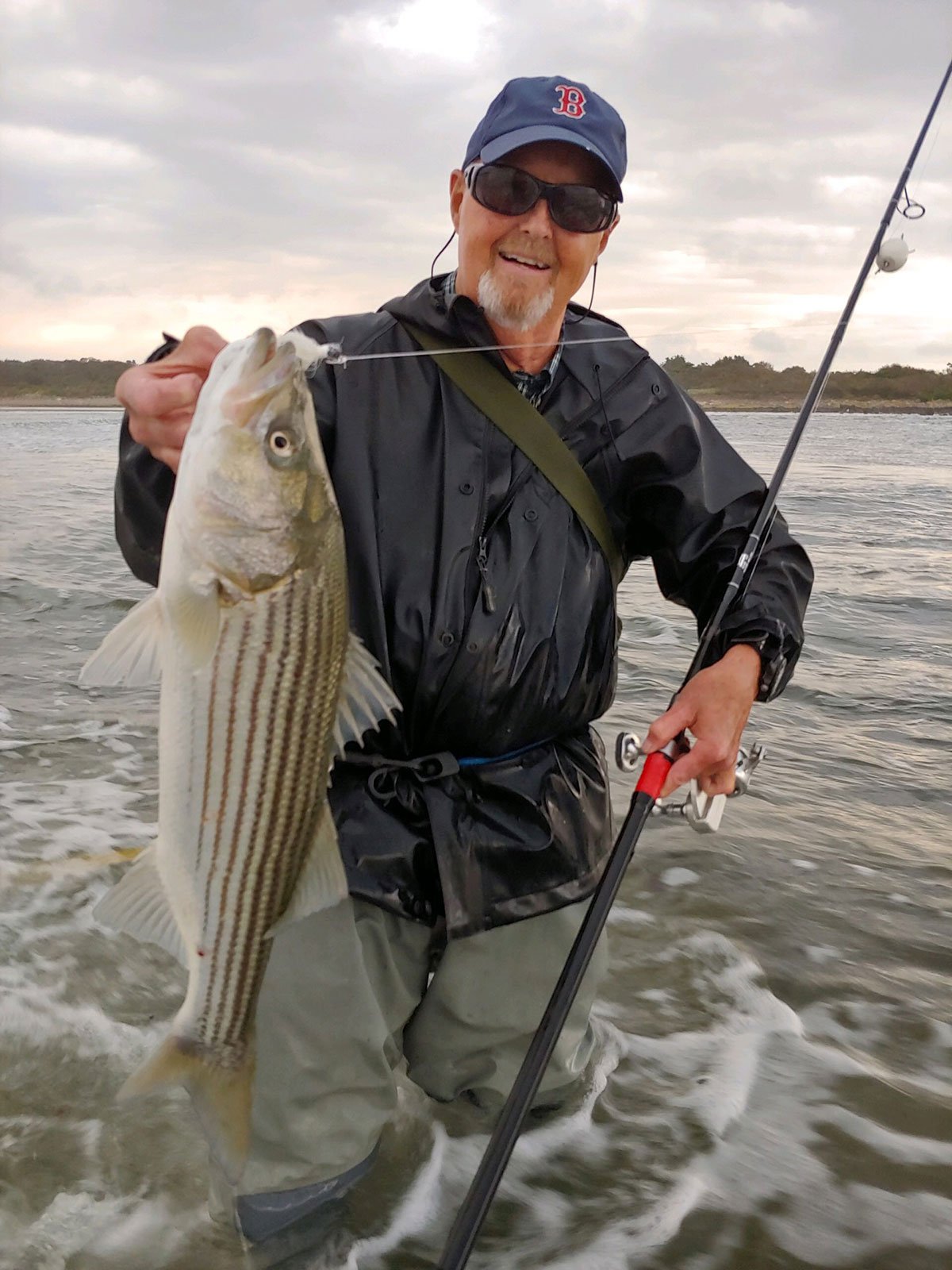
Most of us in our 70s would think twice about walking a mile down the beach in our waders, with a weighty plug bag, rod and other gear, but at 74, Steve McKenna of Cranston, RI still does it, fishing the surf some 70 times a year.
A Man of Endurance
While he is not running competitively anymore, perhaps part of the answer to Steve’s stamina might be the years of training that prepared him to run 15 Boston Marathons and countless other races during his long running career. A few years back, he found that he was getting more tired than he would like after a few hours in the surf, so he eased back into running. His morning routine now includes running 4 miles at the gym each day. He feels good and is ready for another long season in the surf.
Thirty years ago, when Steve often fished five to six times a week, he built a “bass water” body of knowledge relative to tides and wind direction that allowed him to effectively fish a wide range of surf spots ranging from the western shore of Narragansett Bay to Block Island and Cape Cod. More recently, Steve focuses on the western shore of Narragansett Bay, fishing three to four days a week, taking advantage of those years of experience to know when and where to fish, while striking a satisfying balance between bass fishing and enjoying time with his wife Sheila and family.
In The Details
One of the things that guys who catch a lot of big bass have in common, is the amount of time they spend on ensuring that there are no weak links between themselves and a big fish on the end of the line. Steve pays fastidious attention to his hooks, leaders, line and reel, changing his leaders every trip and often during a night’s fishing. When Steve leaves the house for a night’s fishing trip, his intent is to catch large bass and he prepares by making sure everything is capable of landing a truly big fish.
When the moon, tide, wind and bait conditions are right, it is very hard not to fish back-to-back nights because as Steve says, “you might miss the best night!” Knowing the spots and favorable conditions that he does, Steve is now generally comfortable with skipping the next night, getting a good night’s rest and fishing again in another day or so. Last spring, Steve and his fishing partner Jamail, had a good night fishing rigged eels and needlefish in one of his “big fish” boulder field spots. They had caught a number of fish up to 30 pounds, but Steve was perfectly comfortable with staying home the next night.
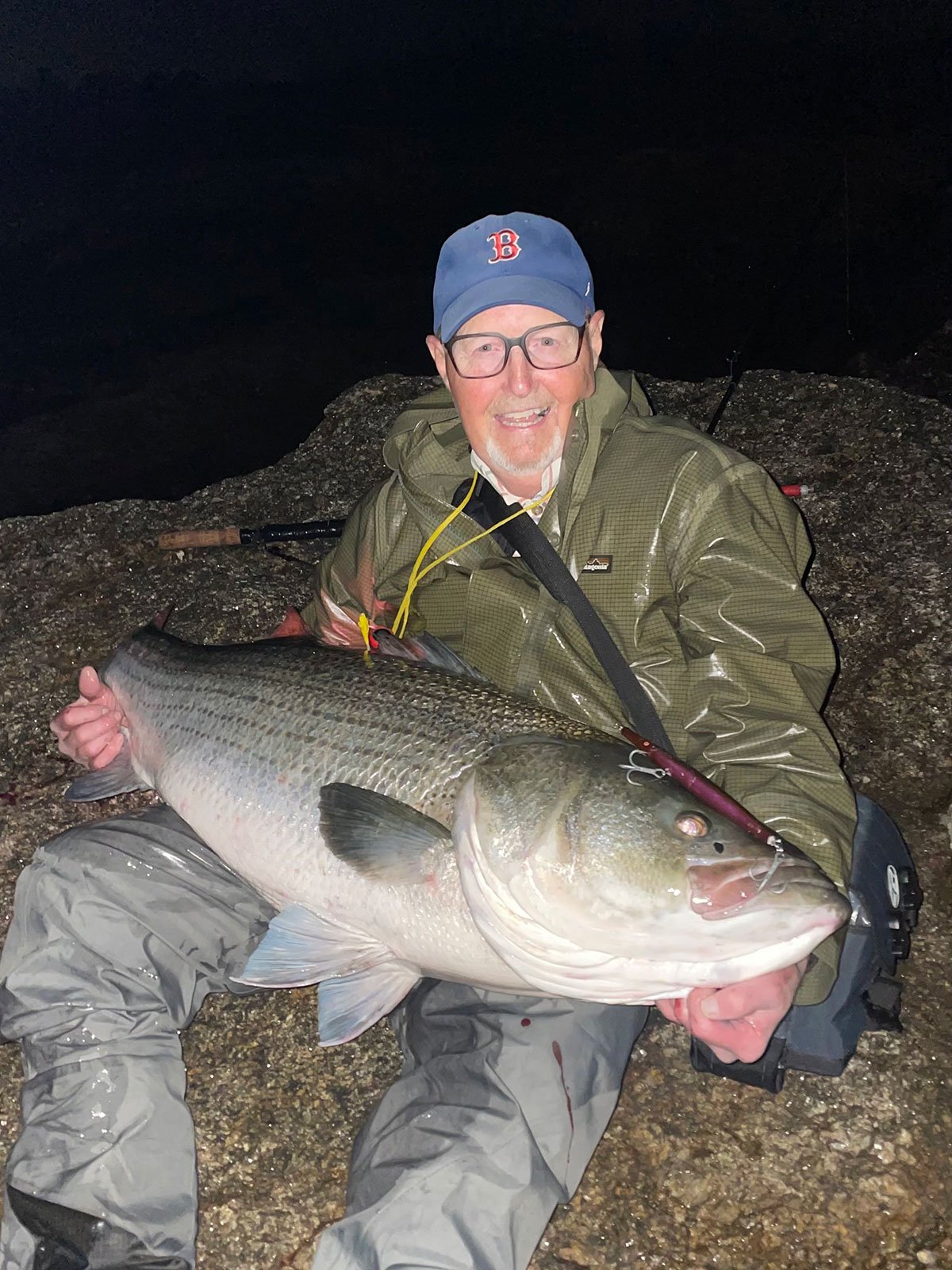
Being a younger man, Jamail persisted until Steve agreed to fish the next night. It is an odd thing, but sometimes you can cast over a patch of good water for quite a while, without even a bump, then switch to an eel or a different plug and start catching fish. Steve and Jamail were fishing side by side that second night, perched on top of some slippery granite. Steve was casting a rigged eel but having limited success, so he switched to a Super Strike “burple” colored needlefish. His needlefish swam only a few feet on the first cast before he felt the take and the heavy surge of a big fish that just realized it was hooked. Fifteen minutes later, a 54.5-pound “cow” striper was in the wash at his feet, a personal best and a product of the strength training, knowledge and attention to detail he employs to catch bass.
Steve and Shelia’s comfortable house is “neat as a pin” and so is his work bench in the basement where he customizes his lures, swaps out hooks and maintains his equipment. Rods, many paired with Van Staal spinning reels, are hung between the floor joists overhead, and others are neatly lined up on a rack, ready to go. Another truism that applies to the most successful fishermen, is that “everything is in its place, has been maintained and is ready to go”.

Fifty Years & Counting
You might want to know how many lures and soft baits does a successful bass fisherman need to own? While it is true that Steve has fished the surf for some 50 years now and has had time to accumulate some tackle, the answer to the prior question, as evidenced by the number of lure-filled buckets and tubs in Steve’s basement, seems to be that there is no reasonable or necessary limit to the number of lures and baits that a surfcaster should own. This limitless cap on the number of lures and baits might be hard for the layperson or your spouse to understand, but it might be just as reasonable as the seemingly common perception that a man’s 1,000-pound bluefin tuna head mount or his personal best, mounted 50-pound bass should be on permanent display in the basement, not somewhere else in the house!
Although Steve’s basement arsenal of lures and baits is extensive, he prefers to travel “light”. His top three nighttime baits are live eels, rigged eels and Slug-Go’s, but when pressed to list his top four lures (ignoring eels), he laid out a twin hook rigged dark-colored 9-inch Slug-Go, a “burple-colored” Super Strike needlefish, a light orange colored darter and a white bucktail that would be dressed with Fat Cow Jig Strip.
Lessons from Dad
Not everyone has a small postal scale on their work bench, but Steve does. The proper lure weight gives you options in terms of how far you can cast it and how quickly it sinks. If you are rigging a soft bait with worm weights or loading a Red Fin, that small scale gives you a quantifiable measure of your handiwork. “You have to pay attention to the details”, was one of the many pieces of advice that Steve’s dad Eugene, gave him as they trout fished together around New England. Eugene introduced Steve to fishing and their time spent fishing trout streams and ponds, was not only great “father and son” time, but it also gave Steve a solid understanding of how current and wind impact where you are likely to find feeding fish.
“You have to be patient,” was another salient piece of advice that Steve’s dad imparted. Whether allowing your running legs to get stronger over a long marathon-focused training season, going through all your plugs and replacing any suspect hooks on a night you would rather be watching the game, or stopping to re-tie your leader part way through a productive night of fishing, Eugene urged Steve to pace himself and not miss the opportunities that being measured and patient would bring him. Sadly, Eugene died at 55 years old, and didn’t live long enough to share Steve’s passion and success as a surf fisherman.
Surf Obsessed
It is a wonderful thing that striped bass are committed to eating throughout the day and night. They may be in deep water during the day and in the shallows at night, but if your family and work schedule precludes you from fishing in the evening, you can develop your skills to find fish at first light or even in the middle of the day. We all have our own preferences for when we like to fish for bass. “I am not a morning person”, says Steve. “It takes me a while to get going in the morning and I am not as mentally sharp as I am later in the day. I’d much rather fish at night, as that offers the best balance of family time, my own biological clock and (when I was working) being alert and engaged during my work day.”
“I actually caught my first striped bass in Maine, while I was going to college”, notes Steve. “When I finished college and came back to Rhode Island, I was very fortunate to meet Tim Coleman and Pat Abate in the late 1970’s and they were extremely kind and supportive fishing partners who mentored my developing surf fishing skills.”
When asked why he doesn’t spend more time fishing from a boat, Steve says, “For me, boats are complicated and they actually dilute my fishing experience. Boats definitely expand the amount of ground you can cover in a night, but I have always preferred the simplicity and solace I get, standing on a wet rock in the dark, with the ocean or bay at my feet, listening to the nighttime sounds and the surf, while I prospect for feeding fish.”

Stevie McAnxious
Like other skillful bass fishermen, Steve thinks about time management and has a plan of how and where he is going to fish before he leaves the house. Details are important and the tide is an important detail. To make sure it is “top of mind”, Steve writes the time of high or low water in the palm of his hand before he leaves the house, so he can best manage his time. This helps him prioritize which spots to fish earlier than others and when he needs to move from a spot that is not producing.
If you’ve seen any of the seminars Steve has done on surfcasting at night, you might have noted that he likes to reel his needlefish, Slug-Go’s and rigged eels faster than most night fishermen do. Tim Coleman affectionately nicknamed Steve as “Stevie McAnxious” because his retrieve was faster than most. The standing adage is that you need to “crawl” your lure when fishing in the dark, but Steve has found more success in a relatively fast retrieve at night for most lures other than live eels. One of the important elements in fishing artificials is presenting it in such a way that it forces the fish to make a decision to strike before it has a careful look at what it’s eating. Perhaps Steve’s fast nighttime retrieve forces bass to make the decision to eat before the “baitfish” escapes.
If you look at the pile of soft and hard baits on Steve’s basement workbench, you realize that he likes to try new lures and is interested in tweaking the ones he already owns. Two of the designs that caught my eye were the K-Tail softbait mullets and the large jointed glide baits. He is largely credited with making 9-inch Slug-Go’s a surfcasting favorite by strategically inserting 4 freshwater nail weights into the body for enhanced casting distance and action. “I am always looking for a new effective lure”, says Steve. “Besides the fact that some of the new lures have very realistic action, I think that there is also value in fishing a lure that the fish really have not seen before.”
All that said, when asked if he could spend equal time experimenting and using his tried-and-true methods, he confesses, “I am addicted to that solid hit of a night time bass. I will spend some time experimenting with new or tweaked lures, but most of my effort will always be using the methods I am confident will get me my next hit.”
Most often, you will find Steve fishing the west side of Narragansett Bay. Because the western side of the bay faces east, a nor’easter will blow baitfish against that shoreline before and during the peak of the storm. You can find quite a few surfcasters casting into the wind at the beginning of a nor’easter to take advantage of this bass feeding opportunity before the water gets dirty and filled with weed. Not many casters know that when that first clearing wind comes from the west or northwest, much of the baitfish are still in the area and there are frequently bigger bass taking advantage of that situation.
When most Narragansett Bay surfcasters are home picking up the sticks on the lawn as the weather begins to clear after a big fall storm and you may see a lone fisherman on a wet rock, casting with the wind at his back, you might stop and watch. It could very well be, the long running, surfmaster, Steve McKenna in his element prospecting for that next big fish.