This is the first time in my boat review career that I’ve actually authored two video reviews before having the opportunity to do a write-up, so allow me to “reverse engineer” this brief overview of Steiger’s reintroduced 28 Fisherman.
Nice To Meet You!
| SPECIFICATIONS | |
| LENGTH | 28 feet (hull only, not bracket or bow pulpit) |
| BEAM | 10 feet |
| WEIGHT | 8,500 lbs. dry |
| DEADRISE AFT | Aft 22 degrees |
| DRAFT | 25 inches |
| FUEL CAPACITY | 230 gallons |
| MAX HORSEPOWER | 700 HP (twin outboards) |
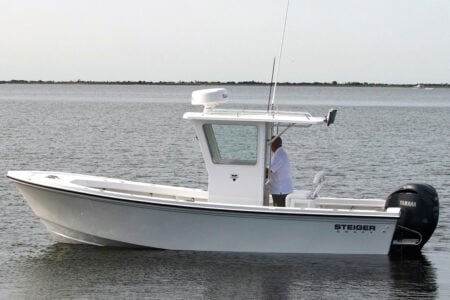
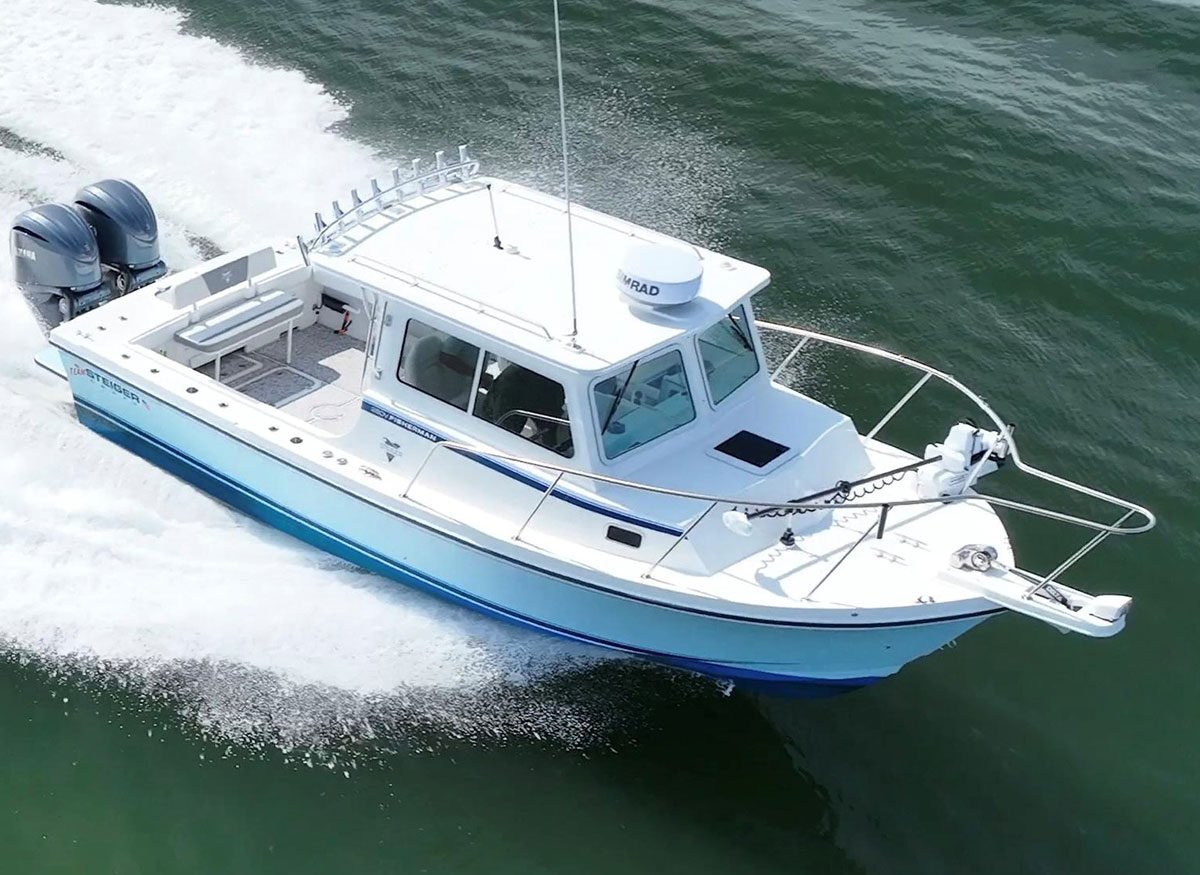
My first exposure to the “reimagined” Steiger Craft 28-footer was at this past New York Boat Show, where it “reappeared” from the Long Island mist and immediately captured my attention. This boat is a versatile platform, built for fishing anywhere from the bays and inlets to the offshore edge. What separates the 28 Fisherman from her Steiger siblings (the 28 Peconic, 28 Deep Vee Miami, and rare 28 Hawaii) is her wide open 80-square foot cockpit and 10-foot beam. The hardtop protects the helm with a reduced-profile three-sided enclosure, while two aft-facing jump seat passengers remain a bit more exposed to the elements.
Another nuance was the original 200-gallon fuel tank paired with standard twin F250 Yamaha V6 four-strokes. That setup raised some range concerns for offshore runs, especially with optional power packages like twin F300s or F350s. When I shared my thoughts with founder Al Steiger and Operations Manager George at the show, they were attentive and receptive.

Problem-Solution
Fast forward to my sea trial in mid-June, and Al had a surprise: the 28 Fisherman would now come standard with upgraded 230-gallon tanks. Additionally, an optional hardtop extension (about 2.5 feet) was now available to shelter the aft-facing jump seats. These updates illustrate one of the key advantages of working with a local builder—flexibility. Unlike high-volume production lines, Steiger can tweak its boats to better suit specific needs and fishing styles.
Standard Features And More
That local, hands-on approach also extends to features. The standard and optional offerings on the 28 Fisherman allow for significant customization. Standard equipment includes a white gelcoat finish, overhead cabin hatch, opening portholes, twin cabin fans, locking companionway, vee-berth, LED lighting, and shelving. There’s also a fiberglass pulpit and bow rail, forward and aft insulated cockpit fish boxes, full swim platform with ladder, raw water washdown, recessed trim tabs, windshield wipers and washers, and a step box for boarding.
Rod and tackle-minded features include a 7-rod rocket launcher with LED spreader lights, six flush-mount rodholders, horizontal rod racks with sinker trays under the gunwales, and a 40-gallon insulated transom livewell that doubles as another fishbox. You also get a two-tone deck in tan or gray.
Optional upgrades range from a Seakeeper gyro stabilizer and Seakeeper Ride system to Yamaha HelmMaster joystick control, bow thruster, freshwater system, additional rocket launcher capacity, 10 alternate hull colors, and more. Nearly anything you can dream up for a fishing or family setup can be built into this boat.
Functional Helm
The helm offers space for a pair of 12-inch displays side-by-side, making it easy to mount all your navigation, sonar, radar, and system controls. Port and starboard helm seats are mounted on dry storage lockers that are ideal for stashing tackle trays or safety gear. Our test model featured a massive 24-inch Simrad multi-function display that managed everything from sonar to navigation—and probably could’ve delivered stock market updates with a smartphone connection.
Power Package
The test boat was equipped with upgraded Yamaha F300s with counter-rotating props. Even with over 200 gallons of fuel, four people onboard, and a full complement of add-ons (including a Seakeeper 1, MinnKota trolling motor, battery bank, bow thruster, and anchor winch), the boat hit 50 mph. Factory tests indicate even higher top-end potential.
One standout feature was the Seakeeper Ride auto attitude control system. Whether hammering the throttle from a standstill, cruising at speed, or carving tight turns, the system kept the boat level and lifted for optimal visibility. Inlets with steep chop highlighted the value of the Seakeeper 1 gyro-stabilizer. Engaged, it dampened roll and pitch noticeably—an asset when offshore or drifting in sloppy conditions. Cruising into a head sea, the hull tracked straight and solid, with zero creaks or slams.
Final Thoughts
This new iteration of the Steiger Craft 28 Fisherman is a true utility player. From inshore casting and trolling to canyon runs and family cruising, she can be tailored to fit nearly any mission. In a world of cookie-cutter center consoles, this boat stands out not just for its rugged build and fishy layout, but for the fact that it’s still backed by a builder who listens—and delivers.