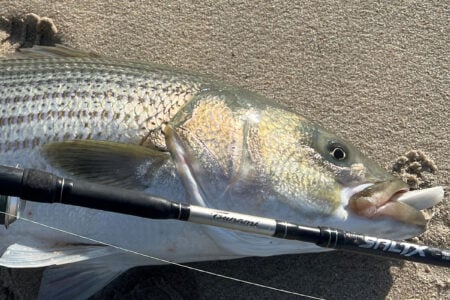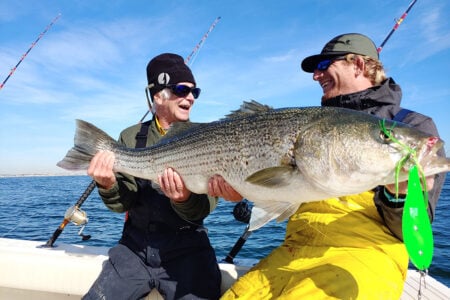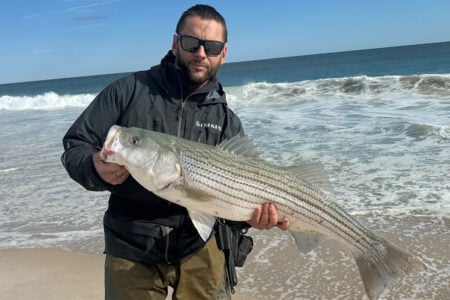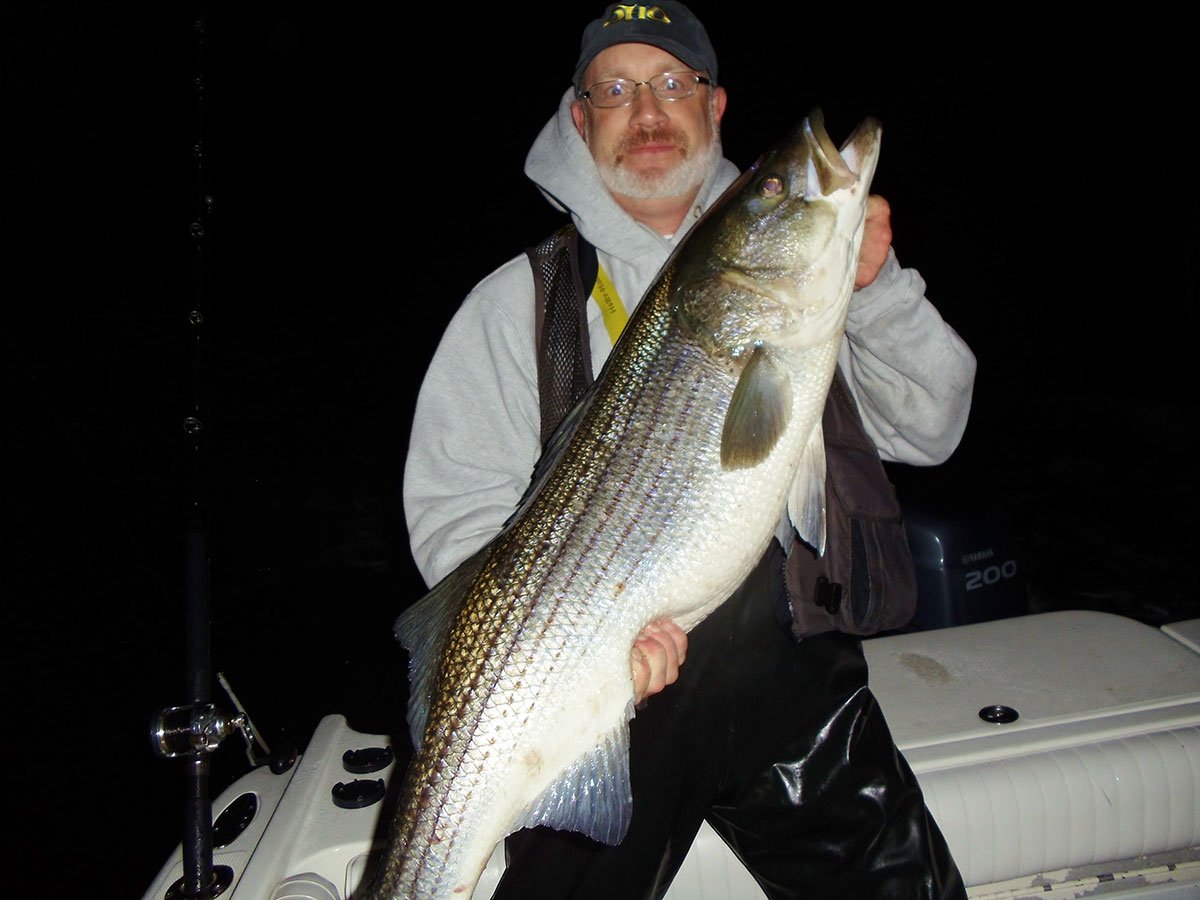
Nighttime striper fishing from a boat is a lost art, maybe it’s time we turn back the clock!
Tired of the mayhem that often accompanies daytime fishing in August? Had enough of the recreational boats who have no idea you are fishing as they blow through the pod of fish you’re working? How about the Jet Ski and sailboat parade that never seems to stop?
If you answered ‘yes’ to any of these questions, maybe it’s time to take a page from your grandfather’s book and consider heading out after dark to hook up with the striped bass of your dreams.
Sure, daytime allows you to target stripers visually; you can see the fleets of boats catching them, you can spot flocks of birds and other feeding activity that you will not be able to see at night. A decent pair of binoculars may be all some anglers need to identify where the bite is, and if that works for you, that’s just fine. But there are times, particularly in midsummer, when the crowds of boats on a bite can be overwhelming. Crossed lines, boats racing each other to reset the drift, tempers flare, the occasional ‘one finger salute’.
Adding to the mayhem, you may have kayaks to watch out for, larger headboats commanding their position, personal watercraft zipping through, and various other non-fishing craft to contend with. By August even the most patient angler might want to take a break from all this ‘full contact fishing’ and opt for a slower-paced option, that comes without the crowds and can be equally, if not even more, productive.

It’s Old School
Let’s not lose sight of that fact that nighttime striper fishing is how this all began. Years back, if your grandfather fished for stripers from a boat, it was likely a smaller craft (under 25 feet) and it was accepted that fishing at night was how you did it. If someone invited you on their boat to fish for stripers, it was going to be done in the dark. This was done for several reasons, one of them being that stripers come closer to shore at night, allowing boaters of the day, to navigate by landmarks. Another was that the gear used at that time was rudimentary by today’s standards and since stripers are less picky at night, night fishing lent itself well to the thicker Dacron and waxed cotton lines and bulkier rigs.
Fast-forward to today, with our advanced electronics, specialized gear and boats designed for fishing and you see very few boats out after dark, except in certain areas like Block Island and Montauk. The night is now the realm of the surfcaster, but it shouldn’t be.
What happened and why did this change to daytime fishing occur? I don’t believe there’s a single reason, it’s more of a convergence of things that seemed to lead to this change. One is electronics; fish-finding technology has become increasingly better and that has allowed anglers to locate and target bass in the daytime that previously would have been very difficult to find with consistency. Boats also became much better, allowing the ‘average’ boat owner to safely and confidently venture further from the dock and farther offshore, even in less-than-ideal conditions.
Fishing gear has also been vastly improved, lighter, stronger, faster reels; micro-thin, ultra-strong lines; invisible fluorocarbon leaders; high-tech lures; surgically-sharpened hooks…these things all work together to make today’s striper fishermen vastly more effective, even in bright sunlight.
Another factor I point to is the moratorium itself, there simply weren’t as many parents, grandparents, aunts and uncles taking the children of that time out nighttime bass fishing and the tradition, largely, came to an end. There weren’t many bass to catch and anglers were discouraged from fishing for the ones that remained, even for catch and release. By the time that all ended and fishing for bass was reopened lives had gotten busier, youth AAU sports had exploded and those kids no longer had time to go fishing at night. As a result, a generation of young anglers never ‘came of age’ fishing in the dark from a boat. Nowadays, most of the boats you see out fishing in the evening, go home when it starts to get dark. Maybe it’s time to turn back the clock.
Night Benefits
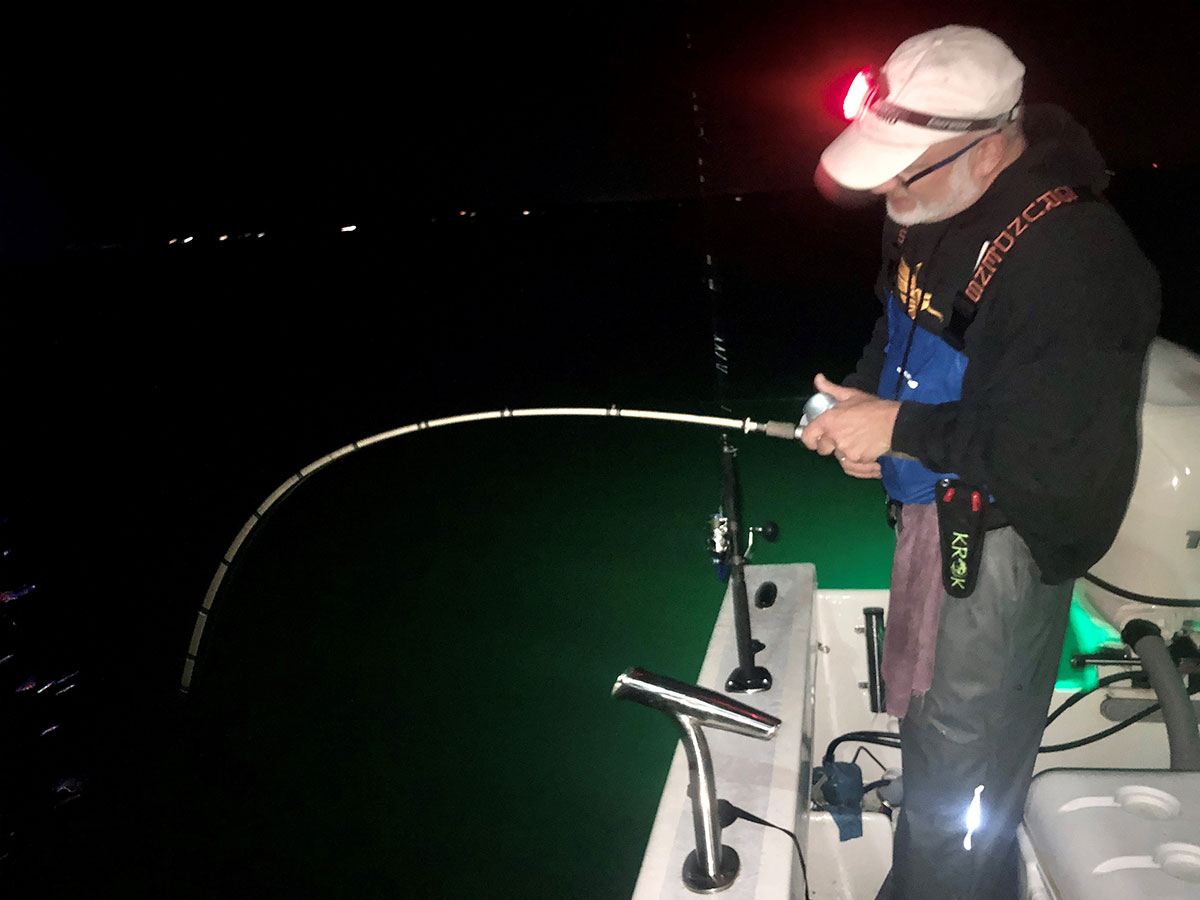
So, what are the actual benefits of being out at night? First of all, as I’ve already noted, the lack of boat traffic and crowding in the hotspots is worth the price of admission on its own. I should mention that the amount of commercial boat traffic will remain steady, so tugs, barges and tankers will run all night, be aware and use those high-tech electronics to stay out of the shipping lanes and other areas of high commercial traffic.
| A MIDNIGHT TROLL |
| Trolling can also be very effective at night, but I caution you to keep things simple. Use single hook rigs like the reliable tube and worm, which works great at night. If you want to use swimming plugs eliminate a treble hook or switch to inline single hooks for your safety and easier, quicker releases. A pro tip I can pass along is to go out in daylight and lay down a trolling track that avoids commercial gear, hang-ups and obstacles, then you can follow the track in the dark, worry free. |
Fishermen who are out at night, tend to be more experienced (I’ll admit this is a broad generalization) but this fact makes for fewer “yahoo” moments. However, keeping a safe and respectable distance from other boats can be a bit deceiving in the dark so make sure you give a wide berth, especially if nearby boats are actively fishing.
After dark, striped bass seem to be a lot less ‘spooky’ and leader shy. This leads to far fewer follows and lot more committed strikes. Typically, it is not necessary to drop down to the lightest leaders or eliminate terminal tackle, unless there are other extenuating circumstances like bioluminescence in the water or a bright, full moon. Furthermore, nighttime stripers are often pretty ‘patternable’ meaning you can figure out a bite and then come back for to a specific spot for a specific tide and get back on the bite. In late-summer and early-fall, you may be able to stay on the bite for weeks. Plus, August nights often feature softer winds, which when coupled with lower boat traffic, makes for flatter seas.
Techniques
Night techniques don’t really need to be much different than daytime but I do simplify things a bit. I like to cast subsurface plugs over flats and boulder fields, things like Bombers, Red Fins, Hydro Minnows or SP’s. I generally rig these on simple 40-pound leaders. If I feel like larger fish are in an area, I may toss weightless live eels in same spots. Steady retrieves with a rare pause is my go to approach. Using my MinnKota Quest trolling motor to slowly and quietly work through a boulder field at night is one of the true joys of late-summer striper fishing and these high-tech trolling motors we have today take this practice to a level our grandfathers couldn’t fathom.
Chunking is a time-proven nighttime method and one that I like a lot, because I can set up with an anchor or spot lock with my Minn Kota and stay put, letting the fish come to me. It makes for an incredibly peaceful, and often very productive, night. Chunking with mono is must for me in the dark, because dealing with two or three braided lines in the dark with fish hooked up is a thing you won’t want to repeat, ever.
Shadow lines are great spots to find nighttime stripers, they can be cast by docks, moored boats, buildings on the shore or bridges, among other possibilities. These spots offer the cover of darkness for predatory fish to ambush prey that’s drifting by on the lighted side of the shadow line. Depending on the depth of the water and where the fish are holding, you can use a variety of lures and live (or dead) baits to catch these fish. Also, be aware that drifting boats tend to approach objects faster than you might assume at night, so keep your eyes on surface structures, like pilings, and have someone at the helm at all times if you’re fishing in and around surface structure.
Dark Hour Safety
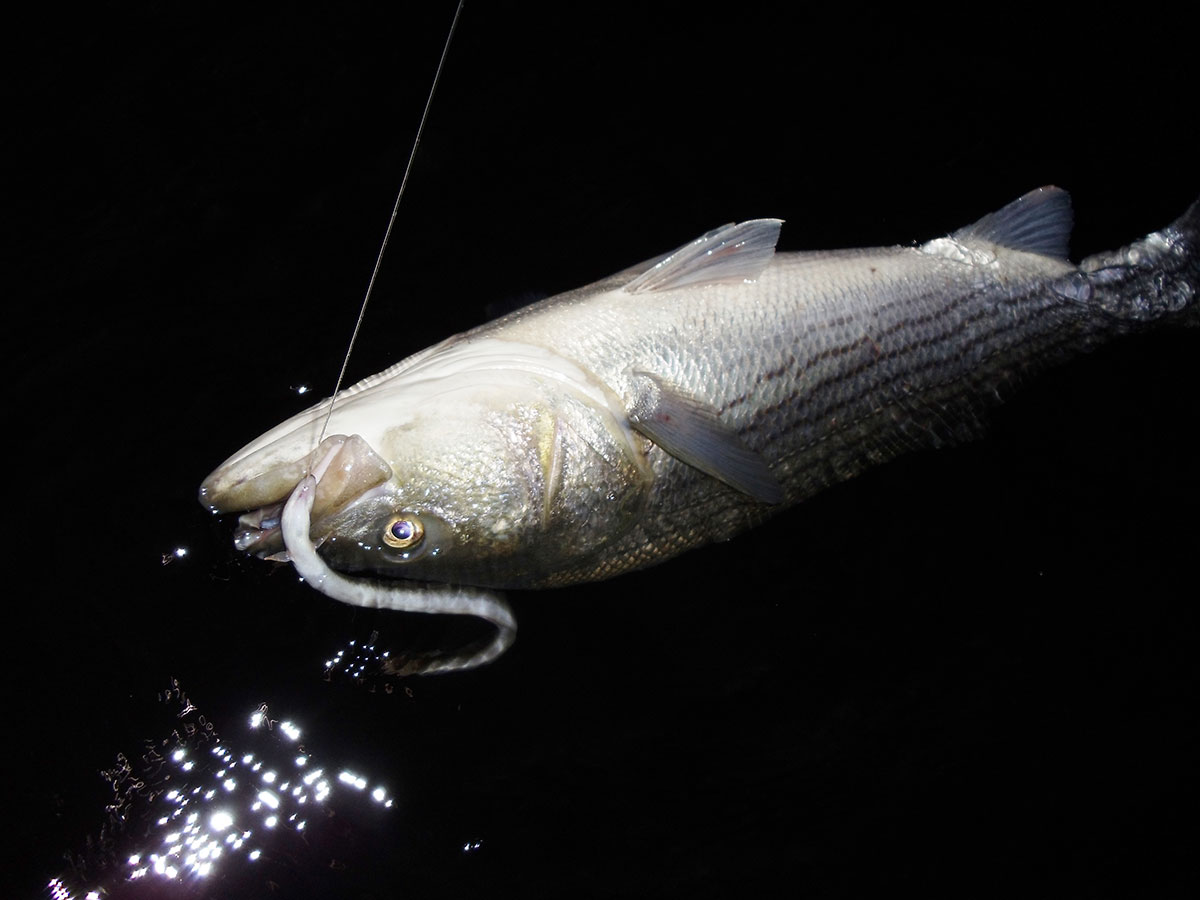
Lastly, you want to approach these after-dark adventures with a ‘safety first’ attitude. All the electronics that help anglers navigate structure in daylight will serve the same purpose at night. Trust your electronics. I trust my Humminbird units with my life! Use their features to keep you safe and to make you a more effective fisherman. GPS Mapping is a godsend, showing where you are, where you can go safely and where you shouldn’t be. Leaving track lines will show you safe tracks you’ve made in the past while also laying out successful drifts. Radar, if you have it, and sonar units will help you navigate in the dark, safely and confidently. Always make sure to dim your screen as the sun goes down, you can’t see squat at night when your screen is on full power, dim and proceed.
Nighttime fishing should include all the basic safety gear you’re required to have in daytime with an extra focus on a bright spotlight, multiple headlamps for each angler onboard (turned off unless needed), well-functioning running lights, a working marine radio and a (fully-charged) backup handheld would be my recommendation, and I always wear my life jacket at night and I encourage all passengers on my boat to do the same. Something I try never to forget is a few dry paper towels sealed in a Ziploc bag for my glasses – nighttime can get misty and my glasses tend to fog up, so keeping the lenses dry is important to me.
| DEPTHS OF DARKNESS |
| I think of nighttime fishing in three different zones – surface, mid-depths and deep.
Shallow: For shallow waters like flats and boulder fields, I like to use shallow swimmers, unweighted soft plastics and live eels. Mid-Depths: When fish are suspended or tight to the bottom at depths of 15 to 30 feet, I will use Ron-Z’s, GT Eels and other soft plastics on 3/4- to 1-ounce leadheads. (These depths are also ideal for trolling.) Deep: In waters deeper than 30 feet, I will use metals with surgical tubes and heavier leadheads. Live eels weighted down with an egg sinker are also a great option for stripers holding in deep waters. |
Despite my comfort boating and fishing at night, I definitely transit slower from spot to spot than I do in the daytime and I typically stick to spots I’m very familiar with – nighttime is perhaps not the best time to explore new spots, but I admit I will occasionally ignore that rule if something seems fishy as I pass by. For beginners, I strongly recommend going out before dark to get a feel for your spots and let darkness fall while you’re on the water, this will ease you into the darkness help you stay oriented in the dark.
With the lower boat traffic, emboldened fish and so much awesome water to cover, late-summer night fishing can be real joy that lets you beat the heat, skip the sunblock, dodge the crowds and – probably – catch more fish. Stay safe and I’ll see you out there!