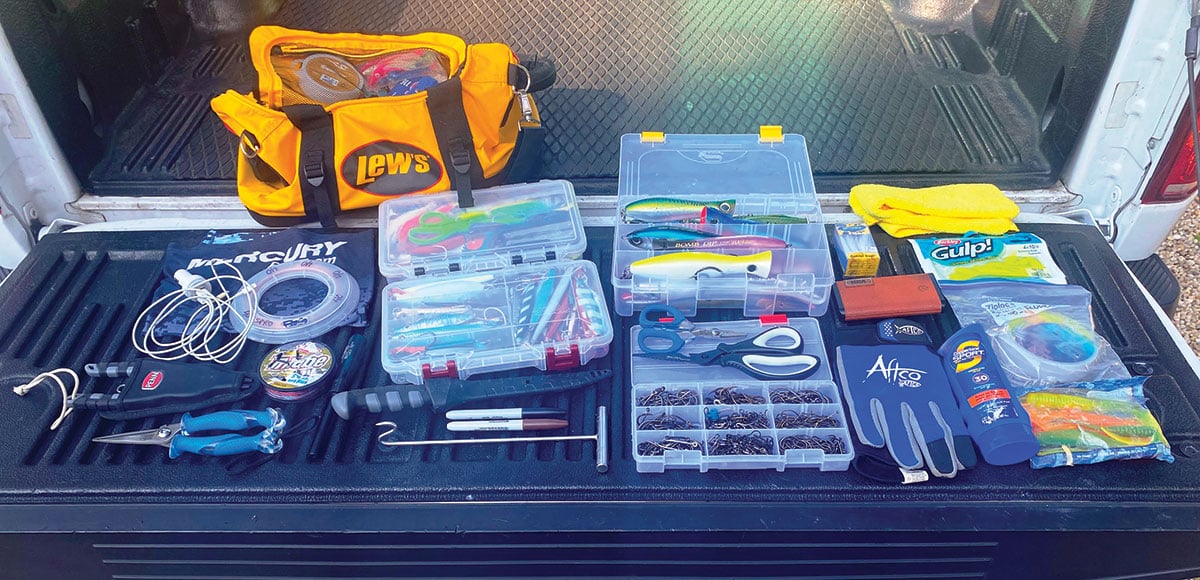
The mobile angler’s blueprint for light, flexible, and efficient tackle storage.
I have had the chance to fish my entire life, from age 6 to age 75. The one constant in my pursuits, that started off in freshwater and graduated into a 99.9% passion and focus on saltwater around age 24, was the need to carry tackle items of one sort or another to make things happen. Be it home or on the road, having the right terminal gear on hand to pursue the catch of the day can be of critical importance.
Most travel tackle systems are based on dedicated 3500, 3600 or 3700 series tackle trays (more specifics on these later), or perhaps a mix of these three most popular sizes. The array of travel tackle bags and boxes can include a variety of sizes and shapes, ranging from waterproof carry/shoulder bags, gasketed boxes, open milk crate type boxes, open satchel bags, back packs, shoulder bags and more. Taking a trip down to your local tackle shop or a little online browsing will uncover dozens of travel tackle varieties and options that will most probably fit your needs.
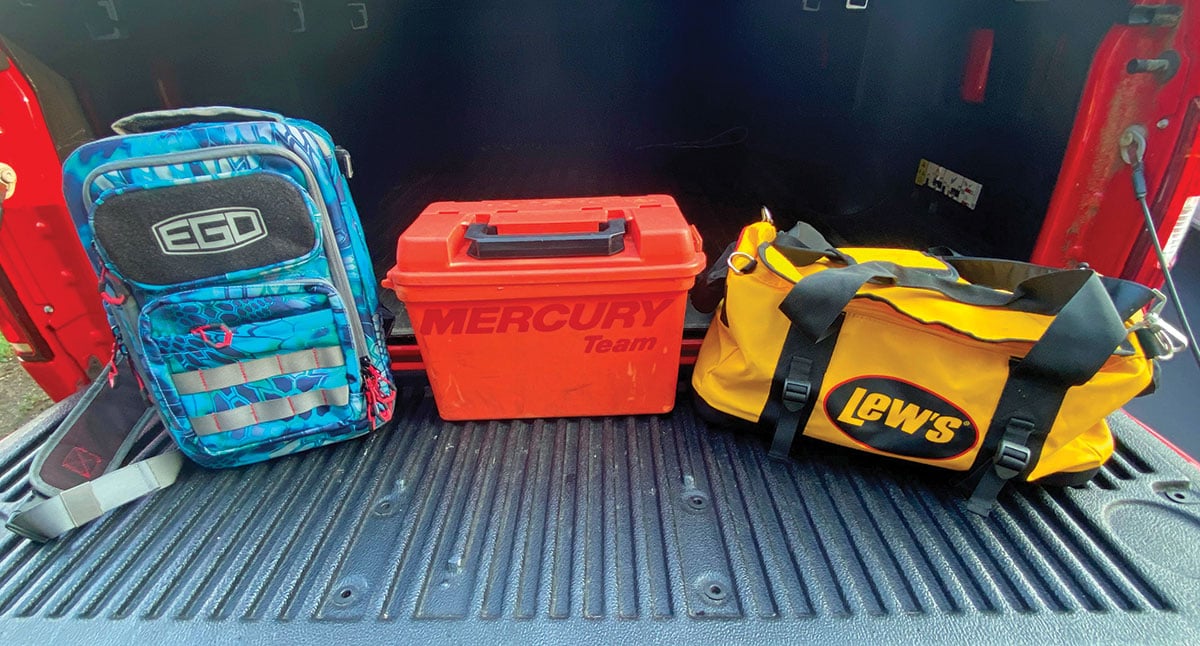
I’ve set up a comparison chart for four of my typical travel tackle carry bag/box options, looking at their size, capabilities and costs, along with some pros and cons of each type:
| Carry Type | Size | Capacity | Pros & Cons |
| Plano USA Model 1612 Utility Box | 15.5”W x 9.5”H x 8” D | 3 x 3600 boxes 1 x 3500 box plus tools, knife & other gear |
Water resistant lid gasket, rugged, affordable and easy to stow & access gear. Single handle. Will get wet if lid is left open or when overloaded. |
| Cabela’s Model 73424 Pro Angler | 14”W x 10”H x 12”D | 6 x 3600 boxes
1 x 3712 box plus tools, knife & other gear |
Water resistant ripstop material, waterproof plastic bottom, easy to stow & access gear. Will stain easily. Dual carry handle & shoulder strap. |
| Lew’s Speed Boat Bag | 18”W x 12”H x 12”D | 4 x 3600 boxes or 3700 boxes, plus tools, knife & other gear | Waterproof material, easy to stow gear, but harder to access gear. Twin carry handles & single shoulder strap. Contents can get easily disorganized. |
As a traveling captain who spends half my time taking my charter customers out on their boats, with the other half going out on my boats, I always taking some type of travel tackle show with me to augment the scope and capability of the planned sport fishing excursion. To ignore this rule of thumb is to invite potential disaster. I have been 40 miles offshore too many times only to discover that the boat owner’s concept of a plentiful supply of requisite tackle items is diametrically opposed to mine. It’s my challenge to determine the nature of each trip and then to support it with my gear, “just in case”.
Even when I am going out on my own boats, with my 228 EdgeWater CC having a built-in tackle center and the smaller EdgeWater 185 CC devoid of any meaningful tackle storage, my addendum travel tackle bag will always include whatever we’ll need for the day’s events and stows neatly in the confines of each boat’s center console when not needed, totally out of the weather but close at hand.
Bass Pro Shops/Cabela’s currently offers at least a dozen 3600 or 3700 series carry bags for traveling anglers. One of the most affordable smaller sizes is the Advanced Angler Pro Large Tackle System series that is built to provide pro-style performance while offering the most efficient and reliable tackle storage available. A large zippered top opening provides fast, easy access to up to seven 3600 series tackle storage boxes (six are included), with plenty of pockets for holding additional gear, all for $99.99.
If this Bass Pro Shops carry bag has the potential to be two large or too heavy, a smaller version, the XPS Tackle Bag might fit the bill. This tackle bag holds up to five 3600 series utility boxes (four included). Anglers can tote their bag using either the included removable shoulder strap or top-mounted handle at a price of $79.99 (available in a five 3700-series tackle tray version for only $10 more).
Sling Pack Route
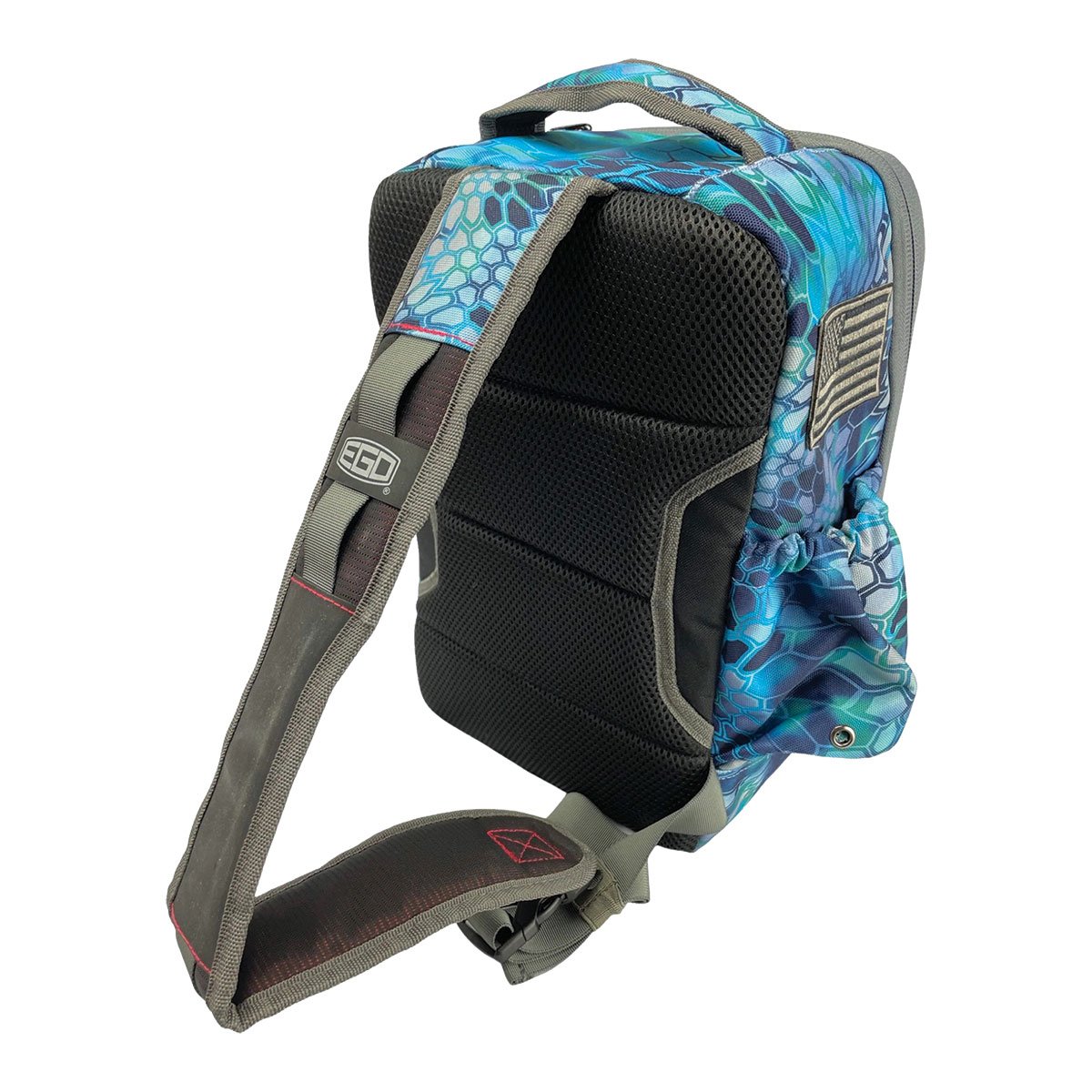
EGO recently introduced their Tackle Box Sling Pack as the cure for seagoing backpacks. Mobility can be hampered by the clumsy double shoulder straps on the typical backpack-style tackle bag. Sometimes difficult to even get both arms through, once in place, the pack often slides down one shoulder or the other.
Conversely, EGO’s Tackle Box Sling Pack’s innovative single padded strap design quickly humps over your head and one shoulder and then instantly settles in place as the strap crosses your chest and pack relaxes on your back. The pack’s weight immediately distributes evenly. Completing the Tackle Box Sling Pack’s carrying capacity, you’ll appreciate a padded handle on top for quick toting.
Overall construction is robust, with the tactical and technical exterior utilizing 1000D Nylon fabric with PVC backing (the tough stuff) to minimize wear and tear. Toughness continues with wide-toothed zippers, which are protected by fabric overlays. EGO gave the Tackle Box Sling Pack hearty zipper pulls, ones you can grab or pull with a single inserted finger. The pack’s external storage sports a trifecta of zippered compartments. The shallow main partition can harbor technology like an iPad, while its two additional mesh zippered slots can hold your smartphone, keys, etc.
Atop the main partition are a pair of full-featured, zippered pouches with ample storage for sunglasses and fishing sundries. The front is finished with laser-cut MOLLE (Modular Lightweight Load-Carrying Equipment) slots for fishing tools and the exterior also includes an elastic water bottle pouch and rod/reel combo holder. The EGO’s Tackle Box Sling Pack includes a trio of 3700 tackle trays that are kept snug with a clever securing strap. EGO partnered with Kryptek to produce two edgy color patterns inspired by US milspec camouflage patterns, Kryptek PONTUS and TYPHON.
The Classics
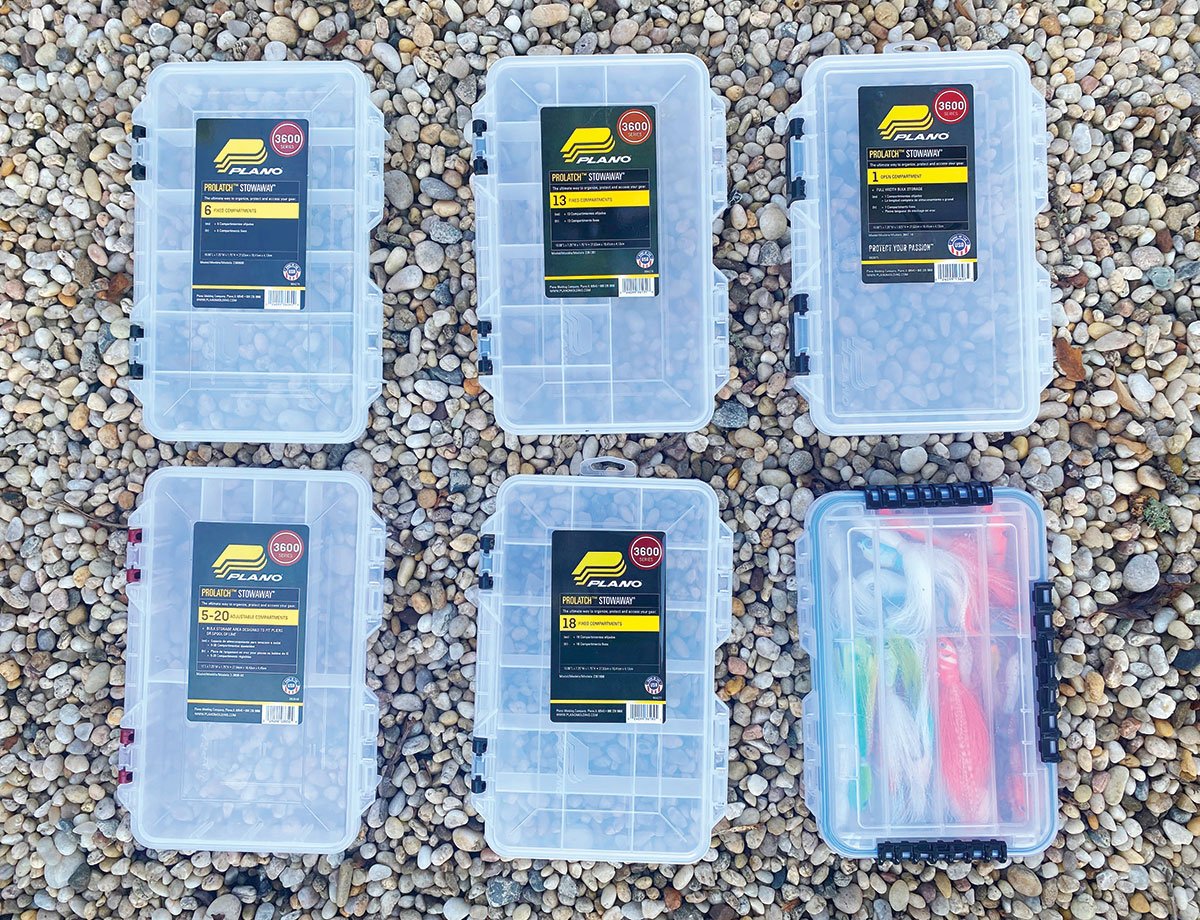
The tackle storage industry has gravitated towards a certain uniformity and consistency when sizing its tackle storage trays, since they are now being used for both portable and permanent residency on a variety of OEM installations on new boats. These trays are manufactured both in the USA and in the Pacific Rim. It’s been my experience that the American versions typically cost a few bucks more and are usually made with a higher degree of quality, using a better grade of materials, along with additional interior layout and locking options.
The following chart indicates the external dimensions of some of the most popular Plano (and competitive) tackle tray model and sizes:
| Manufacturer | Tackle Tray Model | Tackle Tray Dimensions |
| Plano | 3500 | 9” W x 4.75” H x 1.25” D |
| Plano | 3600 | 10.88” W x 7.25” H x 1.75” D |
| Plano | 3600 Deep | 10.88” W x 7.25” H x 2.75” D |
| Plano | 3700 | 14” W x 8.75 H x 2” D |
| Plano | 3700 Deep | 14” W x 8.75” H x 2.75” D |
| Plano | 3712 | 9” W x 6.75” H x 2” D |
Like a foot soldier’s critical kit, it’s a great idea to never run out of requisite items like food, water, ammo, med supplies, etc., but how much can the human form be expected to carry over the long haul and still be effective? The same is true for travel tackle advocates – how much can you realistically lug around from house, to car, to boat and not be totally hamstrung by the sheer weight and size of the operation, knowing that personal items (rain gear, jackets, spare shirts, etc.), food/beverages and rods/reels are also part of the day’s carry equation?
The boat you will board to go to and from the fishing grounds will also have some size and weight restrictions. Where will this assortment of stuff be stowed onboard so that it’s out of the weather, but ready for immediate access when the time arises and be in working condition when you get there? It’s a delicate balance to be prepared for anything and everything out on the water and not be totally encumbered by the magnitude of the process. Anglers need to be able to identify the essential items that are needed for that trip and that’s the true beauty of the travelling tackle bag/box concept’s core flexibility. You take only what you project to need for what you realistically expect to encounter, thereby keeping weight and bulk to an absolute minimum.
I’ll typically have eight to ten boxes of pre-packed 3600 series Plano USA boxes ready to go at the start of the season, each with a different contents mix to support a unique mission objective. I’ll grab these as needed when I am prepping the night before for the upcoming fishing excursion. Is it a shark trip, tuna troll/jig/chunk, wreck/reef, sight casting offshore, sight casting inshore, bunker snagging, drifting the inlet or back-bays, live bait fishing, or any combination of these?
The answer to this question and the knowledge of the boat that will make the journey will determine what boxes get included in the travel mix and which type of tackle box carry case will be chosen for the event.
Critical Components
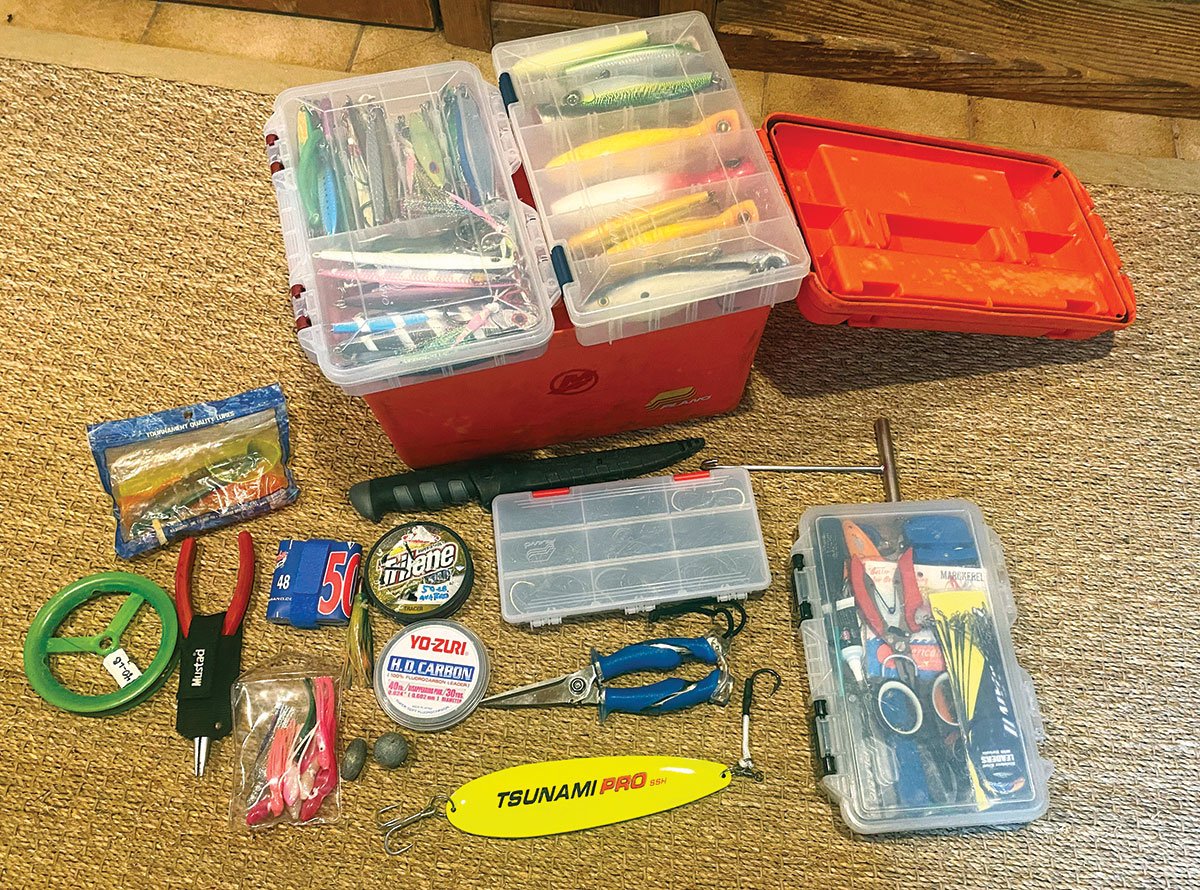
One of the biggest considerations when putting the travel kit together for an impending trip is the weight factor. I can easily load up that simple Plano orange utility box (capacity of 3 x 3600 and 1 x 3500 tackle trays and assorted throw-in items) with 35 to 40 pounds of tackle if my contents include a box of tuna jigs, bucktails, sinkers and such. Stuffing the box with too many toys like this on a regular basis and allowing it to bounce around an open cockpit will have a tendency to warp the Plano molded box out of shape and allow water to seep into the internals via the misshaped gasketed lid.
My old school Cabela’s tackle bag is a great option with a total of eight tackle trays (7 x 3600 and 1 x 3500 or 3712), but I have tried lugging this around when it was stuffed with over 50 pounds of gear and it’s a real PITA. It stretches out every joint, seam, handle, zipper and stitch to the max. This carry bag when fully loaded would probably be a better choice to live as a semi-permanent resident under the console or cabin of a boat that doesn’t have a sophisticated onboard tackle storage system.
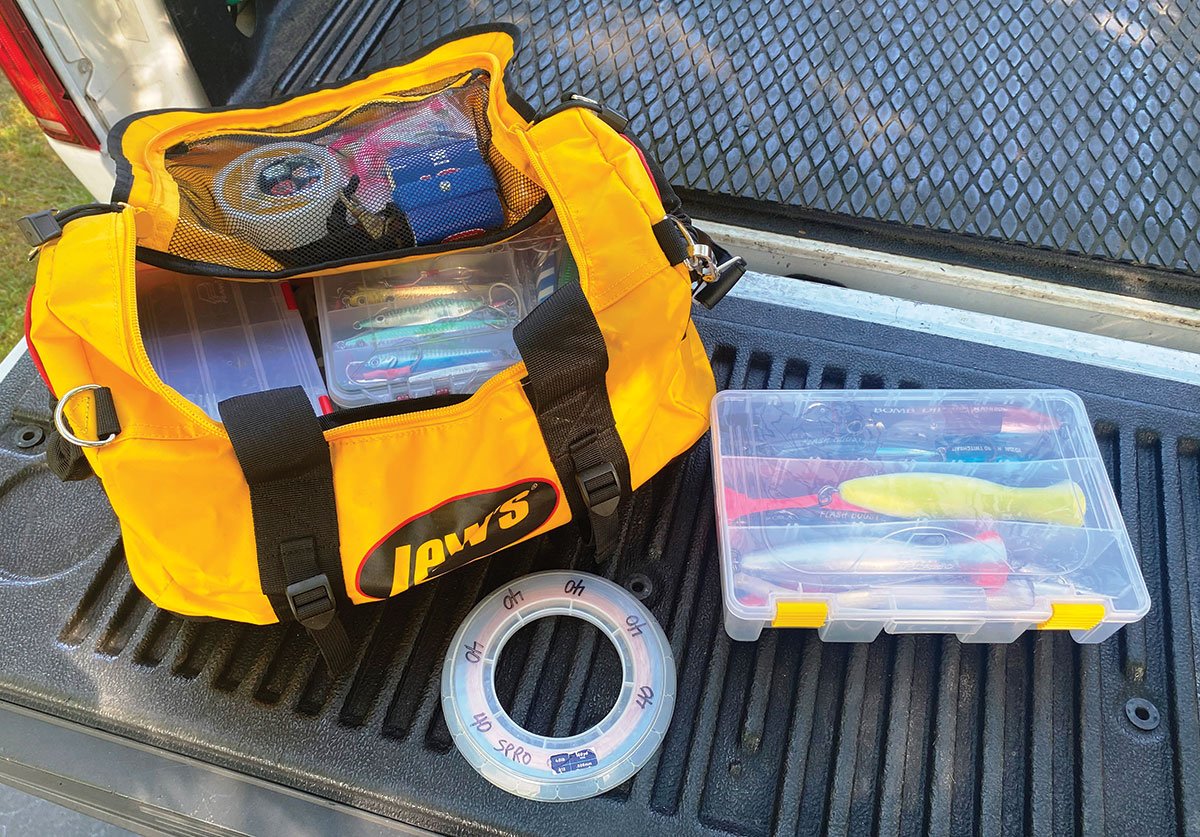
So what items do you really need to lug in the tackle trays of your carry bag or box when making your trip? Some “universal” items that should always find a home in your kit include critical components like snaps, swivels, leader material, braid shears, hook removal tools, an assortment of hooks, pliers, sinkers, knife/hook sharpener and fillet/utility knives. Items like task-specific poppers, darters, inshore jigs, offshore jigs, artificial baits (Gulp, rubber minnows etc.), diving plugs, trolling lures, gloves, etc. can all be added or deleted from the carry bag mix based on the nature, scope, range and time of the year of your trip.
I have lost count of the times we have started out on a trip with one or two things in mind, only to be completely skunked and shut down. When someone onboard suddenly observed something happening on the water that was totally unplanned, we were able to use the contents of my “magic travel box” to leverage a situation and bend the rods.
So whatever your travel tackle needs are for the rest of the season, remember to keep your flexibility high and your overall weight as low as possible and always have enough room for the critical components that will ensure the flexibility and success of your trip.