Warming waters bring more southern visitors, and new angling opportunities.
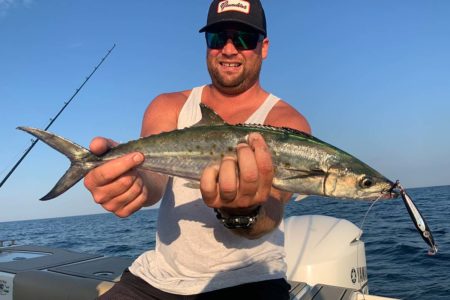
Toothy and aggressive, the twin so called “good eating” mackerels have been somewhat well-established in recent years as one of the more popular new visitors to the Jersey Shore, but from the looks of fishing reports in The Fisherman they appear to be making their presence known seasonally in the Long Island, and New England regions as well.
While most think of oily, fishy tasting fare when mackerel is mentioned, both Spanish mackerel (scomberomorus maculatus) and king mackerel (scomberomorus cavalla) are far away from that misnomer, inviting a lip-smacking taste in the frying pan. Interestingly Spanish mackerel schools have really pushed into New Jersey in the past 8 to 10 years, with similar influxes stretching up into New England, they’d been around cyclically before, though not in the numbers we’re seeing today.
I remember back in the late 1990s, as charted in my log books, witnessing the last two weeks of August seeing the silhouettes of what appeared to be Spanish mackerel jumping in the pre-dawn sunrise, though I couldn’t register if they were actually Spanish macks or not because we had always been brought up to believe they wouldn’t travel this far northward. It took me until 2008 to catch my first Spanish mack from the surfline, and from 2018 to today, I’ve most certainly been in the hundreds of Spanish mack catches from the surf.
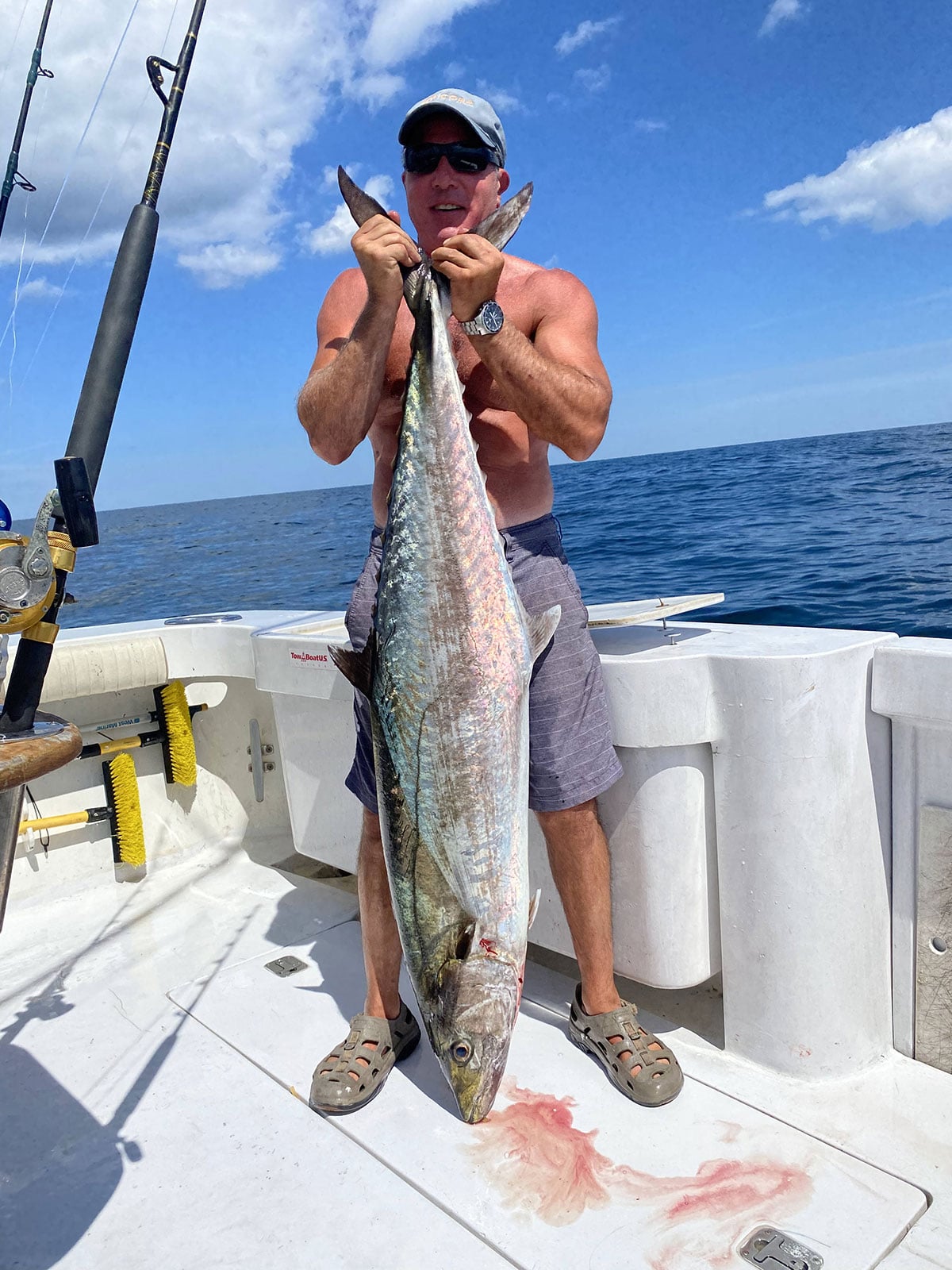
On the other hand, king mackerel – kingfish as they’re often referred in the Southeast – are a bit more elusive in NY Bight waters, though almost every summer you used to hear about a handful being caught in south Jersey off the Wildwood Reef, 5 FB and Old Grounds areas. It does seem that in recent years these kings have pushed a bit northward to spice up the pelagic mix.
Trolling & Jigging
Boaters are delighted to be able to target Spanish through July and August as water temps range in the 70- to 80-degree mark. That spark combines with the presence of small rainbait type schools such as spearing, bay anchovies, sand eels and tropical fry that mackerel gobble up by the mouthful.
Perhaps the easiest way to not only search for, but hook Spanish and kings is to troll, dragging 00 Clark Spoons and small flash feathers on 3- to 4-inch in blue/white silver flash heads, either on flatlines or rigged on 2- to 3-ounce drail weights with a 10-foot section of 50-pound Seaguar fluorocarbon leader to prevent bite offs. A rapid 6- to 8-knot pace skipping on the water’s surface or bubbling below will get smoked. Spanish seem to be close inshore and nearshore out to 8 miles or so whereas king macks seem to stray a bit more into pelagic areas.
Here at the Jersey Shore, I can say with honesty that we’ve actually jigged up a few king mackerel on the tuna grounds as well as one at the Manasquan Ridge area about 5 miles off. Smaller thin profile metals like Deadly Dicks, Williamson Gomoku jigs and Daiwa Saltiga SL jigs can be dropped down and either yo-yoed back to the surface or reeled up at a speedy pace vertically up through the water column.
Generally speaking you’ve got your best shot at king macks jigging more offshore when you’re on the tuna grounds rather than getting random visuals on them to cast to.
By Boat Or Beach
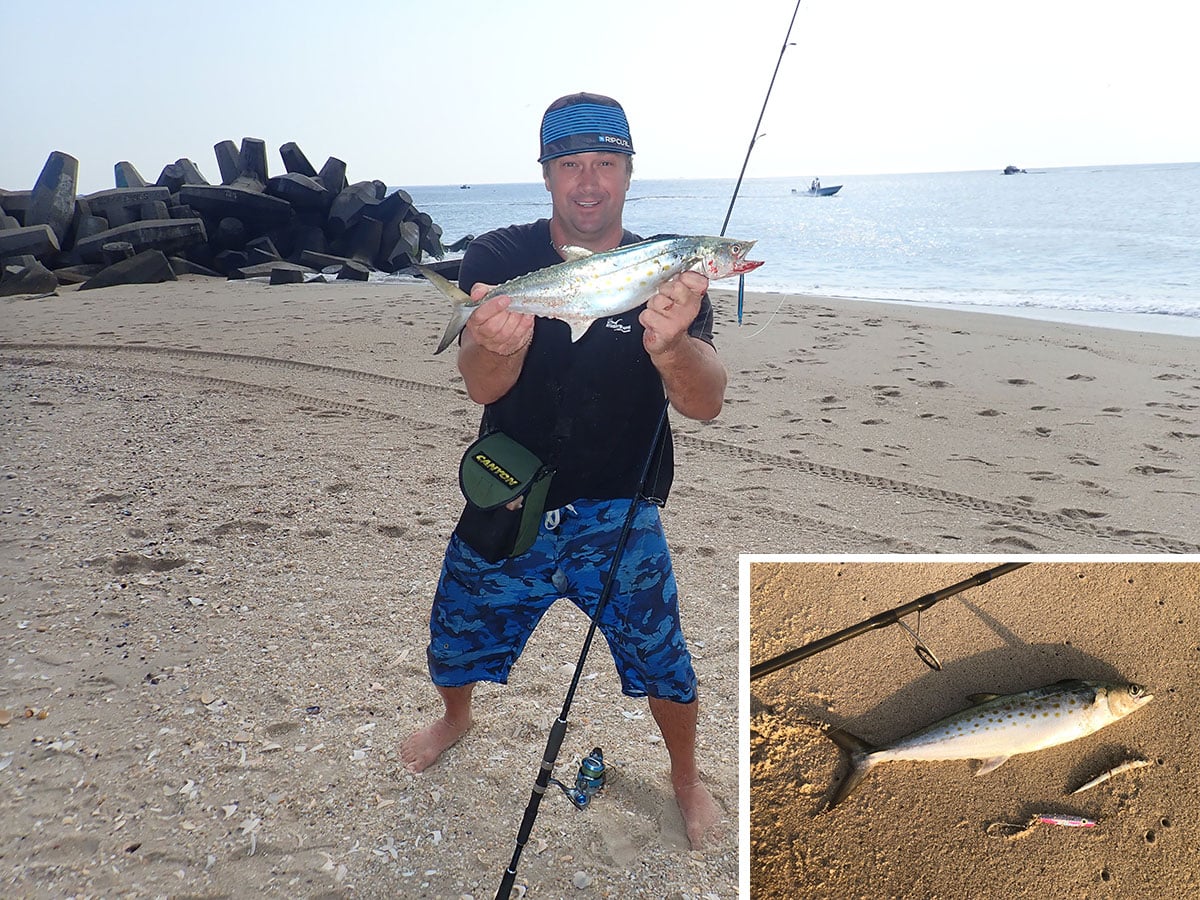
When casting opportunities present themselves, a lighter 7-foot Shimano Terramar spinning Rod rated for 15 to 30-pound line matched with a Daiwa BG Back Bay Saltiga 4000 or Shimano Stradic 5000 will fit the bill. Spool up with 30-pound Power Pro braid, then uni-to-uni knot a 10-foot section of 25-pound Seaguar Fluorocarbon leader and tie directly to any metal lure you intend to whip out. When in hoping to cast and blast along nearshore waters, be on the lookout for schools of Spanish breaking the surface and vaulting clear out of the water as they look like flying missiles when a quick tail whip launches them airborne to crash on top of bait schools.
Searching the shoreline in summer is a wild ride trying to find macks jumping around in the surf. Whippy 8-foot rods are used to launch metals, these rods feature medium fast action, such as a St. Croix Tidemaster inshore rated 8 to 17 pounds. Match it up with a Daiwa 5000 BG or Shimano Stradic 5000 spooled with 30-pound Power Pro braid, Albright knot a 5-foot length of 20 to 25-pound Seauguar fluorocarbon leader and tie direct to the lure with no terminal tackle like barrel swivels or snaps or it may attract a mackerel to target the terminal tackle and get clipped.
| KINGS OR SPANISH? |
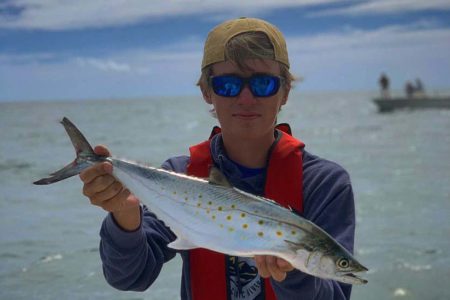
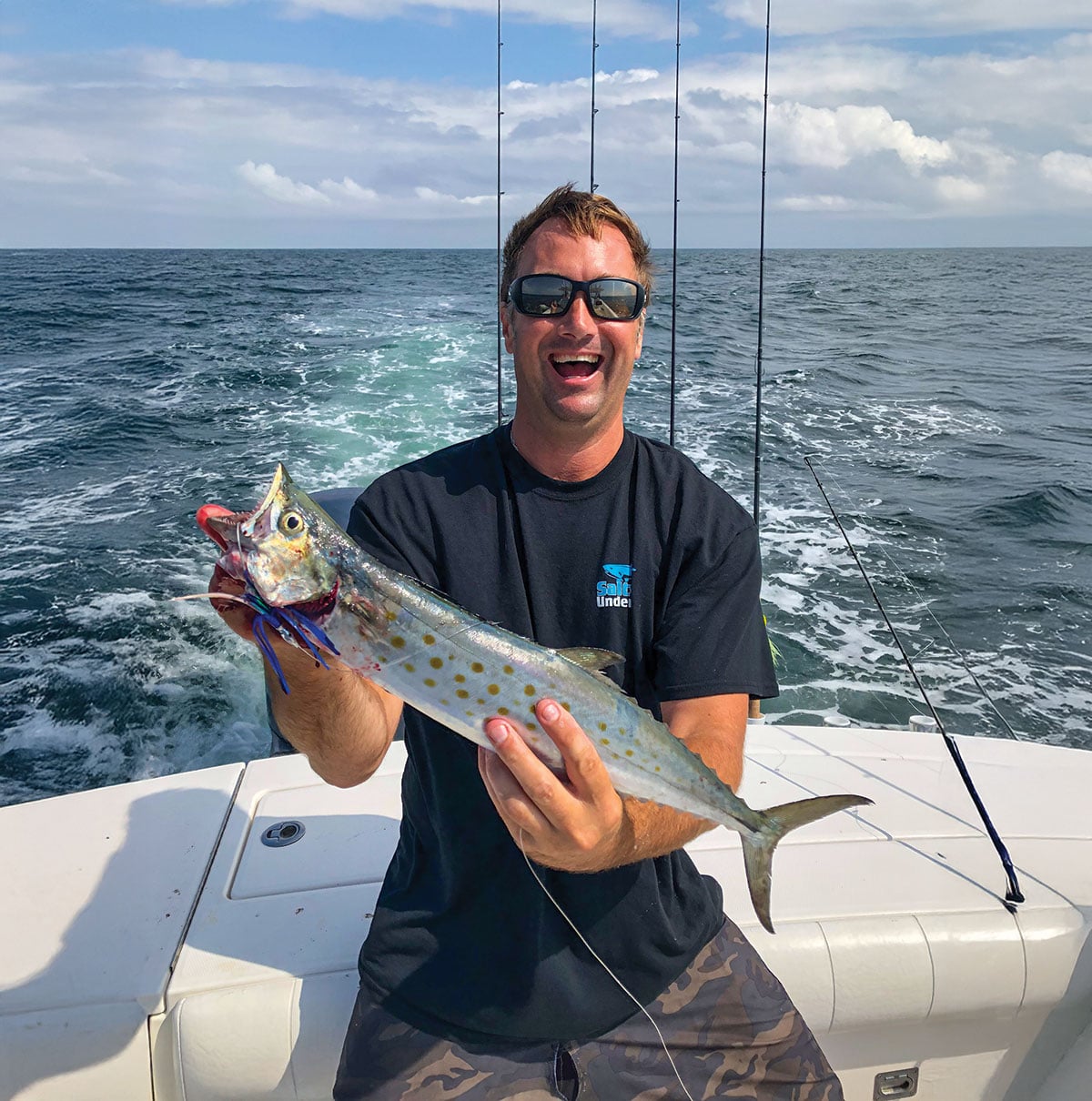
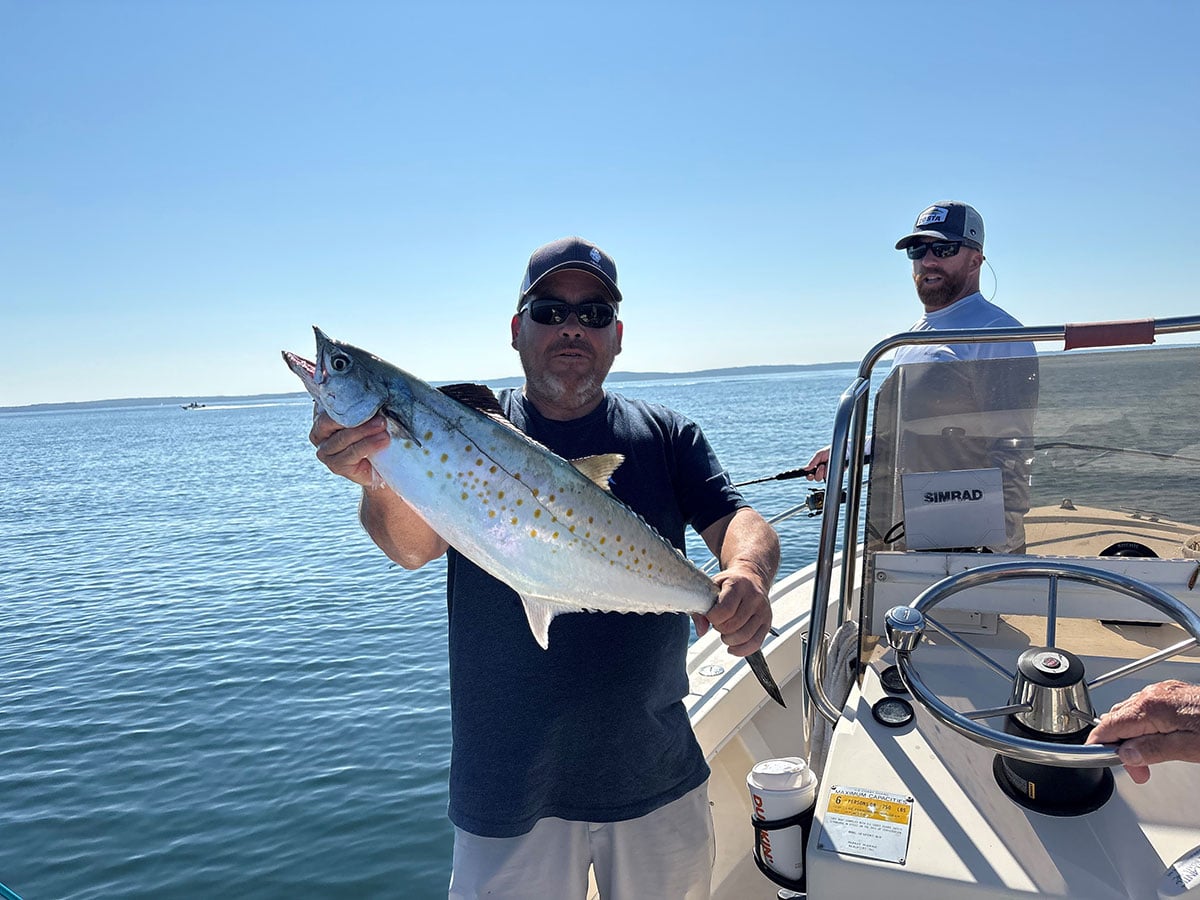
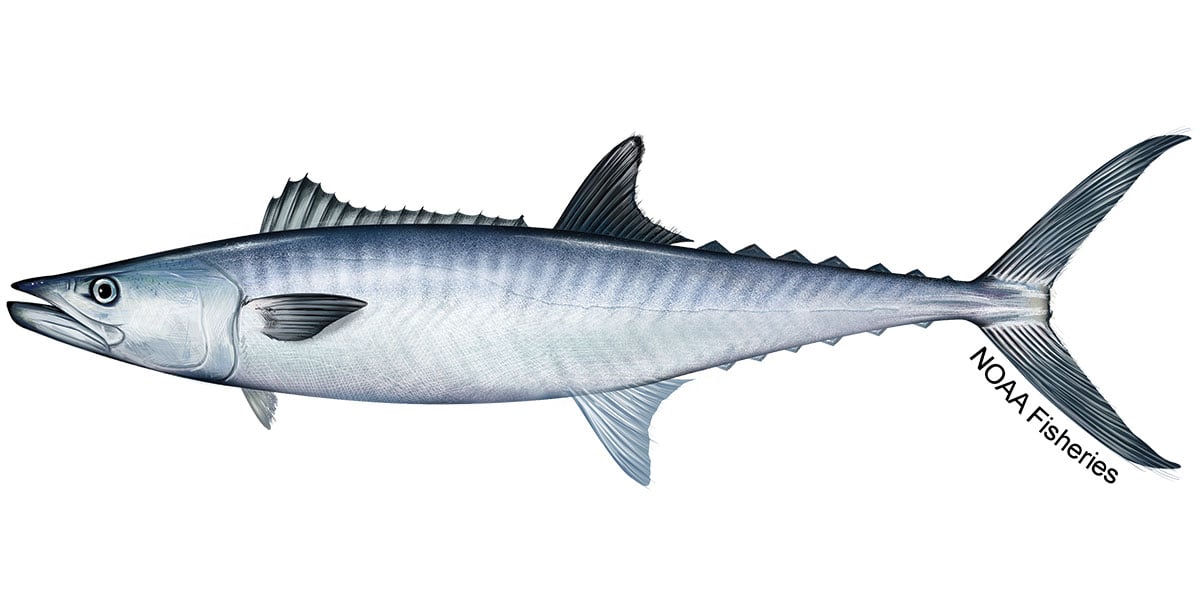
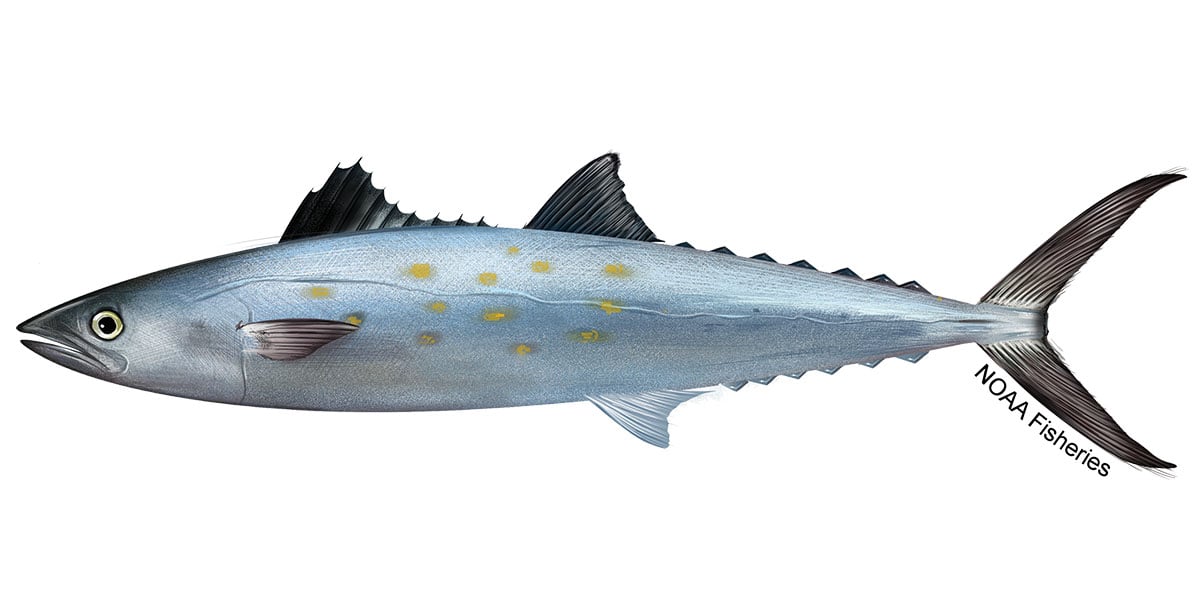
| To best ID each species, both the adult Spanish mackerel and a juvenile king mackerel have gold spots on the body. However, the Spanish mackerel features a black spot on the first dorsal fin. King mackerel lack this telltale spot. Another difference between the two fish is that the king mackerel has a pronounced dip in the lateral line below the second dorsal fin. The lateral line on the Spanish mackerel gently curves to the tail.
– N. Honachefsky
|
Make a far cast, let the lure sink then engage a speedy retrieve so the lure comes up at an angle through the water column all the way back covering various depths. Note in the surf that Spanish schools tend to circle back on the rainbait, so if you miss your shot, you don’t need to go running like a maniac after them, stay put, watch the macks wait it out until they circle back and make the right cast this time.
An interesting story happened to me as the summer of 2022 I saw Spanish schools jumping outside the breakers on a low tide in Lavallette along the Central Jersey coast, whereupon I waded out to make a super long cast with a Williamson Gomoku 1.8-gram jig. As I engaged the reel, it got smoked with immediate effect. For 15 minutes my spool got dumped twice until I finally felt the immense leverage of the fish and pulled it in close enough next to me to see what it was. An absolute unit of a mackerel, jaws flaring and mouth agape with the jig barely hanging out of its mouth finned next to me in waist deep crystal clear tropical shaded water.
A quick measure of 36 to 38 inches approximately from the butt end of my rod to the guide astounded me. I couldn’t tell if it was a world record caliber Spanish or a big king mackerel, so I tried to leader it to me for a closer look to see the spots and lateral line when a quick head shake the jig dropped out and it pumped its tail twice and was gone. Was it a state and consequently world record Spanish breaking 9 pounds, 12 ounces, or was it a legitimate surf-caught king mackerel? I’m not sure, but either way, I’ll take the win.
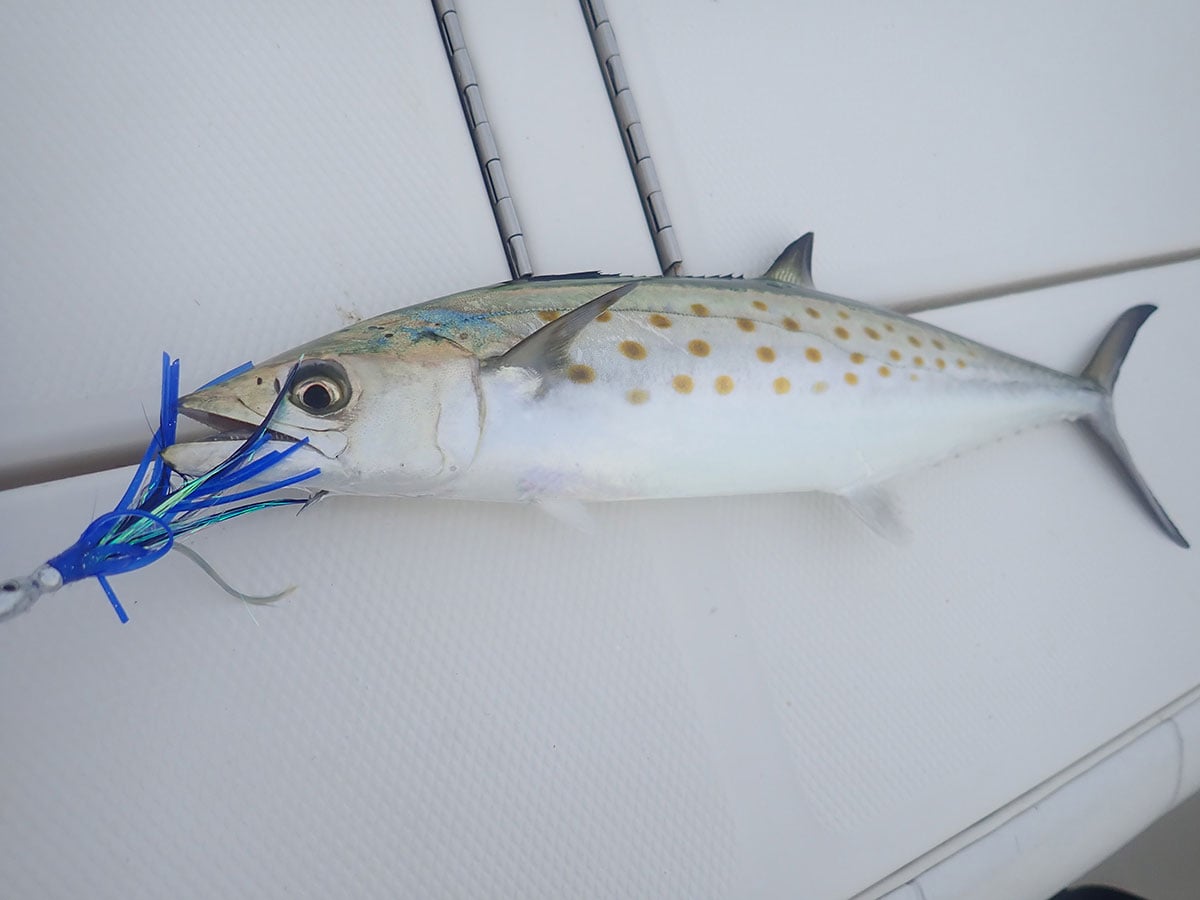
| MACKS ON THE ROAD |
| Spanish and king mackerel are surging further north with each passing year and catches have been on the rise throughout the waters of the Northeast Coast. While this article focuses on the New Jersey bite, anglers fishing New York and southern New England waters will get their shots at these exotics from August through the end of September. Here are a few starting points for anglers who don’t reside along the Garden State Parkway.
New York: While Long Island’s shores typically don’t see king mackerel, Spanish mackerel become a common sight once they move into the area during August and September. In recent years, the best action has been inside the South Shore inlets, from Jones Inlet east through Fire Island, Moriches Inlet, and Shinnecock Inlet. Connecticut: Connecticut usually sees an influx of Spanish macks in September that fills in from east to west. Some of the historic hot zones have been; Avery Point, the Millstone Power Plant, Six Mile Reef, Middle Ground and the Norwalk Islands. Kings are an extreme rarity inside Long Island Sound. Rhode Island: In the Ocean State, Spanish mackerel are a regular visitor and while they are found in many locations, the ones that come up over and over again are the same spots that are famous for false albacore; places like all three Breachways, the West Wall, Brenton Reef and Sakonnet Point are all likely spots to connect with these fish. King macks are rare, but there have been occasional catches across the state. Massachusetts: A few years ago there were several king mackerel caught in and around the west end of the Cape Cod Canal and there have been a few others reported in the Woods Hole area, but these are the exception, not the rule. The best spots in all of New England for large Spanish mackerel seem to be centered around a bit of a “Bermuda Triangle” marked by Nobska Point, Middle Ground and Tarpaulin Cove, but they are regular visitors to both Nantucket and Martha’s Vineyard, and they often venture into Buzzards Bay as well. |