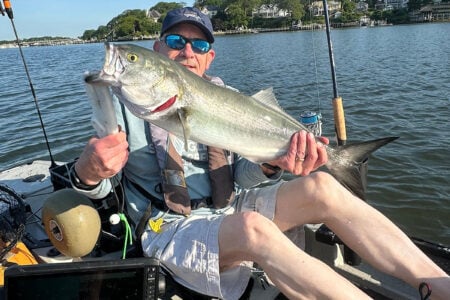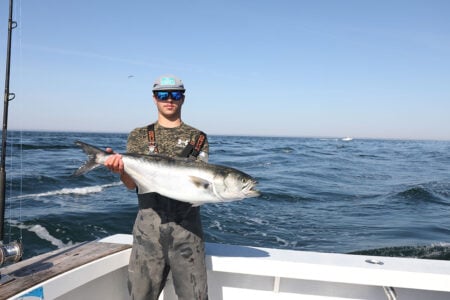
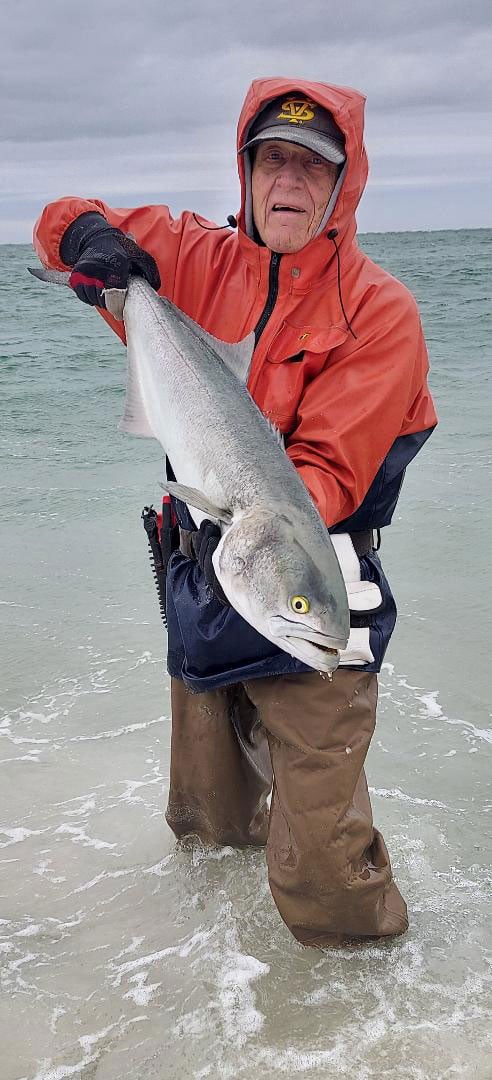
Springtime is the best time to catch surf bluefish!
I haven’t caught a bluefish over 10 pounds in the fall surf since 2012. Have you? In fact, I haven’t caught a bluefish of any size during the fall run since 2012. Although I have managed a few nice blues during the summer months on the north shore, the key phrase is “a few.” The connection I have to the great past decades of monster blues is spring fishing for the toothy critters.
What They Do In April
Spring success is keyed to spawning behavior. In April after the spawn, blues are ravenous and offshore adult baits have moved towards the inlets as they prepare to spawn in the bays with blues on their tails. Although we rarely see adult mullet in our waters, some do move into the bays to spawn in spring, as do adult bunker. Sand eels are also moving shallow to feed on blooming plankton, and squid follow the sand eels. In reality, blues have no choice but to head towards the beaches and inlets to feed.
In recent years, winter-over stripers have joined the spring feeding and added spark to the bluefish run. Since we know that Chesapeake stripers don’t arrive in our waters until mid to late May, we know these early bass are mostly Hudson stock fish that spend the winter in deep holes in the bays or the near ocean, and move on the shallow bait just like the blues do. The addition of stripers and the reduction in the number of blues, has caused anglers to find presentations that serve both masters.
Sweet Spots
Every angler has their favorite spot and tends to fish that location hard, but the truth is the fish and bait are widespread. For example, there’s a queue of anglers every spring from the Jones Beach Coast Guard Station to the inlet jetty casting lures and bait into that stretch of the inlet. Diesel Beach just inside Fire Island is also a perennial favorite, as is Democrat Point. The ocean beaches near the inlets, such as the “pocket” on the east side of the Jones Beach jetty, or Great Gun out east are well-worked by anglers, too. However, there are also fish caught miles to the east and west of the inlets in the ocean when blues chase bait in the surf.
My own experiences mirror the widespread action. When I lived in Nassau County I fished the Lido/Long Beach area with success. When I moved to the south shore in Western Suffolk County, I caught spring blues under the Robert Moses Bridge at Captree, the inlet mouth, as well as the Robert Moses ocean front. Then when I moved east and north, I worked the Smith Point area and caught lots of medium and large blues.
Soft Plastic Lures
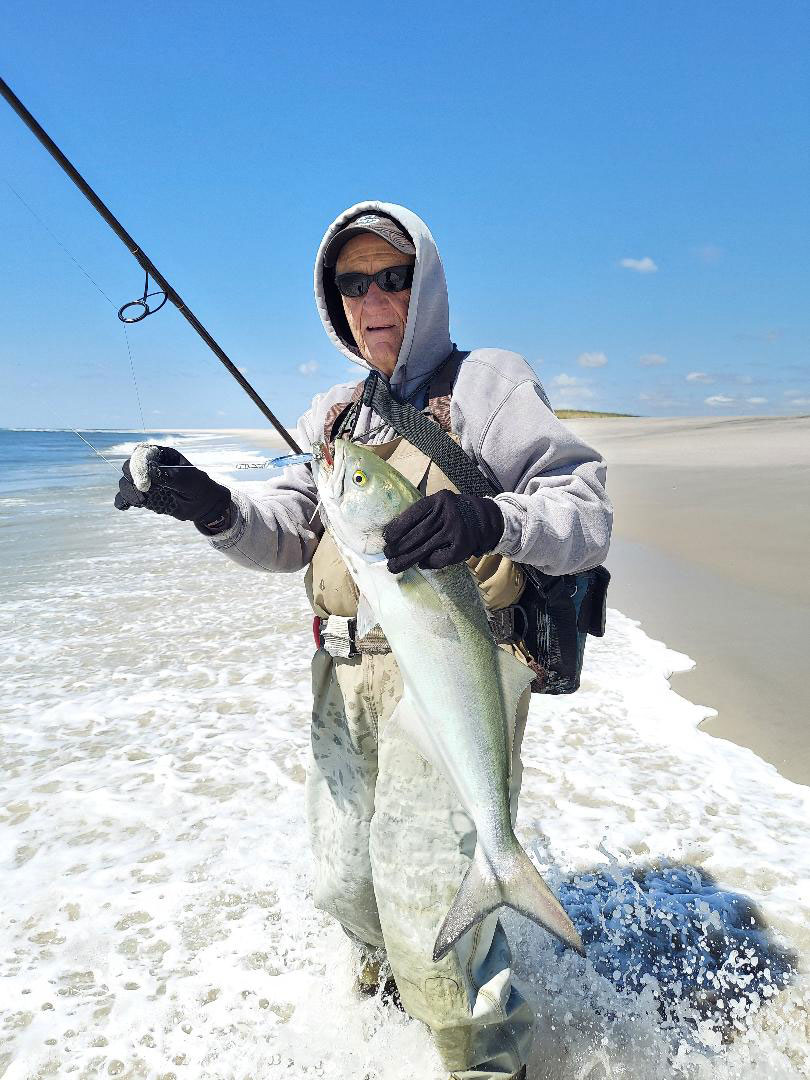
Where once we relied on big bucktails, large tins, and big poppers and pencil poppers during the spring run, the presence of bass has caused us to add soft plastics and swimming plugs to our surf bags. Soft plastics include a variety of Swim Shads such as those from Storm and Tsunami, but I’ve become a big fan of four and 5-inch Z-Man DieZel Minnows. The swim shads work great, but blues easily wreck them and the internal weight system means once the lure is destroyed it’s useless. The Z-Man plastic is made with Elastin. The plastic is very durable and flexible, and although bluefish teeth do penetrate the plastic, they rarely are able to bite off the tail. I’ve caught many big blues on a single DieZel Minnow.
In addition, when one of these lures is destroyed, I can slip it off and replace it on the leadhead. I prefer VMC Boxer heads in 3/4 and 1-ounce weights. The heads are very stable in waves and currents and have a very durable paint finish. Although I prefer pearl for both the minnow and the lead head, chartreuse has also been very effective.
Hard Plastic Lures
It’s been interesting that hard plastic lures such as SP Minnows and Yo-Zuri Hydro Minnows have recently produced during the day, because they are normally used at night. I have studied angler choices and noticed no preference for one model over the other, and lure choices becomes more personal than necessary. The same seems to be true about color. Although I’ve done best with the bone color, other folks swear by some version of chrome, but a few anglers won’t use anything but yellow with orange highlights. Poppers and pencil poppers are also still in vogue. I’ve found it difficult to figure out why feeding preferences change so often, but it explains why surf rats carry a variety of lures. The obvious conclusion would be that bait composition changes from day to day.
I offer these examples. If one day sand eels dominate, tins and tubes, small bucktails, and small then minnow-style soft plastics catch more fish. Then, if bunker dominate the next day, poppers, pencil poppers, and large hard plastic lures become better choices.
Matching Bait
It’s become important to figure out when to switch lures, but it isn’t easy because we rarely see what bait they are feeding on. A few years ago, I was catching fish consistently at a spot and the bait consisted of a mix of bunker, some sand eels, and squid. A variety of lures seemed to catch blues equally well. Then one day, the bait composition changed to sand eels and schools of needlefish, while the bunker left the area. Once we realized that needlefish dominated, we switched to long thin tins, needlefish, and soft plastics, and the bite kicked in big time. Of course, the next day needlefish were gone and squid and sand eels dominated causing us to switch to white bucktails with red and white pork rinds.
Recalling the old days and then taking a good look into my surf bag, I realize how important it has become to carry a diverse group of lures in my bag, although I don’t cram the bag. That way, I’m in a position to easily switch lure styles as the bait changes from day to day and even tide to tide.
If I stayed with lure styles from years past, and my bag remained one-dimensional, I’d be at a significant disadvantage in today’s reality. As I indicated, I don’t stuff my surf bag. An over-filled bag means that when an angler tries to get a lure out, they lift a Christmas tree of tangled lures with hooks.
Instead of a tackle store of variety, some anglers settle on a belief that only one lure style is best and they fill bag tubes with every size and color combination of that lure. Yes, success improves when an angler has confidence in a particular lure, probably because the angler uses it longer and more carefully, but a stubborn reluctance to experiment can limit success.
Bet On Basics
Here’s what I’ve settled on and perhaps it will make sense to you. Keep in mind, that the spring bite is typically a day bite, so success is much more likely during daylight or twilight. I outfit my bag with a limited number of lures for easy access, stick to basic colors, and have a variety of styles that will cover all bait compositions.
My habit is to begin fishing with bucktails because I can use them with many presentations, swim them in all levels of the water column, and imitate almost anything. Yes, sometimes fish become locked onto certain shapes and sizes, but more often than not, bucktails are good choices and a great place to start. From that point I analyze conditions and if fish are present, I “listen” to what they have to say. Yes, fish can tell us a lot about what they’re doing as well as the mood they’re in, but it requires us to pay attention.
Making Adjustments
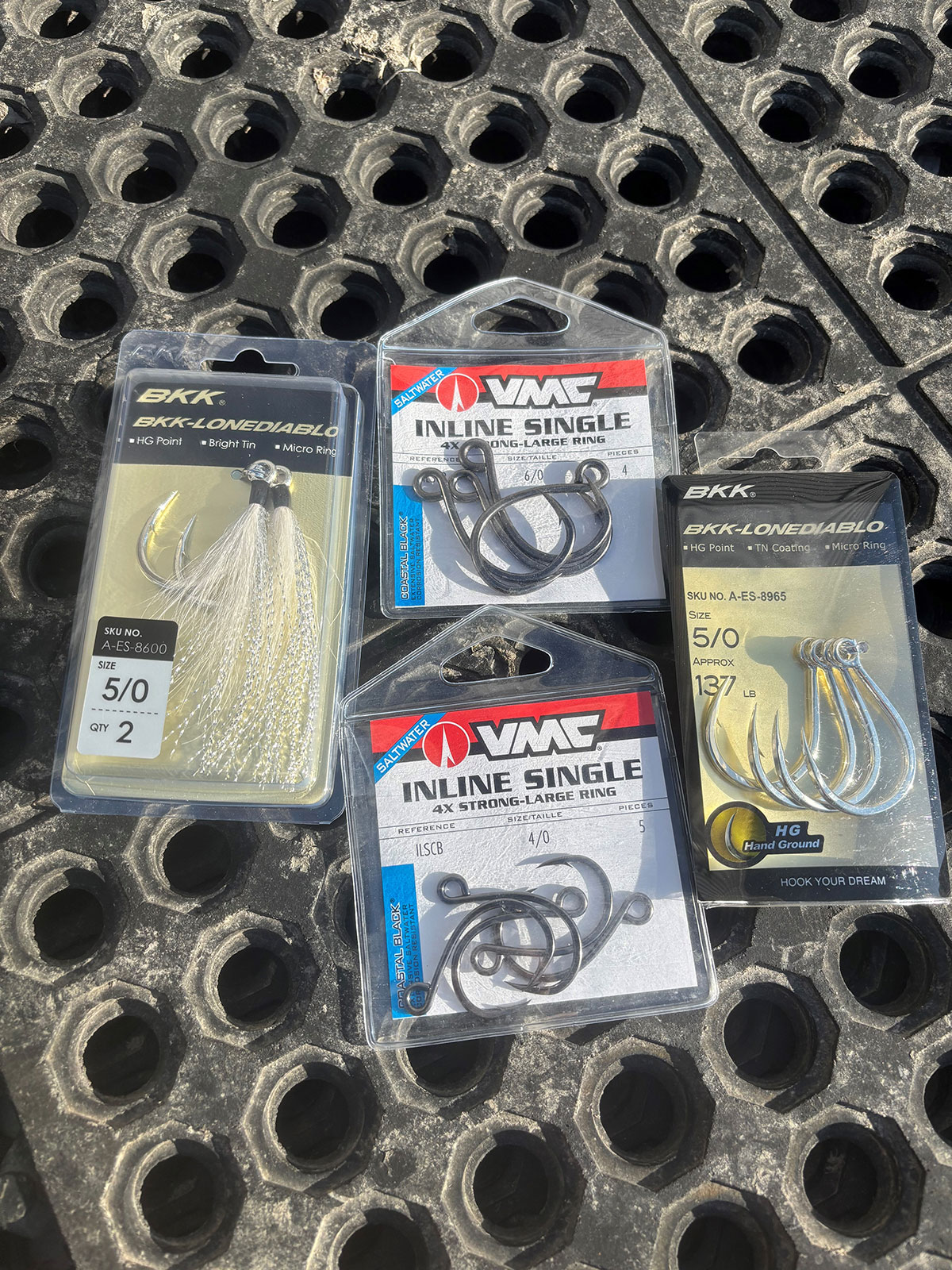
| SWITCHING TO SINGLE HOOKS FOR BLUEFISH |
| When bluefish are crashing the surf, trebles can quickly become a liability. Between violent strikes and constant thrashing in the wash, multiple hook points make handling fish dangerous and often lead to pulled hooks. Switching to inline single hooks keeps things simple and safer. They’re easier to remove, reduce the chance of getting stuck, and typically pin fish clean in the corner of the jaw. With less hardware for the fish to throw, you’ll often land more of the ones you hook. They also hold up better. Bluefish will wreck trebles, but a strong single hook takes the abuse and keeps your plug fishing right.
|
Example: what to do when we get lots of hits but don’t hookup? What would you do? Change your lure or not and why? Change your presentation or not? Change your color or not? Well, the first thing it means to me is that I’m “close.” By that I mean my lure shape and size approximates the bait, but something is a little off. But what? My choice is to first change my presentation. That might include the speed of my retrieve, switching from a straight retrieve to an irregular one, or changing the angle of my cast because predators don’t like bait moving toward them, and a change in cast angle might present the lure as swimming away.
If I haven’t figured out what type and size of bait is present, and if changes in presentation were ineffective, I’d switch to a different style lure. Without surface activity I’d switch to a different subsurface lure; perhaps a tin, but not a popper or shallow swimmer. However, if I see any surface action, however, subtle, I’d switch to a pencil popper first followed by a popper if the pencil didn’t work. I believe you understand my approach. It is a methodical process. I don’t change lures after one or two casts, instead I work through a series of presentations until I find a combination that changes “bumps” into solid hits.
In some ways I like this new deal spring fishing better than a few decades ago when I would exhaust myself on huge blues. It was too easy. Lots of surf rats would fish for a few days and then disappear claiming they were “bluefished-out.” Me, on the other hand, I never get tired of catching big blues. In today’s scene, there are stripers mixed in, and although most bass are small, here and there really big ones show up. But remember, surf fishing is a shoreline activity, and we don’t have a boat to catch up with a school of fish. We are, and always have been, at the mercy of fish mobility, so take advantage of whatever Nature provides.