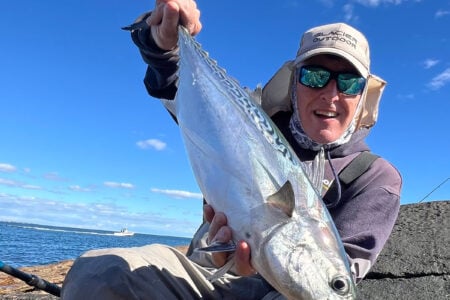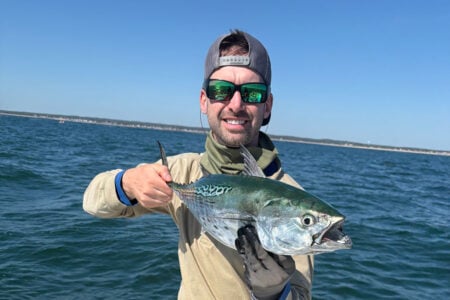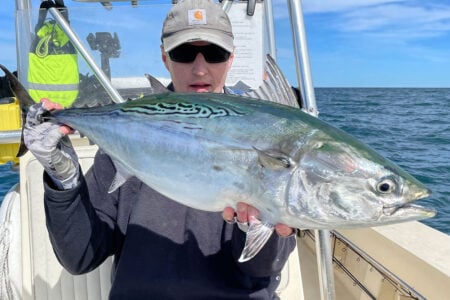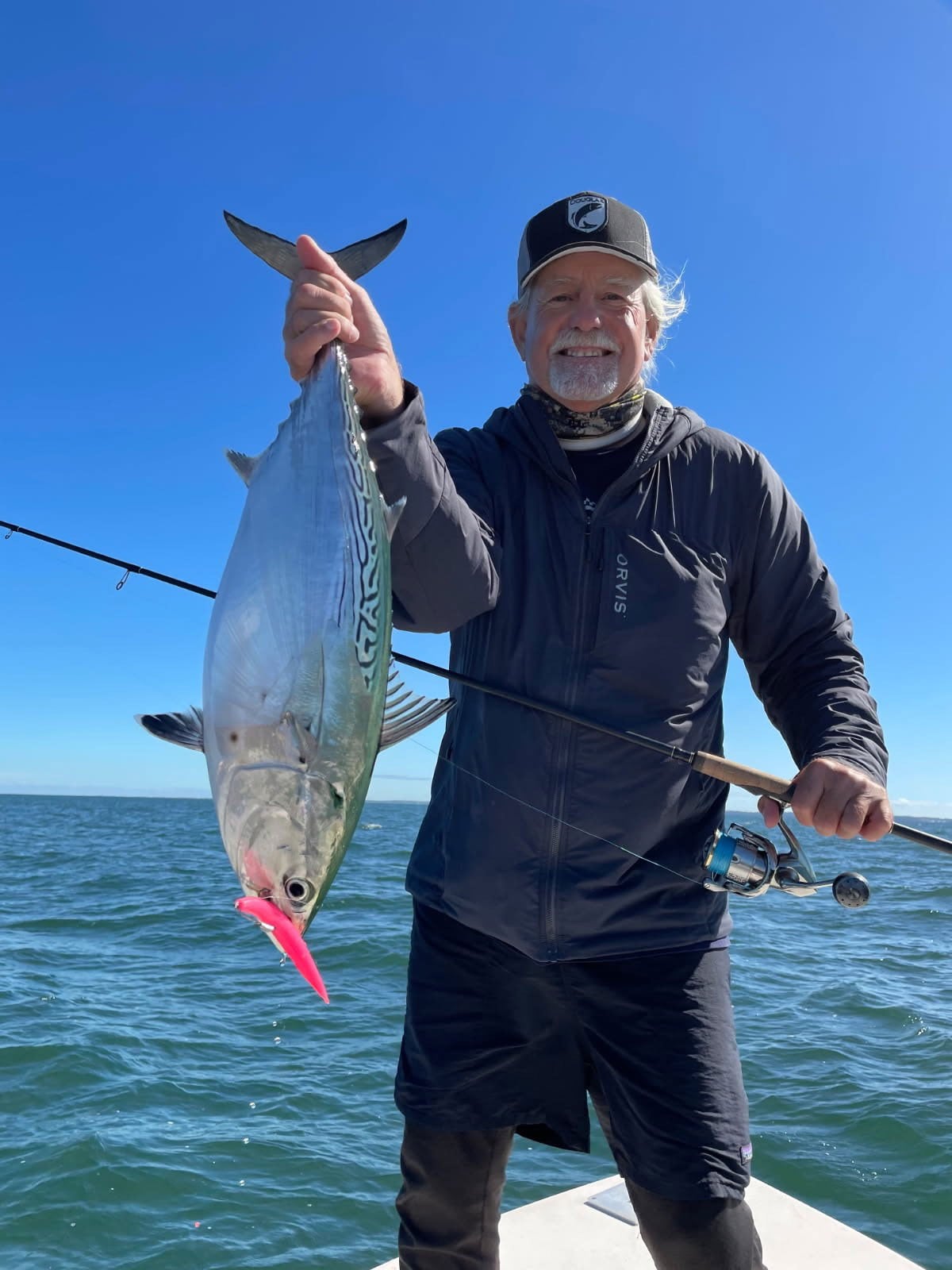
It’s false albacore time—that time of crazed anglers, fast, mysterious fish and long, exciting, reel-screaming runs.
Techniques and knowledge for catching these fish have been narrowed down over the years to the point where, if you stay within a practical range of tackle, lures and flies, while understanding technique, productive areas and albacore behavior, you can consistently catch them.
Today, I’m going to narrow all of this down even further, streamlining it to simplicity. I’ll take it to the bare minimum so you have easy, concise instruction for catching this “wonder” species.
Finding Albacore
Tunny have been found in fewer and fewer places in recent years, to the point where a big, concentrated body of fish may only be available in one place in the entire Northeast during any given year. Last year it was Montauk; the year before, Hyannis, Massachusetts. Who knows where that magic spot will be this season? Places to look include the New York Bight up to Jones Inlet, the far eastern North Shore of Long Island to Plum Gut, around Mt. Sinai in Long Island Sound, Newport, Rhode Island, Hyannis and Buzzards Bay in Massachusetts, the far eastern Connecticut shoreline and, of course, Montauk Point, New York. Even though only one of these places may end up being this year’s “Shangri-La,” at some point some albacore should be available at most, if not all, of these spots for at least part of the September-October season. Be vigilant.
Spotting Them
If albacore are present where you’re fishing, you’ll often see schools rolling and exploding, sometimes with bait flying through the air. They will also hold unseen, or with only subtle indications of their presence, in certain rips.
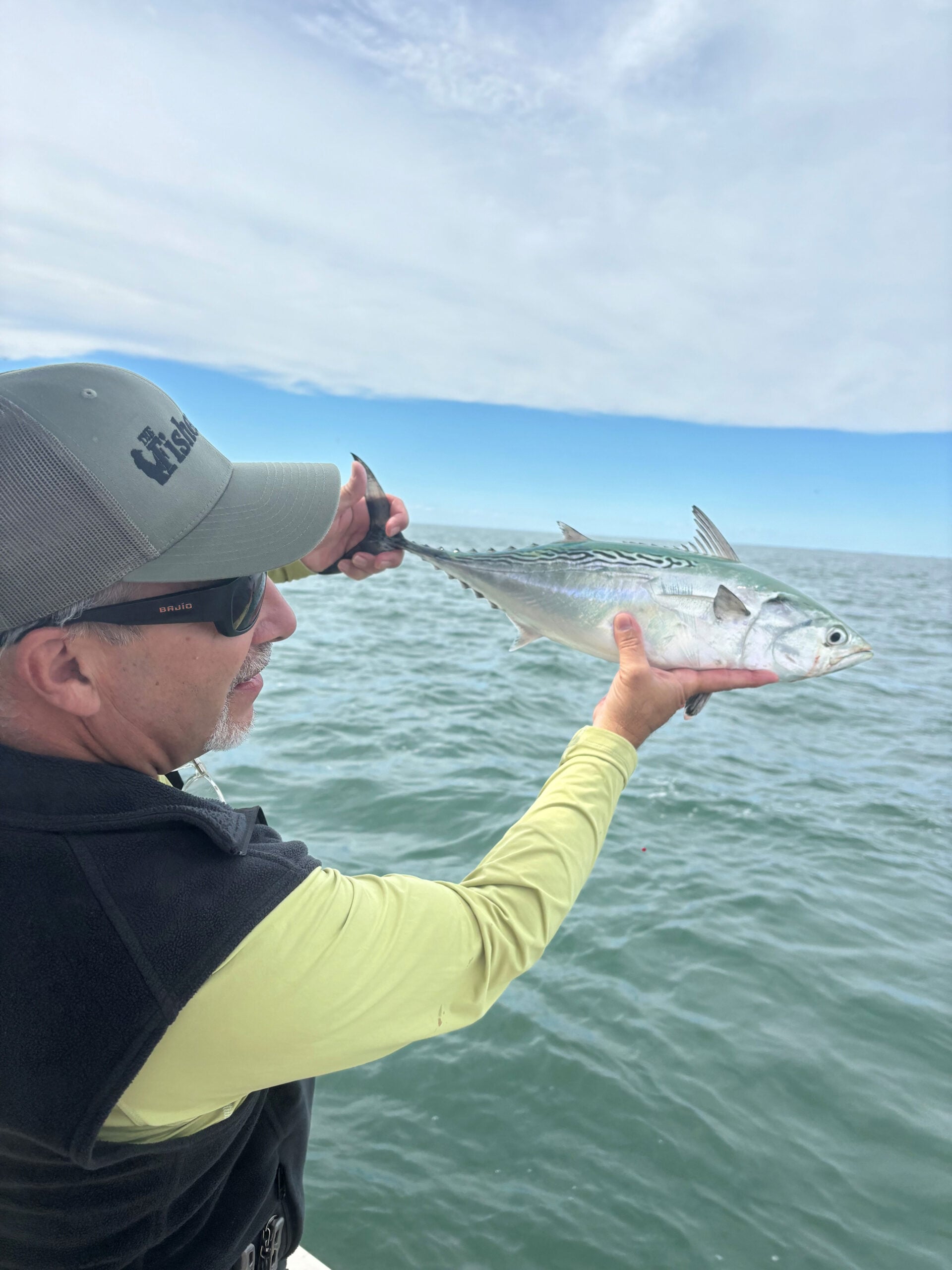
When present, feeding can occur in the morning, throughout the day or during the evening. Sometimes they’ll feed during one of those periods, sometimes two and occasionally all three. At times, they’ll only feed on one tide—say, the outgoing—but other times they’ll feed on both. Sometimes they’ll only feed on a specific tide or stage of tide when located in a particular place. For example, it’s known by locals that the south side of Montauk is usually an incoming-tide spot, while the north side is generally best on the outgoing. Find out the “happening” time of day and tide for the spot you’re fishing during the current year. It can change from year to year.
The Lures
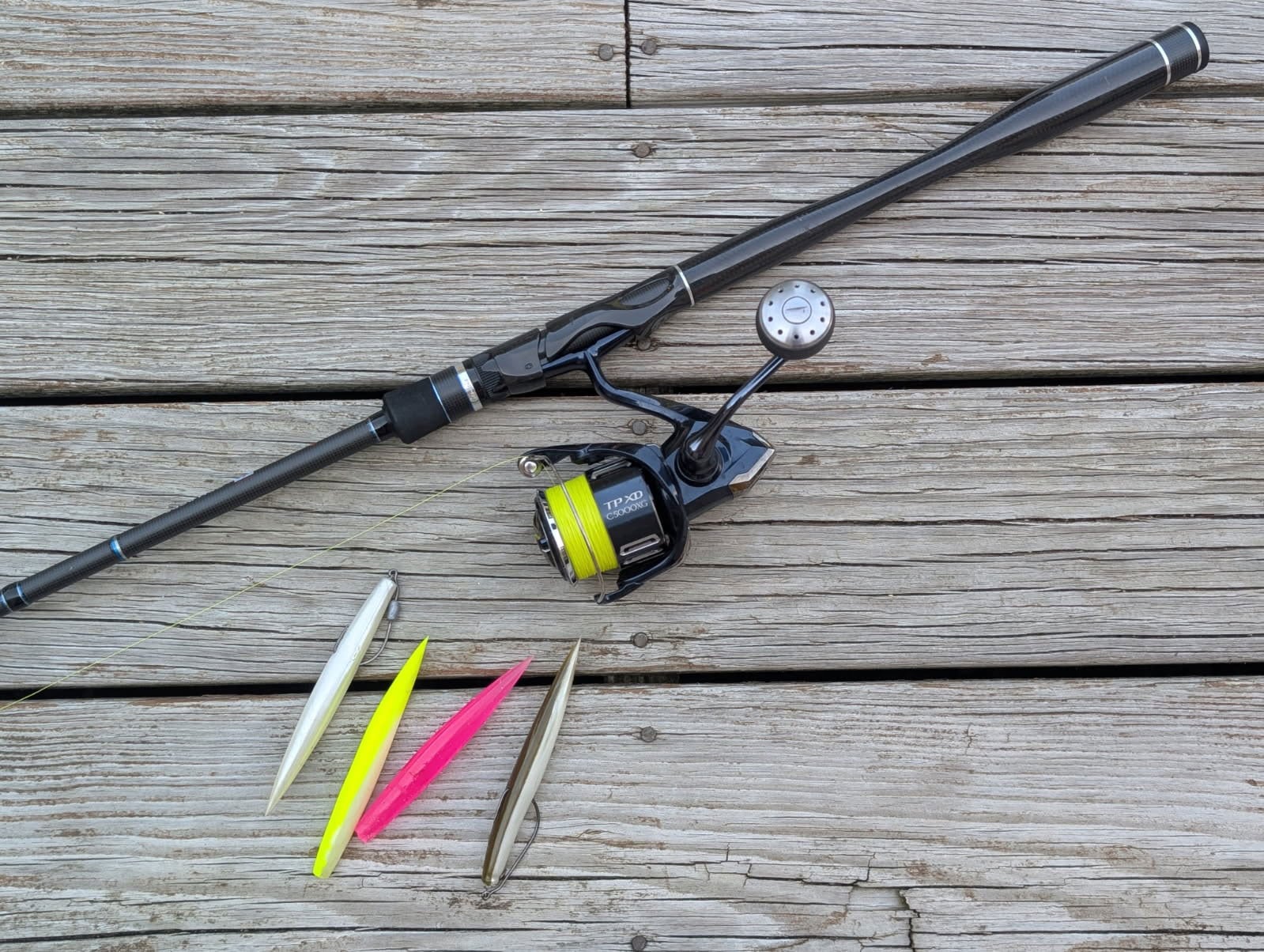
This can be kept pretty simple. In my 35 years of false albacore fishing, one of the most effective lures I’ve found for this species is the 5-inch Albie Snax from Fish Snax Lures. Use white, or pearl, and you’ll be right. Often, it will be all you’ll need. Other effective colors are Hot Pink, Sand Eel (olive/white) and White/Hot Yellow. The lure drives albies wild! I use an Owner 4/0 TwistLOCK hook with my lure, although other hooks can be effective, too.
While the Albie Snax is a favorite, it’s also worth carrying a few hard baits to cover different situations. JoeBaggs Resin Jigs and Hogy Epoxy Jigs are both excellent choices for false albacore, particularly when the fish are keyed in on smaller bait. Their compact profiles cast extremely well, which is important when albies are feeding just beyond normal casting range or moving quickly from one school of bait to another. A selection of small tins should also have a place in your bag. These provide another simple, long-casting option when the fish are feeding on small bait or when wind makes casting lighter offerings difficult.
There’s no reason to overload your bag with dozens of different choices. A handful of Albie Snax, several JoeBaggs Resin Jigs and Hogy Epoxy Jigs, along with a few small tins, will cover most situations you’re likely to encounter during the fall albie run.
How To Fish It
The retrieve I use most creates a steady commotion on the surface while, at the same time, making the lure perform a slight side-to-side motion as it goes. You can’t get this combination by retrieving too fast or too slowly. The proper speed is somewhere in between, but still fast. You’ll want to get your speed and constant, short rod-tip jerks “just right.” When you do, explosions will start happening like it’s the Fourth of July! It’s not a retrieve that’s difficult to achieve, and you’ll get it with a little practice. You’ll see what I mean.
If they’re not hitting the “mass commotion” retrieve, slow things down a little. Using short rod-tip jerks, get that soft plastic to seductively dart from side to side, back and forth, just under the surface. This, too, might take just a little practice. Be persistent. You’ll learn quickly. One lure, two retrieves. Isn’t that easy?
Where To Throw
Cast that lure right into an albie commotion where they’re slashing, sizzling, greyhounding and exploding through a school of bait, which is often jumping and spraying in the chaos. If individual albies are moving through the school in different and multiple directions, your chances for a hookup go way up! An alternative is to cast beyond the other side of the school and retrieve the lure directly through it.
If the albie school is moving straight in one direction—which has been common albie behavior during the past few seasons—you’re going to need a “head-on” shot. That means you’ll have to get, or already be, ahead of the fish so they are swimming directly toward you. You’ll then need to cast right in the direction of their noses and retrieve the lure toward you, with it essentially moving directly away from the direction the fish are swimming. They’re often moving very fast when behaving like this, so your retrieve is going to have to accommodate their speed. In other words, you’ll be moving that lure fast.
Spinning Tackle
You’ll usually be using spinning gear with rods from 6-1/2 to 8-1/2 feet long. A friend of mine, Alex Peru, uses an 8-1/2-foot Daiwa “Light Surf” fast-action rod very effectively for albies from shore or boat. Choose a rod with a fast or extra-fast action in medium-light, medium or medium-heavy power.
For reels, choose a 2500-, 3000-, 4000- or 5000-size spinning reel and spool it with braid from 10- to 20-pound breaking strength. You will be able to fit enough braid in this range on any 2500- to 5000-size spinning reel to handle any albie in the Northeast without running out of line during any “desired” long run. Finish the setup with a 3- to 6-foot leader of 20- to 40-pound mono or fluorocarbon.
To simplify things even further, use a 7-foot, fast-action, medium-power spinning rod paired with a 4000-size spinning reel, 20-pound braid and a 4-foot leader of 20-pound fluorocarbon. That combination gives you the casting ability, line capacity and power needed to handle Northeast false albacore while keeping the tackle light enough to enjoy those famous reel-screaming runs.
Streamlining The Fly Gear
For fly rodding, use a 9-foot fly rod designed for a No. 9 or No. 10 fly line. Good brands include Atlas, Hardy, Orvis, TFO and Winston. Match it with a fly reel recommended for that rod and capable of holding at least 150 yards of backing. Hardy, Nautilus, Tibor, Siegler, Orvis and Lamson are all good makes.
Use an intermediate sinking or floating fly line that properly matches the rod. Scientific Anglers, RIO and Cortland all make excellent lines. If using an intermediate fly line, also purchase a shooting or stripping basket to hold your line, especially when fishing from shore. Some anglers prefer using a basket when fishing any type of fly line.
Finish the setup with an 8- or 9-foot leader that tapers to a 15- or 20-pound tippet. An 8-foot leader tangles significantly less than a 9-footer. For flies, use a Surf Candy or epoxy fly, a small Clouser, a small 3- to 4-inch Deceiver or a small Flatwing.
Again, if you want to eliminate the options and streamline the fly setup to the bare essentials, go with a 9-foot No. 9 rod, a reel capable of holding at least 150 yards of 20- or 30-pound backing, a No. 9 intermediate sinking line and a 9-foot leader terminating in a 15-pound tippet. Add a Surf Candy to the end and you have a simple, proven albie outfit.
Keep It Simple
False albacore fishing can appear complicated. The fish move incredibly fast, their feeding behavior can change by the hour, and anglers often carry boxes filled with different lures and flies in an attempt to prepare for every possible situation. It doesn’t have to be that way.
Find the fish, determine the productive tide and time, put the lure where the albies are going rather than where they were, and concentrate on a couple of proven retrieves. Match that with a simple, properly balanced outfit and you’ve eliminated many of the variables that can make albie fishing seem more difficult than it really is.
One lure, two retrieves and a streamlined tackle setup. Now go find them!