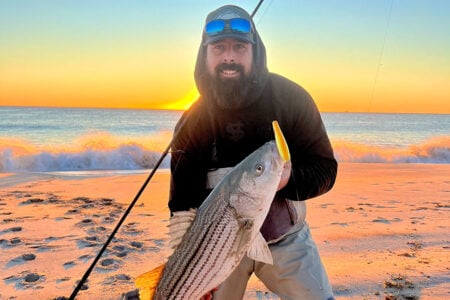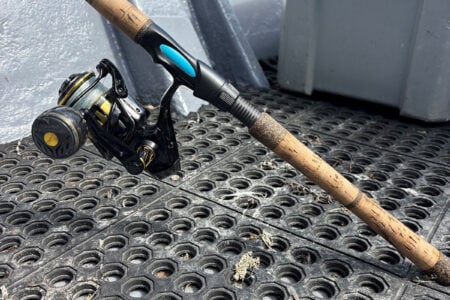

Making the transitional “hook-up” from freshwater fly fishing to salt.
I love putting freshwater fly anglers on their first saltwater fish on the fly. To me – and hopefully to them – the thrill of feeling and catching much bigger fish is the fun and addicting part. When a fish is tight to the fly, pulses of energy shoot through the rod right into your hand. I like to say it feels like you have the captured fish by the tail.
With one trip on my boat clients quickly learn how much easier saltwater fly fishing is when compared to freshwater fly fishing. Out in the salt there are no trees to contend with on a backcast, no snags or obstructions to deal with, and no swift currents that could sweep you off your feet. Rather, the ocean is just a wide open space into which they can cast.
I can usually teach clients how to cast a 9- or 10-weight fly rod well enough in 20 minutes or so that they can cast out 20 or 30 feet of line. This is more than enough to hook up as I can bring them to the fish putting them right in the center of the action. It doesn’t take long for them to get tight to the fly especially when our fall blitzes are occurring.

From Fresh To Salt
While there are various technical aspects to saltwater fly fishing, one of the biggest mistakes I see freshwater fly anglers make is setting the hook on the strike. A trout strike like one that would be used in a stream is what usually happens where they quickly lift the rod straight up to the sky while holding and pulling the line. This type of strike may be the norm for a trout stream as one needs to clear the line up and above any boulders or rocks but in the salt, it is usually the kiss of death resulting in a lost fish. The reason is quite simple and quickly understood by clients when I explain it to them.

Once the rod tip is lifted straight up into the air the fly angler now must lower it. When the rod tip comes down it immediately puts slack in the line. The fish’s main goal in life – once hooked – is to set itself free. It does this by vigorously shaking its head. With slack in the line this is easy for the fish to do, especially if it is a striped bass. This is because when the hook set is made straight up this drives the hook up into its bony palate of the bass. This is not a good place for the hook to be. Even with sharp hooks penetration does not occur as the hook is trying to go into bone and not flesh.
The correct strike and hook set, called a strip strike, which as I’ll explain, will drive the hook into the fleshy corner of the bass’ mouth causing it to penetrate through it giving you a solid connection to the fish.

How to “Strip Strike”
The strip strike begins by having your rod in the correct position when you are stripping your fly in. Your rod should be held out in front of you at a slight angle to your body with the tip pointed down towards the water and pointed at your fly. With every strip you should anticipate that you are going to get a strike as the strip strike should occur instantly when the strike occurs. Your reel and your hand stripping the line should be waist high. When you feel the strike set the hook by pulling the line with your line hand 12 to 14 inches away from the reel in a direction going below your waist and off to the side. Simultaneously pull the rod back to the side with your rod hand keeping your rod at an angle slightly above parallel to the water. Strike hard with the rod in this position.
This side strike will drive the hook into the fleshy corner of the bass’ mouth. While holding the line you can now repeat the strip strike again by bringing your rod hand and line hand together and strike again in the same manner described above. From this point on the strike part is over and clearing any line you have out begins. Do this by letting the line slide through your fingers to get what I call the fish on the reel. This is the best thing to do so you are now fighting the fish with the rod and the reel drag.
Saltwater fly fishing stripping methods can vary from one-handed to two-handed retrieves. Many fly anglers get into the habit of utilizing only one of these methods as they get comfortable with their retrieve and have had success catching fish. However both methods should be part of your arsenal. A two-handed strip for instance will allow one to continuously move the fly, which is an important characteristic when it comes to how several baits swim through the water. It also always gives you complete control of the fly as one of your hands is always in contact with the line.

Two-Handed Hookset
The strip strike for a two-handed retrieve, however, is much more difficult for the beginner as the rod must be placed back into the hand from under your armpit after a strike is made. Many beginners get a lot of slack in their line or lose control of it when this maneuver is done which can cause the fish to be lost.
When you do a two-handed retrieve the rod is held under your armpit with the reel just behind your armpit and lightly up against it. The rod is pointed towards the water with the tip just below parallel. When a fish strikes, employ the strip strike by pulling on the line while allowing the rod to bend while it is still under your armpit. A quick maneuver then is required to get the rod in your hand. While holding the line in your hand that is on the opposite side of the reel lift your reel side elbow high and allow the rod to maneuver down into your hand as you grab the cork grip in front of the reel. Feed line to the fish through your fingers as you do this if necessary.
The whole transfer process should only take a long second or two. Once completed get the fish on the reel and fight it.
Over my 40 plus years of chartering I have always looked forward to having clients that want to use the fly rod for the first time. I always have it onboard and am willing to teach anyone that wants to try it. Trout anglers are some of my favorite fly people to teach because my roots are in freshwater fly fishing in the streams of the Pequest, Musky, and South Branch.
If you are thinking about it this fall is the perfect time to give it a try as our bait migrations and blitzes that take place will have fish right in front of you.