Join the Delaware Bay fleet, or use your own feet for a Clydesdale from the surf!
Black drum fishing has been booming in New Jersey during the spring months as the Garden State has been getting an invasion of the Clydesdales in the surfline and shallow backwaters from Barnegat Bay down through Delaware Bay in the past few years.
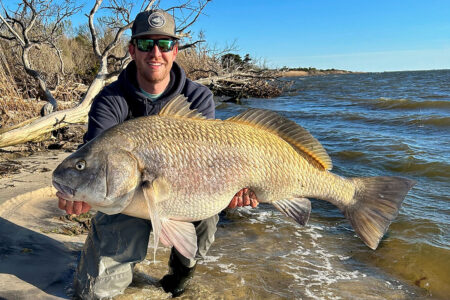
Historically, the Delaware Bay has held honors as the world class arena to target black drum as it lays as the world’s main breeding ground for the species. Boomers average 50 to 80 pounds and reach upwards of 80 to even 95 pounds or more inside the Delaware Bay, leading to a fleet of for-hire opportunities in ports from Cape May to Fortescue, across to Lewes, DE. In fact, as this month’s June edition of The Fisherman hits newsstands during the week of May 18th, we’re in the absolute “prime time” of Delaware Bay drumming.
That said, a myriad smaller bay systems along the coast such as in Great Bay, Barnegat Bay and Lakes Bay also attract minor populations to breed out. Best of all, if you don’t have a boat, don’t worry, there’s ample opportunity to have a big game battle from the surf with the boomers if you set it up right.
Black drum plan the main portion of their spawn around the full and new moons in April, May and June when the tides are super high to allow for better chances of cross pollination of the sperm and eggs. Plus, along the surf and backwaters, the deeper depths allow for the fish to come out of the channels and move up onto the flats on higher tides.
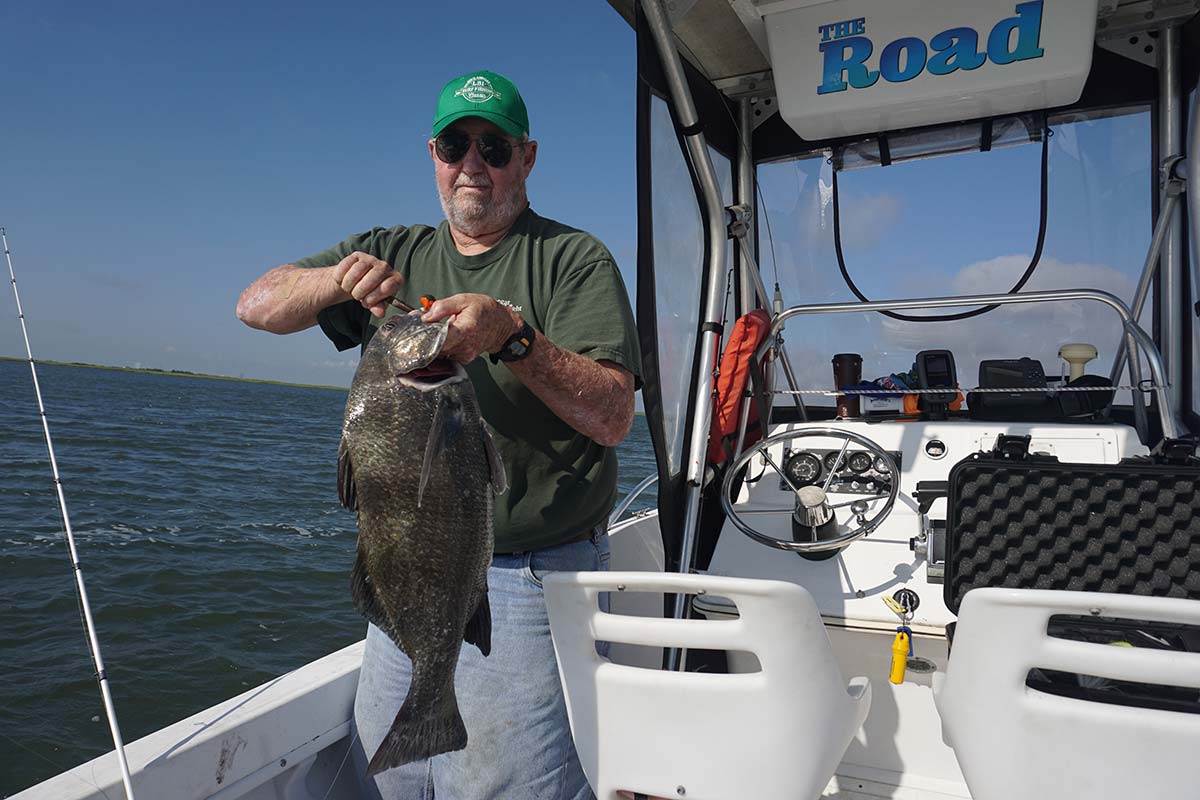
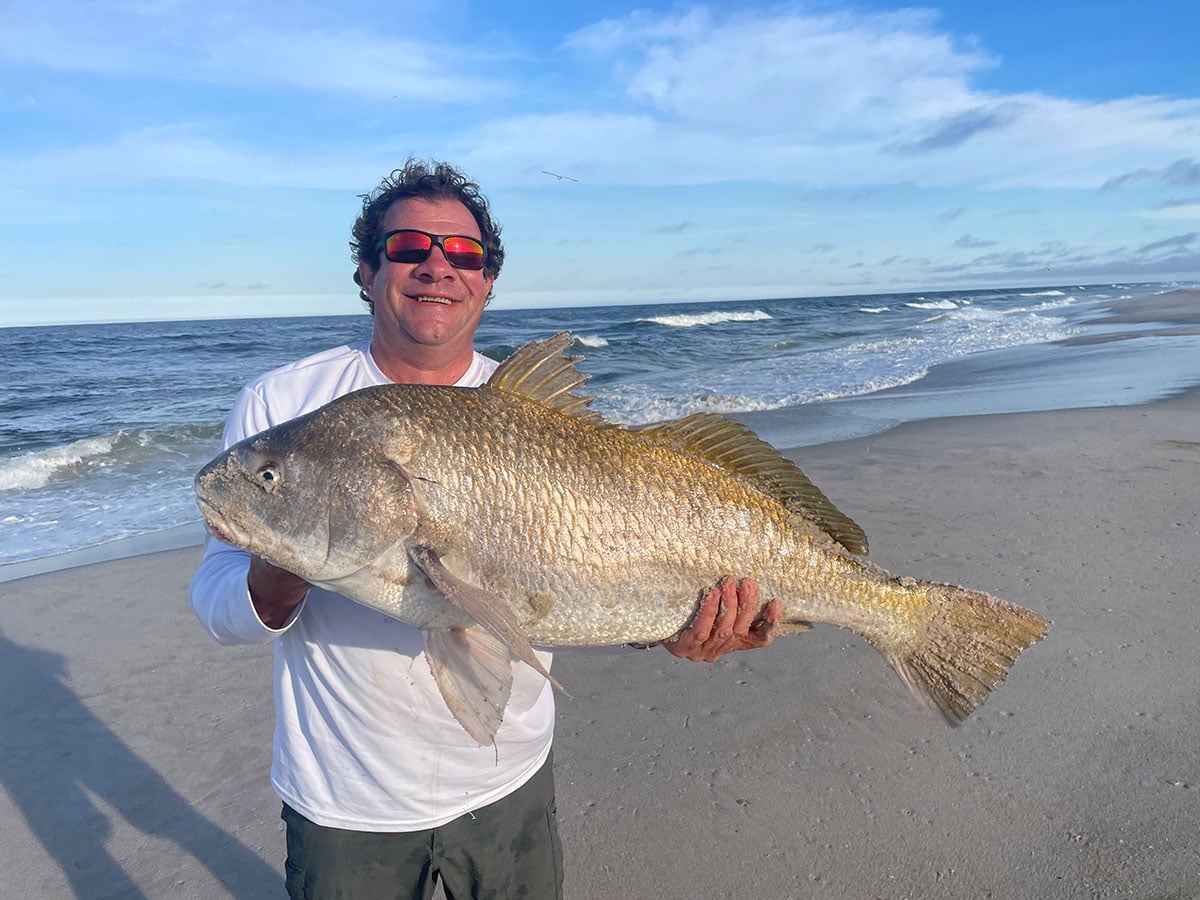
The full moon in April saw a most unusual presence of hundreds of drum entering the relatively shallow Barnegat Bay system which provided incredible big game back bay battles for boaters setting up on a clam chum slick as well as dock and pier anglers tangling with drum pushing the 50- to 60-pound mark. The surf line from the Island Beach State Park down through Long Beach Island, Brigantine, Sea Isle City, Strathmere and of course Delaware Bay at Reed’s Beach and Poverty Beach was absolutely flooded with roving packs of big black drum pushing anywhere from 30 to 75 pounds, offering up insane big game battles from the beach.
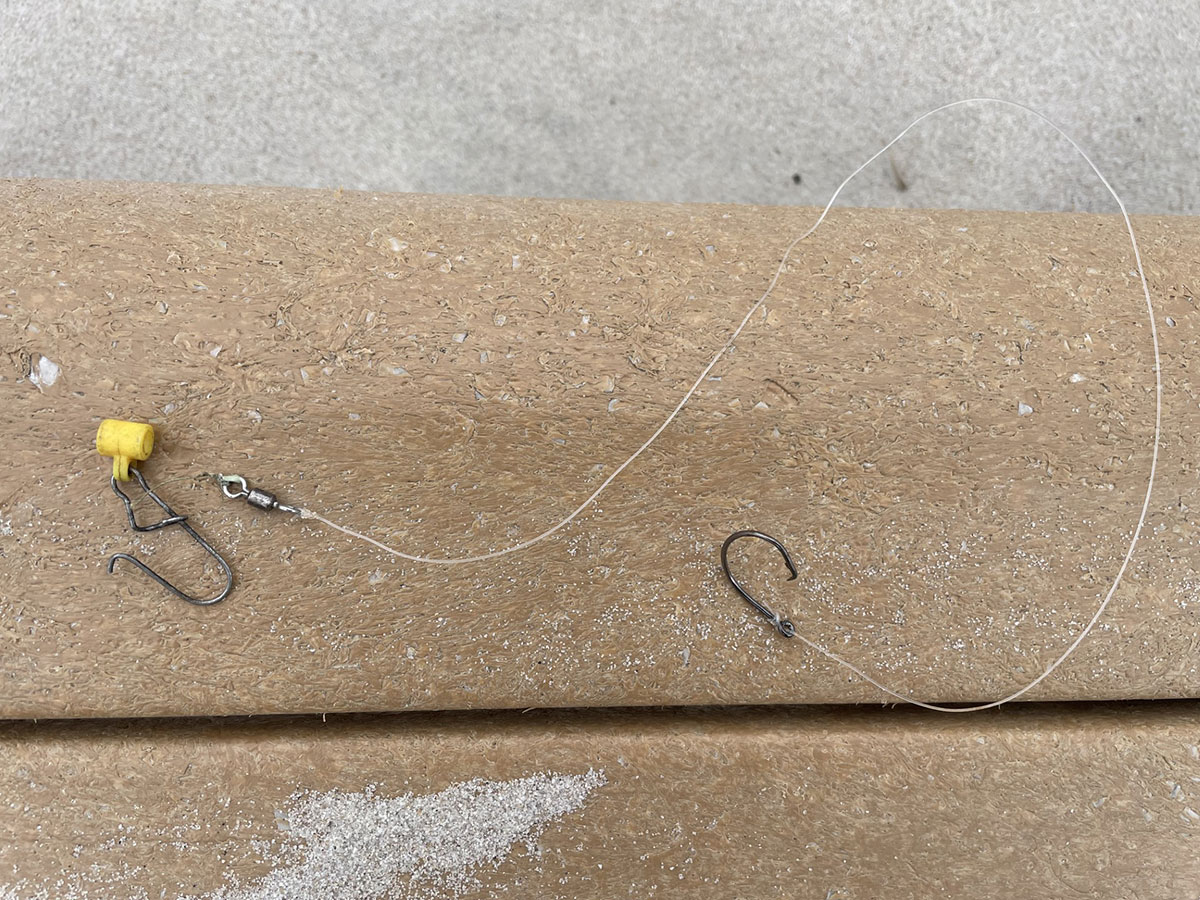
Bait & Tackle
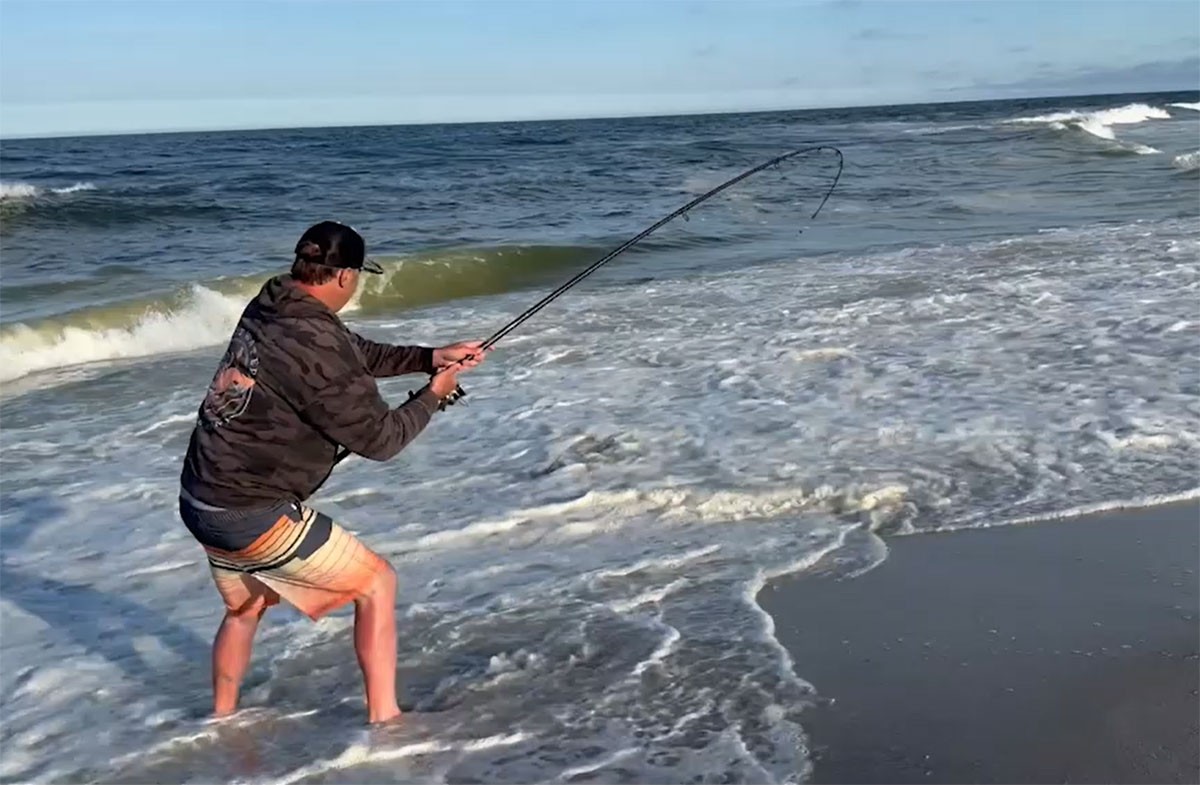
For surf fishing, prep heavy. Imagine fighting a full beer keg equipped with a 9.9-horsepower motor on the back end, that’s what it’s like battling drum from the surf or shoreline. Rods and reels must be ready to do serious battle lest you will never be able to handle the brutes. I employ a 12-foot Shimano Tiralejo or Daiwa Blackline 11-foot BLXT1102XHFS rod matched with a Shimano 14000 Ultegra or Daiwa Saltist MQ14000H reel spooled with 50 to 65-pound Power Pro braid, the tag end attached to a size #2 three way swivel, a sinker clip with a 3- to 5-ounce pyramid sinker; the last eye gets a 24-inch section of 60-pound Yo-Zuri fluorocarbon leader to which a size 10/0 Gamakatsu Big River or 10/0 Octopus circle hook is snelled on.
You are bait fishing with clams here, so a super sturdy metal sand spike driven deep into the sand is need to prevent your rod and reel set up from being stolen and going in the drink on a massive hit. Baits are simple. A whole fresh gob of shucked clam is pierced on the hook three or four times and the bait is cast out into a deep cut or slough where the drum are feeding on crushed clams and crabs.
The key to success is timing and tides. Your best bets are to fish surfside are around the high tides, generally two hours before and two hours after the dead high tide as the deep waters allow enough space for the big barrel chested warriors to enter close into the surf line. Light to moderate 5- to 15-knot easterly onshore winds are preferred as they push water and this the schools of feeding drum up onto the beaches, though you can also throw in some north or west into the wind direction and achieve similar success.
Main spots where drum feed are not only the holes, but the inside and outside of the sandbars as they peruse the grounds to suck down clams and crabs getting washed over the sandbar. When fishing on the bayside, high tide theory again works best, and try to find areas such as piers that extend further out into the bayside to reach deeper channel waters. Back cuts close to the sod banks behind Seaside Park and Island Beach State Park are solid options, as are areas like Graveling Point and the Great Bay and Little Egg Harbor sod banks.
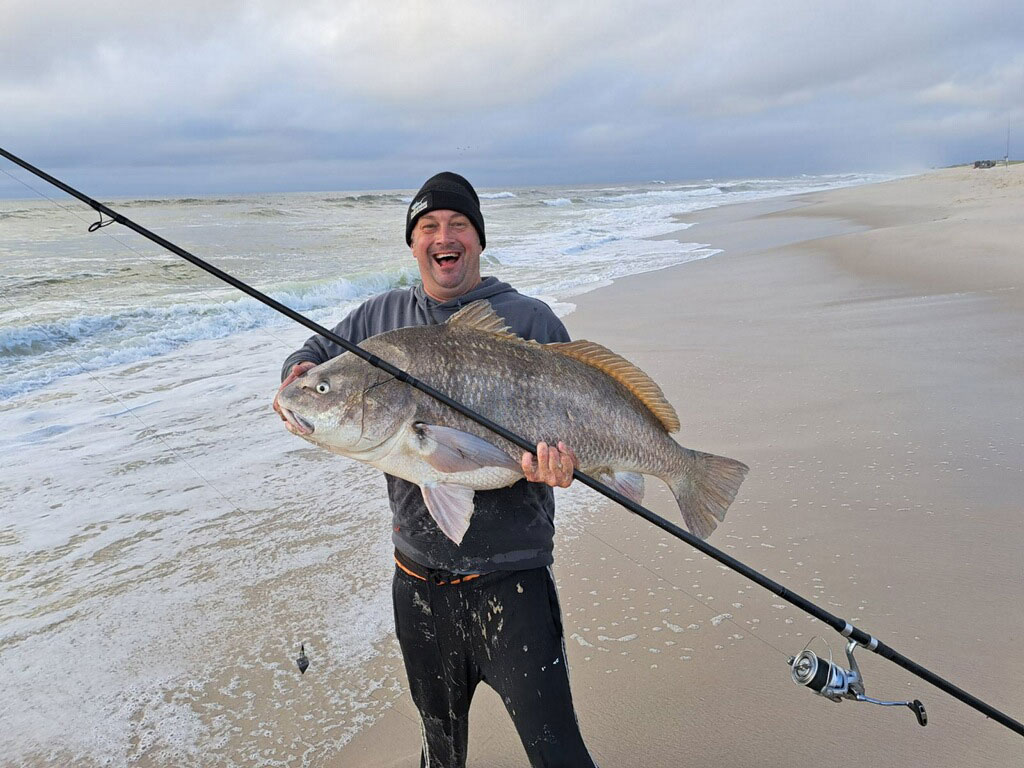
Battle On!
Once hooked into a big boomer, hold on tight. Let them dictate the terms of the fight as the initial run is long and sustained. Surprisingly, they put up quite a tussle as they use their big broomtails to power away from the shoreline and many times come up to the surface and boil up trying to shake the hook. The end game is critical as you plant a 65-pound beast into the undertow. Don’t freak out and pull on the line hard as the drum will use their weight on the receding waves to inevitably snap your line if you are not careful.
| THE “UNDERGROUND” |
| A longtime field editor at The Fisherman Magazine and weekly surf reporter (see his Beach Talk column in the Report Section), Nick Honachefsky is also host of the Saltwater Underground television show on Discovery Channel, Sportsman Channel and Waypoint TV. In the spring of 2024 Honachefsky got into the surf drum bite at Island Beach State Park with good friend Mickey “Deaner” Melchiondo on-camera, offering up some of the tips and tactics seen here en route to a rather epic drum bite in the wash. Check out the Saltwater Underground clip posted April 25, 2025 on Nick’s YouTube channel, www.youtube.com/@nickhonachefsky. |
Time the wave patterns and reel in when they get pushed up onto the sand with a crashing wave, then run down and grab the drum by the mouth or gill plate to land it effectively. My finest day clamming for black drum was in May of 2024 on Island Beach State Park when in one single morning from 6:30 a.m. to 8:30 a.m. I landed 11 black drum from 30 to 65 pounds and lost another half-dozen fish simply because I was alone and couldn’t handle two rods out at once. That kind of action is legit and tested not only my gear, but my willpower and strength with every booming fish trying to break my arms.
Black drum fishing from the surf is a serious big game battle to check off your list. Plan your last shot from the surf in June by focusing on the full and new moon tides.
Honestly, there’s no real reason to keep black drum. It can be a real adrenaline rush to land such a big fish and the thrill to keep it may present itself. The small 10- to 15-pound fish are more suitable to the dinner table, but personally I find them rather tasteless. Believe me, in my younger days I’ve tried every which way to eat them and there are way more palatable fish in our seas.
Even though the limit is three fish at 16-inch minimum, I personally release all black drum caught; if you were around to witness the flush days up through the early 2000s, you may agree that populations seem as if they’ve declined. Those big, old-growing breeder drum are certainly more important to spring spawning if left to do their thing rather than stacked on the dock.