Matching the mood of the situation is the key to catching bunker-crazed stripers on lures.
If you’ve followed my writing long enough, you may remember that I’ve written – multiple times – that I don’t love it when bunker crash the party in my home waters. Some anglers have made it clear that they think I’m ‘not right in the head’ for making such a preposterous declaration, but you have to understand that this comes with the caveat that the bunker are showing unexpectedly, in places where I’m relying on patterns established over many years. The bass seem to become intoxicated by their presence and they go wherever the bunker go; which means they’re not going where they’re supposed to go!
This mostly applies to fishing at night, in fact I’ve grown to love the spring and early summer influxes of bunker in my home waters when fishing in daylight. My memories are riddled with visions of big bass blitzing bunker and the punishing topwater explosions that followed when my plug splashed down in their vicinity. And over the past few seasons, I’ve learned some interesting nuances that have changed the way I approach these situations that have helped me see the light… day or night.
Modes & Moods
First of all, I have learned to loosely categorize the modes or moods of stripers and bunker. Typically, I feel like the bass are often hanging with the school and not actively feeding or stalking the school and waiting for one of the baitfish to make the fatal mistake of straying just a bit too far from the pack. Other times, the bass might be competitively herding the school, which often clicks into an all-out kill mode when the nervous baitfish suddenly attempt to scatter or make a choreographed dash for safety. Another mode is simply staging, where no bunker are present but holding in an advantageous ambush area where they are likely to pass.
There are many reasons why these modes might exist, some possibilities might be how recently the predators have fed, the number of predators stalking the school, a clash of competitive schools finding the same bunker… or it may be related to tide or even lunar phase. If you’ve fished around bait enough than I’m sure you’ve experienced those wild times when seemingly passive stripers change their mood in an instant and switch into kill mode. What causes that? I wish I could definitively say, but current speed, increased competition and the bunker ‘losing their nerve’ are all reasons that I have observed at one time or another that appeared to coincide with the sudden insanity. And I will say that, in daylight, chaos seems to be an advantageous situation for the bass.
Equally important and fascinating are the moods of the stripers themselves. One thing I think we can all agree on is that stripers seem to be far more willing to go into attack mode during their migration periods and that likelihood skyrockets when big bait is in the general area, meaning those fish are constantly on high alert and ready to strike when the opportunity presents itself. My experience has shown that this ‘itchy trigger finger’ mood is amplified in daylight, it’s further ignited by rough water and pushed to the brink of core meltdown when a ton of bass clash with a massive score of menhaden.
You may be asking why, and if you’re thinking that way, then I think your mind is in the right place. Because understanding the reason is going to go a long way toward informing the best ways to present your lures in a mode that will appeal to their mood. My take on this vicious daytime aggression is that daylight allows the stripers to hunt and pursue using their eyes rather than relying on their other senses like they do at night. The increased aggression is likely due to the fact that their prey is also able to use their vision to detect danger and when a stalking predator is seen by her prey, that baitfish does the only thing it can do; it tries to get away. This triggers the very instinct that’s responsible for so much of our lure fishing success and enjoyment; a competitive flight response that an instinctive and opportunistic predator, like a striped bass, often seems powerless to control… especially when there’s more than one predator in pursuit.
Day Walkers
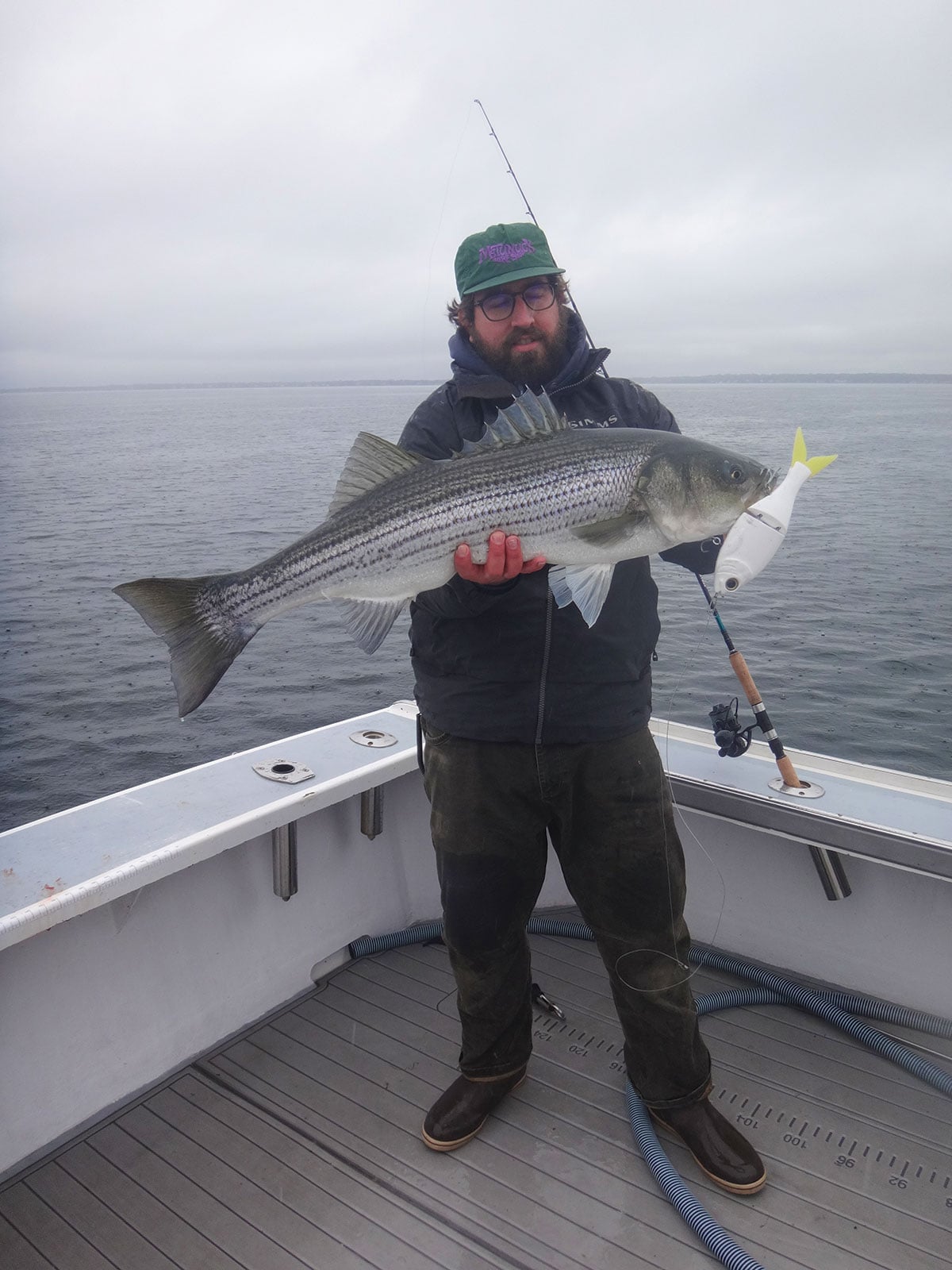
It helps to have had a lot of experiences observing baitfish trying to escape danger and I have been lucky to see a ton of that in my life. But even if you haven’t, I’m sure you can guess the most important part of a panicked retrieve. Yes, that’s right, a high rate of speed is key. Another thing that pogie-obsessed bass can’t ignore is a singled-out baitfish. Evolution wouldn’t have taught these fish to school tightly if it didn’t aid in their survival, so whether it’s just too difficult for predators to target one fish in a tight school of thousands or if they really do perceive it as something much larger, it seems to me that the goal when the bass go crazy attacking the school is to break it up and disperse the school into singles and small pods that the bass can target with greater ease. And we can exploit this by making our plugs act accordingly.
It’s pretty clear that any lure that performs evasive maneuvers catches a lot of stripers, I believe this is directly related to the movements of a singled-out baitfish. And it’s those panicked actions that I believe have made walk-the-dog plugs like The Doc staple baits in ever day bag on the East Coast. You can work them as fast (or slow) as you want and they constantly appear to be trying to avoid being tracked or eaten. And their track record is irrefutable from 25-inchers to fish over 50 pounds, big spooks draw massive strikes from stripers of all sizes.
The recent explosion in interest in two-piece glide baits has the same mechanism at its core; the constant “to and fro” of a glide, when fished fast, looks like a bunker trying to do whatever it has to, to stay alive. A well-made glide also offers the ability to be “burned” meaning, you can point the rod at it and reel as fast you can and the bait will streak across the water, like it’s trying to escape. In no way am I suggesting that this is the only way to fish a glide, but it is an effective way when the bass are charged up on bunker and they’re ignoring the other stuff you’re tossing their way.
Another, underappreciated plug maneuver is the ‘kick out’. If you’ve ever watched large baitfish like bunker, mackerel or herring being chased by bass, you’ve likely seen them roll out onto their side and try to shimmy away from snapping jaws. This signature move is typically punctuated by a reflective flash off the broader flanks of the baitfish. It’s also a very common move, making it something the bass are used to seeing and they react very favorably to this action. There aren’t a ton of baits on the market that can perform it reliably, two that come to mind are the Sebile Stick Shadd FL and a custom made Banana Plug. In either case, the process is easiest with a surf rod, but if you’re fishing from a boat or kayak an 8-foot inshore rod with a reel that boasts the highest line pickup possible will help.
You want to crank these baits FAST and continually and vigorously lift the rod to get the plug to streak forward with a frantic, vibrating swim and kick out with each upward ‘pump’ of the rod. This method is absolutely devastating for bunker-charged bass and the hits are the kind you’ll relive for weeks, or longer.
After Sundown
There will be times when the daytime methods described above, will work after dark, but my experience says that – most of the time – stripers change their tactics when the sun goes down. I dumb this down to the simple fact that the bass are now forced to rearrange their hierarchy of senses to put their lateral line and hearing first. This changes their method from the smash-grab dogfights of daylight to more of a stalk and stab style ambush situation.
While I have always employed some version of this methodology in the surf, I really gained a good grip on it over the past several seasons when the kayak became one of my favorite ways to pursue striped bass. The enlightenment happened at the hands of my Humminbird Helix 9 with sidescan technology. That ability to choose a fishy area or scenario and then use the electronics to seek out bait schools, observe stripers cruising into the area and watching how they use the water and the structure to set themselves up for success, has been really eye-opening. Equally eye-opening has been the methods that have worked best to get bites on plugs and plastics.
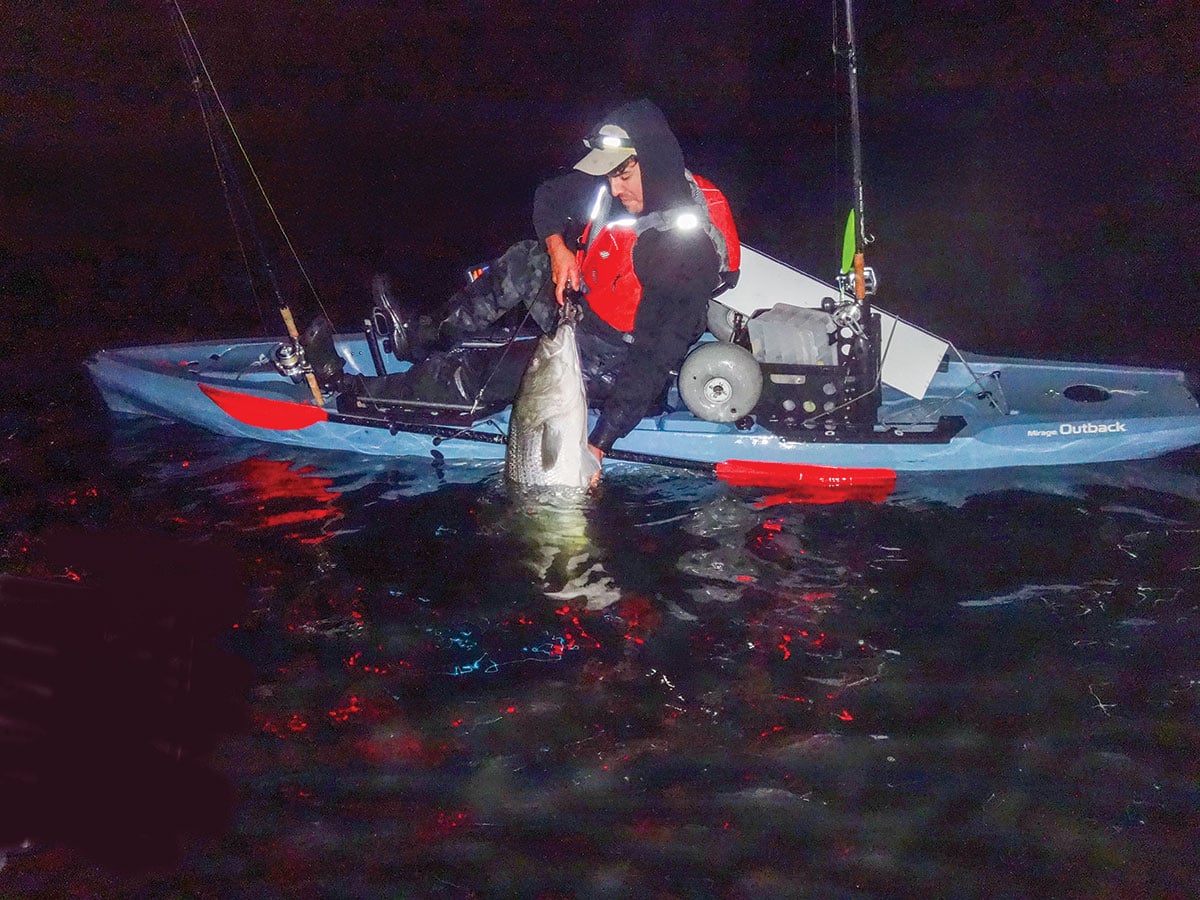
First, I want to run through a couple scenarios that might help you hone in on something that has worked reliably for me. The first is a current-swept ‘tongue’ of shallower water that juts out into a deeper channel. The water humps up from 25 feet to 6 feet over a 100-yard stretch, and then falls back off to about 18 about 50 yards further down-tide. At one point in that drop to 18 feet, it falls off sharply, from 12 to 18, over the span of maybe 30 feet. Spending a lot of time here has shown me that bunker regularly travel through this area and often find themselves sucked over this hump. The bass show up at a very specific stage of the tide, which I can loosely describe as, “as soon as the current starts to move consistently”.
These fish are not staging in one place, they are moving together, facing into the current, and drifting over this edge, and they will do it several times, if there is bait in the area (which there usually is). The bunker are rarely tightly schooled here, I can’t say why, but if I had to guess I’d say it has to do with being sucked through that faster rip or being broken up by the bass in the area. But when there is bait in this spot, we hear it flipping, but rarely mark it on the screen.
The method that works best is to fish baits that you can keep deep, something like a weighted paddletail or a deep-running metal lip that doesn’t pop up too quickly on the pause. The basics of fishing these baits correctly is to try and make the plug carry through the area in the same fashion as the bass are drifting through. I typically cast across the current and keep it swimming deep and with a little bit of urgency, to me, a bunker swimming alone is nervous and trying to find a way back to safety in numbers. The goal is to have that plug or plastic come within striking distance of one of the bass patrolling the area. And the idea is to make them believe that they’ve successfully ambushed an unsuspecting bunker. When you sell it like that, they can’t pass it up.
Island In The Stream
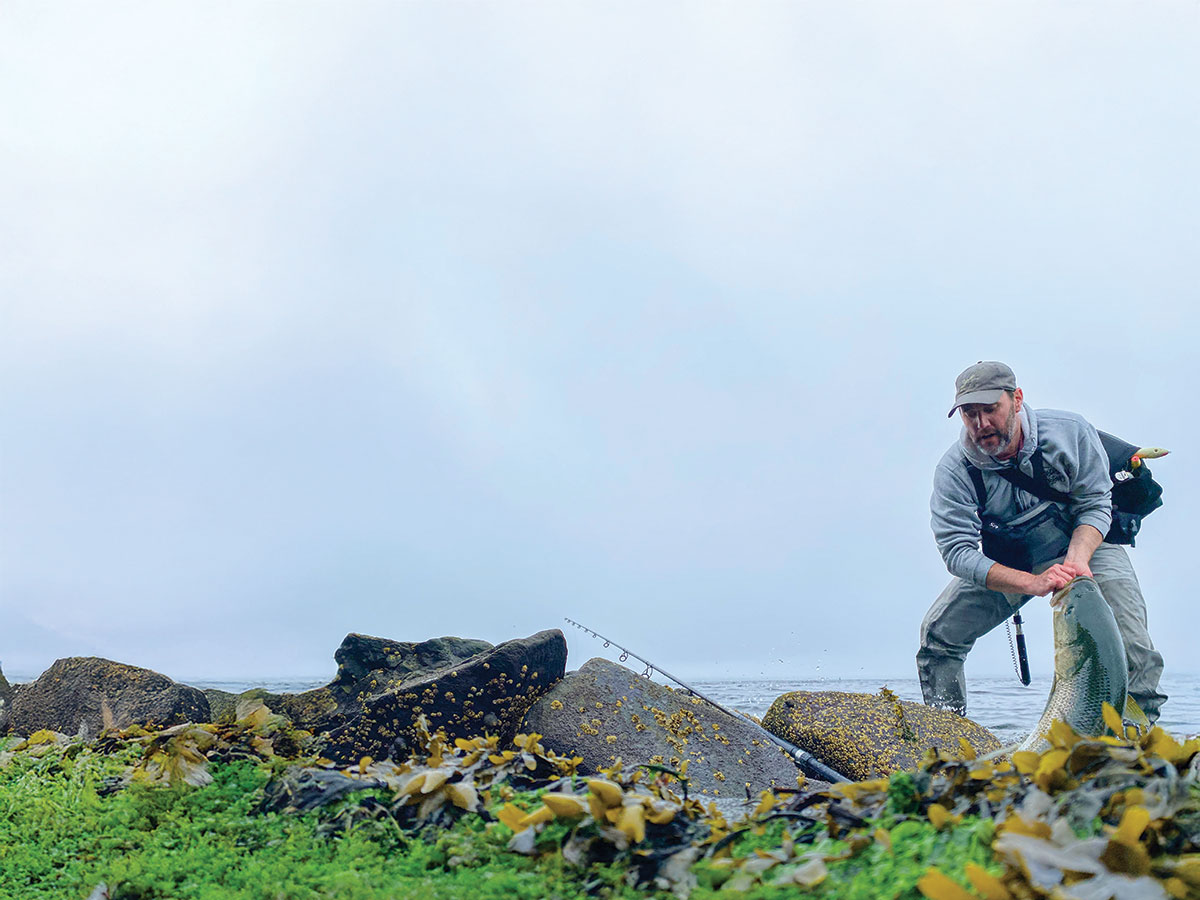
Another bunker exploitation system emerged for me around a small island that breaks the current, on one side of the island, the water is considerably deeper than the other. The bass never set up on the deeper side and it took me a while to figure out why, but it’s quite simple. The shallower water presents fewer escape options for the bunker and, because the same volume of water is moving around each side of the obstacle, the water on shallow side has to move faster, setting up a higher-probability feeding advantage. The bottom on this shallower side is littered with rocks and there’s an area in back of the landmass where a neutral zone exists that often loads up with weeds.
This spot carries a wider variety of sizes, from 40-pounders to 14-pounders, the magic is in the way that island splits the menu, and sends intermittent streams of baitfish through this rocky gauntlet. Here there are two methods that do the most damage, trolling an 8-inch NLBN (or similar) paddletail which I personally don’t really enjoy or casting a large soft plastic on a weighted swimbait hook and drifting with the bait, while trying to keep it deep. With all that said, if I’m honest, trolling has produced the bigger fish.
I hope I’ve made it clear that it’s not just the methods for catching these bunker bass that change from day to night, but also the methods for finding them. In daylight, it’s more about finding a pile of bunker or seeing actively-feeding fish. After dark it’s about finding situations where the bass can stage in an advantageous situation that is likely to funnel the bunker to them. Are these the only ways to line up a good bunker-bass bite? Certainly not, but it is what has worked for me.
When choosing artificials, the number one priority is size. You don’t want to be fishing a 6-inch bait around schools of 12-inch bunker, 99% of the time that’s going to leave your offering falling through the cracks and being mostly ignored. I favor plugs and plastics that fall into the 8- to 14-inch bracket, and if I’m choosing lures at the smaller end of that range, I want them to be beefy enough to look and ‘feel’ the part. When I say ‘feel’ I mean that they displace enough water to draw nighttime interest from a striper with pogies on the brain.
At night, you want to use lures that you can get down to where the fish are holding and that you can keep deep. This is most easily done with weighted soft plastics, matching the weight to the current and drifting with the bait, if you’re in a kayak or boat, or following the drift on the swing if you’re fishing from shore. Big swimmers that get down quickly like trollers or Conrads are also a good choice, my priority with these is that I can hold them at depth, either by their carefully-balanced weighting or by the mechanism of their construction; the sloped head of a well-made troller, for example, can work against the current on the pause, keeping the plug deep.
In daylight, frantic movement is often what draws the most interest. The zig-zagging of spooks or glides or the frantic runs of “vibration baits” like the Stick Shadd, Banana Plug or even a large paddletail swimbait will draw attention when bass are staging for bunker or feeding competitively. I’d be remiss if I didn’t mention the wild movements of the incredibly-popular flutter spoon as part of this profile, once again it’s the evasive and highly-visual (and flashy) descent that draws bass in to strike. But with all this speed and adrenaline at the forefront of my daytime bunker bass profile, I want to encourage you to try slower and even dead-slow retrieves at times as well, especially when you’re in search mode, fishing for isolated fish. Remember, starting slow gives you the option to speed up when a willing participant raises behind your plug, but starting at 90 mph, leaves that option in the dust.
In case you can’t tell, I’ve gained a new appreciation for bunker over the past several seasons. I still don’t love when they show up in places where I typically don’t see them, but in the spots and situations where I’ve learned to expect them and even need them to set off a pattern, they have become the sparkplug for some of the most exciting fishing I find each year.
And I don’t even carry a snag hook or cast net. For me, the plug is the drug.