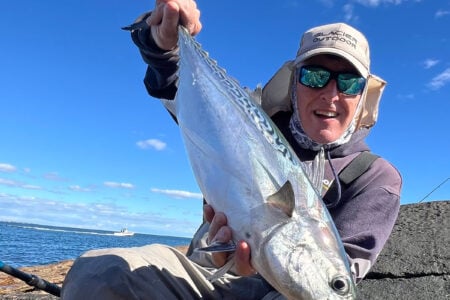
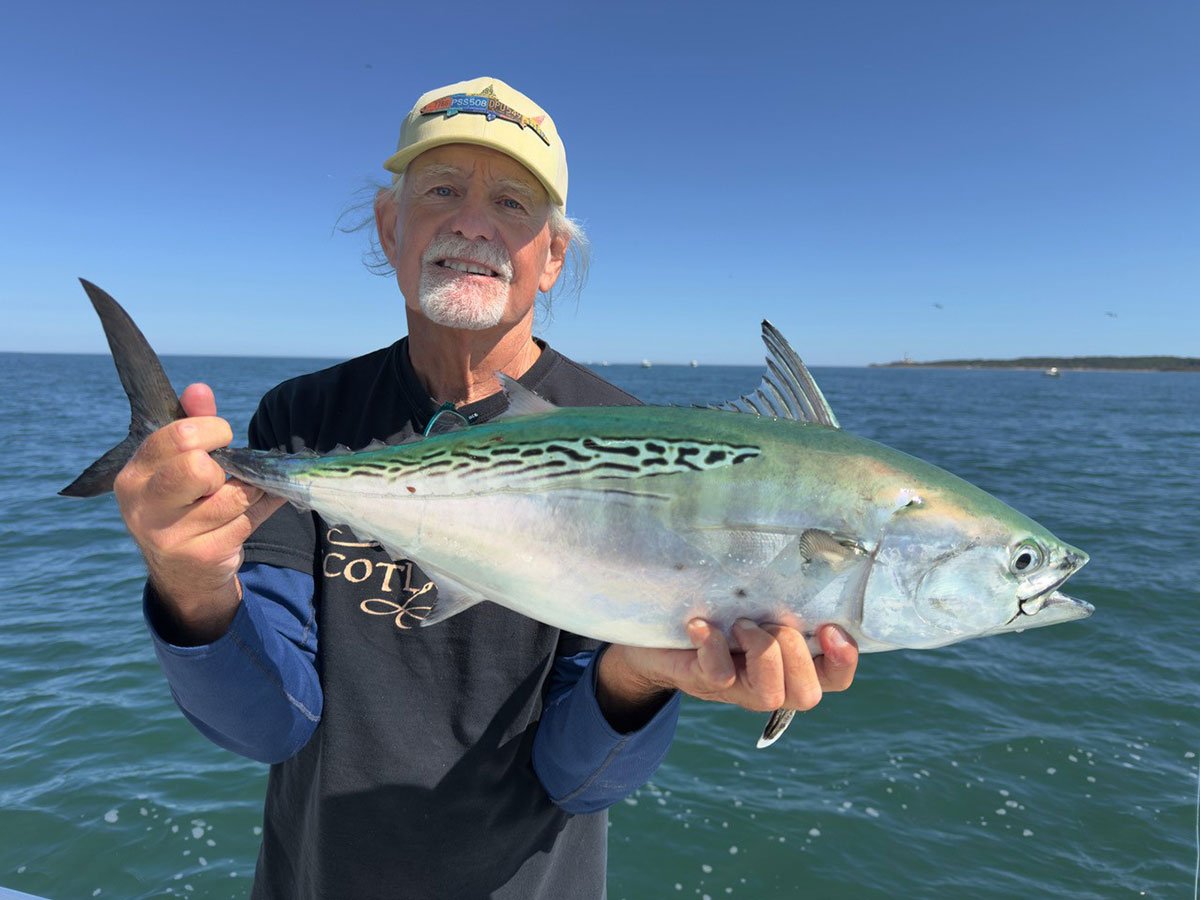
When the falsies are running, know when to turn to the fly or spinning rod.
Many anglers like to fish false albacore with the fly rod, many preferring this method over any other. There are limitations, however, in using the fly rod in albacore situations—significantly more than in using spinning gear—and this difference doesn’t just depend on how extreme the weather situation is (wind or rough seas usually). It also depends on the fishing ability and especially the casting ability of the angler wielding the fly rod.
Skill vs. Conditions
In other words, the better the fly fisherman, and the better the fly caster, the easier it is to catch false albacore in any situation, let alone when the wind starts blowing and the seas get rough and rocking.
But first things first. The determining factor in using a fly rod or a spinning rod (when it gets to the point where you are unable to use fly) is primarily the amount of wind you are fishing in (and that’s wind in any direction, not just that blowing in your face). Rough seas have to be considered too, but they usually correlate with the wind—the windier it is, the rougher the sea. The less skill (and especially casting skill) you have with the fly rod, the less wind you can adequately perform in. Meaning, as you go up in skill level, the more wind you can handle and fish well in. It does, though, get to the point where not even the best fly anglers and casters can perform adequately. We’re talking hurricane force, or really, just a good blow. Everyone has limitations. It also gets to the point where it isn’t even fun. So when conditions get to the point where you personally can no longer perform with the fly rod, switch over to the spinning rod.
That point is different with every fly rodder, and it’s you who has to recognize it.
Hard Truths About Casting
Now, I’ve been all over the Northeast and North Carolina for over three decades chasing false albacore on fly, and there’s one thing that hasn’t changed—this really holds for Montauk, having witnessed thousands of fly rodders in boats there. Very few, very few fly anglers can cast beyond 30 feet, and do this even under the best conditions. When the falsies appear (often suddenly), and they have to make a cast and presentation, the usual decent caster’s performance invariably drops down at least a notch, and knocking knees and tightening muscles turn the hopeful angler into an uncoordinated, back-firing, windshield-wiping Annie! Add some wind to this and it just about puts them on the “no fly” list.
Is this you? If it is, do one thing: practice your fly casting! If you fly fish a lot you should do this all the time anyway, and do so regularly. You should at least do this for a couple of weeks before you albacore fish. And think about your guide too, if you’ll be having one. Do him or her a favor. Besides, practicing your casting is fun. It’s like fishing away from fishing… well, almost.
By the way, most of those “20 to 30-foot cast anglers” would cast farther (in wind too) simply by roll casting. I mean this seriously.

Tips To Improve Your Game
1.) You cast easier and with far fewer tangles if you use an 8-foot leader instead of a 9 or 10-footer.
2.) Here’s a mental trick. Construct a mantra: tell yourself to “relax” when the albacore show up and you have to make that presentation. Practice doing this (even in your mind at home) and practice really relaxing all your muscles immediately when you do. Soon, when the albies show up you’ll do it.
3.) Get a fly casting lesson or attend a fly casting clinic. I give private fly casting lessons, and Riverbay Outfitters in Baldwin offers fly casting clinics. This will really help your casting, and in turn, your catching.
Knowing When To Switch
So again, when the wind gets too heavy and the seas too rough, just switch over to the spinning rod. If the albies are consistently too far beyond for your fly to reach them, or you need a rest from fly casting, do the same. It makes sense.
For anglers who are primarily spin fishermen and want to try fly fishing for albies: go to YouTube for fly casting and fly fishing videos (I have fly casting videos there—Mark Sedotti: The Video Angler), take lessons, or go to a clinic. The easiest thing is to watch videos, buy a fly outfit (9 or 10 wt.), and go out and practice your fly casting. Then go fishing, of course. When it gets too windy, just go back to the spinning rod.
Situations That Favor Spinning Gear
Now, there are also special situations where it gets very hard to take the albies on fly, while at the same time it’s much easier to take them on lures. Here are some.
Situation 1.) The albies are spread out all over, breaking individually or in small pods here and there. If they stay up for only from 1/2 to 2 seconds before they sound it makes it even that much more difficult to take them. It’s lure time.
Situation 2.) Blind casting. You know there are albies right where you are fishing, but they’re not showing, or are popping randomly here and there. They’re not apparently concentrated either. These fish eat a lure much better at this time. You can cover more water and do so quicker with a spinning rod too. Get an Albie Snack and make as much commotion with it on the surface as you can to “bring ’em up.”
Situation 3.) When the schools of albies are moving straight and fast, as well as moving downtide (this behavior was common the previous two seasons, but I haven’t seen it yet this year), you have to get that fly right there ahead of their faces (a classic “head-on shot”) and move it fast in the direction they’re swimming (which is right at you) and keep it ahead of them. You simply have to strip faster than you can to have a chance of hooking up. Grab a spinning rod and do the same with an Albie Snax, epoxy jig or small tin.

When Fly Shines
There’s one ideal situation for hooking up with the fly rod, and thank God, it’s been a common occurrence over the decades. When the albies are concentrated, busting, they’re in good or great numbers, are staying up, and are feeding on the bait school by coming from all directions through it, throw the fly!
The fly rod is a great way to fish albies, but there are almost always limitations when using it. The more skill you have as a fly angler the fewer they are. But everyone has his or her limits here, and when they are reached it gets to the point where you start thinking about picking up the spinning rod. But no matter how you do it, “Boy, those albies are fun!”